
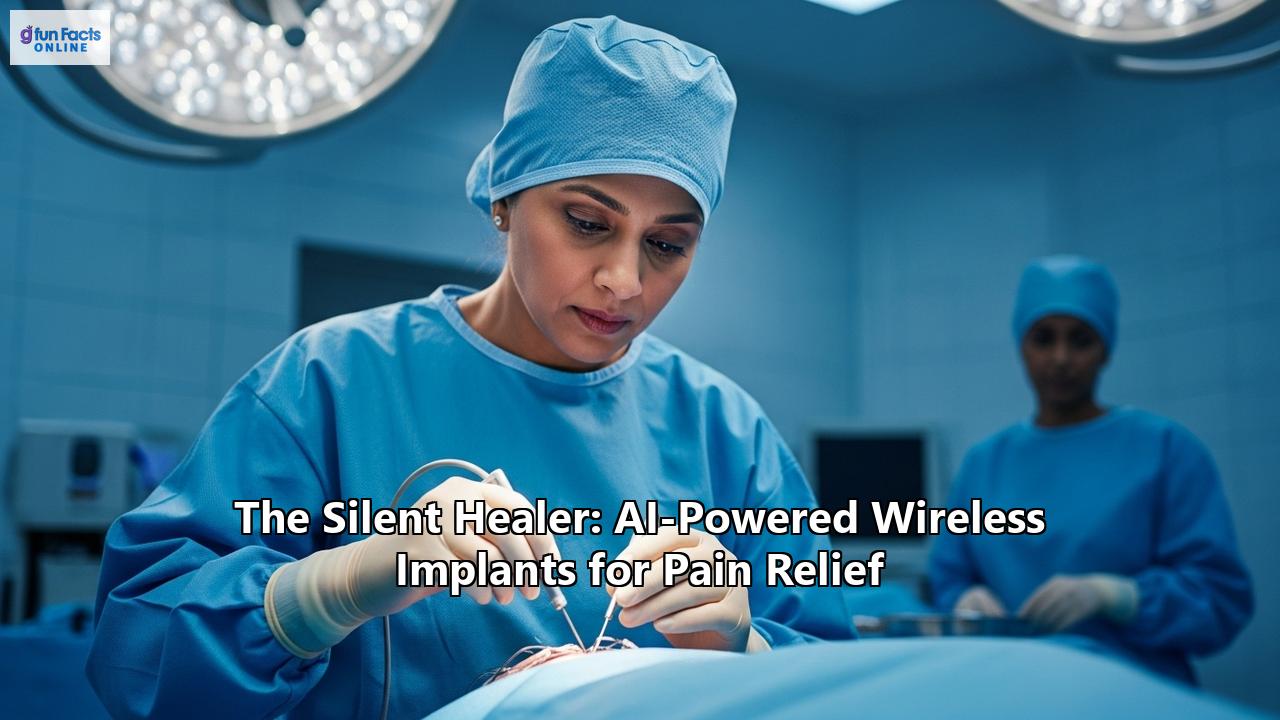
The Silent Healer: AI-Powered Wireless Implants for Pain Relief
For the millions who live in the relentless grip of chronic pain, daily life can be a battle against an invisible enemy. It’s a global health issue that diminishes quality of life, often leading to a dependence on opioid medications, which carry their own significant risks of addiction and side effects. Traditional treatments have often fallen short, but a new frontier in medicine is offering a beacon of hope. This revolution is not found in a pill bottle, but in the sophisticated marriage of microelectronics and artificial intelligence: the AI-powered wireless implant. These "silent healers" are being developed to not just mask pain, but to intelligently understand and adapt to it, offering a personalized, drug-free solution that could transform the lives of countless individuals.
From Rudimentary Pulses to Intelligent Dialogue: The Evolution of Neuromodulation
The idea of using electrical impulses to treat pain is not new. The journey began in the 1960s, spurred by the "gate-control theory of pain," which suggested that electrical stimulation could close the "gates" that allow pain signals to reach the brain. This led to the development of the first spinal cord stimulation (SCS) devices in 1967. These early devices were bulky and rudimentary, but they laid the groundwork for a field that would come to be known as neuromodulation—the alteration of nerve activity through targeted electrical or pharmaceutical agents.
Over the decades, these devices have undergone a remarkable evolution. The first fully implantable systems, based on cardiac pacemaker technology, became available in 1981. Since then, innovations have brought us rechargeable, smaller generators, MRI-compatible devices, and even the first wireless SCS system in 2014. The technology has also diversified into a family of targeted therapies:
- Spinal Cord Stimulation (SCS): The most common form of neuromodulation, SCS involves implanting electrodes in the epidural space along the spinal cord. These electrodes deliver mild electrical pulses that interrupt pain signals. It's a well-established treatment for conditions like failed back surgery syndrome and complex regional pain syndrome (CRPS).
- Dorsal Root Ganglion (DRG) Stimulation: A newer, more targeted approach, DRG stimulation focuses on the dorsal root ganglia—clusters of sensory nerves along the spinal column that act as traffic lights for pain signals. This allows for precise treatment of pain in specific areas like the foot, knee, or groin, which can be difficult to target with traditional SCS.
- Peripheral Nerve Stimulation (PNS): This technique targets nerves outside of the brain and spinal cord, making it ideal for treating localized pain in areas like the shoulders, knees, or even providing relief from chronic headaches.
- Deep Brain Stimulation (DBS): The most invasive of these therapies, DBS involves implanting electrodes deep within specific areas of the brain. While commonly used for movement disorders like Parkinson's disease, it is also being explored as a treatment for severe, intractable chronic pain that hasn't responded to other treatments.
These technologies have provided life-changing relief for many, but they have traditionally operated on a static model. The stimulation is programmed by a clinician and, while the patient may have some control over the intensity, the device doesn't adapt to the dynamic and fluctuating nature of chronic pain. This is where artificial intelligence is changing the game, transforming these implants from one-way broadcasters into intelligent, symbiotic partners in pain management.
The AI Difference: Creating a Closed-Loop Conversation with the Nervous System
The true revolution in implantable pain relief lies in the integration of artificial intelligence, which is creating a new generation of "closed-loop" systems. Instead of just delivering a pre-programmed current, these devices can sense the body's own biological signals, interpret them in real-time, and automatically adjust the therapy. This creates a continuous, personalized feedback loop between the patient's nervous system and the implant.
A groundbreaking example of this is the flexible, ultrasound-induced wireless implantable (UIWI) stimulator developed by researchers at the University of Southern California (USC) and UCLA. This device represents a significant leap forward in several ways:
- Wireless Power: The implant has no internal battery. It's powered by a wearable, external ultrasound transmitter, eliminating the need for invasive surgeries to replace batteries. The implant uses the piezoelectric effect to convert the mechanical waves from the ultrasound into the electrical energy needed for stimulation.
- AI-Powered Pain Assessment: The system doesn't just treat pain; it assesses it. By continuously monitoring the patient's brainwaves (EEG signals), a sophisticated machine learning model can classify pain into different levels, such as slight, moderate, or extreme, with a reported accuracy of nearly 95%.
- Adaptive Therapy: Once the AI identifies the pain level, it automatically instructs the wearable transmitter to adjust the level of ultrasound energy. The implant then delivers the precise amount of electrical stimulation to the spinal cord needed to rebalance the pain signals, providing tailored relief in real-time.
This UIWI stimulator, successfully tested in rodent models, offers a glimpse into a future of truly personalized and self-adaptive pain management. It moves beyond simply masking pain to creating an intelligent system that understands and responds to an individual's unique pain experience.
While the USC/UCLA device is a research marvel, AI is already making its way into commercially available systems. The medical technology company Nevro recently launched its HFX iQ spinal cord stimulation system, which it bills as the only SCS system powered by artificial intelligence. The HFX AdaptivAI platform uses patient input and data from thousands of cases to recommend and create customized therapy programs in real-time. It also gathers data on quality of life metrics, allowing clinicians to remotely monitor their patients' progress and make more informed decisions. This represents a significant step towards bringing intelligent, adaptive therapy into mainstream clinical practice.
The applications of AI in neuromodulation are vast and growing. Machine learning algorithms are being developed to:
- Improve Patient Selection: Predictive models can analyze patient data to identify who is most likely to benefit from a particular type of neuromodulation, improving success rates and avoiding unnecessary procedures.
- Optimize Stimulation Parameters: AI can analyze complex data to fine-tune the vast number of possible stimulation settings for devices like deep brain stimulators, a process that is currently a time-consuming trial-and-error effort for clinicians.
- Enhance Device Design: AI is being used to design more personalized and effective implants by analyzing patient anatomy from CT scans and X-rays to create customized fits that improve function and longevity.
Navigating the New Frontier: Challenges and Ethical Considerations
As with any transformative technology, the road to widespread adoption of AI-powered implants is not without its obstacles and ethical quandaries. These silent healers raise important questions that researchers, clinicians, and society must address:
- Cost and Accessibility: These highly advanced devices are expensive to develop and implant. Ensuring equitable access for all patients who could benefit, regardless of their financial situation, will be a major challenge. The infrastructure required to support these advanced technologies may also not be universally available.
- Data Privacy and Security: Implantable devices that collect and transmit sensitive, real-time health data are a prime target for cyberattacks. Robust encryption and secure data storage systems are paramount to protect patient privacy and prevent unauthorized access or manipulation of these life-altering devices.
- Algorithmic Bias: AI systems are trained on data, and if that data is not diverse and representative of the entire population, it can lead to biased outcomes. An algorithm trained primarily on data from one demographic group may not be as effective for others, potentially worsening health disparities.
- Regulatory Hurdles: Regulatory bodies like the FDA face the challenge of evaluating these complex, evolving systems. Unlike traditional devices, AI models can learn and change over time. New frameworks are needed to ensure their continued safety and efficacy throughout their lifecycle.
- Ethics of Autonomy and Control: As these devices become more autonomous, questions of control and responsibility arise. Patients need to be fully informed about how the AI works, the data it collects, and what level of control they retain. If an AI-driven system makes a mistake, determining liability—whether it lies with the manufacturer, the clinician, or the software itself—is a complex legal and ethical issue.
The Architects of Relief and the Road Ahead
The development of these silent healers is being driven by a convergence of academia and industry. Research institutions like USC, UCLA, Rice University, and Baylor College of Medicine are pushing the boundaries of what's possible. In the commercial space, established medical device giants like Medtronic, Abbott Laboratories, and Boston Scientific are major players in the broader neuromodulation market and are increasingly incorporating AI into their platforms. They are joined by more specialized companies like Nevro, which is pioneering AI-driven SCS, and a host of innovative startups such as Neuralink and Synchron that are developing advanced brain-computer interfaces.
The future of pain management is becoming increasingly electric, intelligent, and personalized. Bioelectronic medicine, the broader field that encompasses these technologies, is poised to move beyond just treating symptoms to offering real-time, adaptive therapies for a vast range of conditions. We are at the dawn of an era where an implant will not just be a passive device, but an active, intelligent partner in a person's health. The goal is a future where these silent healers can learn the language of an individual's pain and respond with a quiet, precise, and unwavering whisper of relief, finally giving millions the chance to reclaim their lives from the clutches of chronic pain.
Reference:
- https://www.pharmasalmanac.com/articles/singing-the-body-electric-exploring-bioelectronic-medicine
- https://pmc.ncbi.nlm.nih.gov/articles/PMC10586864/
- https://www.frontiersin.org/journals/neurology/articles/10.3389/fneur.2024.1467307/full
- https://conservancy.umn.edu/items/b2cd6cc8-6478-4b6e-8f77-8f74c55df21a
- https://www.nevro.com/English/us/investors/investor-news/investor-news-details/2024/Nevro-Announces-the-Launch-of-HFX-AdaptivAI-the-Only-AI-Driven-Technology-in-Spinal-Cord-Stimulation/default.aspx
- https://pmc.ncbi.nlm.nih.gov/articles/PMC11337583/
- https://www.researchgate.net/publication/391910361_The_Application_of_Artificial_Intelligence_to_Enhance_Spinal_Cord_Stimulation_Efficacy_for_Chronic_Pain_Management_Current_Evidence_and_Future_Directions
- https://neuronewsinternational.com/nevro-announces-launch-of-only-ai-driven-technology-in-spinal-cord-stimulation/
- https://www.michaeljfox.org/grant/machine-learning-programming-deep-brain-stimulation-arrays
- https://www.bohrium.com/paper-details/machine-learning-for-adaptive-deep-brain-stimulation-in-parkinson-s-disease-closing-the-loop/894066439084834822-10612
- https://exoswan.com/neurotech-stocks
- https://www.numberanalytics.com/blog/future-bioelectronics-biophysics
- https://news.llu.edu/health-wellness/solution-your-chronic-pain-one-hour-procedure-youve-probably-never-heard
- https://pmc.ncbi.nlm.nih.gov/articles/PMC11513823/
- https://www.dovepress.com/transforming-chronic-pain-management-integrating-neuromodulation-with--peer-reviewed-fulltext-article-JPR
- https://www.omicsonline.org/open-access/the-impact-of-artificial-intelligence-on-the-development-and-design-of-medical-implants-135353.html
- https://pmc.ncbi.nlm.nih.gov/articles/PMC8826344/
- https://www.ominext.com/en/blog/challenges-of-ai-integration-in-healthcare
- https://htec.com/insights/blogs/ai-in-medical-devices-and-healthcare-challenges-and-what-lies-ahead/
- https://www.nsf.org/life-science-news/potential-impacts-generative-ai-across-medical-device-industry
- https://eor.bioscientifica.com/view/journals/eor/9/5/EOR-24-0029.xml
- https://www.fiercebiotech.com/special-report/so-far-just-4-companies-have-a-shot-at-winning-neuromodulation-race
- https://www.emergenresearch.com/blog/top-10-leading-companies-offering-next-generation-implants
- https://aimmediahouse.com/generative-ai/10-companies-building-brain-like-systems-for-smarter-machines
- https://www.northwell.edu/news/the-latest/northwell-health-constellation-forum-2024