
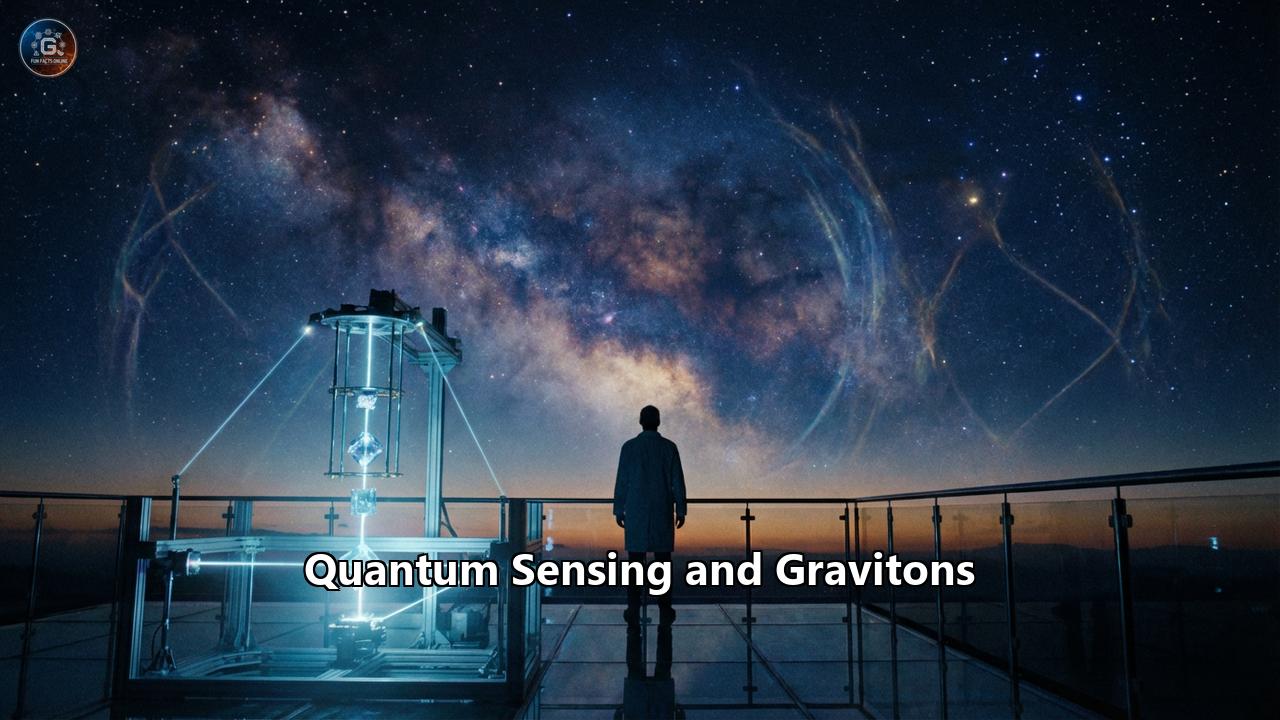
Physics has long been haunted by a ghost. It is a specter that drifts through our equations, essential yet invisible, predicted yet unproven. It is the graviton, the hypothetical fundamental particle that would carry the force of gravity, just as the photon carries light. For nearly a century, the graviton has stood as the ultimate prize—and the ultimate impossibility—in the quest to unify the two great pillars of modern science: Quantum Mechanics and General Relativity.
To detect a single graviton would be to touch the very fabric of spacetime and prove that gravity, like all other forces in the universe, is quantum in nature. It would be the final seal on the Standard Model, or perhaps the opening of a door to a deeper, more exotic reality. But for decades, the consensus among the world’s greatest minds was absolute: it cannot be done. The interactions are too weak, the background noise too high, and the required detectors so impossibly large—the size of Jupiter or even the entire Earth—that the search was deemed a philosophical exercise rather than a physical one.
That narrative is shattering.
We are currently standing on the precipice of a revolution. Driven by the explosive growth of Quantum Sensing—a new field that harnesses the exquisite fragility of quantum states to measure the physical world—the "impossible" experiment is becoming an engineering roadmap. Through a combination of massive acoustic resonators, superconducting qubits, and the mastery of light and matter at the single-particle level, humanity is closing in on the graviton.
This article will take you to the bleeding edge of this high-stakes hunt. We will explore the history of the "impossible" limit, the ingenious new proposals that circumvent it, and the staggering implications of finally capturing the ghost in the machine.
Part I: The Ghost in the Machine
The Unfinished Symphony of Physics
To understand why the graviton is so elusive, one must first appreciate the chasm it is meant to bridge. Modern physics is a tale of two kingdoms. On one side, we have Quantum Mechanics, the rulebook for the very small. It describes a universe of discrete packets, or "quanta." In this world, energy is not smooth; it comes in chunks. Light is not just a wave; it is a stream of photons. Electricity is the movement of discrete electrons. The forces that bind atoms together—electromagnetism, the strong nuclear force, and the weak nuclear force—are all mediated by exchange particles.
On the other side stands General Relativity, Albert Einstein's masterpiece. It describes the universe on the grandest scales: stars, galaxies, and the cosmos itself. In Einstein’s view, gravity is not a force transmitted by particles. It is the curvature of spacetime itself, a smooth, continuous fabric that bends under the weight of mass and energy. "Matter tells spacetime how to curve; spacetime tells matter how to move."
These two theories are the most successful intellectual structures ever built by human hands. Yet, they are mathematically incompatible. Quantum mechanics demands that everything be quantized—chopped into bits. General Relativity insists that spacetime is a smooth, unbroken continuum. When physicists try to combine them, the equations break down, producing nonsense answers like "infinity."
The graviton is the peace treaty. It is the proposed "quantum" of the gravitational field. If gravity is indeed quantum, then the smooth curvature of spacetime is an illusion created by the swarm of countless tiny particles—gravitons—just as the smooth pressure of a gas is actually the chaotic motion of billions of atoms.
The Properties of the Phantom
Theorists have a good idea of what a graviton should look like, even if they’ve never seen one.
- Massless: Like the photon, it must travel at the speed of light, which implies it has zero rest mass.
- Spin-2: This is its unique signature. All other force-carrying particles have a spin of 1 (like the photon or gluon). The graviton’s spin of 2 is required to describe the specific way gravity stretches and squeezes space (the quadrupole nature of gravitational waves).
- Electrically Neutral: It interacts with everything that has mass or energy, but it has no charge of its own.
But its most defining characteristic is its weakness. Gravity is roughly $10^{36}$ times weaker than electromagnetism. A small fridge magnet can lift a paperclip against the gravitational pull of the entire Earth. This extreme weakness means that gravitons interact with matter so rarely that they pass through planets, stars, and detectors as if they weren't there.
Part II: The History of an Impossibility
The Dyson Limit
For a long time, the question of detecting a graviton was considered "metaphysical." If a particle cannot be detected even in principle, does it really exist?
The most famous argument against the detectability of gravitons came from the legendary physicist Freeman Dyson. In the early 21st century, Dyson performed a series of back-of-the-envelope calculations that cast a long shadow over the field. He considered a hypothetical detector designed to catch a single graviton through a process called "thermal absorption"—basically, waiting for a graviton to hit an atom and kick an electron to a higher energy level, similar to how solar panels absorb light.
Dyson calculated that because gravity is so weak, the probability of a single atom absorbing a graviton is vanishingly small. To have any hope of detecting just one graviton, you would need a detector with the mass of the Earth.
But it gets worse. If you built a detector the size of Earth, the crushing gravity of the detector itself would likely collapse it into a black hole before you could finish the experiment. Furthermore, to distinguish the tiny "kick" of a graviton from the background noise of thermal vibrations, you would need to cool this Earth-sized detector to near absolute zero and shield it from all other particles (neutrinos, cosmic rays).
Dyson concluded that building a real-world graviton detector was likely impossible. He estimated that even with a detector the size of the Earth placed in close orbit around the Sun (a source of thermal gravitons), we might see only four events in the 5-billion-year lifetime of the Sun.
For years, the "Dyson Limit" stood as a "Do Not Enter" sign for experimentalists. The search for quantum gravity was left to the theorists, who spun complex webs of String Theory and Loop Quantum Gravity in the safety of their chalkboards, far removed from the laboratory.
The Loophole
However, physics is the art of finding loopholes. Dyson’s calculation relied on a specific assumption: that we would be looking for thermal gravitons emitted spontaneously by sources like the Sun. He treated gravitons like faint starlight.
But what if we didn't look for the faint, steady trickle of thermal gravitons? What if, instead, we looked for the "tsunamis" of gravity?
In 2015, the LIGO (Laser Interferometer Gravitational-Wave Observatory) collaboration made history by detecting gravitational waves—ripples in spacetime caused by the violent collision of two black holes. These waves are not single particles; they are "coherent states," massive floods consisting of roughly $10^{36}$ gravitons acting in unison.
LIGO detects the classical wave, not the individual particles, just as a radio antenna detects a radio wave but not the individual photons. However, the existence of these high-energy waves changed the calculus. We now have sources of gravity that are coherent and incredibly intense.
The question shifted: Can we build a detector sensitive enough to hear the individual "clicks" inside the roar of a gravitational wave?
Part III: The Quantum Sensing Revolution
To answer that question, we must turn to Quantum Sensing. This is a rapidly maturing field that uses quantum systems—atoms, ions, superconducting circuits—as sensors.
In the 20th century, we used quantum mechanics to explain nature. In the 21st century, we are using it to measure nature. The logic is simple: quantum systems are incredibly fragile. A single stray photon, a slight magnetic fluctuation, or a tiny vibration can destroy a delicate quantum state (superposition). Usually, this is a nuisance. But in sensing, it is a feature. If your system is that sensitive to disturbance, it makes for the perfect sensor.
Quantum sensors are already being used to:
- Measure time with atomic clocks so precise they would lose less than a second over the age of the universe.
- Map the brain's magnetic fields using nitrogen-vacancy centers in diamonds.
- Detect dark matter candidates.
Now, a daring group of researchers is turning this arsenal toward gravity.
Part IV: The Breakthrough Proposal
The Gravito-Phononic Effect
In August 2024, a team of physicists led by Igor Pikovski (Stockholm University and Stevens Institute of Technology) published a landmark paper in Nature Communications that effectively dismantled the "impossibility" of graviton detection.
Their proposal is elegant in its simplicity but staggering in its engineering requirements. They suggest a "gravito-phononic" detector.
To understand it, think back to Einstein's Photoelectric Effect (1905). Einstein proved that light was made of particles (photons) by showing that light could kick electrons out of a metal surface. Crucially, he showed that below a certain frequency, no electrons were ejected, no matter how bright the light was. This "threshold" proved that energy was being transferred in discrete packets.
Pikovski and his team proposed a gravitational analogue. instead of a metal plate, they propose using a massive acoustic resonator—essentially a heavy cylinder of aluminum or beryllium, weighing perhaps a few kilograms to a ton.
This cylinder acts like a bell. When a gravitational wave hits it, the "bell" rings—it vibrates. In a classical world, this vibration would be smooth and continuous. But in a quantum world, the vibration energy of the bar is quantized. It can only vibrate at specific energy levels. The unit of this vibration is called a phonon.
The "gravito-phononic effect" describes the process where a single graviton from a passing gravitational wave is absorbed by the bar and converted into a single phonon.
$$ \text{Graviton} + \text{Matter} \rightarrow \text{Phonon} $$
If you can monitor the energy level of the bar with perfect precision, you would see the energy jump up in a discrete step. Step... Step... Step. Each step is the signature of a single graviton being absorbed.
Sidestepping Dyson
How does this beat Dyson’s limit?
- Stimulated Absorption: Unlike Dyson’s thermal gravitons, this method relies on stimulated absorption from a passing gravitational wave (like a binary neutron star merger). The intense flood of gravitons increases the probability of interaction significantly.
- Resonance: By tuning the acoustic bar to resonate at the exact frequency of the gravitational wave, the cross-section for interaction is amplified by orders of magnitude.
- Massive Quantum States: The proposal relies on cooling a macroscopic object (a kilogram-scale bar) to its quantum ground state. This is a regime Dyson did not fully consider feasible, but which is now within reach of modern optomechanics.
The team calculated that a massive bar cooled to near absolute zero could detect single graviton events from a strong gravitational wave source. We don't need to wait a billion years. We might need to listen for the duration of a neutron star inspiral—minutes or hours.
Part V: How to Measure a Ghost
The Challenge of the "Quantum Ground State"
The theory is sound, but the experiment is a nightmare of precision. To see a single phonon—the vibration caused by a single graviton—you must first ensure the bar isn't already vibrating.
You need to cool the bar to its quantum ground state. This means removing all thermal energy until the bar is in its lowest possible energy level. We are talking about temperatures in the micro-Kelvin or even nano-Kelvin range.
If the bar has even a tiny amount of thermal energy, it will be "noisy." Phonons will be popping in and out of existence due to heat, masking the rare arrival of a graviton.
Continuous Quantum Non-Demolition (QND) Measurement
Once the bar is cold, you have to watch it. But here lies the famous quantum trap: Heisenberg's Uncertainty Principle.
If you measure the position of the bar to see if it's vibrating, you disturb its momentum. This "back-action" adds noise to the system, which could mimic a graviton. You can't just touch the bar or bounce a laser off it in a standard way.
The solution is a technique called Continuous Quantum Non-Demolition (QND) Measurement.
In a QND measurement, you choose to measure a specific property (an "observable") that is conserved by the system's evolution. For the graviton detector, you don't measure the position of the atoms in the bar; you measure the energy number (the number of phonons) directly.
How do you do that?You can couple the acoustic bar to a secondary quantum system—a "transducer."
- Superconducting Qubits: Imagine a tiny superconducting circuit (like those used in quantum computers by Google or IBM) attached to the massive bar. The qubit is designed to interact with the phonons. When the bar's energy jumps up by one unit (one phonon), it shifts the frequency of the qubit slightly. By monitoring the qubit, you can count the phonons without collapsing the state of the bar in a destructive way.
- Optomechanics: Alternatively, you can use light. You trap photons in a cavity next to the bar. The vibration of the bar changes the cavity's length slightly, which shifts the phase of the light. By using "squeezed light"—a special quantum state where the noise is manipulated to be lower than the standard vacuum limit in one variable (phase) at the expense of another (amplitude)—you can detect these minute shifts.
Pikovski’s proposal suggests that with current or near-future technology, we can continuously monitor the energy eigenstates of the bar. We would watch the system sit in the ground state (0 phonons) and wait for a "Quantum Jump" to the first excited state (1 phonon).
That jump is the smoking gun.Part VI: Beyond the Single Graviton
Atom Interferometry: The MAGIS and AION Projects
While the acoustic bar is the leading contender for single graviton detection, other quantum sensors are pushing the boundaries of gravity research in parallel.
Atom Interferometry is a technique that uses cold atoms as clocks and rulers. By cooling atoms to ultra-low temperatures, they behave like waves. You can split an atom's wave function into two paths: one that travels higher in a gravitational field and one that travels lower. When you recombine them, the interference pattern tells you precisely how much gravity they felt.Two major projects are currently underway:
- MAGIS-100 (USA): A 100-meter vertical shaft at Fermilab. It will drop clouds of atoms to look for dark matter and gravitational waves in the "mid-band" frequency (0.1 Hz to 10 Hz), a range that LIGO cannot touch.
- AION (UK): The Atomic Interferometric Observatory and Network. Similar to MAGIS, it aims to scale up to kilometer-long towers.
While these detectors are likely detecting the wave nature of gravity (many gravitons), their extreme sensitivity makes them candidates for testing the interface of gravity and quantum mechanics. They could test if a massive object (the atom) can exist in a superposition of two different gravitational states.
Levitated Superospheres
Another fascinating approach involves levitated superconducting spheres. By using magnetic fields to float a tiny sphere of niobium or lead in a vacuum, researchers can isolate it from almost all environmental noise.
This floating sphere acts as a test mass. Because it is superconducting, its motion can be read out using magnetic fluxes (SQUIDs) with quantum precision. These systems are being proposed as compact gravitational wave detectors that could sit on a tabletop rather than spanning kilometers like LIGO.
Part VII: The Theoretical Frontier
What Does It Mean to Detect a Graviton?
If we succeed, the implications are profound.
1. The End of Classical Gravity:Detecting a discrete energy jump (graviton -> phonon) would prove that energy transfer between gravity and matter is quantized. This kills any theory that treats gravity as a purely classical background field while matter is quantum. Gravity must be quantized.
2. The Collapse of the Wavefunction:There is a famous debate in quantum mechanics: Why do superpositions collapse? Why don't we see Schrödinger's cats walking around in real life?
Sir Roger Penrose has proposed that gravity is the culprit. He suggests that maintaining a superposition of a massive object costs energy because you are trying to superimpose two different spacetime curvatures. Eventually, the system becomes unstable and "self-collapses."
The massive acoustic resonators used for graviton detection are the perfect testbeds for this Penrose Interpretation. If gravity causes collapse, these resonators might never reach the ground state or might show a mysterious source of "gravitational noise" that corresponds to the continuous collapse of their wavefunction.
3. Graviton Astronomy:Just as we moved from optical astronomy (looking at light) to radio, X-ray, and gravitational-wave astronomy, detecting gravitons opens a new window.
- The Early Universe: The universe was opaque to light for its first 380,000 years. But it was transparent to gravitons from the Big Bang. Primordial gravitons could carry snapshots of the universe at $10^{-35}$ seconds old.
- Quantum Gravity Models: String Theory predicts an infinite tower of massive gravitons and other exotic particles. While the first detectors will look for the standard massless graviton, future iterations could hunt for these higher-dimensional cousins.
Part VIII: The Road Ahead
The path from "proposal" to "nobel prize" is paved with noise.
The primary enemy is decoherence. The acoustic bar must be isolated from the entire universe.
- Cosmic Rays: High-energy particles from space can hit the bar, heating it up. The experiment might need to be built deep underground, like neutrino detectors.
- Seismic Noise: The vibration of the Earth itself is a deafening roar. The detector needs suspension systems better than anything currently in existence.
- Thermal Noise: Cooling a ton-scale object to micro-Kelvins is a cryogenics challenge that pushes the limits of current refrigeration technology.
- Now: Proof-of-principle experiments are happening with smaller masses (micrograms to milligrams) in optomechanical labs.
- 5-10 Years: We may see the first kilogram-scale resonators cooled to the ground state.
- 10-20 Years: A dedicated "Single Graviton Observatory" could be operational, likely cross-correlating its data with LIGO to confirm that a "click" in the quantum detector matches a "wave" passing through Earth.
Conclusion: The Final Piece of the Puzzle
For decades, the graviton was a ghost story—a particle that we believed in but could never hope to see. It was the "unobservable" limit of our science.
But the history of physics is the history of doing the unobservable. Auguste Comte once declared we would never know the chemical composition of stars; decades later, spectroscopy was invented. Pauli bet a case of champagne that the neutrino could never be detected; today we catch them by the billions.
The proposal to detect single gravitons using quantum sensing marks a paradigm shift. It transforms the problem of quantum gravity from a purely theoretical debate into an experimental engineering challenge. We are no longer asking if it can be done, but how and when.
We are building the traps. We are quieting the noise. We are cooling the atoms. And soon, in the deep silence of a cryostat, a single quantum of spacetime will ring a bell, and the symphony of the universe will finally be complete.
Reference:
- https://www.reddit.com/r/hydrino/comments/1hy0v2h/penrose_on_the_huge_flaw_in_quantum_mechanics_few/
- https://www.osti.gov/pages/servlets/purl/2438523
- https://thequantuminsider.com/2024/11/03/quantum-sensing-the-elusive-gravitons-and-the-quest-to-unite-quantum-physics-with-gravity/
- https://www.thehindu.com/sci-tech/science/gravito-phononic-graviton-detector-stevens-institute-yale-rothman-boughn-pikovski/article70523017.ece
- https://arxiv.org/html/2411.15531v1
- https://scoap3-prod-backend.s3.cern.ch/media/harvested_files/10.1016/j.physletb.2025.139785/main.pdf
- https://static1.squarespace.com/static/56b6357e01dbaea0266fe701/t/677ae044c0f0e423d941d69d/1736106053495/Oscar_Berg.pdf
- https://www.researchgate.net/publication/369640768_Macroscopic_Quantum_Test_with_Bulk_Acoustic_Wave_Resonators
- https://arxiv.org/abs/1206.6045
- https://en.wikipedia.org/wiki/Quantum_nondemolition_measurement
- https://pmc.ncbi.nlm.nih.gov/articles/PMC11305101/
- https://medium.com/@bill.giannakopoulos/reframing-penrose-through-dual-kernel-theory-inverting-the-gravity-causes-collapse-sequence-c65649a77db3
- https://en.wikipedia.org/wiki/Penrose_interpretation