
To the uninitiated, a satchel of salt is a weapon of sterilization. We use it to cure meat, stopping the rot of decay by desiccating bacteria. We scatter it on wounds in our idioms to signify stinging destruction. In the ancient world, to "salt the earth" was the ultimate curse, a ritualistic promise that nothing would ever grow there again. Salt, in our common biological understanding, is the enemy of cellular life. It sucks the water out of cells, collapses proteins, and shreds DNA.
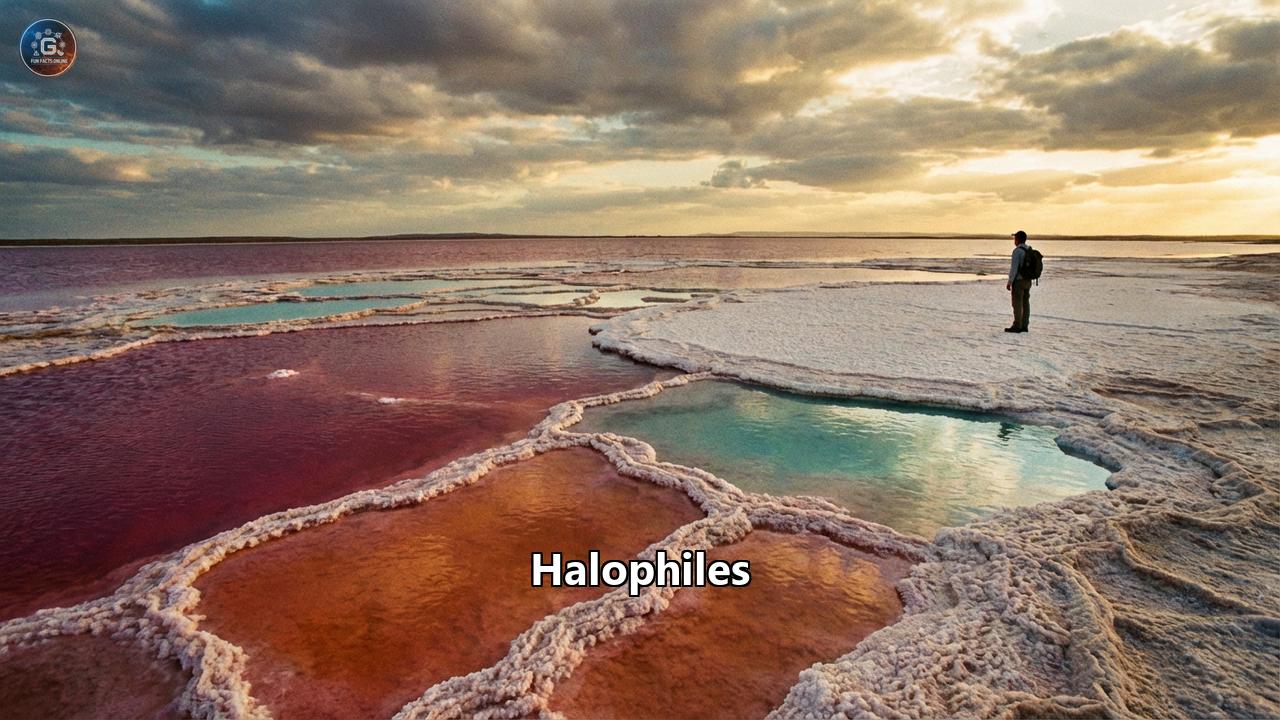
Yet, if you were to fly over the southern tip of the San Francisco Bay, or gaze down at the margins of the Great Salt Lake in Utah, or look at satellite imagery of Lake Retba in Senegal, you would see something that defies this intuition. You would not see a barren, gray wasteland of sterile crystals. Instead, you would see water stained in shocking, psychedelic hues of magenta, ruby red, vermilion, and purple.
These colors are not chemical pollution; they are the bloom of life. They are the signature of the Halophiles—the "salt-lovers."
Halophiles are not merely survivors; they are thrivers. They have conquered environments where the water activity is so low that it should be thermodynamically impossible for life to function. From the sun-baked salt pans of the Atacama Desert to the crushing, pitch-black brine pools at the bottom of the Gulf of Mexico, these organisms have rewritten the rulebook of biochemistry. Their story is one of molecular ingenuity, evolutionary brilliance, and cosmic implication.
I. The Salt Spectrum: Defining the Extreme
To understand the halophile, one must first understand the environment they call home. Ocean water typically contains about 3.5% salt (mostly sodium chloride). For most terrestrial life, and indeed most aquatic life, this is already too salty to drink. But for a halophile, seawater is practically fresh water—a drowning hazard.
Microbiologists categorize these organisms based on their specific addiction to sodium chloride (NaCl). It is a sliding scale of addiction:
- Slight Halophiles: These organisms prefer 1.7% to 4.8% salt. They are the tourists of the saline world, comfortable in marine environments but rarely venturing into the toxic brines.
- Moderate Halophiles: The stakes rise here. These organisms grow optimally between 4.7% and 20% salt. They inhabit salt marshes, coastal lagoons, and the intermediate ponds of solar salterns.
- Extreme Halophiles: These are the true extremists, the "super-specialists." They require salt concentrations from 20% up to the saturation point (about 32-35%), where salt begins to crystallize out of the water. If you place an extreme halophile in seawater, it will often die—not from too much salt, but from too little. Its cell wall, dependent on sodium ions for structural integrity, will literally disintegrate, and the cell will lyse (burst).
There is also a crucial distinction between a Halophile and a Halotolerant organism. A halotolerant organism (like the bacterium Staphylococcus aureus on your skin) can survive high salt if it has to, but it would much prefer a non-saline environment. A true halophile is an "obligate" organism; it needs the salt. It has biochemically wedded itself to sodium chloride.
II. The Physics of Death: Why Salt Kills
To appreciate the genius of the halophile, we must look at the weapon they have neutralized: Osmotic Stress.
Water is the solvent of life. Every chemical reaction in a cell—DNA replication, protein synthesis, energy production—happens in water. Nature follows the law of osmosis: water will move across a semi-permeable membrane (like a cell wall) from an area of low solute concentration (fresh water) to an area of high solute concentration (salty water) in an attempt to equalize the pressure.
When a standard bacterium, say E. coli, falls into a vat of brine, the salt concentration outside the cell is vastly higher than inside. Physics dictates that the water inside the bacterium must rush out to dilute the brine. The cell dehydrates rapidly. The cell membrane pulls away from the cell wall (a process called plasmolysis), the cytoplasm thickens into a useless gel, and molecular machinery grinds to a halt. The cell collapses and dies.
So, how does the halophile stand its ground against this osmotic tide? It has two distinct strategies, which represent a fundamental divergence in the tree of life.
III. Strategy One: The "Salt-In" Solution
The first strategy is the most radical. It is primarily used by the Haloarchaea (halophilic archaea) and a specific group of bacteria called Salinibacter.
If the environment is salty, they reason, then I must become salty.
These organisms do not fight the salt; they invite it in. They use massive amounts of energy to pump potassium ions ($K^+$) into their cells while pumping sodium ions ($Na^+$) out. They accumulate potassium chloride ($KCl$) in their cytoplasm until the internal concentration matches the external concentration of the brine. By balancing the ion concentration, they stop the water from rushing out. There is no osmotic pressure difference. The cell is effectively isotonic with the crystal-laden water outside.
However, this solution creates a new, massive problem. High intracellular salt concentrations are usually devastating to proteins. Proteins rely on a delicate sphere of water molecules (a hydration shell) to maintain their 3D shape. High salt strips this water away, causing standard proteins to unfold (denature) and precipitate out of solution. A normal enzyme dropped into a saturated KCl solution would stop working instantly.
To survive their own cure, Haloarchaea had to completely re-engineer their proteome (their entire library of proteins). Over millions of years of evolution, they altered the amino acid sequences of their proteins.
- Acidic Surfaces: Halophilic proteins are covered in negatively charged (acidic) amino acids like aspartate and glutamate.
- The Solvation Shell: These negative charges bind avidly to water molecules and potassium ions, creating a tightly bound "hydration shell" that stays attached to the protein even in saturated salt.
This adaptation is so complete that these proteins require high salt to function. If you put a "salt-in" halophile into fresh water, its proteins, now lacking the stabilizing salt ions, will repulse each other and unfold, killing the cell. They are prisoners of their own adaptation.
IV. Strategy Two: The "Organic Solute" Solution
The second strategy is more common among halophilic bacteria and eukaryotes (like algae). It is known as the "Compatible Solute" or "Salt-Out" strategy.
These organisms maintain a low salt concentration inside their cells, just like normal life. To prevent water from rushing out into the brine, they synthesize or accumulate massive amounts of organic molecules. These molecules are called "osmoprotectants" or "compatible solutes."
Common compatible solutes include:
- Betaine: Derived from choline (found in sugar beets).
- Ectoine: A cyclic amino acid derivative.
- Trehalose: A sugar found in resurrection plants.
- Glycerol: Used heavily by algae.
These molecules are termed "compatible" because, unlike salt, they do not interfere with the cell's delicate machinery. They are neutral buffers. The cell packs its cytoplasm full of ectoine until the osmotic pressure matches the outside world.
The advantage of this strategy is flexibility. If the rain comes and dilutes the salt lake, the organism can simply break down or excrete the organic solutes and continue living. They are not genetically locked into high-salt dependence like the Haloarchaea.
The disadvantage? It is expensive. Synthesizing complex organic molecules like ectoine costs a tremendous amount of metabolic energy (ATP). The "salt-in" strategy (pumping potassium) is bio-energetically cheaper, which is why in the most extreme environments (approaching saturation), the "salt-in" Archaeans usually outcompete the "organic solute" Bacteria.
V. The Purple Earth: Photosynthesis Without Chlorophyll
One of the most fascinating aspects of halophiles is their color. When we think of photosynthesis—using light to create energy—we think of green chlorophyll. But in the high-salt world, purple reigns supreme.
Many Haloarchaea, such as the model organism Halobacterium salinarum, possess a unique protein in their cell membranes called Bacteriorhodopsin.
Bacteriorhodopsin is a crystalline protein that acts as a light-driven proton pump. It does not contain chlorophyll. Instead, it holds a molecule of retinal—a form of Vitamin A, identical to the molecule in the human eye that allows us to see.
The mechanism is elegantly simple:
- A photon of green light hits the retinal molecule.
- The retinal changes shape (isomerizes).
- This shape change physically pushes a proton ($H^+$) from the inside of the cell to the outside.
- This creates a proton gradient (a battery) across the cell membrane.
- The protons flow back into the cell through a turbine-like enzyme called ATP synthase, generating chemical energy (ATP).
This is photosynthesis, but not as plants do it. It produces no oxygen and fixes no carbon. It is simply a way to supplement energy survival in a starvation environment.
Because retinal absorbs green light (the most energetic part of the visible spectrum) and reflects red and blue, these organisms appear purple.
The Purple Earth Hypothesis:This simple, retinal-based energy system has led astrobiologists to a startling hypothesis. Retinal is chemically simpler to produce than the complex ring structure of chlorophyll. Some scientists, like Shiladitya DasSarma, propose that early Earth, before the rise of green plants, might have been a "Purple Earth." They suggest that the earliest life forms on our planet may have used retinal-based photosynthesis, turning the primordial oceans violet. Chlorophyll (green) may have evolved later to utilize the light wavelengths (red and blue) that the purple organisms were ignoring.
VI. Biodiversity: The Cast of Characters
The world of halophiles is not a monolith; it is a diverse ecosystem of predators, prey, grazers, and viruses.
1. The Haloarchaea (The Kings of Salt):- ---Halobacterium salinarum:--- The most famous halophile. It was isolated from salted fish in the early 20th century. It is the master of the "salt-in" strategy and the primary user of bacteriorhodopsin.
- ---Haloquadratum walsbyi (The Square Microbe):--- For decades, microscopists looking at brine water saw strange, flat, square shapes. They assumed they were salt crystals or optical artifacts. It wasn't until 2004 that researchers successfully cultured Haloquadratum. It is a perfectly square, flat bacterium, like a postage stamp. Its shape provides the highest possible surface-area-to-volume ratio, perfect for nutrient absorption in the thick, viscous brine.
- ---Salinibacter ruber:--- A bacterium that thinks it’s an archaean. It lives in the same saturation limits as Haloarchaea and, unusually for a bacterium, uses the "salt-in" strategy and produces a red pigment called salinixanthin.
- ---Dunaliella salina:--- A unicellular green alga. When stressed by high salt and high UV radiation, it turns bright orange/red. It packs its cell with Beta-carotene (the same pigment in carrots) to protect its DNA from sun damage. It produces so much beta-carotene (up to 14% of its dry weight) that it is harvested commercially. This alga is the primary reason why salt lakes like Lake Hillier in Australia look like strawberry milk.
- ---Artemia (Brine Shrimp):--- Known to children as "Sea Monkeys." These small crustaceans are the grazers of the salt world. They feed on the algae and archaea. They survive the drying of salt lakes by producing "cysts"—dormant eggs encased in a hard shell that can survive desiccation for decades, hatching only when fresh water returns.
Where there is life, there are viruses. Haloviruses infect halophiles. They face the same osmotic challenges as their hosts. Some haloviruses are spindle-shaped, others are spherical. They are distinct because, unlike most viruses that lyse their host quickly, haloviruses often enter a "carrier state," living inside the halophile without killing it immediately, adapting to the slow-growth dynamics of the brine environment.
VII. Extreme Geography: Habitats of the Halophile
Halophiles thrive in places that look like alien planets.
1. Solar Salterns:These are human-made evolution labs. Seawater is pumped into a series of shallow ponds. As the sun evaporates the water, it flows from pond to pond, getting saltier each time.
- Phase 1 (Seawater): Fish and normal algae live here.
- Phase 2 (Concentration): Gypsum precipitates. The fish die. Moderate halophiles take over.
- Phase 3 (Crystallizer Ponds): The water turns to syrup (bitterns). Salt crystallizes. Here, the water turns blood red. Only Haloarchaea, Salinibacter, and Dunaliella remain. It is a visual gradient of life adapting to stress.
Located at the lowest point on Earth, the Dead Sea is a terminal lake—water flows in, but leaves only by evaporation. It is not just salty; it is a unique "calcium-magnesium" brine, which is actually toxic even to many halophiles. Yet, life persists. When heavy rains dilute the top layer, blooms of Halobacterium turn the sea purple-red, a phenomenon recorded in the Bible and historical texts as "blood" turning the waters.
3. Deep-Sea Brine Pools:At the bottom of the Gulf of Mexico and the Red Sea, there are "lakes within the ocean." These are depressions filled with hypersaline water dissolved from ancient salt deposits. The brine is so dense that it does not mix with the seawater above; it has a distinct surface and "shoreline." These pools are anoxic (oxygen-free) and deadly to normal sea life. Eels venturing in die of toxic shock and are preserved (pickled) by the brine. Inside these pools, anaerobic halophiles thrive, utilizing methane and sulfur.
4. Ancient Salt Crystals (The Time Travelers):This is the most controversial and exciting frontier. When salt crystals form (halite), they trap tiny bubbles of water called "fluid inclusions." Halophiles can get trapped inside.
Researchers have cracked open salt crystals from the Permian period—250 million years ago—and claimed to revive dormant Haloarchaea bacteria from within. If true, these organisms are the oldest living things on Earth, surviving in a state of suspended animation, repairing their DNA slowly over geological epochs. While skeptics argue this might be modern contamination, the evidence for long-term survival (at least tens of thousands of years) is robust.
VIII. Biotechnology: The Salt of the Industry
Halophiles are not just biological curiosities; they are chemical factories.
1. The Beta-Carotene Industry:If you take natural beta-carotene supplements, they likely came from Dunaliella salina farms in Australia or Israel. Synthetic beta-carotene is just one isomer (all-trans), but the natural algae produce a mix of isomers (9-cis and all-trans) which is a more potent antioxidant.
2. Ectoine - The Magic Moisturizer:The compatible solute Ectoine is a powerful water-binding molecule. It is now harvested from halophilic bacteria (like Halomonas) and used in high-end cosmetics. It protects human skin cells from dehydration and UV stress, just as it protects the bacteria. It is also used in nasal sprays to reduce inflammation and in eye drops.
3. Bacteriorhodopsin and Bio-Computing:The purple protein is incredibly stable. It retains its color and function even in plastic films. Because it switches states (from purple to yellow) when hit by light, and does so in picoseconds, engineers are exploring it for use in holographic memory storage and optical processing. It can theoretically store data in three dimensions, offering densities far higher than silicon chips.
4. Bioplastics:Many halophiles produce PHAs (polyhydroxyalkanoates) as energy storage granules. These are 100% biodegradable plastics. Unlike normal bioplastics that require sterile, expensive fresh water to produce (to prevent contamination), halophilic plastic factories can run in non-sterile open tanks. If a contaminant falls in, the salt kills it. This makes the production of biodegradable plastics cheaper and more sustainable.
5. Fermented Foods:Asian cuisine owes a debt to halophiles. Soy sauce and fish sauce are products of high-salt fermentation. The high salt prevents spoilage bacteria (like Salmonella) from growing, while allowing halotolerant, enzymatic bacteria (often Tetragenococcus or specific Aspergillus fungi) to break down the proteins into savory amino acids (glutamate), creating the "Umami" flavor.
IX. Astrobiology: Life Beyond Earth
Halophiles are the darlings of NASA and the European Space Agency. When we look for life in the solar system, we are mostly looking for salt water.
1. Mars:Mars is a salty planet. It has vast deposits of chloride salts. We see "Recurrent Slope Lineae"—dark streaks that appear on Martian cliffs during summer, potentially caused by flowing brines. Pure water would boil off instantly on Mars due to low pressure, but a heavy brine remains liquid at lower temperatures and resists boiling. If life exists on Mars today, it is almost certainly a halophile, hiding in the subsurface brines or trapped in salt crystals.
2. Europa and Enceladus:Jupiter's moon Europa and Saturn's moon Enceladus both harbor global liquid oceans beneath miles of ice. The plumes of water shooting out of Enceladus contain organic molecules and salts. These oceans are likely salty, similar to Earth's deep ocean. The halophiles found in Earth's deep-sea brine pools are our best analogues for what might be swimming in the dark oceans of the outer solar system.
3. Panspermia:The ability of halophiles to survive drying, high radiation (a side effect of their DNA repair mechanisms), and long-term stasis in salt crystals makes them the most likely candidates for Lithopanspermia—the theory that life can be transferred between planets via meteorites. If a chunk of Earth were blasted into space by an asteroid impact, the water would boil away, but salt crystals would remain. A halophile trapped inside a fluid inclusion within that salt crystal acts as an astronaut in a tiny, preserved stasis pod, potentially capable of surviving the journey to another world.
X. Conclusion
The study of halophiles forces a re-evaluation of the concept of "extreme." To a Halobacterium, a fresh mountain spring is a lethal acid bath, and a crystal-crusted, sun-blasted salt pan is paradise.
They teach us that life is not fragile. It is obstinate. It finds the energy in gradients of ions, in the lattice of crystals, and in the harsh glare of the sun. From the pink lakes of Australia to the potential brine pockets of Mars, halophiles paint the universe with the vibrant colors of resilience. They are the guardians of the salt, the masters of osmosis, and perhaps, the cosmic seeds of life itself. As we continue to destroy our own freshwater habitats and create more saline wastelands through desertification, these ancient survivors may also be the witnesses to our future. They were here before the oxygen came, and they will likely remain long after the fresh water is gone.
Reference:
- https://www.researchgate.net/publication/260286481_Halophiles_-_Taxonomy_Diversity_Physiology_and_Applications
- https://www.ijcmas.com/vol-4-12/Deepa%20Yadav,%20et%20al.pdf
- https://pubs.acs.org/doi/10.1021/bk-2023-1434.ch001
- https://epslibrary.at/sgem_jresearch_publication_view.php?page=view&editid1=8645
- https://bio.libretexts.org/Bookshelves/Microbiology/Microbiology_(Boundless)/05%3A_Microbial_Metabolism/5.11%3A_Phototrophy/5.11D%3A_Bacteriorhodopsin/05%3A_Microbial_Metabolism/5.11%3A_Phototrophy/5.11D%3A_Bacteriorhodopsin)
- https://en.wikipedia.org/wiki/Bacteriorhodopsin
- https://en.wikipedia.org/wiki/Purple_Earth_hypothesis
- https://astrobiology.nasa.gov/news/was-life-on-the-early-earth-purple/
- https://arxiv.org/pdf/1810.05150
- https://pmc.ncbi.nlm.nih.gov/articles/PMC4187189/
- https://www.tandfonline.com/doi/full/10.1080/09593330903370026
- https://en.wikipedia.org/wiki/Dunaliella_salina
- https://pubmed.ncbi.nlm.nih.gov/25932531/
- https://www.researchgate.net/publication/253562476_Extremely_halophilic_archaea_from_ancient_salt_sediments_and_their_long_term_survival
- https://www.researchgate.net/publication/237670560_Extreme_Halophiles_Are_Models_for_Astrobiology
- https://www.mdpi.com/1660-3397/24/1/26
- https://microbiologysociety.org/resource_library/knowledge-search/the-immortal-halophilic-superhero-i-halobacterium-salinarum-i-a-long-lived-poly-extremophile.html
- https://www.lpi.usra.edu/publications/reports/CB-1152/berkeley-1.pdf