
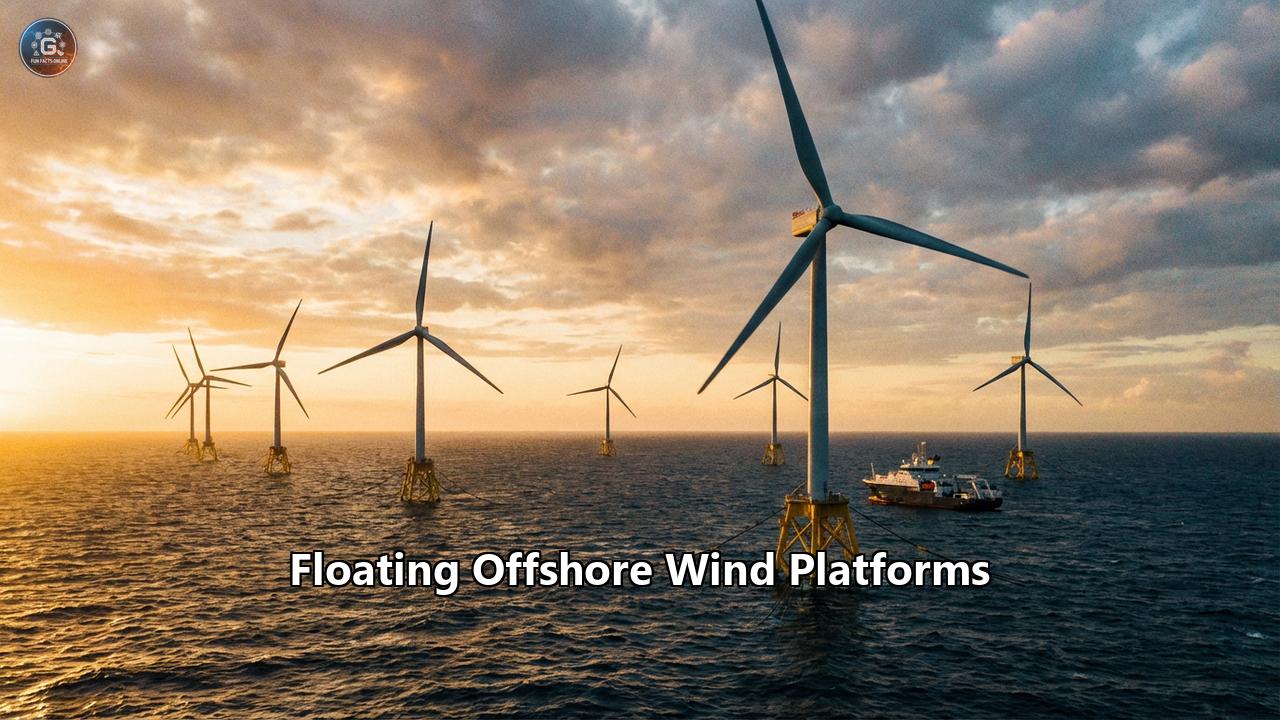
The year 2026 has arrived as a watershed moment for the global energy sector, and nowhere is the transformation more palpable than in the deep waters of the world’s oceans. Floating offshore wind—once a niche engineering curiosity—has firmly transitioned from the "promising prototype" phase to the "industrial reality" phase. As we stand in February 2026, the industry is navigating a complex new world of record-breaking auctions, diverging geopolitical policies, and technological breakthroughs that promise to unlock the 80% of global wind resources that lie in waters too deep for traditional fixed-bottom turbines.
This comprehensive guide explores the state of Floating Offshore Wind Platforms in 2026, dissecting the technologies, market dynamics, economic realities, and environmental frontiers defining this booming sector.
The Global "Reset": The State of Floating Wind in 2026
For the past decade, floating wind was the "future." In 2026, it is undeniably the "present." The sector has just emerged from a year of recalibration—a "reset" characterized by a shift from exuberant targets to steel-in-the-water execution.
The headline story of early 2026 is the divergence in global momentum. While Europe and Asia are accelerating with massive commercial-scale awards, the United States faces a turbulent policy landscape following the passage of the "One Big Beautiful Bill Act" (OBBBA) in July 2025. This legislative pivot has reshuffled the investment deck, creating a world of "headwinds and tailwinds" that developers must navigate with precision.
Despite these regional disparities, the global capacity pipeline has swollen to unprecedented levels. Operational capacity, which hovered around 200 MW just a few years ago, is now on a trajectory to breach the multi-gigawatt mark by 2030, driven by flagship projects in South Korea, the UK, and France.
Part I: The Technological Renaissance
The floating platform is no longer just a steel structure; it is a sophisticated integration of hydrodynamics, aerodynamics, and digital intelligence. In 2026, we are seeing a move away from "one-size-fits-all" concepts toward site-specific optimization.
1. The Battle of the Substructures: Hybridization Wins
The debate between spar-buoys, semi-submersibles, and tension-leg platforms (TLPs) has evolved.
- Semi-Submersibles: These remain the workhorses of the industry due to their shallow-draft towability, allowing turbines to be installed quayside rather than in the treacherous open ocean. However, 2026 has seen the rise of hybrid designs. Japan's Goto Floating Wind Farm, which began commercial operations in January 2026, utilizes a revolutionary hybrid spar-type floater. By combining a steel upper section with a pre-stressed concrete lower section, engineers have lowered the center of gravity while slashing material costs—a critical innovation for resisting the typhoon-strength winds of the Pacific.
- Concrete vs. Steel: The volatility of global steel prices has pushed developers toward concrete. Recent lifecycle assessments in 2025/2026 indicate that concrete floaters can reduce the carbon footprint of a platform by 40-50% compared to all-steel equivalents. Furthermore, concrete structures can be manufactured locally, bypassing the bottlenecked Asian steel shipyards and stimulating local economies.
- TLP Resurgence: Tension-Leg Platforms, which are tethered to the seabed by taut tendons that virtually eliminate vertical motion, are seeing a comeback. New "suction anchor" innovations have solved the historical difficulty of TLP installation, making them a top contender for the ultra-deep waters (>200m) of the Mediterranean and U.S. West Coast.
2. Mooring & Anchoring: The "Shared Economy" of the Seabed
One of the most significant breakthroughs of 2025/2026 is the commercial validation of Shared Anchoring Systems.
- The Problem: Traditional farms required 3-4 anchors per turbine. For a 100-turbine farm, this meant cluttering the seabed with nearly 400 massive anchors, driving up costs and environmental impact.
- The Solution: The DeepFarm project and other pilots have successfully demonstrated that multiple turbines can share a single anchor point without compromising stability. This reduces the number of anchors by up to 50%, slashing CAPEX and minimizing the benthic footprint.
- Smart Moorings: In February 2026, Dublin Offshore received a prototype certificate for a new Load Reduction Device (LRD). This passive system sits within the mooring line, using buoyancy and ballast to dampen the violent snatch loads caused by rogue waves. This allows developers to use lighter, cheaper synthetic ropes (nylon/polyester) instead of heavy steel chains, further reducing costs.
3. The Umbilical Cord: Dynamic Cable Breakthroughs
Connecting a moving giant to a static grid is an immense engineering challenge. A floating turbine does not just sit; it heaves, sways, and surges.
- Nexans and other cable majors have achieved a critical milestone in 2026: the qualification of 145 kV dynamic inter-array cables for water depths exceeding 1,000 meters. These "umbilicals" are reinforced with double-armored layers and fatigue-resistant cores, capable of surviving millions of bending cycles over a 25-year lifespan. This technology is the key that unlocks the "deep deep" waters of the Atlantic and Asia-Pacific.
Part II: The Global Market Landscape
The geography of floating wind has shifted dramatically in the last 12 months.
Asia-Pacific: The New Center of Gravity
- South Korea: The undisputed star of 2026. In a landmark auction result announced in late 2025/early 2026, Equinor’s "Firefly" (Bandibuli) project was awarded a long-term offtake contract. At 750 MW, Firefly is the world's largest commercial-scale floating wind project to secure a route to market. Located 70 km off the coast of Ulsan, it serves as the global blueprint for gigawatt-scale floating deployment, proving that floating wind can compete in highly industrialized energy markets.
- China: Moving at "China speed," the country is rapidly deploying demonstration projects in the South China Sea. The Yangxi West Shapa project, featuring typhoon-resistant turbines, has become a testing ground for shallow-water floating solutions (30-50m depth), a segment often overlooked by European developers.
- Japan: With the goto project operational, Japan is doubling down on floating wind to meet its 2040 targets. The focus is on "japanizing" the supply chain—developing domestic capabilities for floating assembly to revitalize its shipbuilding prowess.
Europe: The Comeback Kid
- United Kingdom: After a disastrous Allocation Round 6 (AR6) where no offshore wind was bid, the UK roared back in Allocation Round 7 (AR7) in January 2026. The auction awarded a record 8.4 GW of total offshore capacity. Crucially, it included contracts for two floating wind projects: Erebus (Celtic Sea) and Pentland (Scotland).
The Price Reality: The strike price for these floating projects cleared at £155.37/MWh (2012 prices)—equivalent to roughly £216/MWh in 2024 money. While high compared to fixed-bottom wind (~£90/MWh), this price reflects the "first-mover" premium necessary to kickstart the supply chain. It is a strategic investment by the UK government to regain leadership in the sector.
- France: The Pennavel project (250 MW) in Southern Brittany continues to progress, and the 2026 North Sea Summit in Hamburg saw European leaders recommit to a staggering 300 GW offshore target by 2050, with floating wind designated as the primary technology for the Atlantic coast.
The United States: Policy Shock and Resilience
The U.S. market is navigating a "policy shock." The One Big Beautiful Bill Act (OBBBA), signed into law on July 4, 2025, has fundamentally altered the playing field.
- The Headwinds: The Act rolls back many of the Inflation Reduction Act (IRA) subsidies and imposes strict Domestic Content Requirements (DCR), rising to 27.5% for offshore wind in 2025 and 35% in 2026. This creates a short-term bottleneck, as the U.S. domestic supply chain for floating platforms is still nascent.
- The Mandates: However, the Act also mandates regular offshore lease sales, forcing the Bureau of Ocean Energy Management (BOEM) to hold auctions in the Gulf of Mexico, Gulf of Maine, and Oregon.
- The Response: Developers are adapting by pivoting to state-level procurement. California and Maine remain committed to their floating wind targets, using state mandates to backstop the federal uncertainty. The result is a bifurcated market: slowed federal momentum, but intense state-level activity.
Part III: The Economic Equation
The "Levelized Cost of Energy" (LCOE) remains the single most important metric for the sector.
The Cost Gap
As of early 2026, the hard truth is that floating wind remains expensive.
- Floating LCOE: ~$150 - $220 / MWh.
- Fixed-Bottom LCOE: ~$70 - $100 / MWh.
- Gas/Nuclear: ~$120 - $150 / MWh (in volatile markets).
While floating wind is currently more expensive than fixed wind, it is becoming competitive with new nuclear and peak-gas generation in regions with high energy prices (like the UK and Korea). The "premium" is shrinking, but the 2026 BloombergNEF (BNEF) report highlights a temporary increase in offshore costs globally due to supply chain inflation and high interest rates.
Industrialization: The Only Way Down
To reach the target of ~$60/MWh by 2035, the industry is embracing modularization. Companies are moving away from bespoke, shipyard-built platforms toward mass-produced "kits" that can be assembled by local labor.
- Port Infrastructure: This is the new bottleneck. You cannot assemble 50 massive concrete floaters without hundreds of acres of quayside laydown area. The UK's FLOWMIS (Floating Offshore Wind Manufacturing Investment Scheme) and similar EU funds are pouring billions into port upgrades in 2026 to create these "gigafactories" of the sea.
Part IV: Environmental Integration & Co-Location
The floating wind farm of 2026 is not just a power plant; it is an integrated marine ecosystem.
Co-Location: Food and Fuel
The concept of multi-use platforms has moved from PowerPoints to Pilots.
- Hydrogen: The Lhyfe "Sealhyfe" pilot successfully completed its sea trials, proving that electrolyzers can operate efficiently on a bobbing platform. In 2026, the HOPE project (10 MW) is scaling this up, aiming to pipe green hydrogen directly from offshore turbines to shore, bypassing the electrical grid entirely. This "electron-to-molecule" conversion is a game-changer for stranded wind assets far from grid connections.
- Aquaculture: The ULTFARMS project is currently running six active pilots across the North and Baltic Seas. These pilots are testing the cultivation of low-trophic species—mussels, oysters, and seaweed—within the safety zones of floating wind farms.
Case Study - Mareld: In Sweden’s Mareld wind farm, the developer Freja Offshore has partnered with Subfarm to install autonomous fish cages between turbine rows. These cages can be submerged 50-70 meters deep to avoid storm damage and surfaced for harvesting. This "protein and power" model improves the economic case for the site while acting as an artificial reef that boosts local biodiversity.
Biodiversity Net Positive
The industry is moving beyond "do no harm" to "do good."
- Benthic Protection: Unlike fixed turbines that require pile-driving (which is noisy and disturbs the seabed), floating anchors have a smaller footprint. The Ossian project in Scotland completed a massive benthic survey in July 2025 using autonomous underwater vehicles (AUVs) to map 420 km of seabed, ensuring that anchors avoid sensitive coral and spawning grounds.
- Mammal Monitoring: New Distributed Acoustic Sensing (DAS) technology is being deployed on export cables. This turns the subsea power cable into a massive "microphone" capable of detecting the vocalizations of baleen whales tens of kilometers away. This real-time data allows operators to curtail noisy maintenance activities when endangered species are present.
Part V: The Road Ahead (2030 and Beyond)
As we look toward the 2030 horizon, the trajectory is clear. The "Reset of 2026" has cleared the froth from the market and replaced it with concrete foundations—both literal and metaphorical.
We are heading toward a future of 20 MW Turbines, towering giants with rotor diameters exceeding 300 meters. We are moving toward Energy Islands, artificial hubs in the North Sea that collect power from gigawatts of floating wind and distribute it to multiple countries simultaneously.
The floating offshore wind platform of 2026 is more than a machine; it is a testament to human ingenuity's ability to adapt. It represents the conquest of the deep ocean—not to plunder its resources, but to harvest its boundless energy. With the "Firefly" lighting the way in Korea, the "Pentland" surging in Scotland, and the "Gulf" auctions looming in America, the era of floating wind has truly begun. The water is deep, the winds are strong, and the anchors are holding fast.
Reference:
- https://www.blackridgeresearch.com/blog/latest-list-top-upcoming-floating-offshore-windmill-fow-farm-plant-power-projects-in-the-world
- https://www.rivieramm.com/news-content-hub/news-content-hub/korean-auction-gives-big-boost-to-floating-wind-with-nearly-19-gw-awarded-83389
- https://www.norwegianoffshorewind.no/news/1-9-gw-capacity-awarded-in-south-korea
- https://www.instituteforenergyresearch.org/regulation/summary-of-key-provisions-in-the-one-big-beautiful-bill-act/
- https://www.bdlaw.com/publications/the-one-big-beautiful-bill-act-is-very-ugly-for-wind-and-solar/
- https://www.energypolicy.columbia.edu/assessing-the-energy-impacts-of-the-one-big-beautiful-bill-act/
- https://www.sidley.com/en/insights/newsupdates/2025/07/the-one-big-beautiful-bill-act-navigating-the-new-energy-landscape
- https://bipartisanpolicy.org/explainer/2025-reconciliation-debate-one-big-beautiful-bill-act-energy-provisions/
- https://ultfarms.eu/pilots/
- https://www.salmonbusiness.com/co-location-pilot-wind-farms-and-aquaculture-set-to-share-marine-space/