
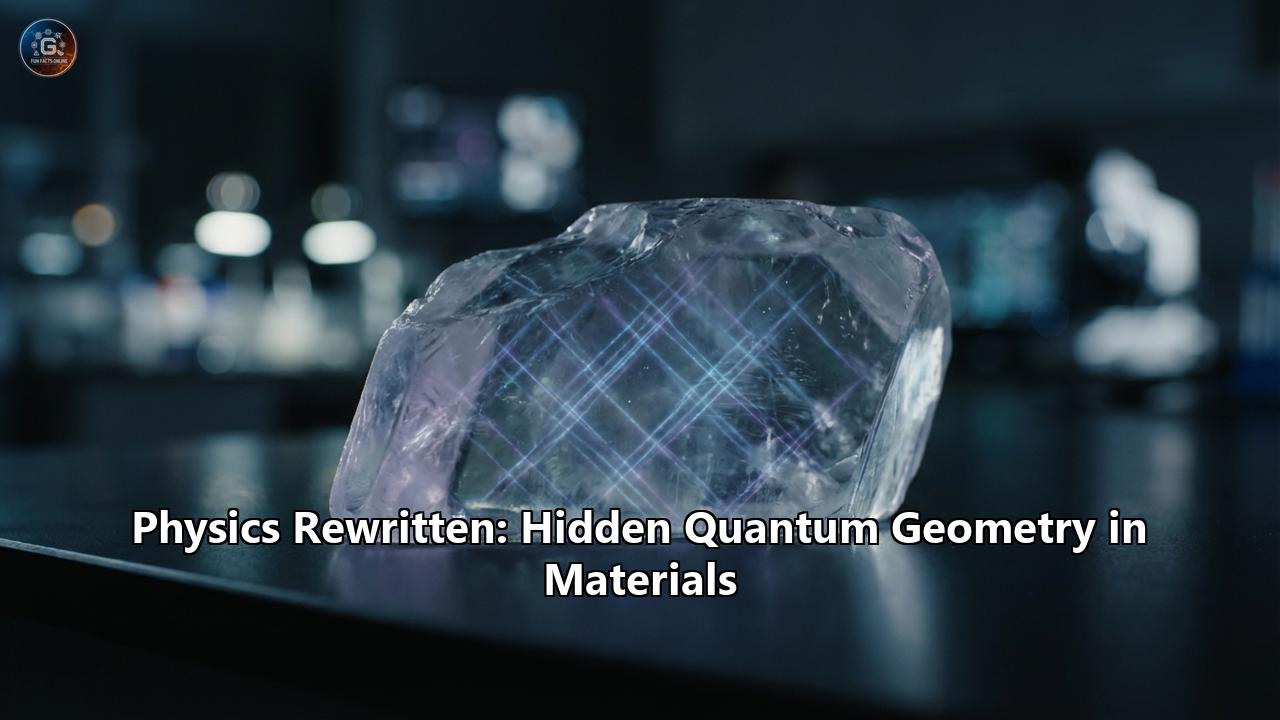
In the quiet corridors of theoretical physics, a revolution has been brewing—one that promises to rewrite the rules of how we understand the material world. For decades, we have been taught to visualize electrons in a solid like tiny balls bouncing through a pinball machine of atoms, or perhaps as waves flowing like water through a pipe. These pictures, while useful, have always been incomplete. They missed a fundamental layer of reality, a hidden fabric that dictates the behavior of matter at its most intimate level.
Now, in a breakthrough that echoes the profound shifts of the early 20th century, scientists have experimentally confirmed the existence of a "hidden quantum geometry" within materials. This geometry does not exist in the physical space we inhabit, but in the abstract mathematical landscape of the electron’s own wave function. Most startling of all, this geometry acts upon electrons with a force that mimics the most mysterious of all fundamental interactions: gravity.
Just as Albert Einstein showed us that gravity is not a force but a curvature of spacetime, physicists have now discovered that the motion of electrons in quantum materials is governed by a curvature of "quantum state space." This discovery is not merely a theoretical curiosity; it has been observed in the lab, measured in twisted layers of graphene and exotic crystals known as kagome metals. It explains "impossible" phenomena like superconductivity in materials where electrons should be frozen still. It offers a blueprint for a new generation of electronics that operate with the efficiency of a superconductor and the speed of light.
This is the story of how a mathematical ghost became a physical reality, and how it is forcing us to rewrite the textbooks of condensed matter physics.
Part I: The Ghost in the Machine
To understand this new geometry, we must first unlearn the classical intuition that has guided materials science for a century. In the standard model of solid-state physics—the theory that gave us the transistor and the silicon chip—electrons are defined by their energy and their momentum. This relationship is often plotted as a curve, a "band structure," which tells you how fast an electron moves for a given amount of energy. Steep curves mean fast electrons; flat curves mean slow ones.
For eighty years, this was enough. If you wanted a better conductor, you looked for a material with steep bands. If you wanted an insulator, you looked for a gap between the bands. But as our ability to engineer materials at the atomic scale improved, anomalies began to appear—ghosts in the machine that the standard maps could not explain.
The first hint of this hidden world came in the 1980s with the discovery of the Quantum Hall Effect, where electrons in a magnetic field moved with a precision that defied the messiness of real-world materials. To explain this, a British physicist named Michael Berry introduced a concept now known as "Berry curvature."
Imagine an electron not as a point, but as a vector—an arrow—moving through a parameter space. As this arrow travels, it can twist and rotate. Berry showed that this rotation creates a "geometric phase," a memory of the path the electron took. In the language of geometry, Berry curvature is like a magnetic field in this abstract space. It pushes electrons sideways, creating currents where none should exist.
For decades, Berry curvature was the star of the show. It explained topological insulators and the anomalous Hall effect. But Berry curvature is only half the story. It represents the imaginary part of a complex mathematical object called the "Quantum Geometric Tensor" (QGT).
The real part of this tensor—the "Quantum Metric"—was largely ignored. If Berry curvature is the "magnetic field" of quantum states, the Quantum Metric is the "gravity." It measures the distance between quantum states. It tells you how distinguishable one electron state is from its neighbor.
For a long time, this concept was considered a mathematical redundancy, a bookkeeping tool with no physical consequence. But in late 2023 and intensifying through 2025, a series of groundbreaking experiments shattered this assumption. Researchers at institutions like the University of Geneva, MIT, and Princeton proved that this "quantum distance" is not just real; it is a dominant force in the quantum realm. It is the hidden geometry that bends electrons like gravity bends light.
Part II: Gravity for Electrons
The analogy to gravity is not just poetic; it is mathematically precise. In Einstein’s General Relativity, a massive object like the sun curves the fabric of spacetime. A planet moving past the sun doesn't "feel" a force; it simply follows the straightest possible path (a geodesic) through this curved environment.
In the new view of quantum materials, the "Quantum Metric" defines the curvature of the space in which the electron's wave function lives. When an electron moves through a crystal, it isn't just traversing the physical distance between atoms; it is navigating the hills and valleys of this quantum landscape.
If the quantum metric is "flat," the electron behaves normally. But if the metric is curved—if the "distance" between states changes rapidly—the electron’s path is warped. It might gain mass, becoming heavy and sluggish, or it might lose mass, zipping through the material as if it were weightless.
This realization answers a question that has plagued physicists for years: How can "flat band" materials conduct electricity?
In a "flat band" material, the relationship between energy and momentum is a flat line. According to classical quantum mechanics, the group velocity of an electron in a flat band is zero. The effective mass is infinite. The electrons should be frozen, unable to carry a current. A flat band material should be the perfect insulator.
And yet, experiments with twisted bilayer graphene—two sheets of carbon rotated at a "magic angle" of 1.1 degrees—showed the exact opposite. When these sheets are twisted to create a flat band, the material doesn't become an insulator. It becomes a superconductor, flowing electricity with zero resistance.
This was a paradox. How can frozen electrons form a supercurrent?
The answer lies in the quantum metric. Even though the band is "flat" in terms of energy (kinetic energy is quenched), it is not "flat" in terms of geometry. The wave functions of the electrons in these bands are highly structured; they possess a deep, complex quantum geometry.
When the electrons interact to form Cooper pairs (the carriers of superconductivity), they don't rely on their kinetic energy, which is zero. Instead, they "slide" along the curvature of the quantum metric. The supercurrent is driven not by the speed of the individual particles, but by the geometry of the space they inhabit. It is a "geometric superfluid," a state of matter where the flow of electricity is sustained by the shape of the quantum universe itself.
Part III: The Materials of the Future
This discovery has turned materials science into a hunt for geometry. We are no longer just looking for specific elements—silicon, copper, gold. We are looking for specific shapes in the quantum structure.
1. Twisted Bilayer Graphene and Moiré MaterialsThe poster child of this revolution is the "moiré" material. When you stack two 2D grids and twist them, you create a large-scale interference pattern called a moiré superlattice. This new, larger pattern radically alters the electronic landscape. It was in these systems that the "magic angle" superconductivity was found. We now understand that the twist creates a perfect storm of quantum geometry—flattening the energy bands while maximizing the curvature of the quantum metric. This allows for robust superconductivity at temperatures and conditions where it has no business existing.
2. Kagome Metalsnamed after a traditional Japanese basket-weaving pattern, Kagome lattices are composed of corner-sharing triangles. This specific arrangement frustrates the electrons—they can't decide where to sit to minimize their energy. This frustration leads to flat bands and rich topological features. In 2024 and 2025, researchers used advanced spectroscopic techniques to map the quantum metric in Kagome metals like iron-tin (FeSn) and cobalt-tin (CoSn). They found that the electrons in these materials effectively occupy a curved space, leading to giant non-linear responses—small inputs of energy resulting in massive outputs of current.
3. Topological AntiferromagnetsRecent work has also highlighted the role of the quantum metric in magnetic materials. In certain antiferromagnets (where neighboring spins point in opposite directions), the quantum metric allows for a new kind of optical manipulation. By shining light on these materials, researchers can induce currents that are rectified—flowing only in one direction—purely due to the geometric "shape" of the magnetic states. This suggests a future of "topological optoelectronics," where light controls electricity without the heat and resistance of traditional wires.
Part IV: Seeing the Invisible
How do you measure a geometry that exists in an abstract mathematical space? You cannot simply look at it with a microscope. The confirmation of the quantum metric required a tour de force of experimental physics, combining techniques that push the boundaries of what is measurable.
The primary tool has been Angle-Resolved Photoemission Spectroscopy (ARPES). In an ARPES experiment, scientists blast a material with high-energy light, knocking electrons out of the crystal. By measuring the angle and energy of the escaping electrons, they can reconstruct the band structure.
However, standard ARPES only sees the energy-momentum relation. To see the geometry, researchers had to develop "Circular Dichroism ARPES." By using circularly polarized light (light that spirals as it travels), they could probe the "handedness" or chirality of the electron states. The quantum metric leaves a subtle fingerprint in how the electrons respond to left-handed versus right-handed light.
Another method involved Non-Linear Transport. In a standard material, if you double the voltage, you double the current (Ohm’s Law). In materials dominated by quantum geometry, this linearity breaks down. The curvature of the quantum metric creates a "second-order" response—a current that depends on the square of the voltage. By carefully measuring these deviations from Ohm’s Law, physicists could back-calculate the curvature of the quantum space, effectively "mapping" the hills and valleys of the metric.
The results were stunning. In some flat-band materials, the contribution of the quantum metric to the conductivity was not a minor correction—it was the dominant mechanism. The geometry was doing all the heavy lifting.
Part V: A New Era of Technology
The implications of "Quantum Geometrodynamics" extend far beyond the laboratory. If we can engineer the quantum metric, we can engineer properties that were previously thought impossible.
1. High-Temperature SuperconductivityThe holy grail of condensed matter physics is a room-temperature superconductor—a material that carries electricity with zero loss without needing expensive cooling. The conventional mechanism for superconductivity (electron-phonon coupling) is too weak to work at high temperatures. But "geometric superconductivity" follows different rules. Because it depends on the shape of the wave function rather than kinetic energy, it is not limited by the same thermal noise. Engineering materials with "maximally curved" metrics could be the path to power grids that never lose energy.
2. Geometric Energy HarvestingThe non-linear nature of these materials makes them ideal for energy harvesting. Because the quantum metric can rectify currents (turning AC into DC) even at zero frequency limits, these materials could be used to harvest energy from ambient radio waves or thermal fluctuations with unprecedented efficiency. Imagine a coating on your phone that recharges the battery by absorbing the stray Wi-Fi signals in the air, driven by the hidden geometry of its atoms.
3. Fault-Tolerant Quantum ComputingQuantum computers are notoriously fragile; a slight temperature change or vibration can collapse the quantum state (decoherence). However, properties based on topology and geometry are robust. You can deform a coffee mug into a donut without tearing it; similarly, you can disturb a material with a strong quantum metric without destroying its conducting state. "Topological Quantum Computing" relies on this robustness. The quantum metric provides a way to quantify and control the "distance" between the 0 and 1 states of a qubit, potentially allowing for error correction that is built into the hardware itself.
Conclusion: The Universe in a Crystal
We are standing at the threshold of a new epoch in physics. For the entirety of the electronics age, we have been playing with the "classical" surface of quantum mechanics. We manipulated charge and spin, but we ignored the space in which they existed.
The discovery of hidden quantum geometry reveals that the universe inside a crystal is as rich and complex as the universe of galaxies and black holes. There are flat lands where electrons stop moving, and curved cliffs where they accelerate without resistance. There are "wormholes" of Berry curvature and "gravity wells" of the quantum metric.
As we learn to map and manipulate this hidden geometry, we are rewriting the definition of what a material can be. We are moving from the chemistry of elements to the alchemy of geometry. The impossible materials of science fiction—superconductors, perfect energy absorbers, light-speed processors—are no longer just dreams. They are geometrical problems waiting to be solved. The physics of the future will not just be about what materials are made of, but about the shape of the quantum space they contain.
Reference:
- https://pmc.ncbi.nlm.nih.gov/articles/PMC8288884/
- https://www.youtube.com/watch?v=E93j0vcYVkc
- https://arxiv.org/abs/2508.00469
- https://phys.libretexts.org/Bookshelves/Classical_Mechanics/Variational_Principles_in_Classical_Mechanics_(Cline)/18%3A_The_Transition_to_Quantum_Physics/18.02%3A_Brief_summary_of_the_origins_of_quantum_theory/18%3A_The_Transition_to_Quantum_Physics/18.02%3A_Brief_summary_of_the_origins_of_quantum_theory)
- https://en.wikipedia.org/wiki/Berry_connection_and_curvature
- https://www.researchgate.net/publication/399276744_From_Berry_curvature_to_quantum_metric_a_new_era_of_quantum_geometry_metrology_for_Bloch_electrons_in_solids