
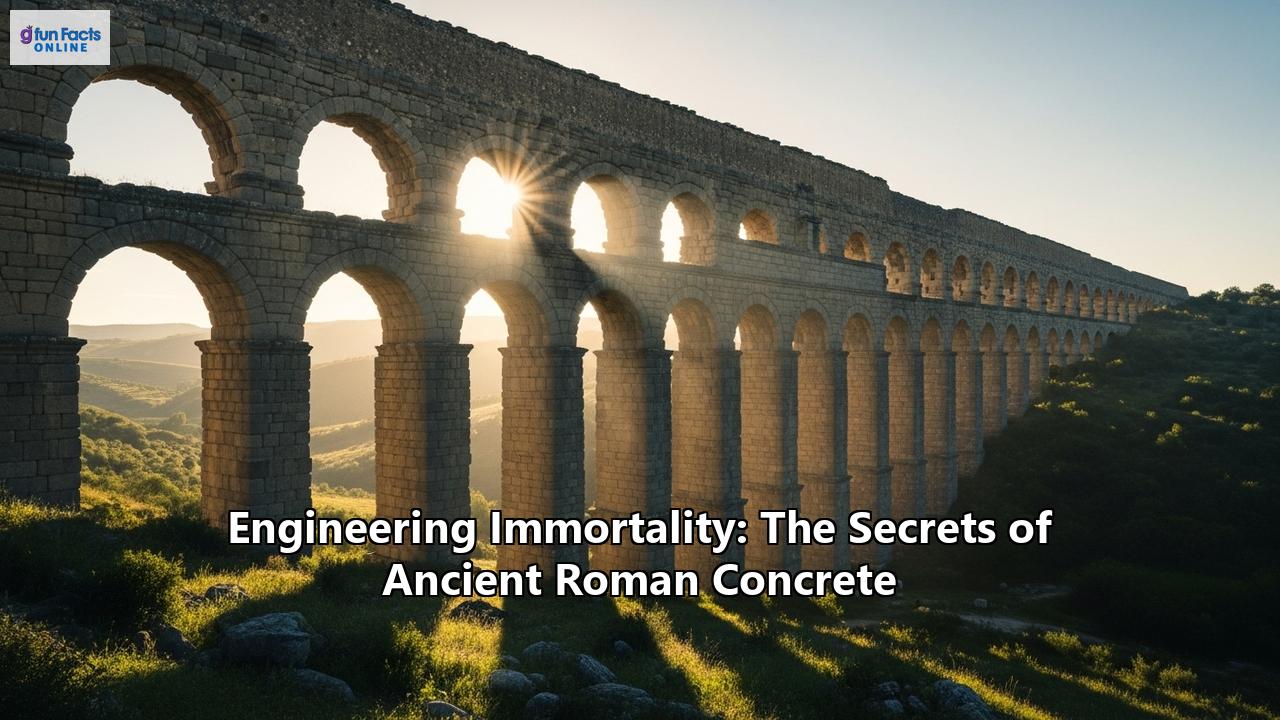
An enduring marvel of engineering, Roman concrete has captivated historians, scientists, and builders for centuries. The silent testament of structures like the Pantheon, with its colossal unreinforced dome still immaculate after nearly two millennia, and the steadfast Roman aqueducts that continue to channel water, speaks volumes of a lost art of construction. While many modern concrete structures show signs of decay within decades, their ancient Roman counterparts have defiantly withstood the ravages of time, earthquakes, and even the relentless assault of the sea. This incredible longevity, once a closely guarded secret of the Roman Empire, is now being unraveled by modern science, revealing a complex interplay of unique materials, ingenious chemical reactions, and revolutionary construction techniques. This exploration delves into the heart of ancient Rome's most remarkable innovation, uncovering the secrets of its immortal concrete.
The Dawn of a Revolution: The Origins and Evolution of Roman Concrete
While the ancient Romans are often credited with the invention of concrete, they were not the first to create cementitious mixtures. As early as 6500 BC, traders in the regions of modern-day Syria and Jordan were using rudimentary forms of concrete for floors and underground cisterns. Later, the Egyptians utilized a mix of mud and straw to bind bricks and employed gypsum and lime mortars in the construction of the pyramids. However, it was the Romans who, starting around the 3rd to 2nd centuries BC, transformed concrete from a simple binding agent into a revolutionary building material, a substance they called opus caementicium, or "cement work."
The development of Roman concrete was not a singular event but a gradual process of experimentation and refinement. Early forms of Roman construction, like the humble stone and mud mortar techniques prevalent in the Mediterranean, laid the groundwork. The Romans initially used a simple mortar of lime and sand, which hardened by reacting with carbon dioxide in the air. However, the true game-changer was the discovery of pozzolana, a volcanic ash found in abundance near the city of Pozzuoli on the Bay of Naples.
The Romans observed that this special sand, when mixed with lime and water, created a mortar of exceptional strength that could even harden underwater. This hydraulic property was a monumental leap forward in construction technology. The earliest large-scale use of this pozzolana-based concrete was in the construction of harbors around Baiae before the end of the 2nd century BC. The strategic importance of these harbors to the Roman military and economy spurred the development and widespread adoption of this new technology.
The recipe for Roman concrete, as described by the architect and engineer Vitruvius in his treatise De architectura around 25 BC, typically consisted of one part lime to three parts pozzolana for buildings, and a one-to-two ratio for underwater structures. The aggregate, the filler material mixed with the mortar, varied depending on the application and available local resources. It could include pieces of rock, ceramic tiles, and even rubble from demolished buildings. In Rome, the readily available volcanic tuff was a common aggregate.
The use of opus caementicium reached its zenith during the Roman Empire, particularly under emperors like Trajan and Hadrian in the early 2nd century AD. By this time, Roman builders had perfected their techniques, enabling them to construct architectural marvels that continue to astound us today. However, with the decline of the Roman Empire from the 5th century AD, the widespread use of concrete waned. The intricate supply chains for high-quality pozzolana collapsed, and the large-scale construction projects that demanded such a versatile material became scarce. The knowledge was not entirely lost, as evidenced by its continued, albeit limited, use in the Byzantine Empire. However, the grand scale and technical sophistication of Roman concrete construction largely disappeared for over a millennium.
The Immortal Ingredients: Deconstructing the Recipe for Longevity
For centuries, the remarkable durability of Roman concrete was a puzzle. Modern analysis, however, has unveiled the secrets behind its strength, revealing a sophisticated understanding of materials science that was far ahead of its time. The key lies in a unique combination of ingredients and the ingenious way the Romans mixed them.
The foundational components of Roman concrete were lime, water, and a special type of volcanic ash known as pozzolana. This ash, rich in silica and alumina, was the "magic ingredient" that set Roman concrete apart from its predecessors. When mixed with lime, a powerful chemical reaction, known as a pozzolanic reaction, takes place. This reaction forms a stable and durable binding agent.
The Roman architect Vitruvius even distinguished between different types of pozzolana based on their color, with reddish varieties often considered of higher quality. This indicates a level of empirical understanding of the material's properties. The pozzolanic mortar was then combined with an aggregate, which could range from heavy stones for foundations to lighter materials for upper levels, a technique cleverly employed in the construction of the Colosseum to reduce weight.
One of the most significant recent discoveries about Roman concrete is the presence of small, white, millimeter-scale chunks of lime, known as "lime clasts." For a long time, these were considered evidence of sloppy mixing or poor-quality control. However, recent research has revealed that these lime clasts were not a flaw but a crucial feature, intentionally created through a process now known as "hot mixing."
Instead of first slaking the lime (mixing it with water to create a paste), the Romans likely mixed quicklime (calcium oxide) directly with the pozzolana and water. This would have created a highly reactive, exothermic reaction, heating the mixture to extreme temperatures. This "hot mixing" process has two key benefits. Firstly, it allows for chemical reactions that would not be possible at ambient temperatures, creating high-temperature-associated compounds that contribute to the concrete's strength. Secondly, the increased temperature significantly reduces curing and setting times, allowing for much faster construction.
The most remarkable function of these lime clasts, however, is their role in the concrete's ability to self-heal.
The Living Stone: Unveiling the Self-Healing Mechanism
Perhaps the most astonishing secret of Roman concrete is its ability to repair its own cracks, a property that has allowed it to endure for millennia. This self-healing capacity is a direct result of the "hot mixing" process and the presence of lime clasts within the concrete matrix.
When tiny cracks begin to form in the concrete, they preferentially travel through the brittle lime clasts. When water, such as rainwater or seawater, seeps into these cracks, it reacts with the highly reactive calcium in the lime clasts. This triggers a chemical reaction that creates a calcium-saturated solution, which then recrystallizes as calcium carbonate, effectively filling the crack. This process can also involve reactions with the pozzolanic materials in the mortar, further strengthening the repaired area.
This self-healing happens spontaneously, automatically repairing damage before it can spread and compromise the structural integrity of the building. Modern scientific experiments have validated this ancient mechanism. Researchers have created samples of Roman-inspired hot-mixed concrete, deliberately cracked them, and then run water through the cracks. Incredibly, the cracks healed completely within two weeks, and the water could no longer flow through. In contrast, identical samples made without quicklime showed no signs of healing.
This inherent ability to mend itself is a key reason why Roman structures have been so resilient, particularly in seismically active regions where minor cracking is inevitable.
The Seawater Secret: Thriving in Marine Environments
The performance of Roman concrete in marine environments is nothing short of miraculous. While modern concrete structures often crumble within decades of exposure to saltwater, Roman piers and breakwaters have stood firm for two millennia, in some cases even growing stronger with time. This extraordinary resilience is due to a unique chemical interaction between the concrete and seawater.
When seawater percolates through the tiny cracks in the concrete, it triggers a reaction with the pozzolanic ash and lime. This interaction leads to the formation of rare and incredibly durable minerals, most notably aluminous tobermorite and phillipsite. These minerals form interlocking, plate-like crystals within the gaps and pores of the concrete.
This continuous, slow growth of new minerals reinforces the concrete's structure, increasing its resistance to fracturing and making it more durable over time. Essentially, the very element that is the kryptonite of modern concrete acts as a catalyst for strengthening its Roman counterpart. This makes Roman marine concrete a "living" material that thrives in a dynamic chemical exchange with the sea.
The discovery of this seawater-strengthening mechanism has profound implications for modern construction, particularly for building durable and sustainable coastal and marine infrastructure.
The Architectural Revolution: How Concrete Shaped the Roman World
The invention and refinement of opus caementicium was not just a technological advancement; it was the catalyst for an architectural revolution that fundamentally reshaped the Roman world. The versatility, strength, and ease of use of concrete liberated Roman architects from the constraints of traditional stone and brick construction, allowing them to create buildings of unprecedented scale, complexity, and form.
Before concrete, large structures relied on post-and-lintel systems, which limited the size and shape of interior spaces. Concrete, however, allowed for the widespread use of arches, vaults, and domes, which could span vast areas and enclose enormous volumes. This led to a new focus on the shape and experience of interior space, a defining characteristic of Roman architecture.
The Pantheon in Rome stands as the ultimate testament to this revolution. Dedicated in 128 C.E., its massive, unreinforced concrete dome, spanning an incredible 43.3 meters (142 feet), remains the largest of its kind in the world. The construction of the dome was a masterpiece of engineering, with the Romans using a progressively lighter aggregate, from heavy basalt in the foundations to light pumice at the crown, to reduce the load.
The Colosseum, another iconic symbol of Rome, is a testament to the scale and speed that concrete construction allowed. Built primarily of concrete, travertine, and tuff, this massive amphitheater could seat an estimated 50,000 to 80,000 spectators. Its complex system of barrel vaults and groin vaults, all made possible by concrete, supported the tiered seating and the vast structure itself.
Roman aqueducts, the lifelines of their cities, also relied heavily on concrete. While the iconic arched bridges are the most visible parts, the vast majority of these water channels were underground tunnels, often lined with waterproof concrete to prevent leaks. The use of concrete was also crucial in the construction of Roman bridges, where it was used for foundations, piers, and the core of the arches, providing a level of strength and permanence that wooden bridges could not match.
Even in domestic architecture, concrete played a vital role. In densely populated cities like Rome and Ostia, it was used to construct multi-story apartment blocks known as insulae, providing housing for the urban population. These structures, with their concrete walls and vaulted ceilings, were a pragmatic solution to the challenges of urban living.
The Lost Art and Its Modern Revival
For centuries, the precise recipe and techniques for creating this remarkable material were considered a lost art. While Roman texts like Vitruvius's De architectura provided valuable clues, the nuances of the "hot mixing" process and the exact properties of the pozzolana were not fully understood until modern scientific analysis.
Today, armed with this rediscovered knowledge, scientists and engineers are working to replicate Roman concrete, not just as a historical curiosity, but as a potential solution to some of modern construction's most pressing problems. The most significant advantage of Roman-style concrete is its environmental sustainability.
The production of Portland cement, the key ingredient in modern concrete, is a major source of carbon dioxide emissions, accounting for roughly 8% of the global total. This is largely due to the high temperatures (around 1,450 degrees Celsius) required to heat the limestone and clays. In contrast, the production of Roman concrete required significantly lower temperatures, around 900 degrees Celsius, resulting in a much smaller carbon footprint.
Furthermore, the incredible durability of Roman concrete means that structures built with it would have a much longer lifespan, reducing the need for costly and resource-intensive repairs and replacements. This longevity, combined with its self-healing properties, makes it an attractive alternative for building more resilient and sustainable infrastructure.
Modern research is exploring the use of fly ash, a byproduct of coal combustion, as a substitute for volcanic pozzolana, as it shares similar chemical properties. This could provide a way to recycle industrial waste while creating a superior building material. Scientists are also experimenting with other materials, such as seashells, as a replacement for limestone, further reducing the carbon footprint of concrete production.
However, there are challenges to the widespread adoption of Roman-style concrete. The specific type of volcanic ash used by the Romans is not readily available in all parts of the world, and finding suitable local alternatives is a key area of research. Additionally, the slower setting time of Roman concrete compared to modern Portland cement could be a disadvantage in today's fast-paced construction industry.
Despite these hurdles, the potential benefits of Roman-inspired concrete are immense. Researchers are actively working to commercialize these modified cement materials, which could be used for a wide range of applications, from more durable roads and seawalls to the safe long-term storage of hazardous waste.
The secrets of ancient Roman concrete, once locked away in the crumbling ruins of an empire, are now providing a roadmap for a more sustainable and enduring future. By looking back to the ingenuity of the past, we may be able to build a better world for generations to come. The enduring legacy of Rome is not just in its art, its laws, or its language, but in the very stones of its immortal structures, a testament to the enduring power of human innovation.
Reference:
- https://en.wikipedia.org/wiki/Roman_concrete
- https://news.mit.edu/2023/roman-concrete-durability-lime-casts-0106
- https://greenbuildingcanada.ca/durable-sustainable-concrete/
- https://www.auckland.ac.nz/en/news/2025/06/17/low-carbon-concrete-alternative.html
- https://www.researchgate.net/publication/323916481_Roman_Concrete_for_Durable_Eco-Friendly_Construction_-_Applications_for_Tidal_Power_Generation_and_Protection_against_Sea_Level_Rise
- https://www.dezeen.com/2023/01/17/self-healing-roman-concrete-mit-harvard/
- https://joticle.com/jot/what-are-current-uses-of-pozzolanic-sand-in-construction
- https://gharpedia.com/blog/mysterious-roman-concrete-standing-for-2000-years/
- https://www.quora.com/Why-do-we-no-longer-use-Roman-concrete-if-it-was-superior
- https://www.cementl.com/what-is-pozzolana-cement/
- https://www.quora.com/What-are-the-advantages-and-disadvantages-of-Roman-concrete-compared-to-modern-cement
- https://www.timesofisrael.com/still-standing-researchers-crack-secret-of-ancient-romes-self-healing-concrete/
- https://www.eit.edu.au/roman-concrete-changing-modern-civil-engineering/
- https://cimsa.com.tr/en/concrete-cracks-self-healing-ancient-roman-concrete/
- https://ecommons.udayton.edu/graduate_theses/7353/
- https://riskfrontiers.com/insights/roman-concrete-2-discovery-of-the-chemical-processes/
- https://www.popsci.com/science/roman-concrete/
- https://www.youtube.com/watch?v=OJUz6FXeBwM
- https://www.networx.com/article/using-concrete-the-green-way
- https://science.howstuffworks.com/why-ancient-roman-concrete-stronger-than-modern.htm
- https://dependency.blog/the-weight-of-water-and-the-cost-of-labour-reconstructing-the-past-with-roman-concrete
- https://wilkescenter.utah.edu/podcast/19-the-significance-of-ancient-roman-concrete-for-a-decarbonizing-world/