
If you were to walk into the archives of the ancient world—say, the ruins of the Library of Alexandria or the unearmarked caves of early human settlements—you would find our ancestors’ legacy etched in stone, clay, and pigment. Those mediums, primitive by modern standards, possessed an extraordinary quality: permanence. Today, in the era of quantum computing, artificial intelligence, and global interconnectedness, we generate more data in a single day than humanity produced from the dawn of civilization to the turn of the millennium. Yet, ironically, our digital empire is built on a foundation of sand. Hard drives crash, solid-state drives lose their charge, magnetic tapes degrade, and CDs suffer from "disc rot." We are facing the very real threat of a "Digital Dark Age," a future where our descendants might inherit billions of terabytes of unreadable, corroded metal and plastic.
Enter a technological miracle straight out of science fiction: laser-etched quartz glass, or "5D optical data storage." Often referred to as the "Superman memory crystal," this groundbreaking medium promises to store unimaginable amounts of data for a period that defies human comprehension—up to 13.8 billion years, roughly the current age of the universe.
The transition of this technology from a theoretical physics experiment to a commercial reality between 2024 and 2026 marks one of the most significant breakthroughs in the history of information technology. Spurred by pioneering research at the University of Southampton's Optoelectronics Research Centre and major tech initiatives like Microsoft's Project Silica, laser-etched glass is poised to solve the global data storage crisis, drastically reduce the carbon footprint of server farms, and secure the legacy of human civilization for eternity.
The Fragility of the Zettabyte Era
To understand the magnitude of the 5D optical storage breakthrough, one must first grasp the precarious state of global data. We currently live in the Zettabyte Era. Every photograph uploaded to the cloud, every financial transaction processed, every genomic sequence mapped, and every scientific simulation run contributes to a digital mountain that grows exponentially.
The problem is not just how to process this information, but how to keep it. The backbone of our modern cloud infrastructure relies heavily on magnetic hard disk drives (HDDs) and magnetic tape for "cold storage"—archival data that does not need to be accessed instantly but must be retained for legal, historical, or scientific reasons. However, magnetic storage is inherently unstable. The magnetic fields that represent the ones and zeros of our digital lives slowly lose their alignment over time, a phenomenon known as "bit rot" or magnetic decay. As a result, data centers must constantly migrate data to new drives every five to ten years.
This endless cycle of migration is a logistical nightmare and an environmental disaster. If our current trajectory remains constant, experts predict that by 2040, a significant percentage of global electricity consumption could be devoted solely to powering and cooling data storage facilities. Furthermore, the physical hardware required—racks upon racks of spinning metal disks and plastic tapes—generates mountains of electronic waste (e-waste).
We have essentially been building an eternal library out of disappearing ink.
What is Laser-Etched Quartz Glass?
The solution to the impermanence of digital data was found not in a complex synthetic polymer, but in one of the most abundant and stable materials on Earth: silica, or quartz glass.
Fused silica is chemically inert, highly resistant to thermal shock, and immune to electromagnetic interference. It does not rust, it does not rot, and a stray magnet cannot wipe its contents. However, writing data into a solid block of glass is no simple feat. It requires the precision of advanced optics and the raw power of quantum-level manipulation.
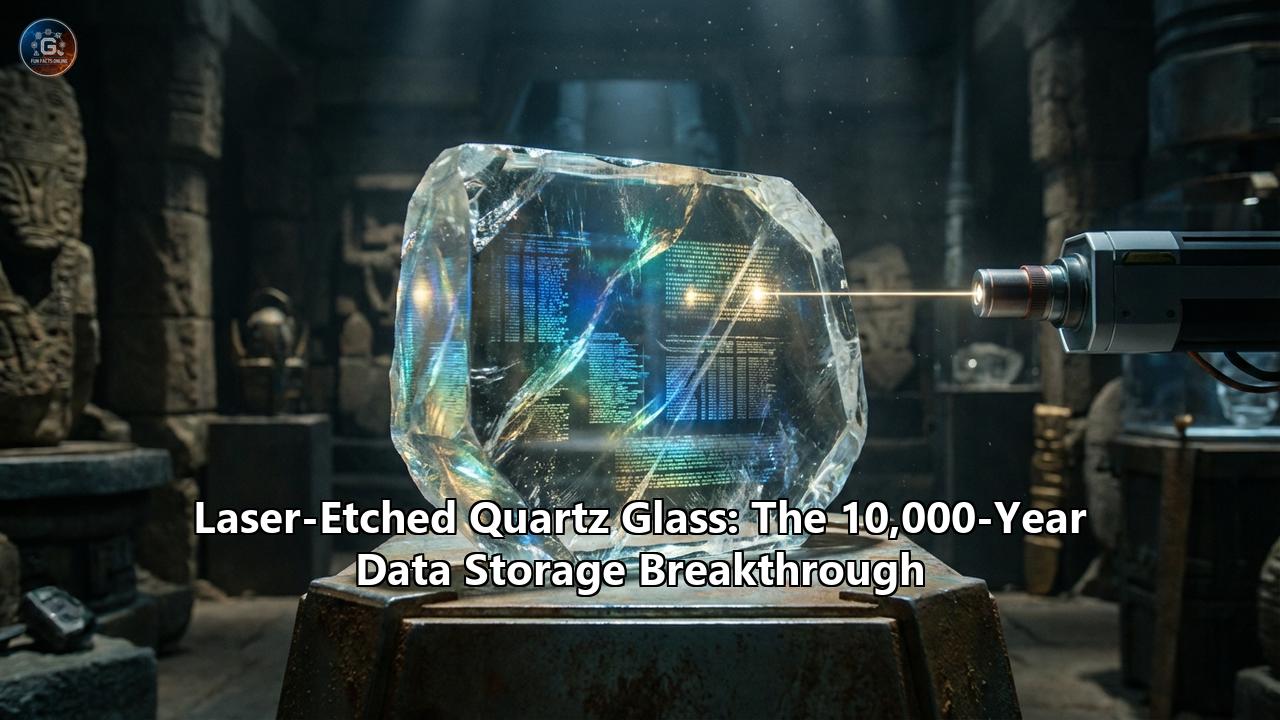
The technology is formally known as 5D optical data storage. To the naked eye, the medium looks like a simple, transparent coaster, often about the size of a standard CD or a 5-inch glass disc. But beneath its smooth surface lies a staggering landscape of nanoscale engineering.
The Magic of the Femtosecond Laser
The core of this breakthrough relies on the femtosecond laser. A femtosecond is one quadrillionth of a second. To put that into perspective, there are as many femtoseconds in one second as there are seconds in 31.7 million years. Lasers capable of emitting light pulses at this incomprehensibly short duration can deliver intense bursts of energy without generating heat that would otherwise melt or crack the glass.
When a femtosecond laser is focused deep within the fused silica, it creates tiny, microscopic physical alterations in the glass structure. These alterations are called "nanogratings." Unlike a traditional CD or DVD, which only stores data on the 2D surface of the disc, the femtosecond laser writes data three-dimensionally throughout the volume of the glass. The laser moves precisely across the X, Y, and Z axes, layering data in stacked tiers within the quartz.
The "Five Dimensions" of Data
The "5D" moniker is not a marketing gimmick; it describes the actual physical properties used to encode the binary data.
- X-axis (Spatial position)
- Y-axis (Spatial position)
- Z-axis (Depth within the glass)
- Slow Axis Orientation (Polarization)
- Strength of Retardance (Intensity of the light)
When the laser blasts a microscopic point in the glass, it creates a nanostructure that affects how light travels through it—a property known as birefringence (the same optical property that makes crystals split light into a prism of colors). By altering the orientation of the nanograting (the 4th dimension) and the size of the nanograting (the 5th dimension), researchers can encode multiple bits of information into a single microscopic point.
When it comes time to read the data, an optical microscope equipped with a polarizer shines light through the glass. The way the light bends and changes as it passes through the nanogratings is captured by a camera and instantly translated back into digital data.
Forged for Eternity: Outlasting Human Civilization
The physical durability of these memory crystals borders on the mythic. Because the data is inscribed deep within the molecular structure of the fused quartz rather than resting on the surface, it is virtually indestructible under normal—and even extreme—planetary conditions.
The University of Southampton's Optoelectronics Research Centre, led by visionary researchers like Professor Peter Kazansky, has subjected these 5D memory crystals to grueling tests. The results are breathtaking:
- Thermal Stability: The crystals can withstand freezing temperatures and infernos up to 1,000°C (1,832°F) without losing a single byte of data. At room temperature, the data is projected to remain perfectly intact for billions of years.
- Radiation and EMP Resistance: Unlike magnetic drives that can be wiped out by solar flares, cosmic radiation, or electromagnetic pulses (EMPs), quartz glass is entirely unaffected. You could detonate an atomic device next to a 5D crystal, and while the explosion might blast the disc into a wall, the data inside would survive the radioactive fallout.
- Water and Chemical Proof: It cannot rust, corrode, or suffer from water damage. It is impervious to most acids and chemical solvents.
Because of these properties, SPhotonix—the commercial spin-off company created in 2024 to bring this technology to market—confidently states that a 5D optical storage disc is capable of lasting 13.8 billion years. That is the estimated age of the universe. In a very literal sense, the data written onto these glass discs will outlast the Earth itself, enduring until the sun expands and engulfs the planet.
The 2024–2026 Breakthroughs: From the Laboratory to Reality
For years, 5D optical storage was dismissed by skeptics as an expensive laboratory trick. It was slow to write, difficult to read, and confined to university research centers. However, the period between 2024 and 2026 proved to be the tipping point where science fiction transitioned into commercial reality.
In 2024, researchers from the University of Southampton officially spun off their enterprise into a startup called SPhotonix. Their goal was clear: take the "Superman memory crystal" out of the pristine lab environment and place it into the sprawling, power-hungry data centers of the world. By late 2025, SPhotonix successfully raised $4.5 million in early funding and announced that they had moved the technology from a localized lab experiment (Technology Readiness Level 5) to a deployment-ready system suitable for operational environments (TRL 6).
This commercialization push revealed staggering capabilities. A single 5-inch glass disc, barely larger than a CD, was successfully engineered to hold an astonishing 360 Terabytes (TB) of data. To put that into perspective, 360 TB is roughly equivalent to 72,000 standard DVD movies, or millions of high-resolution photographs, crammed into a glass coaster.
Overcoming the Bottlenecks: Speeds and Costs
The historic challenge with laser-etched glass was the write speed. Early iterations took hours to write a few megabytes. However, by 2025, SPhotonix announced functioning prototypes capable of writing data at 4 Megabytes per second (MBps) and reading it at 30 MBps. While this is slower than a modern NVMe solid-state drive, it is more than adequate for cold-storage archival purposes.
Furthermore, the technological roadmap dictates rapid scaling. By 2028–2029, developers expect to achieve sustained read and write speeds of 500 MBps, putting it on par with commercial SATA SSDs.
The cost of this technology is also descending from the stratosphere. SPhotonix estimates that the commercial reading machines will cost around $6,000, while the high-powered femtosecond laser writing machines will be priced in the $30,000 range. A field-deployable reader is expected to be hitting the market by mid-to-late 2027. For an enterprise data center operator currently spending millions of dollars a year replacing degraded magnetic tapes and powering climate-controlled server rooms, a $30,000 investment for a zero-maintenance, infinite-lifespan archival system is the bargain of the century.
Project Silica: Big Tech Enters the Fray
While SPhotonix drives the commercialization of 5D memory crystals out of the UK, the corporate titan Microsoft has been quietly pioneering its own parallel initiative: Project Silica.
Microsoft's cloud division, Azure, manages exabytes of data across the globe. Recognizing the unsustainable trajectory of magnetic storage, Microsoft partnered with the University of Southampton years ago to explore volumetric archive recording in fused silica. Project Silica's focus is specifically on enterprise-level cloud storage—designing massive automated libraries where robotic arms glide along racks of glass plates, retrieving and reading archives at lightning speed.
Project Silica highlighted the specific economic advantage of the "Write Once, Read Many" (WORM) medium. Most archival data in the cloud—such as medical records, financial compliance logs, historical census data, and old media files—rarely needs to be rewritten. It just needs to be preserved and occasionally accessed. By shifting this massive volume of dormant data off spinning hard drives and onto passive glass plates, tech giants can drastically reduce the power consumption of their data centers, aligning with aggressive carbon-neutral climate goals.
Preserving the Code of Life: The Human Genome Project
Beyond the commercial applications of cloud computing and data centers, laser-etched quartz glass has profoundly inspired the scientific and biological communities. It offers an unprecedented opportunity to create an enduring, indestructible record of life on Earth.
In a monumental achievement in 2024, Professor Peter Kazansky and his team at the University of Southampton successfully stored the complete human genome—the entire DNA blueprint of a human being—onto a 5D memory crystal. The three billion base pairs of the human genome were mapped, digitized, and blasted into the fused silica.
The motivation behind this endeavor was as philosophical as it was scientific. Because the memory crystal can survive for billions of years, it could potentially outlast the human race. "We know from the work of others that genetic material of simple organisms can be synthesised and used in an existing cell to create a viable living specimen in a lab," Professor Kazansky noted during the 2024 announcement.
This opens up the astonishing possibility of bringing humanity—or endangered plant and animal species—back from extinction in the far future, millions of years from now, should advanced future civilizations (or extraterrestrial intelligences) discover the crystal and possess the scientific capability to synthesize DNA.
To aid whoever—or whatever—might find the crystal in the distant future, the research team etched a visual key on the surface of the glass. This key pays homage to the famous Pioneer plaques launched by NASA in the 1970s. It features a visual depiction of the universal elements (hydrogen, oxygen, carbon, nitrogen), the structure of the DNA double helix, and an illustration of human male and female forms. It is the ultimate message in a bottle, cast into the ocean of deep time.
A Journey to the Stars: Space Exploration and the Ultimate Archive
Because of their durability, lightweight nature, and extreme resistance to cosmic radiation and vacuum conditions, 5D memory crystals are the perfect candidates for space exploration. If humanity is to become a multi-planetary species, our data must travel with us, surviving the harsh, irradiated void of space.
The concept of sending quartz-encoded data into the cosmos is already underway. Back in 2018, a 5D Memory Crystal containing a digital copy of Isaac Asimov's seminal sci-fi masterpiece, the Foundation Trilogy, was placed in the glove compartment of Elon Musk's red Tesla Roadster, which was launched into a solar orbit aboard the maiden flight of the SpaceX Falcon Heavy.
The ambition did not stop there. In June 2025, an eternal archive containing ultra-high-resolution images of the Chauvet Cave paintings—some of the earliest known human art, dating back 32,000 years—was launched into Earth's orbit aboard The Exploration Company's Nyx space capsule.
These missions serve a dual purpose. First, they test the viability of the storage medium in actual space flight. Second, they act as off-world backups for human culture. Should a cataclysmic extinction event—such as an asteroid impact, a supervolcano, or a global nuclear conflict—render the Earth uninhabitable, the memory crystals orbiting our sun or stashed safely on the Moon or Mars will survive perfectly intact.
Revolutionizing the Enterprise: Use Cases for the Next Decade
While the preservation of humanity's legacy is a poetic and profound application, the immediate impact of laser-etched quartz glass will be felt in the global economy. Over the next decade, as reader and writer technologies become widely available, several key industries are poised to undergo a massive transformation.
1. National Archives and Libraries
Libraries, museums, and national archives are currently in a constant battle against physical degradation. Digitizing ancient texts is only half the battle; maintaining the digital files is just as expensive. 5D optical storage will allow institutions like the Library of Congress or the Vatican Archives to back up their entire collections onto a few hundred glass discs, ensuring that historical texts, treaties, and cultural artifacts are preserved indefinitely without the need for constant server maintenance.
2. The Global Seed Vaults
Facilities like the Svalbard Global Seed Vault in Norway act as a fail-safe for global agriculture. Storing the genetic sequencing data of every known plant alongside the physical seeds is crucial. With 5D glass storage, scientists can bury an indestructible biological database deep within the permafrost, immune to moisture, cold, and time.
3. Medical and Compliance Data
Hospitals and healthcare networks generate massive amounts of data, including high-resolution MRI and CT scans. By law, medical records must often be kept for decades. The sheer volume of this data puts an immense financial strain on healthcare IT budgets. Fused silica offers a WORM (Write Once, Read Many) compliant medium that guarantees data integrity. Because the glass physically cannot be overwritten or altered by ransomware attacks, it provides the ultimate cybersecurity defense for immutable health records.
4. Media and Entertainment
The film and music industries are terrified of losing their master recordings. We have already seen tragic losses, such as the 2008 Universal Studios fire that destroyed thousands of original master tapes of legendary musicians. Major studios are closely watching the development of SPhotonix and Project Silica. Archiving original 8K uncompressed video files and master audio tracks onto glass discs will ensure that the cultural output of the 21st century never fades, degrades, or accidentally burns to ash.
The Environmental Imperative
We cannot discuss the future of data without addressing the elephant in the room: climate change. The internet is a physical thing. It lives in millions of servers housed in massive warehouses globally. These servers run hot, requiring industrial-scale air conditioning systems and billions of gallons of water for cooling.
The global data storage infrastructure currently consumes an estimated 1-2% of all global electricity, and this number is rocketing upward. Furthermore, standard hard drives contain rare earth metals that require environmentally destructive mining operations. When these drives die after five years, they are shredded and dumped into landfills.
Laser-etched quartz glass fundamentally alters this ecological equation. Silica is the most abundant mineral in the Earth's crust; it is essentially highly purified sand. Manufacturing glass discs requires very little in the way of toxic chemicals or rare earth elements.
More importantly, a WORM glass archive requires zero electricity to maintain its data. A WORM drive on glass does not need to be kept in a climate-controlled room. It does not need a constant trickle of voltage to prevent data loss. A data center could theoretically house an exabyte of archival data in a warehouse with the lights off, the air conditioning disabled, and the power cord unplugged. The only energy required is the brief moment a robotic arm picks up the disc and slides it into an optical reader. This paradigm shift will save billions of dollars in energy costs and significantly shrink the carbon footprint of the tech industry.
Overcoming the Hurdles of Tomorrow
Despite the boundless optimism surrounding 5D memory crystals, the technology is still navigating the growing pains of a nascent industry.
The primary hurdle remains hardware accessibility. While the fused silica discs themselves are incredibly cheap to produce—costing pennies in raw materials—the femtosecond laser writers are highly complex, precision optical instruments. SPhotonix’s projected $30,000 price point for a writer is a massive reduction from million-dollar lab equipment, but it still limits the technology to enterprise, government, and heavy-industry buyers. It will likely be a decade before we see a consumer-grade "glass burner" that a home user could plug into their PC.
Secondly, standardizing the file systems and decoding algorithms is paramount. A 10,000-year storage medium is useless if the software required to read it goes obsolete in 50 years. To counter this, researchers are developing open-source, universal decoding instructions etched into the physical surface of the glass—a Rosetta Stone for the digital age—ensuring that even if Windows or Linux cease to exist, future engineers can easily rebuild a reader from scratch to decode the binary data.
Conclusion: The Ultimate Legacy of Human Civilization
Since the dawn of self-awareness, humanity has been obsessed with permanence. We painted hunting scenes on the walls of Lascaux, carved the Code of Hammurabi into diorite pillars, and built the Pyramids of Giza to defy the passage of time. Yet, as our civilization advanced into the digital realm, we inadvertently traded the permanence of stone for the fleeting convenience of magnetic fields.
Laser-etched quartz glass brings us full circle. Through the mastery of light, quantum mechanics, and nanoscale engineering, we have synthesized a modern equivalent of stone tablets—only millions of times denser and infinitely more resilient.
The breakthroughs of the mid-2020s by institutions like the University of Southampton and startups like SPhotonix have moved this technology from the realm of theoretical physics to commercial viability. By storing 360 Terabytes of data on a piece of glass that can survive the death of our sun, we have secured our digital footprint.
Whether it is solving the catastrophic energy consumption of modern data centers, archiving the human genome to guard against extinction, or simply ensuring that the art, music, and science of the 21st century survive for the next 10,000 years and beyond, 5D optical data storage represents one of the crowning achievements of human ingenuity. We are no longer writing our history in disappearing ink. We are etching it into the stars.
Reference:
- https://www.basicknowledge101.com/resources/knowledgepreservation.html
- https://www.quora.com/What-is-the-most-reliable-way-to-save-digital-data-for-millions-of-years
- https://www.xda-developers.com/this-glass-5d-memory-crystal-could-make-data-last-for-138-billion-years/
- https://www.scribd.com/document/815150243/Disk-Scheduling
- https://www.southampton.ac.uk/news/2024/09/human-genome-stored-on-everlasting-memory-crystal-.page
- https://www.tomshardware.com/pc-components/storage/sphotonix-pushes-5d-glass-storage-toward-data-center-pilots
- https://www.forbes.com/sites/tomcoughlin/2026/01/21/digital-storage-and-memory-projections-for-2026-part-3/
- https://www.southampton.ac.uk/research/highlights/preserving-dna-in-everlasting-memory-crystals