
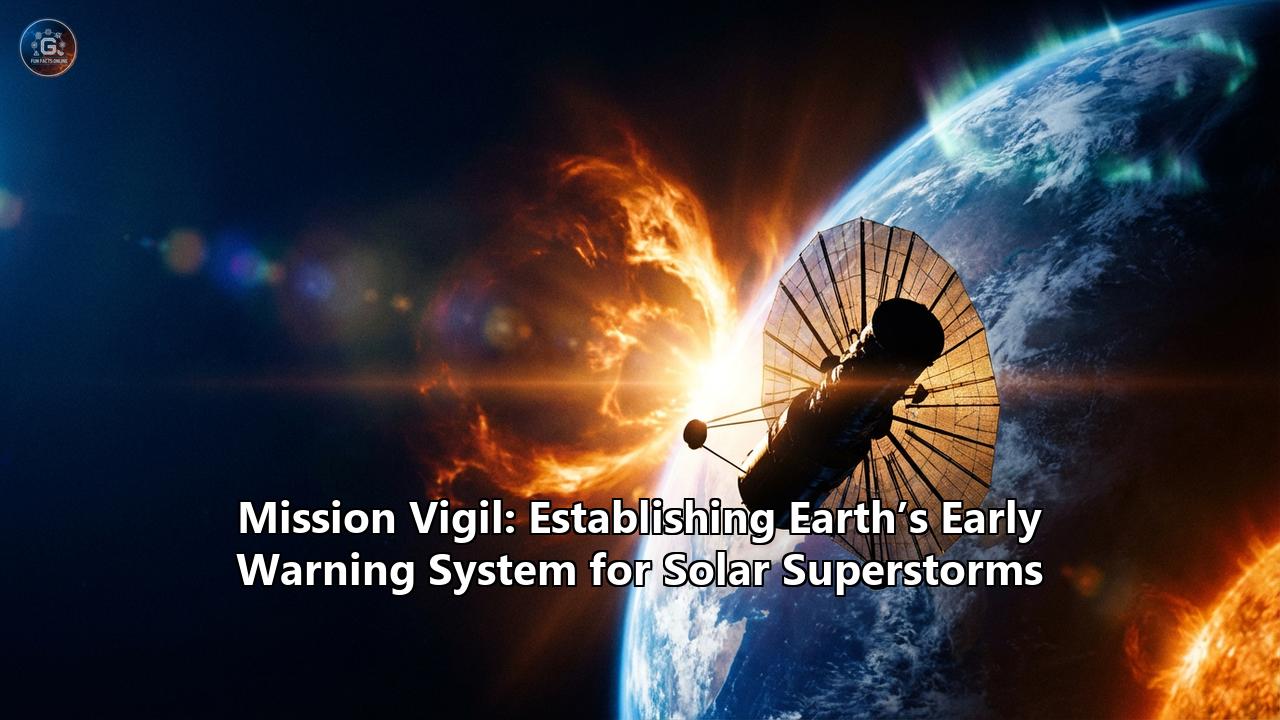
It begins in silence, 150 million kilometers away.
Deep within the twisting, chaotic magnetic fields of the Sun, a tension builds. Ideally, this magnetic energy would release slowly, a gentle simmer of solar wind that washes harmlessly over the planets. But sometimes, the Sun snaps. In a fraction of a second, magnetic field lines reconnect, unleashing a blast of radiation and plasma with the force of billions of nuclear warheads. A Coronal Mass Ejection (CME)—a tsunami of charged particles—tears away from the solar surface, screaming into the void at three thousand kilometers per second. Its target: Earth.
For decades, humanity has played a dangerous game of Russian roulette with our star. We have built a civilization entirely dependent on delicate electronics, global positioning systems, and vast, interconnected power grids, all while leaving ourselves blind to the barrel of the gun pointed at us. We rely on aging satellites positioned directly between us and the Sun, which can only see the bullet when it is already halfway down the barrel—giving us a mere 15 to 60 minutes of warning before impact.
That is about to change.
Enter Mission Vigil. Formerly known as the "Lagrange" mission, this ambitious undertaking by the European Space Agency (ESA) represents a paradigm shift in planetary defense. It is not just a scientific probe; it is Earth’s first operational deep-space sentry. By positioning itself in a unique gravitational harbor known as Lagrange Point 5 (L5), Vigil will act as a "side mirror" for the Earth, peering around the curve of the Sun to spot dangerous solar activity days before it rotates into view.
This is the story of how a robotic guardian will revolutionize our relationship with the Sun, transforming space weather from a terrifying unpredictable force into a manageable forecast, securing the future of our electrified world.
Part I: The Sword of Damocles
The Vulnerability of the Modern World
To understand the necessity of Mission Vigil, one must first understand the fragility of the systems it is designed to protect. In 1859, the Earth was struck by the most powerful solar storm on record, known as the Carrington Event. The impact was spectacular. Auroras were visible as far south as the Caribbean and Hawaii. Miners in the Rocky Mountains woke up at 1:00 AM, convinced by the brilliant sky that it was morning, and began making breakfast.
But the technological impact, while frightening, was limited. The "internet" of 1859 was the telegraph system. Operators reported sparks flying from their equipment, papers catching fire on desks, and streams of electricity flowing through the wires even after the batteries were disconnected.
If a Carrington-class event were to strike Earth today, the results would not be merely anecdotal; they would be apocalyptic.
The Trillion-Dollar Nightmare
Modern society is built on a foundation of long-distance electrical transmission lines. When a massive CME strikes Earth’s magnetic field, it induces Geomagnetically Induced Currents (GICs) in the ground. These currents seek the path of least resistance, which often happens to be the high-voltage cables of our power grids.
These rogue currents can overwhelm massive transformers—the backbone of the grid—causing them to overheat and melt. In a worst-case scenario, hundreds of these custom-built, multi-ton transformers could be destroyed simultaneously across a continent. These are not off-the-shelf parts; they take months or years to manufacture. A collapse of this magnitude could leave hundreds of millions of people without power for weeks, or even months. No water pumping, no refrigeration, no banking, no internet, no fuel pumps.
A 2013 study by Lloyd’s of London estimated that a severe solar storm could cost the global economy up to $2.6 trillion USD and take up to a decade for full recovery.
The Near Misses
We have already seen warning shots.
- 1989: A moderate solar storm collapsed the Hydro-Québec power grid in Canada, plunging 6 million people into darkness for nine hours in freezing temperatures.
- 2003: The "Halloween Storms" forced aircraft to reroute, disrupted satellite communications, and caused a blackout in Sweden.
- 2012: A superstorm arguably stronger than the Carrington Event tore through Earth’s orbit. If it had happened just one week earlier, Earth would have been directly in the line of fire. As Daniel Baker of the University of Colorado put it, "If it had hit, we would still be picking up the pieces."
We have been lucky. But in the game of orbital mechanics, luck eventually runs out. Mission Vigil is the insurance policy we can no longer afford to live without.
Part II: The Strategic High Ground
Why Lagrange Point 5?
Currently, our primary space weather eyes are satellites like SOHO, DSCOVR, and ACE. These sit at Lagrange Point 1 (L1), a point of gravitational balance directly between the Sun and Earth, about 1.5 million kilometers away.
While L1 is useful, it has a fatal flaw: a lack of perspective. Imagine trying to determine the speed and size of a baseball pitched directly at your face. It is incredibly difficult to judge the velocity of an object moving straight toward you until it is very close. This is the problem with L1 monitors. They see the CME as a growing halo, but calculating its exact speed, density, and orientation (which determines if it will magnetically connect with Earth) is fraught with uncertainty.
Mission Vigil changes the geometry of the battlefield.Vigil will be the first mission ever to take up residence at Lagrange Point 5 (L5). This is a gravitational "parking spot" located 60 degrees behind Earth in its orbit around the Sun. The distance is immense—roughly 150 million kilometers from Earth.
From this vantage point, Vigil does not look at the Sun head-on. It looks at the Sun from the side.
The "Side Mirror" Advantage
The L5 perspective offers three revolutionary capabilities that will transform space weather forecasting:
- The Profiler View: When a CME is launched toward Earth, Vigil sees it from the side. Just as a sideline referee can judge a sprint better than someone at the finish line, Vigil can precisely measure the speed, expansion rate, and density of the plasma cloud as it races toward Earth. This allows for highly accurate arrival time predictions, narrowing the error margin from 12 hours down to just a few hours.
- The Peek Around the Corner: Because the Sun rotates (once every 27 days), active sunspots—the guns that fire solar flares—rotate from the left (East) to the right (West) across the Sun’s face as viewed from Earth. Vigil, sitting 60 degrees "behind" Earth, can see these dangerous regions 4 to 5 days before they rotate into Earth's view. It gives us a "forecast of the forecast," allowing scientists to warn grid operators that a volatile region is about to aim at Earth, nearly a week in advance.
- The Beam of Light: The interplanetary space between the Sun and Earth is not empty; it is filled with the Parker Spiral of the solar wind. Vigil’s position at L5 is magnetically connected to the Earth via these spiral arms. It can sample the stream of fast solar wind before that same stream rotates to hit Earth, providing a direct "taste test" of the plasma environment we are about to experience.
Part III: Anatomy of a Guardian
The Spacecraft and Instruments
Building a spacecraft to survive and operate at L5 is a monumental engineering challenge. Vigil is not merely a research probe; it is an operational mission. This means it must be robust, reliable, and able to transmit data 24/7/365, regardless of the conditions. It cannot go into "safe mode" when a storm hits—that is exactly when it needs to be working hardest.
Led by the European Space Agency, with Airbus selected as the prime contractor, the Vigil spacecraft is a marvel of resilience. It is a box-like structure roughly the size of a delivery van, equipped with solar arrays and a high-gain antenna dish essential for beaming data across the 150-million-kilometer abyss.
The "eyes and ears" of Vigil consist of a suite of state-of-the-art instruments provided by a global consortium of partners, including NOAA (USA), NASA (USA), and top European institutes.
1. The Photospheric Magnetographic Imager (PMI)
- Provided by: Max Planck Institute (Germany)
- Function: The "Map Maker." This instrument scans the surface of the Sun to map its magnetic field. Since all solar storms are driven by magnetic energy, knowing the complexity of the magnetic field allows scientists to calculate how much energy is stored in a sunspot and how likely it is to erupt. PMI will give us the first high-resolution magnetic maps of the Sun's "side," filling in the blind spots of our star.
2. The Compact Coronagraph (CCOR)
- Provided by: NOAA / Naval Research Laboratory (USA)
- Function: The "Eclipse Maker." To see the faint atmosphere of the Sun (the corona), you must block out the blinding light of the solar disk. The CCOR creates an artificial eclipse, allowing the camera to see CMEs the moment they leave the Sun. This is the primary tool for detecting the "mass" in Coronal Mass Ejection.
3. The Heliospheric Imager (HI)
- Provided by: Leonardo / CSL (Italy/Belgium)
- Function: The "Trackers." While the coronagraph sees the launch, the Heliospheric Imager tracks the storm as it travels through the dark void of space. It is a wide-angle camera that watches the plasma cloud on its journey from the Sun to the Earth. This continuous tracking is the key to precise arrival time forecasting.
4. The Plasma Analyser (PLA)
- Provided by: Mullard Space Science Laboratory (UK)
- Function: The "Taste Tester." This in-situ instrument measures the density, velocity, and temperature of the solar wind washing over the spacecraft. It effectively "tastes" the space environment at L5, providing data on high-speed solar wind streams that will hit Earth days later.
5. The Magnetometer (MAG)
- Provided by: Imperial College London (UK) / IWF Graz (Austria)
- Function: The "Compass." Mounted on a long boom to avoid interference from the spacecraft's electronics, the MAG measures the orientation of the Interplanetary Magnetic Field (IMF). This is crucial because if a solar storm's magnetic field points "south" (opposite to Earth's "north" pointing field), it creates a connection that funnels energy directly into our atmosphere. Vigil helps predict this magnetic orientation.
6. The Extreme Ultraviolet Imager (JEDI)
- Provided by: NASA (USA)
- Function: The "Flash Detector." This instrument looks at the Sun in the extreme ultraviolet spectrum, revealing the hot, twisting loops of plasma in the corona. It helps identify the source regions of flares and provides context for the magnetic data.
Part IV: The Operation – A Week in the Life of Vigil
To truly appreciate the value of Mission Vigil, let us simulate a crisis scenario set in the mid-2030s, after the spacecraft is fully operational.
Day 1: The Ghost AppearanceVigil, humming silently at L5, detects a massive, complex sunspot group emerging on the Sun’s eastern limb (the left side, from Vigil’s perspective). To Earth-based telescopes, this region is still invisible, hidden behind the curve of the Sun. Vigil’s PMI instrument analyzes the magnetic polarity and realizes this is a "delta-class" sunspot—unstable and primed for X-class flares.
- Action: The ESA Space Weather Service Network issues a "Pre-Warning" to global operators. Grid controllers know that in 4 days, a loaded gun will be pointing at Earth. They delay planned maintenance on critical lines.
The sunspot group rotates into Earth’s view. Because of Vigil’s early data, scientists already have a full magnetic 3D model of the active region. They don't need to wait for Earth-based scans to build up; they have a 4-day history of the region's evolution.
Day 6: The EruptionThe sunspot snaps. An X20-class solar flare erupts. The light hits Earth in 8 minutes, causing radio blackouts on the day side. But the real threat, the CME, is lagging behind.
Vigil’s Compact Coronagraph (CCOR) captures the launch. Crucially, its Heliospheric Imager (HI) watches the CME from the side.
- The Calculation: From Earth (L1), the CME looks like a growing halo, and speed estimates range from 1,500 to 2,500 km/s. But Vigil’s side view triangulates the speed precisely at 2,150 km/s. It also determines the CME is heading slightly south of the ecliptic plane.
Using Vigil’s data, the NOAA Space Weather Prediction Center and ESA’s equivalent update their forecast. Instead of a 12-hour window ("The storm will hit sometime between noon and midnight tomorrow"), they issue a precision alert: "Impact expected at 14:30 UTC +/- 2 hours."
- The Response:
Power Grids: Operators in high-latitude regions (Scandinavia, Canada, Northern US) reduce the load on long transmission lines to prevent induced current buildup.
Aviation: Polar flights are rerouted to lower latitudes to protect passengers and crew from radiation and ensure radio contact.
Satellites: Commercial satellite operators (like Starlink) put their fleets into "safe mode," orienting them to minimize drag and electrical damage.
Astronauts: The crew on the Lunar Gateway station retreats to their storm shelter, knowing exactly when the radiation front will pass.
Day 8: ImpactThe storm hits at 14:45 UTC, almost exactly as predicted. The auroras are blindingly bright, painting the sky red and green over Berlin and New York. The power grid groans under the induced currents, voltage fluctuates, but because the operators were prepared and the load was managed, nothing breaks. No transformers explode. No blackouts occur.
The storm passes. The world keeps turning, unaware of the catastrophe that was averted by a sentinel 150 million kilometers away.
Part V: The Science of Stereo
Unlocking the Physics of the Sun
While Vigil’s primary purpose is operational safety (protecting infrastructure), its scientific potential is staggering. For the first time in history, humanity will have a permanent, high-quality "stereoscopic" view of the Sun.
By combining data from Vigil (at L5) with data from satellites at L1 (like NOAA's SWFO-L1) and Earth orbit, solar physicists will be able to view solar structures in 3D.
- 3D Magnetic Modelling: Currently, we have to guess the height of magnetic loops based on 2D images. With two angles, we can use triangulation to build true 3D models of the solar corona. This is the "Holy Grail" for understanding how solar flares are triggered.
- The Solar Wind Puzzle: We still don't fully understand how the solar wind is accelerated to such high speeds. Having two measurement points separated by 150 million kilometers will allow scientists to see how the solar wind structure varies over large distances, refining the models that predict space weather throughout the entire solar system.
This data is not just for Earth. As we move toward becoming a multi-planetary species, understanding the "weather" of the solar system is vital. A mission to Mars takes 6 to 9 months. Astronauts in deep space are outside Earth's protective magnetic bubble. Vigil is the first step toward a solar-system-wide weather network that will eventually protect travelers to the Moon, Mars, and beyond.
Part VI: The Global Shield
International Cooperation
Space weather ignores borders. A solar storm does not care if a power grid is American, Chinese, or European. It strikes the entire planet. Therefore, the response must be global.
Mission Vigil is a shining example of this necessity. While it is an ESA mission, the inclusion of American instruments (from NOAA and NASA) signals a unified approach to planetary defense.
- NOAA's Contribution: The US National Oceanic and Atmospheric Administration is providing the Compact Coronagraph. NOAA recognizes that data from L5 is just as valuable to the US power grid as it is to Europe's. By contributing hardware to a European spacecraft, they secure access to this vital data stream at a fraction of the cost of launching a separate mission.
- Data Sharing: The data from Vigil will be streamed freely to the global scientific and operational community. It will feed into the models used by the UK Met Office, the US Space Weather Prediction Center, and similar centers in Japan, South Korea, and Australia.
This collaboration also sets a precedent for the future. Discussions are already underway regarding Lagrange Point 4 (L4). L4 is located 60 degrees ahead of Earth. A future mission at L4, combined with Vigil at L5 and satellites at L1, would provide a near-360-degree view of the Sun. We would see every sunspot, every flare, and every streamer, no matter where they are on the star. Vigil is the first pillar of this future "ring of fire" monitoring system.
Part VII: The Future is Secure
The launch of Mission Vigil, targeted for the early 2030s on an Ariane 6 rocket, will mark the moment humanity stopped crossing its fingers and started managing its destiny in space.
For thousands of years, we worshipped the Sun as a god—capricious, life-giving, and occasionally wrathful. We offered prayers to appease it. Today, we offer engineering. We offer mathematics. We offer Vigil.
The cost of the mission—estimated in the hundreds of millions of euros—is a rounding error compared to the trillions of dollars in damage a single unpredicted superstorm could cause. It is the ultimate investment in civilizational resilience.
As we stand on the precipice of a new era of electrification, where everything from our cars to our heating systems relies on the grid, and as we launch mega-constellations of thousands of satellites, our vulnerability to space weather has never been higher. But with Vigil, our ability to defend ourselves catches up.
Deep in the void, trailing the Earth in its eternal dance around the star, Vigil will watch. It will not sleep. It will not blink. And when the Sun inevitably rages again, Vigil will ensure that we are not caught in the dark. It is the silent guardian, the watchful protector, ensuring that the light of our civilization endures, no matter what the universe throws our way.
Reference:
- https://www.treehugger.com/spectacular-solar-storms-history-5185181
- https://orbitaltoday.com/2025/07/19/esas-vigil-could-save-us-from-a-potential-catastrophe/
- https://www.esa.int/Space_Safety/Vigil
- https://encyclopedia.pub/entry/28632
- https://spacetech.media/satellite-technology/airbus-to-build-esas-vigil-space-weather-satellite/
- https://www.esa.int/Space_Safety/Vigil/Vigil_mission_overview
- https://en.wikipedia.org/wiki/ESA_Vigil
- https://www.globaldefenseaerospacepost.com/news/articleView.html?idxno=2003
- https://www.ras.ac.uk/events-and-meetings/ras-meetings/space-weather-science-fifth-lagrange-point
- https://weather.metoffice.gov.uk/learn-about/space-weather/l5-mission
- https://newspaceeconomy.ca/2023/04/08/a-history-of-havoc-the-most-disruptive-solar-storms-and-their-consequences/
- https://www.eoportal.org/satellite-missions/vigil
- https://www.ralspace.stfc.ac.uk/Pages/Lagrange.aspx
- https://www.gov.uk/government/case-studies/esa-vigil
- https://karlobag.eu/en/space/mission-vigil-esas-lagrange-point-5-space-guard-will-protect-the-earth-from-devastating-solar-storms-r7wx8
- https://www.researchgate.net/publication/273578235_Mission_to_the_Sun-Earth_L_5_Lagrangian_Point_An_Optimal_Platform_for_Space_Weather_Research_Mission_to_the_Sun-Earth_L5_Point
- https://www.researchgate.net/publication/364731198_The_Strongest_Solar_Storms_in_Recorded_History_and_Their_Effects
- https://www.azoquantum.com/Article.aspx?ArticleID=626
- https://www.nesdis.noaa.gov/our-satellites/lagrange-points-orbital-parking-spot-satellites