
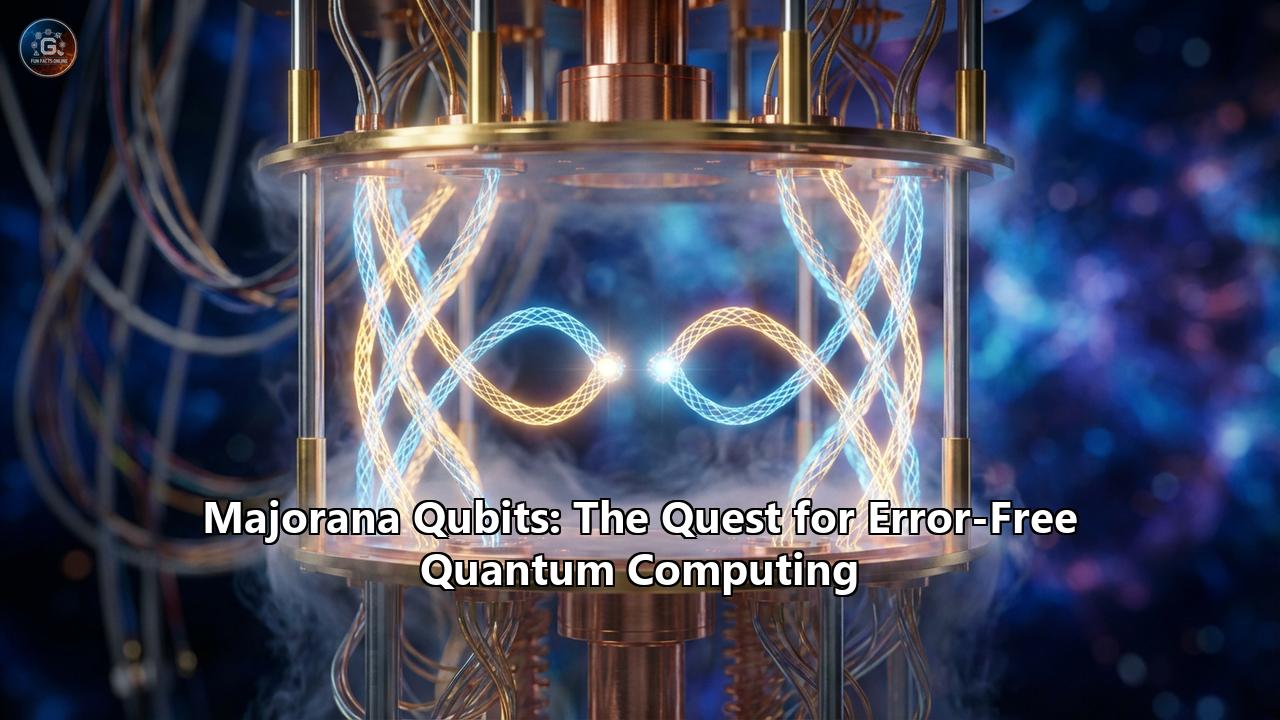
The quest for the perfect qubit has been the defining saga of the quantum age. For decades, physicists have wrestled with "noisy" intermediate-scale quantum (NISQ) devices, where qubits—made of superconducting circuits, trapped ions, or photons—are fragile infants, collapsing into decoherence at the slightest whisper of thermal vibration or electromagnetic stray. But in the hushed corridors of theoretical physics, a different kind of champion has long been predicted, one that doesn't just resist errors but mathematically forbids them: the Majorana qubit.
As we stand in 2026, the landscape of topological quantum computing has shifted dramatically. With the recent unveiling of the "Majorana 1" processor and breakthrough demonstrations of non-Abelian braiding, what was once a beautiful mathematical fiction is fast becoming an engineering reality. This is the story of the "error-free" quantum computer—how it works, why it was so hard to build, and why it changes everything.
The Ghost in the Machine: Who is Majorana?
To understand the future of computing, we must look back to 1937. The enigmatic Italian physicist Ettore Majorana proposed a solution to the Dirac equation that predicted a new class of particle. Unlike the electron (whose antiparticle is the positron) or the proton (whose antiparticle is the antiproton), a Majorana fermion is its own antiparticle. It is a peculiar, Janus-faced entity that, when two meet, can annihilate completely into energy.
For 80 years, this particle was a ghost. Neutrinos were suspected to be Majorana fermions, but proof remained elusive. Then, condensed matter physicists realized they didn't need to find the particle in a particle collider; they could manufacture it. By forcing electrons to dance in unison inside a superconductor, they could create a collective excitation—a quasiparticle—that behaves exactly like a Majorana fermion.
These "Majorana Zero Modes" (MZMs) are the holy grail of quantum hardware. They don't exist as single points in space; rather, a single qubit of information is stored non-locally, split between two separated Majorana modes. This is the magic trick: to corrupt the data, noise would have to disturb both separated ends of the wire simultaneously. Local noise—a shaking atom, a stray photon—cannot "see" the global information, making the qubit immune to the primary enemy of quantum mechanics: decoherence.
Topology: The Geometry of Protection
The robustness of Majorana qubits comes from topology, the branch of mathematics concerned with properties that remain unchanged under deformation. A coffee mug and a donut are topologically identical because one can be stretched into the other without tearing; both have one hole.
In a topological quantum computer, information is not encoded in the delicate state of a single particle (like the spin of an electron). Instead, it is encoded in the "knots" formed by the world-lines of particles as they move through time.
The Dance of the Anyons
In our familiar 3D world, particles are either bosons (like photons) or fermions (like electrons). If you swap two identical bosons, nothing changes. If you swap two fermions, the quantum wavefunction picks up a negative sign.
But in the 2D plane of a semiconductor nanowire, a third type of particle emerges: the Anyon. When you swap (or "braid") two non-Abelian anyons—the class to which Majorana modes belong—something profound happens. The system doesn't just pick up a plus or minus sign; it undergoes a unitary transformation. The state of the system changes fundamentally, but in a way that depends only on the topology of the braid (the order of the swaps), not on the messy details of the path taken.
This is Topological Quantum Computing. To run a program, you don't pulse lasers or microwaves with perfect precision. You simply "braid" your Majorana quasiparticles around each other. If your hand shakes while braiding, it doesn't matter. As long as particle A goes around particle B, the computation is perfect. It is digital logic in an analog world.
The Hardware: Anatomy of a Topoconductor
For years, the field was plagued by false starts. "Evidence" of Majorana modes often turned out to be mundane disorder effects. But the 2020s brought a pivot from pure physics to heavy engineering, culminating in the architecture we see today in devices like Microsoft's Majorana 1.
The Nanowire Recipe
The classic recipe for a Majorana qubit sounds like alchemy:
- The Wire: Take a nanowire made of a semiconductor with strong spin-orbit coupling, such as Indium Antimonide (InSb) or Indium Arsenide (InAs).
- The Coat: Wrap it in a superconducting shell (often Aluminum).
- The Field: Apply a precise magnetic field.
When tuned correctly, the superconducting gap in the wire "inverts." The bulk of the wire becomes an electrical insulator, but at the two ends, zero-energy states emerge. These are the Majoranas.
The "Topoconductor" Breakthrough
The recent leaps, including the controversial but pivotal February 2025 announcement of the Majorana 1 chip, relied on a new class of materials dubbed "Topoconductors." These are not just simple nanowires but complex heterostructures grown with atomic precision to eliminate the "chemical mess" at the interface between the semiconductor and the superconductor.
The Majorana 1 chip, an 8-qubit processor, utilized a measurement-based approach. Instead of physically moving particles around (which is slow and generates heat), the device performs "braiding" by turning interactions on and off and measuring the "parity" (even or oddness) of adjacent Majorana pairs. This "teleportation-based braiding" allows for computational speeds that rival superconducting transmons but with the promised error resilience of topology.
The "Quantized Conductance" Controversy
No history of this field is complete without addressing the scars. In 2018 and 2021, high-profile papers claiming to see the signature of Majoranas—quantized conductance peaks—were retracted. It turned out that "bad" disorder could mimic "good" topology.
This forced a paradigm shift. The community moved away from looking for simple "peaks" in data to establishing rigorous gap protocols. To prove a qubit is topological today, it must pass a battery of tests: the "Topological Gap Protocol." It's not enough to look like a Majorana; it must braid like a Majorana.
Recent work in 2025 and 2026 has focused on interferometry—measuring the interference patterns of electrons moving through the device—to prove the non-Abelian nature directly. This is the smoking gun that separates a true topological qubit from a dirty wire.
Beyond Microsoft: The Ecosystem
While Microsoft's "Azure Quantum" roadmap has been the most visible, they are not alone.
- Google Quantum AI: In a stunning move, Google demonstrated that they didn't need new particles to do topological computing. Using their existing "Sycamore" superconducting processors, they simulated the behavior of non-Abelian anyons. They created "logical" Majoranas out of the collective states of standard qubits. While this doesn't offer the hardware-level protection of a native Majorana nanowire, it allows for immediate testing of topological algorithms.
- Academic Labs (InSb & SnTe): Groups in the Netherlands (Delft), Denmark (Copenhagen), and China have pushed the material science. The discovery of multiple Majorana modes in vortices of Tin Telluride (SnTe) superconductors has opened a second front: 2D topological materials that might be easier to scale than 1D nanowires.
The Road to the Million-Qubit Era
Why the obsession with Majoranas? It comes down to scalability.
A standard qubit requires massive overhead for error correction. To make one perfect "logical" qubit, you might need 1,000 physical qubits arranging in a "surface code" to correct errors. This means a useful computer needs millions of physical qubits—a nightmare of wiring and cooling.
A Majorana qubit is hardware-protected. Its physical error rate is theoretically orders of magnitude lower. This means you might only need 10 or 100 physical Majoranas to build a logical qubit. The path to a million-qubit machine—the threshold for simulating complex drugs or breaking RSA encryption—becomes a problem of engineering, not sci-fi.
The Verdict
As we survey the field in 2026, the "Majorana 1" era is just beginning. We have not yet reached the "iPhone moment" where topological chips are in every server. The devices are still finicky, requiring near-absolute zero temperatures and magnetic fields that must be tuned to the micro-Tesla.
However, the physics is no longer in doubt. The question has shifted from "Do these particles exist?" to "How fast can we manufacture them?"
The Majorana qubit represents a profound shift in how humans interact with nature. We are no longer just manipulating matter; we are manipulating the topology of the vacuum itself, tying knots in the fabric of quantum reality to store our data. If the roadmap holds, the noisy era of quantum computing is drawing to a close, and the silent, error-free topological age is about to begin.
Reference:
- https://en.wikipedia.org/wiki/Majorana_fermion
- https://quantum.microsoft.com/en-us/insights/education/concepts/topological-qubits
- https://phas.ubc.ca/~berciu/TEACHING/PHYS502/PROJECTS/18Majorana.pdf
- https://medium.com/intuitionmachine/majorana-the-physicist-who-became-his-own-antiparticle-11a6975ef0ac
- https://sanfordlab.org/news/majorana-mysteries
- https://postquantum.com/quantum-modalities/majorana-qubits/
- https://scitechdaily.com/quantum-computing-breakthrough-scientists-finally-unlock-the-secret-of-majorana-qubits/
- https://www.quantamagazine.org/major-quantum-computing-strategy-suffers-serious-setbacks-20210929/
- https://www.ggi.infn.it/sft/SFT_2015/LectureNotes/Berg1-2.pdf
- https://physicstoday.aip.org/features/majorana-qubits-for-topological-quantum-computing
- https://fiveable.me/condensed-matter-physics/unit-10/majorana-fermions/study-guide/y4322C3JrGB5EoNV
- https://www.startupdefense.io/blog/majorana-1-revolutionizing-quantum-computing-with-topological-qubits
- https://www.eurekalert.org/news-releases/989056
- https://quantum.microsoft.com/en-us/vision/quantum-roadmap
- https://quantumcomputingreport.com/a-deeper-dive-into-microsofts-topological-quantum-computer-roadmap/