
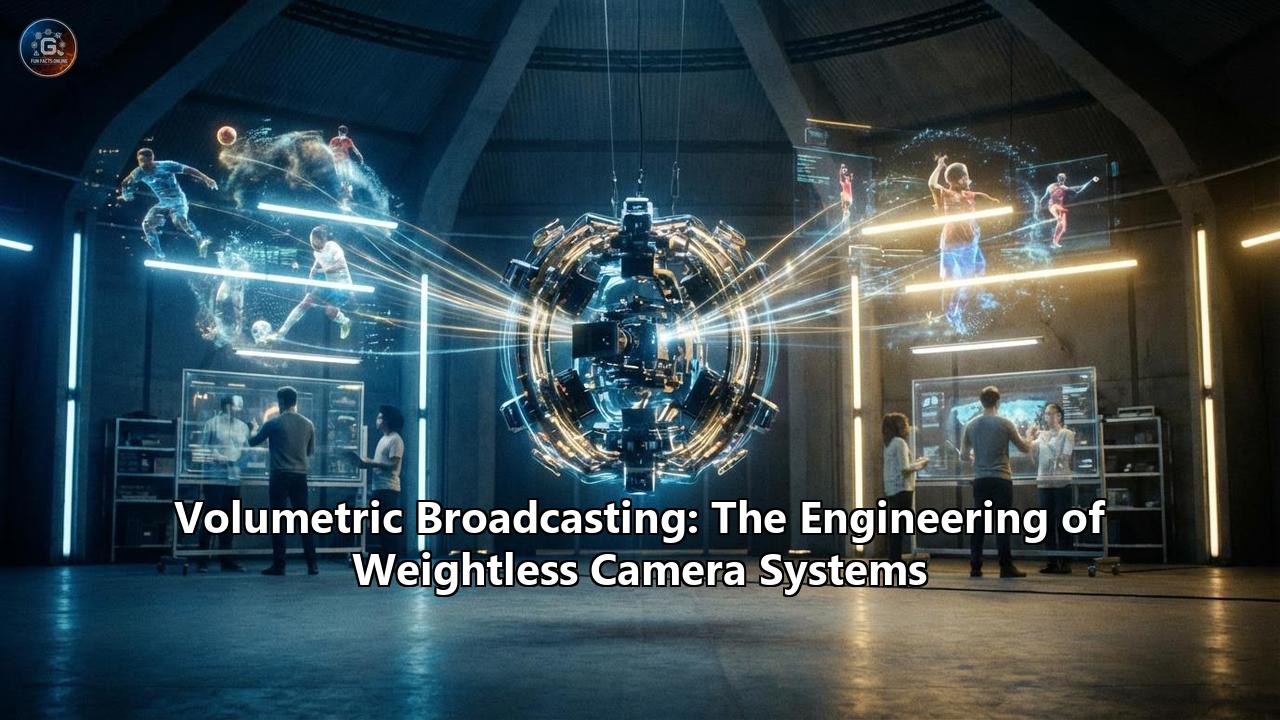
Imagine a moment in a championship football game: the quarterback releases the ball, a defender leaps into the air, and time suddenly freezes. But instead of watching this frozen tableau from the fixed, distant vantage point of a broadcast lens, you—the viewer sitting on your couch—grab your remote, push a joystick, and seamlessly "fly" your perspective down from the stands. You glide effortlessly over the turf, swoop beneath the leaping defender, and position yourself directly over the quarterback’s shoulder to see the exact gap in the defense he spotted just milliseconds before the throw.
You are not looking through a physical camera. No drone, wire-rig, or steady-cam operator could ever capture this impossible, physics-defying movement. You are looking through a "weightless camera"—a purely digital lens exploring a meticulously reconstructed, mathematically perfect 3D clone of reality.
This is the promise and the emerging reality of Volumetric Broadcasting, an engineering marvel that is quietly dismantling a century of traditional, two-dimensional video production. By transforming how light, space, and time are captured and distributed, volumetric technology is giving birth to Free-Viewpoint Video (FVV), shifting the power of the director’s chair directly into the hands of the audience.
To understand how this revolution is unfolding, we must dive deep into the engineering of the weightless camera, the mind-bending data pipelines required to process reality in real-time, and the psychological shift required to tell stories in six degrees of freedom.
The Evolution of Camera Movement: Chasing Weightlessness
For as long as motion pictures have existed, filmmakers and broadcasters have been locked in a battle against gravity and physical space. The history of cinematography is largely the history of untethering the lens.
In the early days, cameras were massive, immobile wooden boxes. The invention of the dolly and the crane allowed the lens to glide, but it was still bound to tracks and heavy counterweights. The 1970s brought the Steadicam, isolating the camera from the operator's footsteps and allowing it to float through hallways. Then came cable-suspended sky-cams in sports stadiums, giving us sweeping aerial views of the gridiron, followed by modern drones that can dive off skyscrapers and weave through narrow alleys.
Yet, all these innovations share the same fundamental limitation: they are physical objects with mass, bound by the laws of physics, inertia, and safety regulations. You cannot fly a drone between two colliding rugby players. You cannot put a physical camera directly in the path of a 100-mph tennis serve.
The first conceptual breakthrough in escaping these physical limits came from visual effects, most famously the "Bullet Time" sequence in The Matrix (1999). By firing a sequence of still cameras arranged in a circle, the directors created the illusion of a camera moving at impossible speeds through frozen time. However, Bullet Time was strictly predefined. The path of the "virtual camera" was baked into the physical placement of the still cameras.
Volumetric broadcasting takes the Bullet Time concept and applies a layer of computational omniscience. Instead of just stitching images together to form a specific path, volumetric systems capture the geometry of the entire space. It turns the stadium, the actors, and the ball into three-dimensional data points. Once the real world is converted into a 3D volume, the physical camera is no longer needed to explore it. The "camera" becomes a piece of software—a weightless, mass-less, infinitely agile mathematical construct that can be placed absolutely anywhere within that captured volume.
The Anatomy of a Volumetric Stadium: Engineering the Capture
Building a volumetric broadcasting environment is not a matter of simply upgrading existing broadcast equipment; it requires turning a physical venue into a colossal, synchronized optical scanner.
To capture a space volumetrically—whether it is an NBA court, an NFL stadium, or a cinematic soundstage—engineers must deploy dense arrays of ultra-high-definition cameras. The two most prominent pioneers in this space, Intel and Canon, have showcased different but equally staggering approaches to this hardware challenge.
The Intel True View ApproachIntel’s True View system, which has been installed in over a dozen NFL stadiums (including Mercedes-Benz Stadium in Atlanta and Nissan Stadium in Nashville), relies on raw, brute-force optical capture. The system typically utilizes around 38 interconnected 5K Ultra HD cameras strategically mounted on the stadium’s catwalks and upper tiers. These cameras do not follow the ball like traditional broadcast cameras. Instead, they stare fixedly at the volume of the field, capturing every inch of the playing surface from multiple converging angles.
The Canon Free Viewpoint SystemCanon’s approach, utilized by NBA teams like the Brooklyn Nets and Cleveland Cavaliers, as well as the 2019 Rugby World Cup, scales the camera array even higher. A standard Canon Free Viewpoint deployment often involves upwards of 100 high-resolution cameras forming a continuous ring around the arena.
The primary engineering hurdle at the capture stage is microsecond synchronization. For a volumetric model to work, every single camera in the array must capture its frame at the exact same fraction of a millisecond. If a football is spinning through the air and the cameras are out of sync by even a few milliseconds, the resulting 3D model of the ball will be smeared, disjointed, or ghosted. This requires a dedicated, hardwired fiber-optic network using Precision Time Protocol (PTP) to ensure that the global shutter of every lens fires in perfect unison.
Furthermore, these are not depth cameras (like LiDAR or Microsoft Kinects), which struggle over long stadium distances. They are standard optical cameras. The magic of depth extraction happens entirely in the processing layer, using advanced photogrammetry and machine learning to deduce three-dimensional structure purely from 2D pixel data.
The Data Tsunami: Processing the Impossible
Capturing the video is only 10% of the battle. The true engineering marvel of volumetric broadcasting lies in data processing.
Consider the math: 100 cameras, each shooting 4K or 5K resolution, at 60 frames per second. This generates an ungodly amount of data—often hundreds of gigabits or even terabytes per second. Intel has noted that producing just a 15- to 30-second True View clip requires crunching roughly one terabyte of data. It is impossible to send this raw data to a remote cloud server for live broadcasting; the latency and bandwidth requirements would break any existing network.
Therefore, volumetric broadcasting relies on massive Edge Computing infrastructure built directly into the stadiums. Hidden in the bowels of these arenas are racks of high-performance servers running custom-designed parallel processing algorithms.
Here is how the data is transformed from flat pixels into a navigable 3D world:
- Foreground Extraction and Silhouetting:
Because crunching the entire stadium's data in 3D is computationally wasteful (the grass and the empty seats don't change shape), the first step is separating the dynamic elements (players, referees, the ball) from the static background. Canon achieves this by attaching a dedicated pre-processing unit to each of the 100 cameras. This processor uses visual algorithms to instantly cut the athletes out of the background without the need for a green screen.
- Volumetric Visual Hulls:
Once the silhouetted 2D images of a player are extracted from 100 different angles, the edge servers cast these silhouettes into a virtual 3D space. Where the 100 visual cones intersect, the system creates a "visual hull"—a rough 3D shape of the player.
- Voxelization and Meshing:
This rough shape is then divided into "voxels" (3D pixels). Just as a 2D image is made of flat squares, a 3D volumetric model is made of millions of tiny 3D cubes. A dense wireframe mesh is draped over these voxels to create a smooth, continuous digital replica of the athlete.
- Texture Mapping:
Finally, the system goes back to the original high-resolution 2D video feeds and projects the exact colors, lighting, and textures (the wrinkles in the jersey, the sweat on the skin, the team logos) onto the 3D mesh.
All of this—from capture to extraction, meshing, and texturing—must happen in a matter of milliseconds to allow for near-live replay and eventual live streaming. The output is a complete 3D scene data file, vastly smaller in file size than the sum of the 100 camera feeds, which can then be transmitted over a network to the end-user.
AI and the Future of Rendering: NeRFs and Gaussian Splatting
While the brute-force voxelization method works, it is computationally heavy and can sometimes result in artifacts—players looking slightly plastic, or blurry edges where the cameras couldn't see perfectly.
The next frontier of volumetric engineering is heavily reliant on Artificial Intelligence. The industry is currently undergoing a paradigm shift toward Neural Radiance Fields (NeRFs) and 3D Gaussian Splatting.
Instead of trying to physically build a 3D geometric mesh, a Neural Radiance Field uses a neural network to "memorize" how light travels through a scene. By feeding the AI the footage from the stadium cameras, the AI learns the volume of the space. When the user moves their weightless camera to a completely new angle—one that no physical camera actually captured—the AI instantly hallucinates or "synthesizes" what the light should look like from that specific point in space.
This AI-driven approach is revolutionary for several reasons. First, it handles complex textures like hair, reflections, and semi-transparent objects much better than traditional meshing. Second, it drastically reduces the number of physical cameras required. If an AI can accurately predict the missing visual information, stadiums might eventually only need 20 or 30 cameras instead of 100, democratizing the technology and making it affordable for smaller venues and local broadcasters.
The Immersion Paradox: Who is the Camera For?
As the engineering hurdles are cleared, the broadcasting industry faces a fascinating philosophical and psychological challenge: The Immersion Paradox.
Currently, the term "immersive broadcasting" is used to describe two entirely different technologies. The first is Virtual Production (using massive LED walls, like in The Mandalorian), where the actors and crew are immersed in a digital world, but the viewer at home still watches a flat 2D screen. The second is Spatial Broadcasting—true volumetric video—where the audience wears a headset (like the Apple Vision Pro or Meta Quest) or uses a tablet to physically walk around the content in six degrees of freedom (6DoF).
In true volumetric broadcasting, the viewer is the camera operator. And this terrifies traditional directors.
For a century, the art of filmmaking and live sports production has been about curated attention. A director chooses when to show a wide shot to establish the scene, when to cut to a close-up to show emotion, and when to pan to follow the action. Storytelling is about control.
When you give the viewer a weightless camera, you surrender that control. If a viewer is busy flying their virtual camera up to the stadium rafters to look at the crowd, they might completely miss the game-winning touchdown.
To solve this, pioneers in volumetric storytelling are developing hybrid approaches. For instance, in a live broadcast, the professional director will still provide a curated, "guided" path for the weightless camera—swooping dynamically through the volumetric space to show the best angles. However, at any moment, the viewer can squeeze a trigger or pinch a screen to "break away" from the director's path and take manual control of the lens.
We saw a glimpse of this narrative potential at CES 2023, where Canon demonstrated their Free Viewpoint technology not on sports, but on cinema. Using a scene from M. Night Shyamalan’s thriller Knock at the Cabin, Canon reconstructed the sequence volumetrically. Viewers could watch the scene from four distinct perspectives: over the shoulder of the characters, from the top-down perspective of a crow flying above the cabin, or from the ground-level perspective of a cricket hiding in the grass. The ability to instantly shift the camera’s perspective from the gods to the insects—without any cut or loss of fidelity—proves that volumetric technology is not just a sports replay gimmick; it is an entirely new grammar for visual storytelling.
Delivery and Consumption: Bringing the Volume to the Couch
How does a broadcaster deliver a hologram to a living room?
Volumetric broadcasting requires a radical rethinking of content delivery networks (CDNs). Traditional video streams send a fixed grid of pixels. Volumetric streams must send geometry, texture atlases, and spatial coordinates.
The industry is converging on highly optimized edge-to-client streaming protocols. In a 6DoF environment, your television or VR headset doesn't need to render the entire stadium at maximum resolution—it only needs to render exactly what your weightless camera is looking at. Through techniques like foveated rendering and view-dependent streaming, the edge servers track the exact coordinates of the user's virtual camera and stream only the specific data packets required for that viewing angle.
The hardware for consumption is rapidly catching up to the capture technology.
- Mobile and Web: Using standard smartphones and tablets, users can swipe the screen to orbit around a play, effectively turning their phone into a magic window looking into a miniature holographic world.
- Augmented Reality (AR): With devices like AR glasses or smartphones, volumetric feeds can be projected onto a physical coffee table. A fan could literally watch tiny, photorealistic holographic football players running a play on their kitchen counter.
- Virtual Reality (VR): With headsets like Meta Quest or Apple Vision Pro, fans can scale the volumetric data to life-size. You can stand on the virtual 50-yard line, turning your physical head to track the ball, effectively teleporting into the stadium space.
Beyond Sports: Education, Communication, and the Metaverse
While billions of dollars in sports broadcasting rights are driving the development of volumetric tech, its most profound impacts may be felt far off the field.
Volumetric TelepresenceCompanies like SOAR are developing volumetric capture systems for live human communication. Traditional video conferencing (like Zoom) forces humans into what developers call "Flat Stanley mode"—2D rectangles that lack depth, eye contact, and spatial presence. By applying volumetric capture to standard webcams and depth sensors, we are moving toward real-time 3D telepresence, where a colleague's photorealistic, full-3D avatar is beamed into your room, allowing you to walk around them as they speak.
Education and Digital HumanitiesThe Center for Digital Humanities (CDH) at the University of Arizona recently conducted a year-long longitudinal study on volumetric broadcasting in higher education. Their findings align with "media richness theory," proving that capturing full 3D representations of instructors and cultural artifacts vastly reduces the transactional distance of remote learning. When students can use a weightless camera to examine a volumetrically captured historical artifact from every angle, or walk around a guest lecturer, cognitive engagement and information retention spike dramatically compared to flat video. Volumetric broadcasting turns passive viewing into active spatial exploration.
The Complete Liberation of the Lens
We are standing at the threshold of a new era of visual media. The engineering required to realize Volumetric Broadcasting—the microsecond synchronization of hundreds of lenses, the petabytes of real-time edge computing, the AI-driven radiance fields, and the complex streaming architectures—is among the most sophisticated technological symphonies ever conducted.
But the technology itself is ultimately just a vessel for a deeper human desire: the desire to break free from the frame.
For the first time in history, the camera is no longer a physical object that limits what we can see. The lens has become weightless. It has become digital tissue, seamlessly weaving together space, time, and data. Whether we are flying over the shoulder of our favorite athlete, standing inside a cinematic thriller, or learning from a holographic professor in our living room, volumetric broadcasting fundamentally changes our relationship with digital reality. We are no longer just watching the broadcast; we are finally stepping inside it.
Reference:
- https://www.emergentmind.com/topics/free-viewpoint-video-fvv
- https://promwad.com/news/immersive-sports-broadcasting-volumetric-video
- https://opus.lib.uts.edu.au/bitstream/10453/165865/2/02whole.pdf
- https://global.canon/en/news/2019/20190917.html
- https://etd.lib.metu.edu.tr/upload/12624823/index.pdf
- https://www.streamtvinsider.com/tech/intel-s-true-view-camera-system-added-to-two-more-nfl-stadiums
- https://www.youtube.com/watch?v=yDRcnAXaTiw
- https://arxiv.org/abs/2007.00558
- https://medium.com/design-bootcamp/why-immersive-tech-in-broadcasting-is-really-about-storytelling-not-gadgets-7804f82a073d
- https://www.youtube.com/watch?v=2Can98NLBWU
- https://www.researchgate.net/figure/Example-of-collaborative-live-streaming-for-a-free-viewpoint-video_fig6_272641088
- https://multimedia.tencent.com/products/free-viewpoint-video
- https://library.iated.org/download/CARTER2025EXP