
For over a century, physics has been a house divided. On one side stands Albert Einstein’s General Relativity, a majestic cathedral of geometry where gravity is not a force, but the curvature of space and time itself. On the other side is Quantum Mechanics, the chaotic, probabilistic rulebook of the subatomic world. These two theories hate each other. Try to combine them mathematically, and the equations explode.
But while string theorists and cosmologists look to the stars or particle colliders to reconcile them, a quiet revolution has occurred in a much smaller place: the silicon and carbon landscape of a microchip.
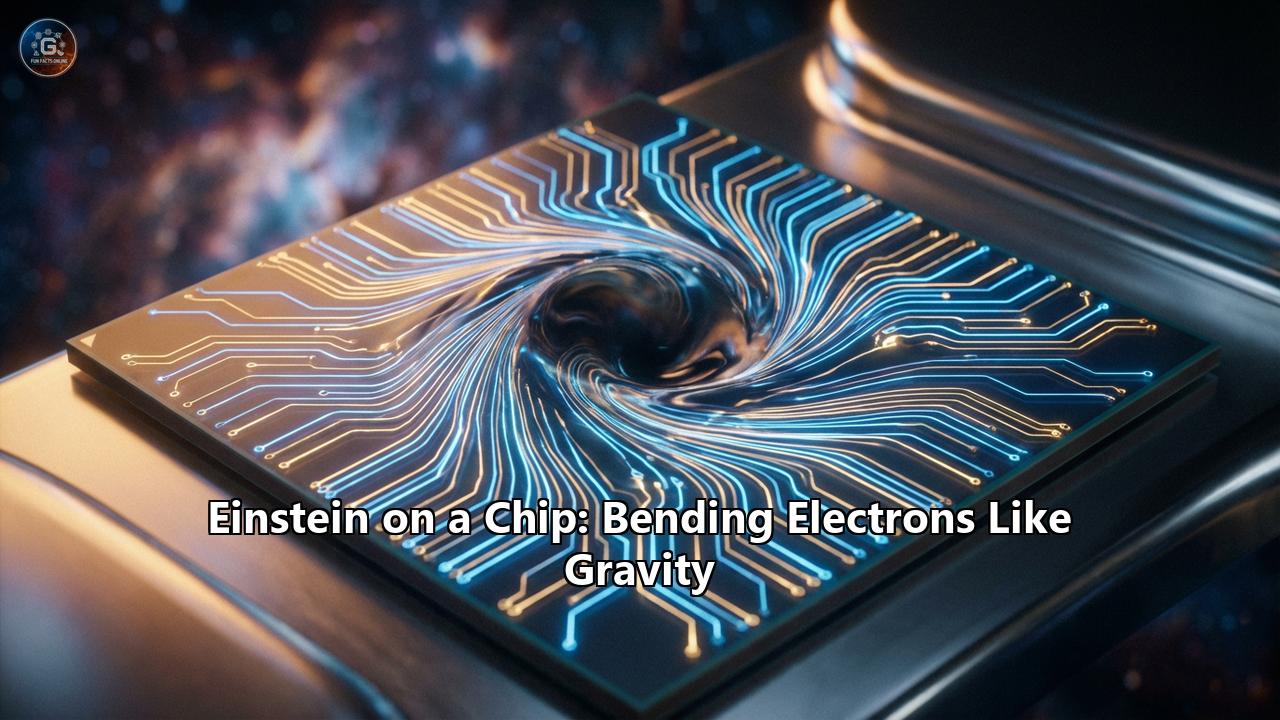
In a groundbreaking development reported in late 2025, researchers have successfully identified a "hidden geometry" within quantum materials—a feature known as the quantum metric—that forces electrons to move exactly as if they were falling through the warped spacetime of a black hole. This isn't just a simulation; mathematically, the electrons are experiencing gravity.
Welcome to the era of "Einstein on a Chip." By bending materials instead of space, and manipulating quantum wavefunctions instead of planets, scientists are unlocking a new branch of technology: Gravitronics. This article explores how we learned to bend electrons like gravity, and why this breakthrough could lead to the ultimate green supercomputer.
1. The Breakthrough: The "Hidden Geometry" of Quantum Matter
The headline news comes from a collaboration involving the University of Geneva (UNIGE) and institutes in Salerno and Italy. For decades, we believed that the only thing affecting an electron's path in a solid was the electromagnetic force (the electric potential of atoms).
However, the UNIGE team discovered that in certain quantum materials, the wavefunction of the electron—the mathematical cloud describing its probability—possesses its own intrinsic curvature. This is called the Quantum Metric.
Think of a standard microchip as a flat sheet of paper. Electrons travel in straight lines. The UNIGE discovery reveals that in specific materials, this "paper" is crumpled and twisted on a quantum level. The electron doesn't "feel" a force pulling it; it simply follows the curve of the quantum metric, curving its path just as light curves around a star.
Why this matters:This allows engineers to steer electric currents without using external magnetic fields (which are bulky and energy-hungry). Instead, the "gravity" is built into the crystal lattice itself.
2. The Physics: How to Fake a Universe
To understand how a chip can mimic gravity, we must look at Einstein's central equation: the Metric Tensor ($g_{\mu\nu}$). In General Relativity, this tensor tells you how to measure distances in space. If the metric is constant, space is flat. If the metric varies (due to a massive object like the Sun), space is curved.
In solid-state physics, we don't have planets to warp space. But we have something else: Strain and Topology.
The Dirac Equation Connection
In "normal" materials, electrons are massive and sluggish. But in advanced materials like Graphene and Weyl Semimetals, electrons become "massless Dirac fermions." They zoom through the lattice at 1/300th the speed of light, behaving more like photons than matter.
Because they move relativistically, they obey the Dirac Equation. If you deform the lattice they travel through—stretch it, twist it, or heat it unevenly—you change the distance between atoms. Mathematically, this change enters the Dirac equation exactly where the Metric Tensor enters Einstein’s equations.
The result: To the electron, the distorted lattice looks identical to a gravitational field. It doesn't know it's in a lab in Geneva or Rochester; it thinks it's skimming the event horizon of a black hole.3. The "Flavors" of Artificial Gravity
Scientists are using three main approaches to build these "gravitational" chips, each with different applications.
A. Strain Engineering (The Rubber Universe)
The most intuitive method involves physically stretching materials. Research from the University of Maryland and Berkeley Lab has shown that if you take a flake of graphene (a single layer of carbon atoms) and stretch it into a specific triangular shape, you create a "pseudomagnetic field."
- The Effect: The strain creates a gauge potential that mimics a magnetic field of 300 Tesla. For context, the strongest continuous magnet on Earth is only about 45 Tesla.
- The Application: "Valleytronics." We can separate electrons by their "valley" (a quantum property), allowing for a new type of computing that uses no charge, reducing heat dissipation to near zero.
B. Weyl Semimetals (The Axial-Gravitational Anomaly)
This is the most "cosmic" approach. In 2017, a team led by IBM Research and the University of Hamburg used a crystal called Niobium Phosphide (NbP)—a Weyl semimetal—to observe a phenomenon previously thought to exist only in the moments after the Big Bang: the Axial-Gravitational Anomaly.
In flat space, certain conservation laws (like charge and momentum) are rigid. In curved space, they can break. By applying a temperature gradient (heat) to the Weyl semimetal, the researchers simulated a gravitational field. They observed a "pumping" of electrons from one quantum state to another that violated classical conservation laws—exactly as predicted by string theory for the early universe.
- Real-world use: This anomaly generates electricity from waste heat with incredible efficiency, potentially revolutionizing energy harvesting.
C. Photonic Crystals (Bending Light for 6G)
It’s not just electrons. Researchers at Tohoku University and Osaka University have created "photonic crystals" with distorted lattices that act as "pseudogravity" for light.
- The Goal: 6G Communications. As we move to Terahertz frequencies (which behave like light), we need to steer beams around obstacles without slowing them down. Instead of using lenses (which absorb energy), we can use a "gravity chip" to curve the beam of data around a corner, just as a galaxy lenses the light of a distant quasar.
4. The Killer App: Why We Need "Gravitronics"
Why go through the trouble of simulating gravity? It’s not just for the Nobel Prize.
1. The End of Heat (Ballistic Computing)
Modern processors are limited by heat. Resistance occurs because electrons smash into atoms, scattering and releasing energy. In a "gravitational" material, electrons follow geodesics—the path of least resistance. They don't scatter; they flow like water down a frictionless pipe. This is called Ballistic Transport.
- University of Rochester researchers have proposed "Ballistic Deflection Transistors" that steer electrons using these geometric forces, operating at speeds unheard of in silicon, with a fraction of the heat.
2. Quantum Protection
Quantum computers are notoriously fragile; a slight vibration destroys the calculation (decoherence). However, geometric properties are topological—they are robust. You can crumple a sheet of paper, but you can't change the fact that it has four corners. By encoding quantum data in the "curvature" of the electron's path, we can build qubits that are immune to local noise.
3. Laboratory Cosmology
We cannot fly to a black hole. But we can build one. Researchers at Utrecht University have proposed using these chips to create an "event horizon" for spin waves.
- The Experiment: By creating a region where the flow of the material is faster than the speed of the waves, you create a point of no return. This allows scientists to study Hawking Radiation (the heat emitted by black holes) on a table-top, answering fundamental questions about the death of the universe.
5. Conclusion: The Future is Curved
We are witnessing a rare moment in history where abstract theory crashes into concrete engineering. The "Einstein on a Chip" breakthrough proves that geometry is physical. We don't need to generate massive forces to control the universe; we just need to shape the stage on which the actors play.
As we master the Quantum Metric and Strain Engineering, we are moving toward a future of electronics that mimic the elegance of the cosmos: frictionless, efficient, and guided by the invisible hand of geometry. The next supercomputer won't just calculate physics; it will be physics.
Reference:
- https://scitechdaily.com/scitechdaily/page/327/
- https://scitechdaily.com/
- https://scitechdaily.com/a-long-standing-spintronics-mystery-may-finally-be-solved/
- https://scitechdaily.com/physicists-open-a-message-in-a-bottle-from-interstellar-space/
- https://scitechdaily.com/einstein-in-a-chip-hidden-geometry-bends-electrons-like-gravity/
- https://arxiv.org/pdf/2412.09733
- https://www.cpfs.mpg.de/2812070/20170719_nat_te