
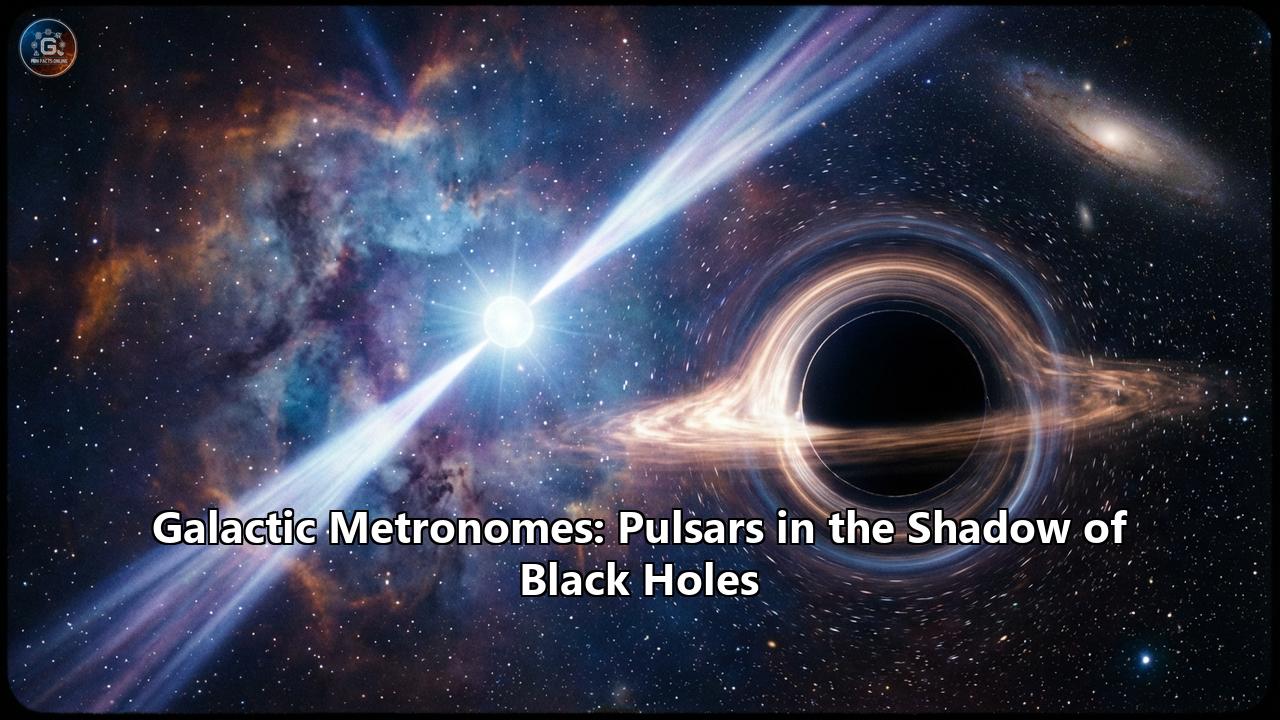
The universe is a symphony of motion, but not all dancers are equal. Most celestial bodies move to the gentle, predictable waltz of Newtonian physics, their orbits governed by the mild curvature of spacetime. But in the deepest, darkest corners of the cosmos, the dance becomes chaotic, relativistic, and profoundly extreme. At the absolute pinnacle of astrophysical obsession lies a theoretical pairing so perfect, so uniquely suited to testing the very limits of human knowledge, that astronomers have spent more than half a century searching for it. They seek the ultimate cosmic laboratory: a rapidly spinning neutron star—a pulsar—locked in a relentless gravitational embrace with a black hole.
To understand why this specific binary system is considered the "Holy Grail" of modern astronomy, one must first understand the two distinct entities involved. They represent the endpoints of stellar evolution, the crushed remnants of massive stars that have exhausted their nuclear fuel and collapsed under their own weight. Yet, their natures could not be more different. One is the universe's most perfect clock; the other is its darkest abyss. When the metronome meets the shadow, the resulting ripples in spacetime hold the power to either confirm Albert Einstein’s General Theory of Relativity in its most extreme regime, or to break it entirely, paving the way for a new era of physics.
The Anatomy of a Metronome
The story of the pulsar begins with the violent death of a giant star. When a star with a mass roughly eight to twenty times that of our Sun reaches the end of its life, it can no longer sustain the nuclear fusion that pushes outward against the crushing inward force of its own gravity. The core collapses in a fraction of a second, resulting in a cataclysmic supernova explosion. What remains is a neutron star—a sphere of incredibly dense matter roughly 20 kilometers across, yet containing more mass than our entire Sun. The density is so extreme that protons and electrons are crushed together to form a highly compressed fluid of neutrons. A single teaspoon of neutron star material would weigh billions of tons on Earth.
Because of the conservation of angular momentum—the same physical principle that causes a spinning figure skater to rotate faster when they pull their arms in—the collapsed core spins at a staggering rate. Furthermore, the collapsing star's magnetic field is compressed, creating a magnetosphere trillions of times stronger than Earth's. As the neutron star spins, this intense magnetic field rips charged particles from the surface and accelerates them to near the speed of light, beaming highly focused electromagnetic radiation out from the magnetic poles.
If the star's magnetic axis is misaligned with its axis of rotation, these beams of radiation sweep through space like the light from a cosmic lighthouse. When one of these beams sweeps across Earth, radio telescopes detect a brief, sharp "pulse" of radio waves. Hence, the term "pulsar."
The discovery of these objects is one of the most famous tales in 20th-century astronomy. In 1967, Jocelyn Bell, a 24-year-old postgraduate student at the University of Cambridge, was analyzing miles of paper chart recordings from a newly constructed radio telescope. She noticed a "bit of scruff"—a strange, repeating signal pulsing precisely every 1.33 seconds. The signal was so unnervingly regular that, for a brief time, Bell and her supervisor, Antony Hewish, jokingly dubbed it "LGM-1," standing for "Little Green Men," wondering if it might be an extraterrestrial beacon. It was soon realized, however, that they had discovered the first rapidly rotating neutron star. The discovery fundamentally changed astrophysics, eventually earning the 1974 Nobel Prize in Physics (awarded to Hewish and Martin Ryle, though Bell Burnell's exclusion remains one of the most controversial decisions in Nobel history).
Over the decades, astronomers found even more extreme versions of these objects: millisecond pulsars. These pulsars have been "spun up" by siphoning matter from a companion star, reaching rotational speeds of hundreds of times per second. Because of their massive inertia, millisecond pulsars are incredibly stable rotators. The arrival times of their pulses can be predicted to an accuracy of a fraction of a microsecond, making them cosmic clocks that rival, and sometimes surpass, the precision of the best atomic clocks on Earth.
The Shadowed Abyss
If the pulsar is the ultimate clock, the black hole is the ultimate devourer. When a star significantly more massive than the Sun dies, not even the quantum mechanical repulsion of neutrons (neutron degeneracy pressure) can halt the gravitational collapse. The core shrinks until it breaches its own Schwarzschild radius, forming a black hole—a region of spacetime where gravity is so intense that nothing, not even light, can escape.
Black holes are entirely characterized by just three properties: mass, spin, and electric charge (the so-called "No-Hair Theorem"). Despite this apparent simplicity, they warp the fabric of spacetime in ways that defy everyday intuition. Around a black hole, the gravitational pull is so severe that it causes time to drastically slow down relative to a distant observer—a phenomenon known as gravitational time dilation. Furthermore, if the black hole is spinning, it literally drags the fabric of space and time around with it like a spoon stirring honey, an effect known as frame-dragging or the Lense-Thirring effect.
For decades, black holes were mathematically fascinating but observationally elusive. We can only "see" them by observing their effects on their immediate surroundings—whether by watching stars whip around an invisible center of mass, as they do at the core of our Milky Way, or by detecting the high-energy X-rays emitted by superheated gas spiraling into the void.
The Ultimate Laboratory
Astrophysicists love pulsars because their clock-like precision makes them perfect probes of spacetime. By carefully measuring the Time of Arrival (ToA) of a pulsar's ticks, astronomers can detect minuscule changes in its environment. If a pulsar is moving toward us, the pulses arrive slightly closer together (blueshifted); if it is moving away, they arrive further apart (redshifted).
This technique, known as pulsar timing, has already yielded some of the most rigorous tests of General Relativity. In 1974, Russell Hulse and Joseph Taylor discovered the first binary pulsar, PSR B1913+16, a neutron star orbiting another neutron star. By timing the pulsar over several years, they observed that the orbit was slowly shrinking. The system was losing energy at the exact rate predicted by Einstein's theory due to the emission of gravitational waves—ripples in spacetime radiating outward from the orbiting masses. This monumental discovery earned Hulse and Taylor the 1993 Nobel Prize in Physics.
In 2003, astronomers at the Parkes Observatory in Australia discovered the first "Double Pulsar" system, PSR J0737-3039, where both neutron stars are actively emitting beams that sweep across Earth. With an incredibly tight orbital period of just 2.4 hours, this system allowed astronomers to measure relativistic effects to a staggering 99.99% accuracy, including the Shapiro delay—the subtle slowing of light as it climbs out of the gravitational well of the companion star.
But as profound as the Double Pulsar is, it still involves two relatively lightweight objects. The gravitational fields, while strong, are not the absolute maximum the universe can offer. To push General Relativity to its breaking point, and to test alternative theories of gravity like Scalar-Tensor Gravity (which suggests the existence of a scalar field coupled to matter that alters gravitational behavior in extreme environments), astronomers need a pulsar orbiting a black hole.
If a millisecond pulsar were orbiting a black hole, its highly regular ticks would be subjected to the ultimate funhouse mirror of spacetime. As the pulsar swings close to the black hole, the immense gravity would cause the pulses to arrive progressively later (the Einstein delay). The light itself would be bent and stretched. The black hole's frame-dragging would cause the pulsar's orbit to precess (wobble) in highly complex ways. By measuring these timing anomalies, astronomers could weigh the black hole with unprecedented accuracy, map its exact spin, and rigorously test whether the "No-Hair Theorem" holds true. Furthermore, any deviation from Einstein's predictions would be the first tangible crack in General Relativity, a vital clue in the long-sought quest to unite gravity with quantum mechanics.
Decades of Near Misses and The Swallowing Problem
Given the billions of stars in the Milky Way, why has a pulsar-black hole binary been so difficult to find? The answer lies in the messy, violent reality of stellar evolution.
For a pulsar and a black hole to end up in a binary orbit, they must begin as two highly massive stars locked in a binary system. The heavier star will run out of fuel first, exploding in a supernova and collapsing into a black hole. This explosion must not be so violent that it breaks the gravitational bond between the two, an event known as a "supernova kick." Millions of years later, the second star explodes, collapsing into a neutron star. Again, the system must survive the kick.
Even if the binary survives both explosions, a secondary issue arises: the "swallowing" problem. If the orbit is too tight, or if the black hole is too massive, the black hole's tidal forces will simply rip the neutron star apart and swallow it whole, extinguishing the pulsar forever. Conversely, if the orbit is too wide, the relativistic effects are too weak to be measured with the necessary precision.
Furthermore, searching for pulsars requires looking through the dense gas, plasma, and dust of the Milky Way. Free electrons in interstellar space disperse radio waves, causing the sharp pulses to smear out. This makes finding fast-spinning millisecond pulsars incredibly difficult, particularly in the galactic center where black holes are most abundant.
For decades, astronomers have scoured the skies with the world's largest radio telescopes—Arecibo, Parkes, Green Bank, Lovell, and FAST—finding thousands of pulsars, but the elusive black hole companion remained hidden. Until the 2020s brought the dawn of next-generation arrays.
January 2024: The Mass Gap Mystery in NGC 1851
The first major breakthrough in this quest occurred in January 2024, utilizing the spectacular capabilities of the MeerKAT radio telescope in South Africa. An international team of astronomers, part of the TRAPUM (Transients and Pulsars with MeerKAT) collaboration, targeted a globular cluster named NGC 1851.
Globular clusters are ancient, densely packed spheres of hundreds of thousands of stars. They are the cosmic equivalent of a mosh pit. In these crowded environments, the normal rules of stellar evolution are frequently interrupted by dynamic encounters. Stars pass so close to one another that they can disrupt orbits, swap companions, or even collide head-on. It is a prime hunting ground for exotic binaries.
In NGC 1851, the team analyzed the ticks of a millisecond pulsar designated PSR J0514-4002E. This pulsar rotates over 170 times per second and resides in an eccentric 7-day orbit with a massive, dark companion. By precisely measuring the orbital motion via pulsar timing, they calculated the total mass of the system and isolated the mass of the companion object.
The result was stunning: the dark companion weighed in at approximately 2.35 times the mass of the Sun.
This number falls precisely into what astrophysicists call the "Black Hole Mass Gap". According to established theories of stellar collapse, the heaviest a neutron star can get before its own gravity overcomes neutron degeneracy pressure and crushes it into a black hole is about 2.2 solar masses (the Tolman-Oppenheimer-Volkoff limit). Meanwhile, the lightest black holes formed from collapsing stars are generally observed to be around 5 solar masses.
The companion to PSR J0514-4002E sits right in the middle of this forbidden zone. Is it the most massive neutron star ever discovered, defying our understanding of nuclear physics at extreme densities? Or is it the lightest black hole ever found, challenging our models of stellar collapse?.
Astronomers theorize that this "mass gap" object may not have formed from the collapse of a single star. Instead, in the chaotic environment of NGC 1851, two smaller neutron stars might have collided and merged, forming a single, bloated, supermassive object. This new arrival then wandered through the cluster, gravitationally kicking a white dwarf out of its orbit and capturing the millisecond pulsar for itself.
Regardless of whether it is an unimaginably heavy neutron star or a lightweight black hole, the discovery of PSR J0514-4002E proved that the long-sought extreme binaries exist, providing a unique laboratory for probing matter under the universe's most brutal conditions.
February 2026: The Supermassive Grail Near Sagittarius A
While the mass-gap binary in NGC 1851 provided a tantalizing glimpse into extreme stellar physics, it left the ultimate test of General Relativity somewhat ambiguous. Astronomers still hungered for an undeniable, confirmed black hole—and ideally, the biggest one of them all.
In February 2026, the astrophysics community was electrified by a report from the Breakthrough Listen Galactic Center Survey. Led by Karen I. Perez, a recent PhD graduate from Columbia University, a team of scientists utilized some of the most sensitive radio investigations ever conducted to scan the incredibly turbulent central region of the Milky Way.
At the heart of our galaxy lies Sagittarius A (Sgr A), a supermassive black hole weighing four million times the mass of the Sun. Surrounding it is a chaotic maelstrom of orbiting stars, superheated plasma, and dense magnetic fields. The sheer amount of scattering and dispersion caused by the plasma makes detecting the crisp radio ticks of a pulsar near the galactic center an incredibly daunting task.
Despite these overwhelming odds, the researchers identified a highly promising signal: an 8.19-millisecond pulsar candidate, designated BLPSR, located in the immediate vicinity of the supermassive black hole.
The implications of this potential discovery, published in The Astrophysical Journal, are staggering. If follow-up observations confirm the pulsar and astronomers can successfully map its timing residuals, it will represent the holy grail of observational relativity. Tracking a fast-spinning pulsar in the intense gravitational well of a supermassive black hole would allow scientists to directly measure the distortion of spacetime on a macroscopic scale.
"Any external influence on a pulsar, such as the gravitational pull of a massive object, would introduce anomalies in this steady arrival of pulses, which can be measured and modeled," noted Slavko Bogdanov, a Columbia astrophysicist and co-author on the study. "In addition, when the pulses travel near a very massive object, they may be deflected and experience time delays due to the warping of space-time, as predicted by Einstein's General Theory of Relativity".
A confirmed millisecond pulsar orbiting Sagittarius A would essentially act as an ultra-precise GPS satellite charting the extreme curvature of the black hole's event horizon. It would allow physicists to measure the exact spin of Sgr A and potentially observe the effects of quantum gravity, probing regions where our current understanding of physics completely breaks down.
The Symphony of Spacetime and the Horizon of Discovery
As we stand in the late 2020s, the search for galactic metronomes in the shadows of black holes has transitioned from a theoretical dream to an observational reality. The dual discoveries of the 2024 NGC 1851 mass-gap binary and the 2026 Sagittarius A pulsar candidate signify a golden age of radio astronomy.
These breakthroughs were made possible by the meticulous preservation of legacy data and the rapid advancement of telescope arrays. Looking forward, the imminent completion of the Square Kilometre Array (SKA) in Australia and South Africa, alongside the Next-Generation Very Large Array (ngVLA) in North America, will increase our sensitivity by orders of magnitude. The SKA is projected to be so powerful that it will likely detect every single observable pulsar in the Milky Way that is beamed toward Earth. Within that vast catalog, astronomers anticipate finding dozens of pulsar-black hole binaries, representing various masses and orbital configurations.
Each new binary discovered will act as a tuning fork, struck against the fabric of the universe. By listening to the precise rhythm of their pulses, humanity is learning to read the deepest secrets of gravity. We are moving beyond the elegant equations scribbled on chalkboards a century ago by a patent clerk in Bern, stepping into the cosmic laboratories where spacetime itself is warped, dragged, and torn.
The dance between the pulsar and the black hole is a silent one, playing out over millions of years across thousands of light-years of empty space. But through the giant metallic dishes resting on the surface of our pale blue dot, we have finally learned to hear the music. And as the ticks of the metronome continue to echo out of the abyss, they promise to reveal the ultimate truths of the cosmos—how it began, how it works, and how, inevitably, it will end.
Reference:
- https://en.wikipedia.org/wiki/PSR_J0737%E2%88%923039
- https://imagine.gsfc.nasa.gov/educators/programs/cosmictimes/educators/guide/1993/gravitational_waves.html
- https://en.wikipedia.org/wiki/Jocelyn_Bell_Burnell
- https://www.cam.ac.uk/stories/journeysofdiscovery-pulsars
- https://physicstoday.aip.org/news/detection-of-the-first-pulsar
- https://www.frontiersin.org/news/2022/09/22/children-in-science-jocelyn-bell-burnell-discovered-pulsars
- https://www.sciencenews.org/article/jocelyn-bell-burnell-physics-prize-pulsar-discovery-interview
- https://cerncourier.com/a/double-pulsar-opens-up-new-astrophysics/
- https://grokipedia.com/page/Hulse%E2%80%93Taylor_pulsar
- https://physicstoday.aip.org/news/hulse-and-taylor-win-nobel-prize-for-discovering-binary-pulsar
- https://www.nobelprize.org/prizes/physics/1993/hulse/facts/
- https://www.nobelprize.org/prizes/physics/1993/press-release/
- https://physicsworld.com/a/first-double-pulsar-comes-into-view/