
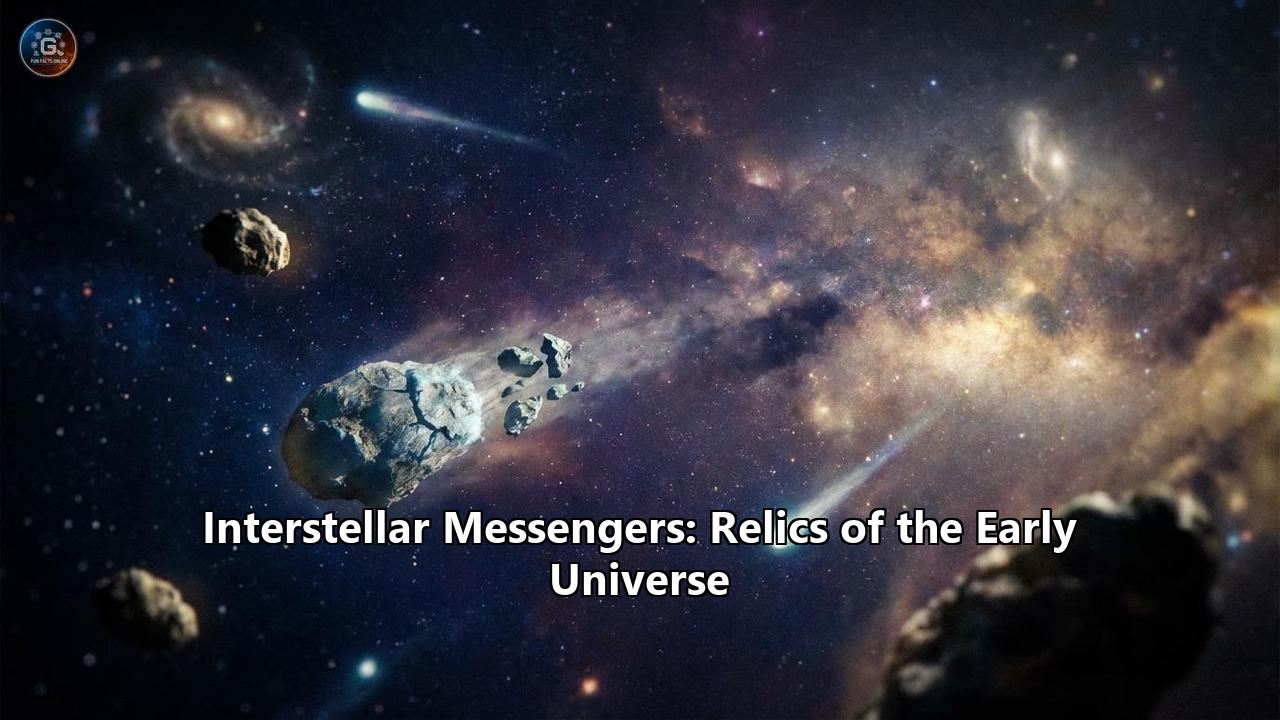
Imagine standing on the shore of a vast, silent ocean, watching the waves roll in. Occasionally, amidst the familiar shells and local driftwood, the tide deposits something entirely alien—a piece of debris carved by foreign currents, carrying the scent of distant, uncharted waters. For millennia, humanity has gazed up at the night sky, charting the predictable clockwork of our local solar system. We cataloged our own planetary family, mapped the orbits of familiar comets, and assumed we were relatively isolated in the dark void of space. But recently, the cosmic tide has brought us something extraordinary: interstellar messengers.
These nomadic relics—ranging from microscopic specks of ancient stardust and ghost-like subatomic particles to massive, icy mountains hurtling through our solar system at unimaginable speeds—are fragments of the early universe and distant star systems. They are the ultimate cosmic driftwood, carrying the chemical, isotopic, and physical fingerprints of environments billions of light-years away and billions of years in the past.
With the sudden influx of interstellar object discoveries, peaking with the spectacular arrival of comet 3I/ATLAS in 2025 and 2026, and the dawn of next-generation observatories like the Vera C. Rubin Observatory, we are entering a golden age of interstellar astronomy. We are no longer just looking at the stars; the stars are sending pieces of themselves to us.
The Vanguard of the Void: The Era of Interstellar Objects
To understand the profound significance of these messengers, we must first look at the macroscopic visitors that have violently disrupted our understanding of orbital mechanics: interstellar objects (ISOs).
For decades, astronomers theorized that the space between the stars was not completely empty, but littered with rogue asteroids and comets ejected from their home systems during the violent process of planetary formation. Yet, until recently, we had never seen one. That changed in October 2017 with the arrival of 1I/‘Oumuamua.
Discovered by the Pan-STARRS1 telescope in Hawaii, ‘Oumuamua was a shock to the scientific community. Its trajectory was purely hyperbolic—meaning it was moving too fast to be bound by the Sun’s gravity. It plunged into our solar system from the direction of the constellation Lyra, whipped around the Sun, and shot back out toward the constellation Pegasus. But ‘Oumuamua was bizarre. It lacked a cometary tail, yet it exhibited "non-gravitational acceleration"—a slight push as it moved away from the Sun. Its shape was highly elongated, resembling a cigar or a flattened pancake. Theories regarding its nature ranged from a fractal dust-bunny to a nitrogen iceberg chipped off a Pluto-like exoplanet, and inevitably, to speculations of an alien solar sail. ‘Oumuamua was a silent, mysterious scout that left our system as quickly as it arrived.
Two years later, in 2019, an amateur astronomer named Gennady Borisov spotted a fuzzy speck moving across the dawn sky. 2I/Borisov was undeniably an interstellar comet. Unlike ‘Oumuamua, Borisov behaved exactly like the comets we know, shedding a brilliant tail of gas and dust as the Sun heated its icy surface. Observations revealed that Borisov contained water, carbon monoxide, and hydrogen cyanide. It proved that the fundamental chemistry of comets—the primordial building blocks of planetary systems—is largely consistent across the Milky Way.
But the universe was not done with us.
In July 2025, the NASA-funded Asteroid Terrestrial-impact Last Alert System (ATLAS) in Chile detected a tiny, fast-moving speck. Traced back through archival data, this object—designated 3I/ATLAS—was confirmed as our third interstellar visitor. Plunging inward at a blistering speed of 135,000 miles per hour, 3I/ATLAS proved that our solar system is a bustling intersection for cosmic wanderers. By the time it made its closest approach near the orbit of Mars in late October 2025, telescopes around the world were trained on it.
What 3I/ATLAS revealed in early 2026 shattered expectations. Using the James Webb Space Telescope (JWST) and the Atacama Large Millimeter/submillimeter Array (ALMA), astronomers mapped the outgassing of this alien world in unprecedented detail. They found an object bursting with complex chemistry. The coma of 3I/ATLAS possessed one of the highest carbon dioxide-to-water ratios ever recorded, but most stunningly, it was immensely rich in methanol. In the cold, dark molecular clouds where stars are born, methanol forms on the surfaces of microscopic dust grains. The fact that 3I/ATLAS is saturated with this organic alcohol provides a pristine, frozen chemical "fingerprint" of the alien star system where it coalesced billions of years ago. It is a floating time capsule, offering a direct look into the protoplanetary disks of distant stars.
Microscopic Time Capsules: Presolar Grains and Stardust
While macroscopic visitors like 'Oumuamua and 3I/ATLAS capture the headlines, Earth has been quietly receiving interstellar messengers since its formation. You do not need a space telescope to find pieces of other stars; you just need to know where to look on Earth.
Hidden deep within certain primitive meteorites are microscopic particles known as presolar grains. These are literal pieces of stardust that predate the formation of our solar system, making them older than the Sun itself.
The most famous repository of these ancient relics is the Murchison meteorite, which fell in Australia in 1969. When scientists first cracked open fragments of this carbonaceous chondrite, they noted a distinct, tar-like odor—the smell of extraterrestrial organic chemistry. But the true treasure lay in what remained when the meteorite was subjected to harsh acids.
By dissolving the bulk of the meteorite, cosmochemists isolated incredibly resilient, microscopic grains of silicon carbide, graphite, nanodiamonds, and corundum. When analyzed using mass spectrometry, these grains revealed isotopic ratios that are entirely impossible to produce within our solar system.
Isotopes are variations of chemical elements that have different numbers of neutrons. In our solar system, the ratio of certain isotopes (like Carbon-12 to Carbon-13) is relatively uniform, having been thoroughly mixed in the solar nebula 4.6 billion years ago. However, the presolar grains found in Murchison possess isotopic ratios that are wildly divergent.
These anomalies act as a direct barcode to the stars that forged them. Some silicon carbide grains show the signature of Asymptotic Giant Branch (AGB) stars—swollen, dying red giants that continuously dredge up newly synthesized carbon from their cores and expel it into space via strong stellar winds. Other grains, particularly certain nanodiamonds, carry the violent, rapid-neutron-capture signatures of core-collapse supernovae.
Recent dating of presolar grains from the Murchison meteorite revealed that some of this stardust is up to 7 billion years old. This means these microscopic messengers drifted through the freezing void of interstellar space for over two billion years before they were caught in the gravitational collapse that formed our Sun, incorporated into an asteroid, and eventually plummeted to the Australian outback. They are the only tangible materials we can hold in a laboratory that physically bridge the gap between our current epoch and the stellar generations that lived and died before Earth existed.
The Invisible Envoys: Cosmic Rays, Neutrinos, and the Extreme Universe
Beyond physical matter, the universe communicates with us through highly energetic, invisible messengers. These are the particles and waves that travel across cosmological distances, unhindered by the immense spans of space and time, bringing news of the most violent events since the Big Bang.
Cosmic Rays: The Speeding Bullets of Space
Discovered in 1912 by Victor Hess during high-altitude balloon flights, cosmic rays are not actually rays, but high-energy subatomic particles—mostly protons and atomic nuclei—moving through space at nearly the speed of light.
While the Sun produces low-energy cosmic rays, the most fascinating are the Ultra-High-Energy Cosmic Rays (UHECRs). These particles pack an astonishing amount of kinetic energy. The famous "Oh-My-God" particle, detected in 1991, was a single proton carrying the kinetic energy of a baseball thrown at 60 miles per hour.
Because cosmic rays are electrically charged, their paths are twisted and bent by the magnetic fields of the Milky Way and intergalactic space. By the time they hit Earth's atmosphere—creating a cascading "air shower" of secondary particles—their trajectory has been thoroughly scrambled, making it incredibly difficult to point back to their source. However, astrophysicists believe these ultra-high-energy messengers are born in the crucibles of the early universe: the supermassive black holes at the centers of active galaxies (quasars), and the remnants of hypernovae.
Neutrinos: The Ghost Particles
If cosmic rays are the noisy, disruptive messengers, neutrinos are the silent ghosts. Neutrinos are subatomic particles with virtually no mass and no electrical charge. They rarely interact with normal matter; trillions of them are passing through your body, and the Earth itself, right now without hitting a single atom.
Because they are electrically neutral, neutrinos are not deflected by magnetic fields. Because they interact so weakly, they are not absorbed by dust or gas. They travel in perfectly straight lines from their source to us, making them the ultimate cosmic messengers for peering into the hearts of dense, violent phenomena.
To catch these ghosts, scientists built the IceCube Neutrino Observatory, a massive detector encompassing a cubic kilometer of pristine ice deep beneath the South Pole. In 2017, IceCube detected a highly energetic neutrino and immediately alerted telescopes worldwide. They traced the neutrino back to a blazar known as TXS 0506+056, a giant elliptical galaxy with a rapidly spinning supermassive black hole shooting a jet of high-energy particles directly at Earth, located 4 billion light-years away. This event marked the birth of "multi-messenger astronomy," where humanity could finally "see" the light and "feel" the particles from the same deep-space event.
Gravitational Waves: Ripples in the Fabric of Reality
Perhaps the most profound messengers of all do not travel through spacetime; they are ripples in spacetime itself. Predicted by Albert Einstein in 1916, gravitational waves were finally detected a century later by the LIGO observatory.
When incredibly massive and dense objects—like black holes or neutron stars—spiral into one another and merge, they distort the fabric of reality, sending shockwaves propagating outward at the speed of light. Unlike light, which can be blocked by dust or absorbed by gas, gravitational waves pass through everything unhindered.
These waves allow us to listen to the dark universe. We can now detect the collisions of black holes that happened billions of years ago, long before the Earth was formed. Furthermore, cosmologists are currently searching for the ultimate relic: primordial gravitational waves. These are the theoretical ripples generated by cosmic inflation, the exponential expansion of space that occurred just fractions of a second after the Big Bang. If detected, these primordial waves would be the oldest messengers in existence, bringing us data from the very dawn of time.
The Oldest Light: The Cosmic Microwave Background
While we search for the gravitational echoes of the Big Bang, we already have access to its visual afterglow. The Cosmic Microwave Background (CMB) is the oldest light in the universe, an omnipresent sea of microwave radiation that bathes the entire cosmos.
For the first 380,000 years of the universe's existence, it was a blindingly hot, dense soup of protons, electrons, and photons. The temperature was so extreme that atoms could not form; any time an electron tried to bind to a proton, a high-energy photon would blast it away. Because photons were constantly colliding with free electrons, light could not travel freely. The universe was a glowing, opaque fog.
As the universe expanded, it cooled. Eventually, it reached a critical temperature (around 3,000 Kelvin) where electrons could finally settle into orbits around protons, forming the first stable hydrogen atoms. This event, known as Recombination, removed the free electrons that had been scattering the light. Suddenly, the fog lifted. The photons that existed at that exact moment were allowed to stream freely through space.
Over the next 13.8 billion years, as the fabric of space stretched, these photons were stretched with it, their wavelengths lengthening from high-energy visible light into the microwave spectrum. Today, we detect this light as the CMB. When mapped by satellites like Planck and WMAP, the CMB reveals microscopic temperature fluctuations—the quantum seeds that gravity would eventually pull together to form the very first stars, galaxies, and superclusters. The CMB is the ultimate relic, a literal baby picture of the universe.
The Chemistry of Life: Are Messengers Sowing the Seeds?
The discovery of complex molecules in interstellar objects like 3I/ATLAS—and the ancient organic compounds locked inside presolar grains—reignites one of the most profound questions in science: the theory of Panspermia.
Panspermia suggests that the basic building blocks of life, or perhaps life itself in the form of dormant extremophile microbes, are distributed throughout the universe by meteoroids, asteroids, and comets. We now know definitively that the universe is teeming with organics. Interstellar clouds contain the raw materials for amino acids. Meteorites found on Earth have been shown to contain nucleobases (the letters of DNA and RNA). And now, the deep-space detection of methanol and other complex hydrocarbons spewing from interstellar comets proves that these chemical precursors can easily survive the perilous journey between the stars.
Could the early Earth have been "seeded" by an influx of these interstellar messengers? During the Late Heavy Bombardment, our young planet was pummeled by comets and asteroids. If a significant portion of those impactors were interstellar—carrying complex, pre-synthesized organic molecules from older star systems—it could have vastly accelerated the timeline for the emergence of life on Earth.
Every interstellar object that passes through our system is a reminder that the Milky Way is not a collection of isolated, quarantined islands. It is a highly connected ecosystem. Stellar winds, supernovae, and gravitational ejections act as a cosmic cross-pollination system, endlessly shuffling the deck of chemical ingredients necessary for life.
The Next Era: Catching the Messengers
For a long time, humanity's interaction with interstellar messengers was entirely passive. We waited for meteorites to fall, or we serendipitously spotted objects like 'Oumuamua only as they were already zooming away. But the rules of the game have fundamentally changed. We are entering an era of proactive interstellar interception.
A monumental leap forward occurred on June 23, 2025, with the "First Look" event of the Vera C. Rubin Observatory. Situated high in the Chilean Andes, this groundbreaking facility houses an 8.4-meter telescope equipped with the largest digital camera ever constructed—a staggering 3,200-megapixel behemoth.
The Rubin Observatory is now executing the Legacy Survey of Space and Time (LSST), scanning the entire visible southern sky every few nights. It is generating an unfathomable 20 terabytes of data daily, effectively creating a high-definition, decade-long time-lapse movie of the cosmos. Because of its immense wide-field view and extreme sensitivity to faint, fast-moving objects, Rubin is mathematically predicted to find not just one or two, but potentially dozens of interstellar objects every year. We will no longer be surprised by them; we will see them coming from billions of miles away.
Knowing they are coming is only half the battle. The ultimate prize is touching them.
Enter the Comet Interceptor, a groundbreaking mission developed by the European Space Agency (ESA) in collaboration with the Japanese Space Agency (JAXA). Scheduled for launch in 2029, Comet Interceptor is a mission of patience and ambush. Unlike traditional missions that launch toward a known target, Comet Interceptor will be launched into a holding pattern at the Sun-Earth Lagrange Point 2 (L2), a stable gravitational pocket a million miles from Earth.
There, it will wait. It will wait for the Rubin Observatory, or another early-warning system, to spot a "dynamically new" comet plunging inward from the Oort Cloud—or, better yet, a newly discovered interstellar object on a reachable trajectory.
Once a suitable target is identified, the spacecraft will fire its engines and intercept the messenger. As it approaches, Comet Interceptor will deploy two smaller auxiliary probes. Together, this trio of spacecraft will execute a daring, simultaneous multi-point flyby. They will create a 3D profile of the object's nucleus, map the plasma environment, and sample the pristine dust and gas directly. If the target is an interstellar object, Comet Interceptor will be the first human-made machine to taste the atmosphere of an alien star system.
The Cosmic Connection
The discovery and study of interstellar messengers profoundly shift our perspective of our place in the universe. It is easy to feel small and isolated when looking up at the immense, cold void of the night sky. The distances between the stars seem insurmountable, the timescales unfathomable.
Yet, the messengers prove that the universe is intimately connected. The iron in your blood, the calcium in your bones, and the carbon in your DNA were forged in the hearts of dying stars. That fact alone connects us to the cosmos. But the arrival of presolar grains, the constant rain of cosmic rays, and the sudden, blazing transit of interstellar comets like 3I/ATLAS show us that this connection is not just historical—it is active, ongoing, and physical.
We are standing at the nexus of a cosmic highway. The artifacts of the early universe, the breath of dying red giants, and the frozen oceans of unborn exoplanets are flying past our cosmic doorstep. With our expanding technological prowess—from the deep-ice neutrino traps of Antarctica and the spacetime-measuring lasers of LIGO, to the sweeping gaze of the Vera Rubin Observatory and the ambitious ambush of the Comet Interceptor—we are finally learning how to read the cosmic mail.
These interstellar messengers are the relics of the early universe and the ambassadors of alien worlds. They remind us that the story of the cosmos is not just happening out there, in the untouchable distance. It is happening right here. We are a part of the grand, swirling, interconnected machinery of the Milky Way, and for the first time in human history, we are reaching out to catch the pieces of the puzzle as they fly by.
Reference:
- https://www.youtube.com/watch?v=-vzafaw0t08
- https://science.nasa.gov/blogs/spherex/2026/02/04/nasas-spherex-mission-tracks-brightening-of-interstellar-comet/
- https://www.astronomy.com/science/how-to-see-rubin-observatorys-first-light-images/
- https://baylorlariat.com/2026/02/05/third-ever-interstellar-comet-made-a-pit-stop-in-our-solar-system/
- https://www.space.com/astronomy/comets/interstellar-comet-3i-atlas-is-bursting-with-methanol-new-study-finds
- https://rubinobservatory.org/news/rubin-first-look
- https://www.space.com/astronomy/rubin-observatory-takes-its-1st-look-at-the-night-skies-space-photo-of-the-day-for-june-26-2025
- https://www.youtube.com/watch?v=gMfGmu37cyM
- https://en.wikipedia.org/wiki/Comet_Interceptor
- https://www.esa.int/Science_Exploration/Space_Science/Comet_Interceptor/Comet_Interceptor_factsheet
- https://www.imperial.ac.uk/space-and-atmospheric-physics/research/missions-and-projects/space-missions/comet-interceptor/
- https://brclab.aeronomie.be/projects/comet-interceptor