
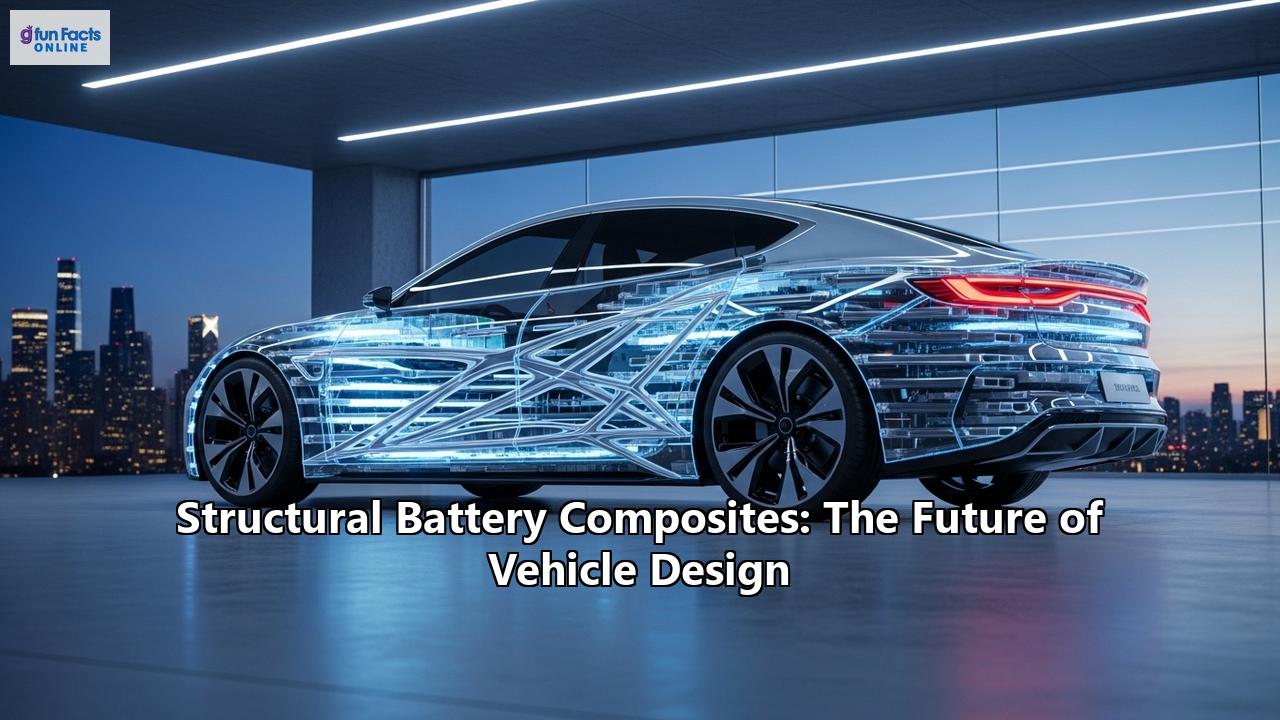
The Unseen Powerhouse: How Structural Batteries Are Forging the Future of Vehicle Design
Imagine a car that is its own battery. Not a vehicle with a heavy, distinct battery pack bolted to its chassis, but one where the very components that provide its strength and shape—the floor, the roof, the door panels—are also the source of its power. This is not science fiction; this is the revolutionary world of structural battery composites (SBCs), a groundbreaking technology poised to fundamentally rewrite the rules of vehicle design and electrification.For decades, the electric vehicle (EV) has been a story of compromise. The immense weight of the battery pack, the single heaviest component in most EVs, has been a persistent anchor, limiting range, dictating design, and adding to the overall energy consumption. But a paradigm shift is underway, moving from a philosophy of simply carrying a battery to becoming the battery itself. This concept, often referred to as "massless energy storage," represents a monumental leap in materials science, merging the robust mechanical integrity of advanced composites with the electrochemical potential of a rechargeable battery. The result is a vehicle that is lighter, more efficient, and offers unprecedented design freedom, heralding a new era for not only electric cars but also for aviation, drones, and personal electronics.
This article will delve deep into the intricate world of structural battery composites, exploring their historical development, the complex science that makes them possible, the innovative manufacturing processes being developed, and the immense advantages they offer. We will also confront the significant challenges and hurdles that must be overcome before our cars, planes, and gadgets can truly become their own power sources.
The Genesis of an Idea: A History of Integrated Power
The journey towards structural batteries is not a single eureka moment but rather a gradual convergence of advancements in two distinct fields: composite materials and electrochemistry. While the fundamental principles of batteries have been understood for over two centuries, with Alessandro Volta's invention of the voltaic pile in 1799 laying the groundwork, the concept of a structural battery is a far more recent innovation.
The seeds of this idea were planted with the increasing use of high-performance composite materials, such as carbon fiber reinforced polymers (CFRPs), in aerospace and high-performance automotive applications. Engineers valued these materials for their exceptional strength-to-weight ratio, which allowed for the creation of lighter and more efficient vehicles. The fuselage and wings of the Boeing 787 Dreamliner, for instance, utilize a significant amount of CFRP, leading to a 20% weight reduction compared to traditional aluminum construction.
The true conceptual leap occurred within the last few decades, as researchers began to notice the intriguing overlap in the constituent materials of composites and batteries. High-performance carbon fibers, the backbone of many advanced composites, also possess remarkable electrochemical properties, including good electrical conductivity and the ability to intercalate lithium ions—a key process in lithium-ion batteries. This realization sparked a revolutionary question: what if a material could perform both its structural and energy-storing duties simultaneously?
Early research, notably pioneered in Sweden and at institutions like Imperial College London, began exploring this very question. Two primary pathways emerged. The first, a more straightforward approach, involved embedding commercially available, thin, flexible batteries into a composite structure. In this "decoupled" or "embedded" design, the battery cells are protected by the composite, forming a sandwich-like structure where the battery acts as the core and strong face sheets carry the mechanical loads.
The second, more ambitious approach, is the creation of truly "monolithic" or "coupled" structural battery composites. In this elegant solution, the lines between the structural and energy-storage components blur completely. The carbon fibers themselves act as the negative electrode (anode) and the structural reinforcement. The polymer matrix, which in a conventional composite simply binds the fibers together, is re-engineered into a "structural battery electrolyte" (SBE) that can both transfer mechanical loads and facilitate the transport of ions between the electrodes. The positive electrode (cathode) is typically formed by coating another layer of carbon fibers with an electrochemically active material like Lithium Iron Phosphate (LFP).
This journey from a theoretical concept to the first functioning laboratory prototypes has been marked by significant milestones, including the development of the first carbon fiber-based anodes and the formulation of solid and semi-solid electrolytes that possess the necessary combination of ionic conductivity and mechanical stiffness. While the technology is still in the early stages of commercialization, the rapid pace of innovation promises a future where the structure is the battery.
The Inner Workings: A Symphony of Chemistry and Physics
To truly appreciate the elegance of a structural battery, one must look deep within its composite structure, where a complex interplay of electrochemical and mechanical processes unfolds. The functionality of these materials is a testament to clever material science and multi-physics engineering.
Two Paths to Integration: Embedded vs. Monolithic
The world of structural batteries is broadly divided into two distinct design philosophies: embedded systems and monolithic composites.
Embedded Structural Batteries: This approach is the more mature of the two and can be seen as a stepping stone towards fully integrated systems. In essence, it involves strategically placing and integrating conventional, often flexible or thin-film, lithium-ion battery cells within a larger composite structure. A common configuration is a sandwich panel, where the batteries form a core material bonded between two strong and stiff composite face sheets (like CFRP or aluminum). The face sheets are responsible for handling in-plane and bending loads, while the battery core contributes to shear and compression strength, all while storing electrical energy.Tesla's structural battery pack is a prominent commercial example of this philosophy. Instead of packaging cylindrical cells into modules, which are then placed in a pack, Tesla bonds the individual cells together and integrates them with upper and lower metal sheets. This creates a rigid, load-bearing structure that forms the floor of the vehicle, enhancing chassis stiffness, providing torsional rigidity, and reducing the total number of parts. This integration results in tangible benefits, including a 10% reduction in weight and a 14% increase in range for the Model Y.
Monolithic Structural Batteries: This is the holy grail of structural energy storage, representing a truly multifunctional material where the roles of structure and power are intrinsically linked. These are also referred to as "massless" batteries because the mass of the energy storage system is one and the same as the mass of the structural component.A typical monolithic SBC is a laminate composite that mirrors the architecture of a conventional lithium-ion battery, but with a structural twist:
- The Negative Electrode (Anode): Instead of a graphite-coated copper foil, monolithic SBCs use high-strength carbon fibers. These fibers serve a dual purpose: they provide the primary mechanical reinforcement for the composite and, thanks to their graphitic structure, they can host lithium ions during the charging process.
- The Positive Electrode (Cathode): This is often created by coating another layer of carbon fibers with an electrochemically active cathode material, such as lithium iron phosphate (LiFePO₄). The carbon fibers in the cathode act as a lightweight and strong current collector, replacing the traditional aluminum foil.
- The Separator: A thin, porous, and electrically insulating layer, often made of glass fiber fabric, is placed between the anode and cathode to prevent short circuits, just as in a conventional battery.
- The Structural Battery Electrolyte (SBE): This is perhaps the most innovative component. The SBE is a multifunctional matrix that must perform two seemingly contradictory roles: it needs to be mechanically robust to transfer loads between the carbon fibers, and it must be ionically conductive to allow lithium ions to shuttle between the anode and cathode. This is often achieved through a phase-separated polymer system. This clever design consists of a stiff, continuous polymer skeleton that provides the structural integrity, and an interconnected, liquid electrolyte-filled porous network that facilitates ion transport.
The Electrochemical Dance: Charging and Discharging
The process of charging and discharging a monolithic structural battery is a carefully choreographed dance of ions and electrons, deeply intertwined with the material's mechanical state.
During charging, an external power source creates a voltage difference. This drives lithium ions (Li+) from the LiFePO₄-coated cathode, through the ionically conductive phase of the structural electrolyte, across the separator, and into the microstructure of the carbon fiber anode, where they are stored. This process is known as lithiation.
During discharging, the process reverses. The lithium ions spontaneously travel back from the carbon fiber anode to the cathode, releasing electrons that flow through an external circuit, creating the electric current that powers the vehicle.
The Chemo-Mechanical Coupling: A Two-Way Street
A critical and complex aspect of monolithic SBCs is the phenomenon of chemo-mechanical coupling. The electrochemical processes directly influence the mechanical state of the material, and conversely, mechanical stresses and strains can affect the battery's performance.
As lithium ions are inserted into the carbon fibers during charging (lithiation), they cause the fibers to swell slightly. Conversely, when they are removed during discharging (delithiation), the fibers contract. This repeated swelling and shrinking induces internal stresses and strains within the composite. If not managed properly, this can lead to micro-damage, delamination at the fiber-matrix interface, and a gradual degradation of both the mechanical and electrical properties of the material.
Conversely, external mechanical loads placed on the vehicle's structure—from cornering, bumps in the road, or a crash—can deform the composite. This deformation can alter the pathways for ion transport within the electrolyte, affect the contact between the electrodes and the electrolyte, and even influence the rate of electrochemical reactions. Understanding and modeling this intricate multiphysics behavior is a key challenge for researchers and is essential for designing durable and reliable structural batteries.
Forging the Future: The Manufacturing of Structural Composites
The journey of a structural battery composite from a laboratory concept to a vehicle component is paved by sophisticated manufacturing processes. The choice of technique is critical, as it directly influences the final product's quality, cost, performance, and scalability. The methods employed are largely adaptations of established composite manufacturing technologies, each with its own set of advantages and challenges when applied to these multifunctional materials.
Vacuum Assisted Resin Transfer Molding (VARTM)
VARTM is a widely used and cost-effective process for creating large composite parts, making it a strong candidate for manufacturing SBC components like floor pans or body panels. The process begins with laying dry reinforcement fabrics—which, for monolithic SBCs, would include the carbon fiber anode layer, the separator, and the cathode-coated fiber layer—into a single-sided mold. This entire assembly is then sealed under a vacuum bag. A vacuum is pulled to remove all the air, and the low-viscosity structural battery electrolyte resin is then drawn into the mold by the pressure differential, infusing the dry fibers. The part is then cured, often with the application of heat, to solidify the resin.
The primary advantages of VARTM are its relatively low tooling costs and its ability to produce very large and complex parts, which would be difficult or prohibitively expensive with other methods. However, ensuring complete and uniform infusion of the electrolyte resin without creating voids (air bubbles) is a significant challenge, as voids can severely compromise both the mechanical strength and the ionic conductivity of the battery.
Autoclave Curing
For applications where the highest possible quality and performance are non-negotiable, such as in aerospace or high-performance supercars, autoclave curing is the gold standard. This process involves placing a pre-impregnated composite layup (where the fibers are already saturated with a precise amount of resin) into a pressure vessel (the autoclave). The autoclave then applies both high pressure and elevated temperatures in a precisely controlled cycle.
The intense pressure consolidates the composite layers, squeezing out any trapped air or excess resin, resulting in a very low void content and a high fiber-to-resin ratio. This produces parts with superior mechanical properties, consistency, and reliability. The major drawbacks of the autoclave process are its high capital and operational costs, its slow cycle times, and the limitations on the size of the components that can be manufactured. For structural batteries, a key challenge is ensuring that the high curing temperatures do not degrade the electrochemical components of the cell.
3D Printing (Additive Manufacturing)
A more recent and highly flexible approach to fabricating SBCs is through additive manufacturing, or 3D printing. This technology offers unprecedented design freedom, allowing for the creation of complex, customized, and optimized geometries that are impossible to achieve with traditional methods.
Several 3D printing techniques are being explored for SBCs. One promising method is coextrusion deposition, where continuous carbon fibers coated with a solid polymer electrolyte are printed along with a cathode-doped matrix material. This allows for the creation of micro-battery cells at the fiber level, distributed throughout the printed structure. Another approach involves a decoupled design, where a structural framework is first 3D-printed, and then the energy-storing components are integrated into it. This method minimizes the mechanical stress on the battery materials themselves.
Researchers have demonstrated 3D-printed structural batteries with impressive properties, achieving high energy densities and good mechanical strength. The key advantages of 3D printing are the ability to rapidly prototype complex designs and the potential for creating highly integrated, multifunctional components. However, scaling this technology for large-scale automotive production and ensuring the long-term reliability of the printed materials remain significant challenges.
Comparison of Manufacturing Processes
| Process | Advantages for SBCs | Disadvantages for SBCs |
| :--- | :--- | :--- |
| VARTM | - Lower tooling and processing costs.
- Suitable for very large components (e.g., car floors).
- Flexible in tooling design. | - Higher risk of voids, which degrade performance.
- Lower fiber volume fraction compared to autoclave.
- Process control can be challenging. |
| Autoclave | - Produces very high-quality, strong, and reliable parts.
- Low void content ensures good mechanical and electrical properties.
- High consistency and repeatability. | - Very high capital and operational costs.
- Slow cycle times, limiting production volume.
- High curing temperatures can damage battery components.
- Size of parts is limited by the autoclave dimensions. |
| 3D Printing | - Unparalleled design freedom for complex geometries.
- Enables customized and optimized structures.
- Potential for rapid prototyping and fabrication.
- Integration of micro-battery cells. | - Scalability for mass production is a major challenge.
- Material properties and consistency can be difficult to control.
- Often a trade-off between printability and electrochemical performance. |
The choice of manufacturing process will ultimately depend on the specific application, balancing the need for performance, cost, and production volume as structural battery technology matures and moves towards commercial viability.
The Rewards of Integration: A Paradigm Shift in Vehicle Performance
The adoption of structural battery composites promises to be one of the most significant advancements in electric vehicle technology since the advent of the lithium-ion battery itself. By dissolving the boundary between structure and power, SBCs offer a cascade of benefits that could dramatically improve nearly every aspect of EV performance, design, and sustainability.
The Ultimate Diet: Radical Weight Reduction
The most profound advantage of structural batteries is the significant reduction in vehicle weight. In a conventional EV, the battery is "parasitic mass"—it adds weight without contributing to the vehicle's structural integrity. The battery pack in a mid-size EV can weigh hundreds of kilograms, requiring a heavier, stronger frame to support it, which in turn necessitates more powerful motors and brakes.
Structural batteries break this cycle by making the energy storage system a functional part of the vehicle's chassis. Components like the floorpan, roof, or even body panels can be replaced with SBCs, eliminating the need for redundant structural reinforcements and heavy battery casings. This concept of "massless energy storage" means the effective weight of the battery is significantly less than its actual weight because it simultaneously fulfills a structural role. Researchers estimate that replacing just the roof of an EV with a structural battery could result in weight savings of up to 20%. More optimistic projections suggest that fully integrated SBCs could reduce a vehicle's overall weight by as much as 50% compared to conventional designs.
This initial weight reduction creates a virtuous cycle known as the "mass-saving loop." A lighter vehicle requires less energy to accelerate, allowing for a smaller, lighter battery to achieve the same range. This, in turn, allows for lighter suspension and braking systems, leading to further weight savings and enhanced efficiency.
Unleashing Range and Efficiency
The direct consequence of radical weight reduction is a dramatic increase in vehicle range and efficiency. It is a fundamental law of physics that a lighter vehicle requires less energy to move. Studies have shown that a 10% reduction in vehicle weight can improve an EV's range by 7-10%.
When this principle is applied to the transformative potential of SBCs, the numbers become staggering. Research from Chalmers University of Technology suggests that an EV equipped with competitive structural batteries could see its driving range increase by as much as 70% on a single charge. This isn't just an incremental improvement; it's a leap that could effectively eliminate range anxiety, one of the biggest psychological barriers to widespread EV adoption.
A New Canvas for Design
For decades, vehicle design has been constrained by the bulky, rigid shapes of engines and, more recently, battery packs. The large, flat "skateboard" chassis common in many EVs is a direct result of the need to accommodate a massive battery pack under the floor.
Structural batteries shatter these constraints, offering automotive designers a newfound freedom. Since the energy storage is distributed throughout the vehicle's structure, engineers are no longer forced to design around a single, massive component. This could lead to:
- More Spacious and Versatile Interiors: With the battery integrated into the floor, the need for a thick, raised platform is reduced, potentially leading to more cabin space, lower seating positions, and more flexible interior layouts.
- Innovative Vehicle Architectures: The entire vehicle body becomes a potential energy source. This could enable radical new vehicle shapes and forms that are more aerodynamic and efficient.
- Improved Structural Performance: By making the battery an integral part of the chassis, the overall rigidity and strength of the vehicle can be significantly enhanced. A stiffer chassis improves handling, ride quality, and crash safety. Tesla and Volvo, for instance, have both claimed that their structural battery pack designs improve the overall structural integrity of the vehicle.
Enhanced Safety and Sustainability
While presenting new challenges, structural batteries also offer potential safety benefits. In a conventional EV, the concentration of a huge amount of energy in a single pack creates a significant risk in the event of a crash. A distributed energy storage system, spread throughout the vehicle's structure, could potentially reduce the risk of a single point of failure leading to a catastrophic thermal runaway event. Furthermore, the use of semi-solid or solid-state electrolytes in many monolithic SBC designs can inherently reduce fire risk compared to the flammable liquid electrolytes used in most current lithium-ion batteries.
From a sustainability perspective, lighter vehicles consume less energy over their lifetime, reducing the overall carbon footprint of transportation. Moreover, by combining two components (structure and battery) into one, SBCs can lead to more resource-efficient designs that reduce the total amount of material required for manufacturing.
The advantages of structural batteries represent a fundamental rethinking of how vehicles are conceived and built. They promise not just better EVs, but a completely new generation of vehicles that are lighter, more efficient, and more intelligently designed than ever before.
The Roadblocks to Revolution: Confronting the Challenges
While the promise of structural battery composites is immense, the path to their widespread adoption is fraught with significant technical, manufacturing, and safety hurdles. The very multifunctionality that makes them so appealing also creates a host of complex challenges that researchers and engineers are working diligently to overcome.
The Fundamental Tug-of-War: Energy vs. Strength
The most significant challenge in developing monolithic SBCs is the inherent trade-off between electrochemical performance and mechanical robustness. The properties that make a good battery are often at odds with those that make a strong structural component.
- Energy Density: To store a large amount of energy, battery electrodes need to be porous with a high surface area to accommodate as many lithium ions as possible. However, porosity is the enemy of mechanical strength, creating voids that can compromise the integrity of a composite. Current SBC prototypes have a lower energy density than traditional lithium-ion batteries. While weight savings can compensate for this, a primary goal is to close this energy density gap without sacrificing strength.
- Ionic Conductivity vs. Stiffness: The structural battery electrolyte (SBE) must be a master of two trades. For high power output, it needs to be highly conductive, allowing ions to move freely. This is typically achieved with liquid or gel-like materials. However, for structural integrity, it needs to be stiff and strong to transfer loads between the carbon fibers. This is a property of solid materials. Creating a single material that excels at both remains a key research challenge. Current solutions like bi-continuous, phase-separated electrolytes are a clever compromise but still represent a difficult balancing act.
The Critical Interface: Where Materials Meet
In any composite material, the interface between the reinforcement (carbon fibers) and the matrix (the electrolyte) is critical to its overall strength. In an SBC, this interface is even more crucial and complex. The repeated swelling and shrinking of carbon fibers during charging and discharging (chemo-mechanical coupling) creates cyclic stresses at this interface. This can lead to delamination, where the fibers separate from the matrix, or the formation of micro-cracks. Such damage not only weakens the structure but can also sever the pathways for ion transport, leading to a loss of battery capacity and a shortened lifespan.
The Manufacturing Maze: From Lab to Production Line
Scaling up the production of SBCs from small, laboratory-sized samples to large, reliable automotive components is a monumental challenge.
- Cost and Complexity: Current manufacturing methods, especially those that yield high-quality parts like autoclave curing, are expensive and time-consuming. Estimates suggest that structural battery systems could currently cost 2.5 to 3.5 times more than a conventional battery and chassis structure. Developing cost-effective, high-volume manufacturing processes is essential for commercial viability.
- Quality Control: The multifunctional nature of SBCs means that quality control is doubly important. A single small void or defect could compromise not only the structural integrity of a car door but also its ability to store energy. Ensuring consistent, defect-free production at an industrial scale is a significant hurdle.
- Packaging and Sealing: Like any lithium-ion battery, the components of an SBC must be perfectly sealed from the environment, as moisture and oxygen can severely degrade battery performance and life. Creating a robust, lightweight, and durable sealing solution for a large, complex-shaped structural component is a major engineering challenge.
The Safety Equation: New Risks and Regulations
Integrating a vehicle's power source into its crash structure introduces a new dimension to automotive safety.
- Damage and Durability: How does an SBC perform after a minor collision? If a door panel that is also a battery gets dented, does it still function safely? The long-term durability of these materials under constant vibration, temperature fluctuations, and repeated mechanical and electrical loading is still an area of active research.
- Thermal Runaway: While distributed energy storage might reduce the risk of a single-point failure, the risk of thermal runaway in the flammable electrolytes still exists. Damage to a structural component could trigger an internal short circuit, leading to a fire that is integrated into the vehicle's frame, which could be more difficult to manage than a fire in a self-contained battery pack.
- Repair and End-of-Life: This is one of the most significant practical challenges. If a conventional battery pack degrades, it can be replaced. But if your car's floorpan is the battery, what happens when it reaches the end of its useful life? The prospect of having to dispose of an entire vehicle because its integrated battery has failed is a major economic and environmental concern. This "planned obsolescence" is a strong argument against deeply integrated structural batteries. New repair strategies and recycling processes for these complex, multifunctional materials will need to be developed.
Overcoming these challenges will require continued innovation in materials science, manufacturing engineering, and battery management systems. The road is long, but the potential rewards of successfully navigating these roadblocks are so transformative that they continue to drive intense research and development across the globe.
The Horizon of Innovation: The Future Trajectory of Structural Batteries
The path forward for structural battery composites is one of continued innovation, aimed at overcoming current limitations and unlocking their full, transformative potential. Researchers and industry leaders are pursuing multiple avenues to enhance performance, reduce costs, and ensure the safety and sustainability of this next-generation technology. The future of vehicle design may well be shaped by the success of these endeavors.
The Next Generation of Materials
The evolution of SBCs is intrinsically linked to the development of more advanced materials. Key areas of research include:
- Higher Energy Density Cathodes: While Lithium Iron Phosphate (LFP) is a popular choice for its safety and cost-effectiveness, researchers are exploring new cathode chemistries that can store more energy without compromising structural integrity.
- Advanced Structural Electrolytes: The quest for the perfect SBE continues. The development of solid-state electrolytes with higher ionic conductivity at room temperature is a major goal. These materials could eliminate the need for flammable liquid components, dramatically improving safety while still providing the necessary mechanical strength.
- Alternative Ion Chemistries: While most research focuses on lithium-ion, other chemistries are being explored. Sodium-ion SBCs, for example, could offer a more sustainable and lower-cost alternative, as sodium is far more abundant than lithium. Zinc-based batteries are also being investigated for their potential safety and cost advantages.
The Role of Artificial Intelligence and Modeling
The sheer complexity of the chemo-mechanical interactions within an SBC makes traditional trial-and-error research slow and inefficient. This is where artificial intelligence (AI) and advanced computational modeling are becoming indispensable tools.
- AI-Driven Material Discovery: AI algorithms can analyze vast datasets to predict the properties of new material combinations, accelerating the discovery of novel electrolytes and electrode materials with optimized multifunctional properties.
- Multiphysics Simulation: Sophisticated computer models that can simulate the coupled mechanical, electrical, and thermal behavior of SBCs are crucial. These models allow engineers to predict how a structural battery will perform under real-world conditions, optimize designs for durability and safety, and understand failure mechanisms before a physical prototype is ever built.
Real-World Prototypes and Industry Adoption
The transition from the lab to the road is already beginning. Several automakers and startups are actively developing and patenting structural battery technologies:
- Tesla: Their structural battery pack in the Model Y is the most prominent commercial example, demonstrating the real-world benefits of even a partially integrated system.
- Volvo: The company has announced plans to use the battery pack as a structural element, sandwiching cells between metal plates to form the floor of future EVs, claiming this will improve both energy density and vehicle rigidity.
- Hyundai and Kia: Patent filings reveal that these automakers are exploring designs where the vehicle's floor doubles as the upper panel of the battery case, allowing for more efficient packaging and a greater number of cells.
- Chalmers University of Technology: A leading research institution in this field, Chalmers has developed numerous prototypes, consistently improving the energy density and mechanical stiffness of their carbon fiber-based structural batteries, with the stated goal of achieving a 70% increase in EV range.
The Path to Commercialization
For structural batteries to become a mainstream technology, several key developments are needed. Manufacturing processes must be scaled up and automated to bring down the high costs. This will likely involve a gradual evolution, starting with high-end, low-volume vehicles and progressing to mass-market applications as the technology matures and costs decrease.
Furthermore, a new ecosystem for testing, certification, repair, and recycling will need to be established. New safety standards must be developed to account for the unique challenges of these dual-function components. Strategies for repairing or replacing damaged or degraded structural batteries will be crucial for consumer acceptance and long-term viability. The development of effective recycling processes to recover valuable materials from these complex composites is also a critical environmental and economic consideration.
Conclusion: A Lighter, Brighter Future for Mobility
Structural battery composites represent more than just an incremental improvement in battery technology; they are a fundamental reimagining of what a vehicle can be. By transforming passive structural components into active energy storage devices, they offer a clear and compelling path towards lighter, more efficient, and longer-range electric vehicles. The concept of "massless energy storage" is a powerful one, promising to solve many of the core challenges that have hindered the widespread adoption of electric mobility.
The road ahead is not without its obstacles. The intricate dance between mechanical strength and energy density, the complexities of manufacturing, and the critical questions of safety and lifecycle management all present formidable challenges. Yet, the sheer scale of the potential reward has ignited a global research effort, with universities, startups, and established automakers all racing to perfect this transformative technology.
The vehicles of the future may not look radically different on the outside, but their very essence will have changed. Their frames will not just be skeletons but a working circulatory system of power. As this technology matures, we can expect to see vehicles that are not only better for the environment but are also better to drive, offering superior performance, greater design freedom, and a level of integration that was once the stuff of science fiction. The silent revolution is here, and it is being built, quite literally, into the very fabric of our future vehicles.
Reference:
- https://www.bohrium.com/paper-details/carbon-fiber-reinforced-structural-battery-composites-progress-and-challenges-toward-industrial-application/985485297053597866-3768
- https://eureka.patsnap.com/report-manufacturing-routes-for-structural-battery-panels-and-beams
- https://www.newsworthy.ai/curated/structural-batteries-poised-to-revolutionize-electric-vehicle-de/202514486
- https://gao.nankai.edu.cn/_upload/article/files/e5/44/bbc919704b44a030e30c7daf2c23/aec629d8-6b83-4ef1-9a5b-6a11d0540a0e.pdf
- https://asmedigitalcollection.asme.org/electrochemical/article/22/1/010801/1198728/Composite-Structural-Battery-A-Review
- https://www.emobility-engineering.com/battery-safety/
- https://eureka.patsnap.com/report-aerospace-applications-of-structural-battery-composites
- https://www.google.com/search?q=time+in+TT
- https://pmc.ncbi.nlm.nih.gov/articles/PMC8068925/
- https://www.bohrium.com/paper-details/composite-structural-batteries-with-co3o4-cnt-modified-carbon-fibers-as-anode-computational-insights-on-the-interfacial-behavior/812558304042549252-2033
- https://crimsonpublishers.com/psprj/pdf/PSPRJ.000624.pdf
- https://www.diva-portal.org/smash/get/diva2:1471537/FULLTEXT01.pdf
- https://www.engineering.com/why-ev-structural-batteries-are-a-bad-idea/
- https://blogs.cuit.columbia.edu/yanggroup/files/2023/04/1-103.pdf
- https://www.researchgate.net/publication/336543737_Prospective_Life_Cycle_Assessment_of_a_Structural_Battery
- https://www.nrel.gov/transportation/energy-storage-safety
- https://www.eigen.energy/articles/ev-battery-safety
- https://www.researchgate.net/publication/239407126_Mechanical_durability_and_electrical_durability_of_an_aluminium-laminated_lithium-ion_polymer_battery_pack_for_a_hybrid_electric_vehicle
- https://escholarship.org/uc/item/75s4q169
- https://research.chalmers.se/en/publication/536818
- https://ouci.dntb.gov.ua/en/works/lmbb3X2B/
- https://research.chalmers.se/publication/536845/file/536845_Fulltext.pdf
- https://pmc.ncbi.nlm.nih.gov/articles/PMC10582827/