
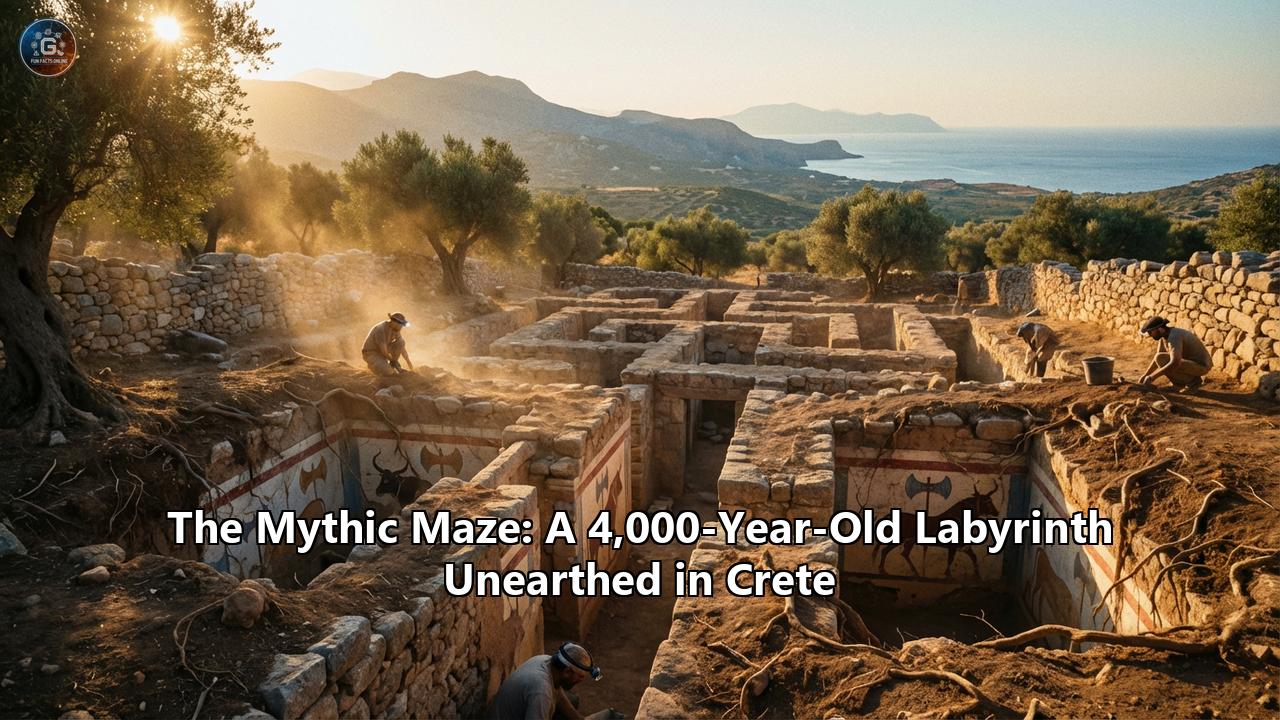
The heavy drone of excavators on Papoura Hill, just northwest of Kastelli, Crete, was meant to signal the future. Here, machinery was carving out the landscape for the island’s new international airport, a controversial colossus of concrete and steel intended to replace the aging facility in Heraklion. But in June 2024, the roar of progress was silenced by a whisper from the past.
As the dust settled on the 494-meter summit, workers peered into a trench and found not bedrock, but geometry. Concentric rings of stone, meticulously laid and impossibly old, spiraled outward from a central core. It was a structure that defied the standard blueprints of Minoan archaeology—a labyrinthine riddle in stone that would soon captivate the world and force a dramatic halt to the airport’s radar installation.
What lay exposed was a 4,000-year-old architectural anomaly: a circular building spanning 48 meters in diameter, covering 1,800 square meters, and consisting of eight superimposed stone rings. It was not a palace. It was not a tomb. It was something entirely new, yet hauntingly familiar to anyone versed in the myths of this island. In the land of King Minos, archaeologists had found a real labyrinth.
Part I: The Anatomy of the Enigma
To understand the magnitude of the Papoura Hill discovery, one must first discard the popular image of a Minoan site. When we think of Minoan Crete, we think of the Palace of Knossos: sprawling, rectangular courtyards, colorful frescoes of bull-leapers, and grand staircases. We think of "palatial" architecture—linear, orthogonal, and administrative.
The structure at Papoura is radically different. It is, above all, circular.
The Rings of StoneThe complex is built like a stone ripple frozen in time. Eight rings of masonry, with an average thickness of 1.4 meters, encircle a central core. These rings are not merely decorative; they form a stepped, ziggurat-like elevation that would have risen prominently against the skyline of the Protopalatial period (approx. 2000–1700 BCE).
The heart of the structure, dubbed Zone A, is a circular building 15 meters in diameter. Its interior (9 meters wide) is divided into four distinct quadrants by cross-shaped walls. This "quadrant" layout is a classic organizing principle, yet here it is enclosed within a circle—a rarity in Minoan architecture.
Surrounding this core is Zone B, a second circular belt where radial walls slice through the concentric rings, creating a honeycomb of smaller, trapezoidal rooms. It is here that the "labyrinth" comparisons move from poetic to literal. To navigate this zone, one would have to pass through narrow openings, moving between radial sectors in a path that was likely circuitous and confusing.
A Labyrinthine LogicWhile the Greek Ministry of Culture was careful to dampen "Minotaur" headlines, stating the find was not the Labyrinth of myth, the architectural logic is undeniably labyrinthine. A labyrinth, in the ancient sense, was not necessarily a puzzle to get lost in (a maze) but a unicursal path leading to a center—a journey of ritual procession.
The distinct zones suggest a hierarchy of access. The outer rings might have been for the community, a place of gathering and observation. The inner radial rooms of Zone B likely served as preparation areas or secondary ritual spaces. The central core, Zone A, would have been the sanctum sanctorum, reserved for the highest rites or the most privileged initiates.
The structure’s location is equally telling. Perched on a summit, it commands a 360-degree view of the surrounding plains. It is a "Peak Sanctuary" in location, but a "Monumental Building" in form—a hybrid that bridges the gap between the wild, elemental worship of the mountains and the organized, bureaucratic religion of the palaces.
Part II: The Feast of the Mountain Gods
If this wasn't the prison of a monster, what was it? The soil of Papoura Hill has given up clues that point not to fear, but to feasting.
Archaeologists recovering artifacts from the destruction layers—dated to the Middle Minoan IB to II periods—found vast quantities of animal bones. These were not whole skeletons of sacrificial victims left to rot, but the fragmented, butchered remains of sheep, goats, and cattle. They tell a story of massive communal consumption.
The Ritual of ConsumptionIn the Minoan world, religion was visceral. It was about the sharing of food and drink to cement social bonds and appease natural forces. The Papoura structure was likely a "community hall" writ large. We can imagine the scene 3,800 years ago:
Villagers from the Kastelli plain trekking up the slopes, carrying jars of wine and leading livestock. The air would be thick with the smoke of roasting meat. The concentric walls of the structure would act as a theater, separating the participants by status or clan.
The pottery found at the site reinforces this. Fragments of high-quality ceramic vessels—drinking cups, jugs, and pithoi (storage jars)—suggest that wine was flowing freely. This was a site of commensality, a place where the disparate farming communities of the region came together to forge a collective identity under the gaze of the heavens.
A Sanctuary Unlike OthersMinoan Crete is dotted with "Peak Sanctuaries"—remote hilltop shrines like Mt. Juktas and Petsofas. These sites are usually characterized by open-air altars, bonfires, and fissures in the rock where votives (clay figurines of limbs, animals, and beetles) were deposited.
Papoura Hill disrupts this pattern. It is not an open-air altar; it is a built environment. It represents a moment where the "wild" worship of the peaks was being formalized, enclosed, and architecturalized. It suggests a local elite—perhaps a clan that controlled the Kastelli plain—was powerful enough to mobilize the labor required to quarry, transport, and arrange these massive stones. They were claiming the mountain for themselves, turning a natural high place into a constructed monument of power.
Part III: The Shadow of the East
The most intriguing aspect of the Papoura discovery is that it doesn't look entirely "Cretan." In fact, when archaeologists looked for parallels, they had to look across the sea.
The Greek Ministry of Culture noted that the structure has no exact parallel in Minoan Crete. However, it bears a striking resemblance to the "Circular Cities" of the Early Bronze Age in the Near East.
- Mari and the Kranzhügel: In Syria and the Jazira region, archaeologists have long studied circular settlements known as Kranzhügel ("wreath-mounds"), such as Tell Chuera and Tell al-Rawda. These sites feature concentric fortifications and radial street plans.
- The Tombs of Oman: Further afield, in the monumental landscape of Bat and Hili in Oman (ancient Magan), circular stone towers and tombs from the 3rd millennium BCE dominate the terrain.
Could Papoura Hill be evidence of an "international" style? We know the Minoans were master seafarers. Their "Kamares ware" pottery has been found in the palaces of Egypt and the Levant. They imported tin from Afghanistan and copper from Cyprus. It is not a stretch to imagine that a Minoan architect, having traveled to the ports of Byblos or Ugarit, brought back the concept of the "monumental circle"—a shape that symbolizes unity, eternity, and the cosmos.
However, the Minoans rarely copied; they adapted. If they borrowed the circular form from the East, they infused it with their own sensibility. They didn't build a fortress or a tomb; they built a ritual stage. They took the defensive architecture of Syria and turned it into a religious architecture of Crete.
Part IV: The Labyrinth Myth—A Thread to the Past
One cannot discuss a complex, maze-like structure in Crete without addressing the Minotaur in the room.
For centuries, the "Labyrinth" was considered pure myth. Then, in the early 20th century, Sir Arthur Evans excavated Knossos. He found a palace so vast and confusing, with its hundreds of rooms and winding corridors, that he declared it to be the Labyrinth. He argued that the word Labyrinthos was derived from Labrys (the double axe), a symbol found etched into the palace walls. Thus, the Labyrinth was the "House of the Double Axe."
But there has always been a disconnect. The myth speaks of a prison designed by Daedalus, a specific structure built for the Minotaur, distinct from the palace.
The discovery at Papoura Hill reignites this debate.
- The Architecture of Dance: In the Iliad, Homer mentions that Daedalus fashioned a "dancing floor" (choros) for Ariadne in broad Knossos. Some scholars have argued that the original Labyrinth was not a roofed building, but an open-air patterns for ritual dance. The concentric rings of Papoura—resembling the winding path of a traditional Greek folk dance—fit this description beautifully.
- The Dark Side of the Myth: The Minotaur myth is a story of savage tribute—Athenian youths sent to be devoured. While we find no evidence of human sacrifice at Papoura (only animal), the "labyrinthine" nature of the site suggests control and restriction. Entering the center was not for everyone. It was a privileged, perhaps terrifying, journey into the heart of the structure.
Is Papoura the original Labyrinth? Likely not. The myth is probably a composite memory of many such structures—the dark, winding corridors of Knossos, the cavernous quarries of Gortyna, and perhaps, circular sanctuaries like Papoura. But Papoura proves that the concept of the labyrinth—a complex, constructed, circular enclosure—was a real part of the Minoan architectural vocabulary, long before the Greeks spun their tales of heroes and monsters.
Part V: A Civilization of Paradoxes
This discovery forces us to rethink the political landscape of Protopalatial Crete.
The traditional view is that the Palaces (Knossos, Phaistos, Malia) were the sole centers of power. They acted as "central places" that sucked in resources from the countryside. But Papoura Hill is 30 kilometers from Knossos. It is a monumental structure standing alone, high in the mountains.
This suggests a Heterarchy rather than a strict Hierarchy.
Perhaps Minoan power was not as centralized as we thought. Perhaps regional clans—the "Lords of Kastelli"—had the autonomy to build their own monuments, distinct from the palaces. They could mobilize labor, throw massive feasts, and maintain their own ritual connections to the gods.
The "Minoan Peace" (the idea that Crete was a peaceful, unfortified paradise) has long been challenged, but Papoura adds nuance. It is not a fortress, yet its walls are thick and commanding. It asserts ownership of the land. It says: "We are here. We hold the high ground."
Part VI: The Future of the Past
The discovery of the Papoura labyrinth created a modern drama as tense as any ancient myth. It lay directly in the path of the New Heraklion International Airport at Kastelli, a massive infrastructure project deemed vital for Greece’s economy.
In many countries, the bulldozer would have won. But Greece is the custodian of the cradle of Western civilization. The archaeological community mobilized. The Greek Ministry of Culture, led by Lina Mendoni, made a bold decision: The airport would change, not the ruin.
The radar station that was to sit atop Papoura Hill would be relocated. The structure would be preserved intact, excavated, and eventually opened to the public. It was a victory for heritage over haste.
The Unfinished ExcavationAs of 2026, the excavation is still young. Archaeologists have only scratched the surface (literally and figuratively).
- The Depth: We do not yet know how deep the foundations go. Is there a crypt beneath the central Zone A?
- The Roof: Was the central building domed? The thickness of the walls suggests it could support a corbelled vault, similar to the later Tholos tombs of Mycenae. If so, it would be one of the earliest monumental domes in Europe.
- The Destruction: Why was it abandoned? The pottery suggests use ended around 1700 BCE—the end of the Protopalatial period. This coincides with a wave of destruction (possibly seismic or invasion) that leveled the old palaces. Did an earthquake shatter the Papoura sanctuary? Or was it ritually "killed" and buried, as Minoans sometimes did with their sacred sites?
Conclusion: The Maze Remains
The Papoura Hill discovery is a reminder that the past is never a closed book. Just when we thought we had mapped the Minoan world—categorizing it into "Palaces," "Villas," and "Peak Sanctuaries"—the earth offered up something that fits none of our boxes.
It is a circle in a world of squares. A labyrinth in a land of palaces.
As travelers fly into the new Kastelli airport in the coming years, they will look out their windows. Below them, on a lonely hill, they will see the concentric rings of stone. They will see the ghost of a feast that ended 4,000 years ago. And they will witness the enduring power of the labyrinth—a symbol that, whether built of stone or myth, continues to draw us toward its center.
Glossary of Terms
- Minoan Civilization: The Bronze Age civilization of Crete (c. 3000–1100 BCE), considered the first advanced civilization in Europe.
- Protopalatial Period: The era of the "First Palaces" (c. 1900–1700 BCE), characterized by the emergence of large administrative centers and explosive artistic growth.
- Peak Sanctuary: A type of Minoan shrine located on mountain summits, used for offering votives to nature deities.
- Labrys: The double-headed axe, a sacred symbol of Minoan religion, etymologically linked to the word "Labyrinth."
- Tholos: A circular building, often a tomb, with a beehive-shaped dome.
- Kamares Ware: A style of fine Minoan pottery from the Protopalatial period, known for its eggshell-thin walls and polychrome decoration on a dark background.
Reference:
- https://greekreporter.com/2025/10/13/archaeologists-puzzle-over-purpose-minoan-labyrinth-crete/
- https://archaeologymag.com/2024/06/labyrinthine-structure-from-the-minoan-civilization-on-crete/
- https://secrental.com/blog/what-makes-it-special-unique-minoan-structure-discovered-in-crete
- https://knossos-palace.gr/minoan-double-axe/
- https://chronique.efa.gr/?r=report&id=19649
- https://en.wikipedia.org/wiki/Papoura_Hill_Circular_Structure
- https://www.labyrinthpark.gr/en/history-of-labyrinth
- http://www.minoer.net/wp-content/uploads/2011/02/Watrous.pdf
- https://en.wikipedia.org/wiki/Minoan_peak_sanctuaries
- https://www.historyskills.com/classroom/ancient-history/minoan-religion/
- https://pergamos.lib.uoa.gr/uoa/dl/object/3239367/file.pdf
- https://www.brepols.net/products/IS-9782503551838-1
- https://en.wikipedia.org/wiki/Labyrinth
- https://historygreek.org/artifacts/labrys
- https://www.worldhistory.org/Labyrinth/
- https://www.colorado.edu/classics/2018/06/15/minoan-pottery