
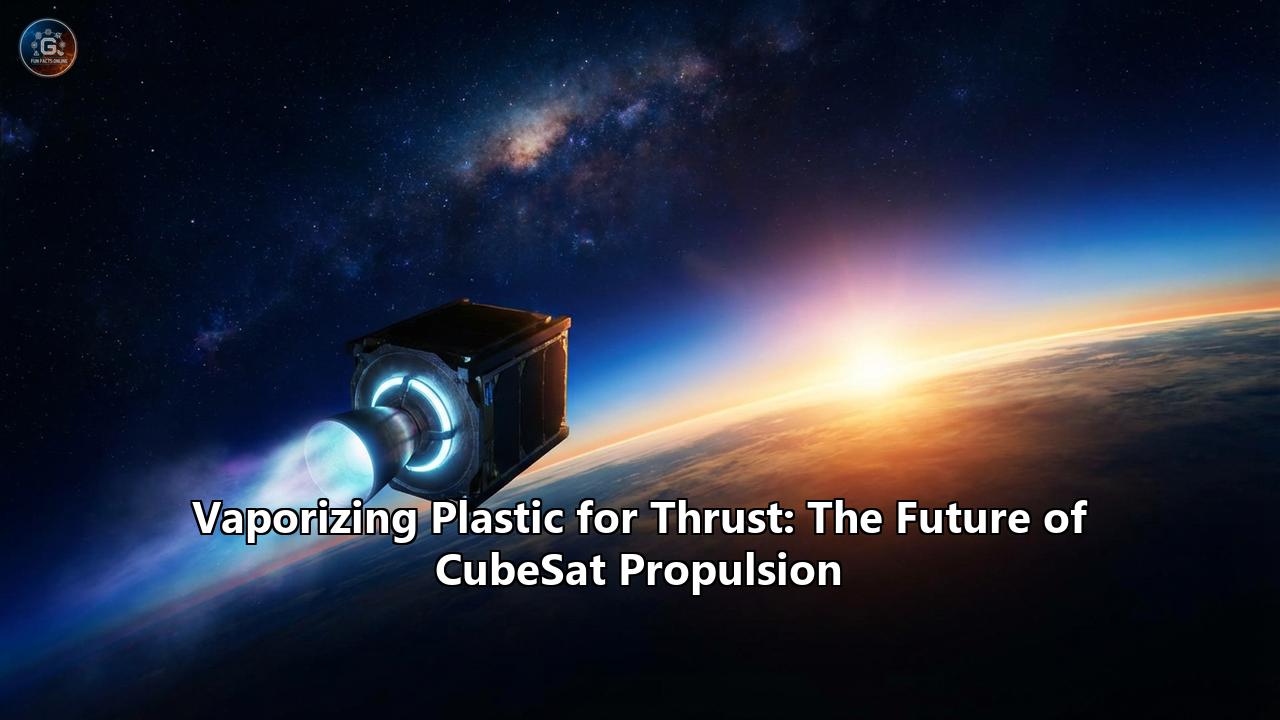
For decades, the propulsion equation for small satellites—specifically CubeSats—has been plagued by a difficult compromise. To move a satellite, you traditionally needed dangerous, toxic, and pressurized liquids that required heavy steel tanks and terrified safety officers. Or, you had to settle for being a "drift" satellite, tumbling helplessly once deployed, unable to dodge space debris or extend your mission life.
But a new wave of "Green Propulsion" technologies is breaking this deadlock. By using inert, solid polymers like Delrin (POM), Teflon (PTFE), and Polyethylene (PE) as fuel, engineers are turning the very structure of the satellite into a gas tank. Whether by melting it, burning it, or blasting it into plasma, plastic is becoming the ultimate deep-space fuel.
The Problem: Why CubeSats Need a New Engine
To understand why vaporizing plastic is revolutionary, we must first understand the "Propulsion Gap" in the small satellite market.
CubeSats are standardized nanosatellites built in 10x10x10 cm units (1U). They are cheap, versatile, and democratizing space access for universities and startups. However, they are often launched as "secondary payloads"—hitchhikers on rockets carrying billion-dollar primary satellites.
This creates a massive problem. Launch providers are understandably paranoid about carrying hitchhikers loaded with pressurized gas or explosive liquid fuel. If a CubeSat’s fuel tank were to leak or explode during launch, it could destroy the primary payload. As a result, most CubeSats are launched without any propulsion at all. They are static bricks, doomed to a short life of orbital decay.
Solid plastic propulsion solves this instantly. A spool of plastic filament or a block of polymer resin is:- Non-explosive: You can hit it with a hammer, and nothing happens.
- Unpressurized: No heavy titanium tanks are needed to contain it.
- Non-toxic: It’s safe for students and engineers to handle without hazmat suits.
- Space-Efficient: Solid plastic is far denser than gas, allowing more fuel to be packed into tight spaces.
Technology 1: The "Space 3D Printer" (Monofilament Vaporization)
The most direct interpretation of "vaporizing plastic for thrust" is a technology that borrows heavily from the world of 3D printing. The leading example of this is Monofilament Vaporization Propulsion (MVP), pioneered by companies like CU Aerospace.
How It Works
Imagine a standard FDM 3D printer mechanism inside a satellite.
- Storage: The fuel is a solid fiber of Delrin (Polyoxymethylene or POM), a common engineering thermoplastic known for its stiffness and low friction. It is spooled tightly, just like printing filament.
- Feeding: When the satellite needs to maneuver, a small motor drives a pinch roller to push the fiber forward.
- Vaporization: The fiber is fed into a Resistojet—a super-heated chamber (approx. 1,100 Kelvin). Unlike a 3D printer that merely melts the plastic to lay it down, this chamber gets so hot that the plastic sublimates or creates a phase change directly from solid/liquid into a high-pressure gas.
- Thrust: This hot gas is forced out of a nozzle at high speed. The rapid expansion generates thrust.
The Physics of "Clean" Vaporization
Why Delrin? Why not ABS or PLA?
The magic lies in the chemistry of Polyoxymethylene. When heated, Delrin decomposes cleanly into formaldehyde gas and other simple molecules without leaving behind a sticky, carbon-heavy residue (char). If you tried this with other plastics, the "gunk" would clog the nozzle instantly. Delrin turns into a pure, high-pressure gas stream, providing a specific impulse (Isp) of roughly 65 to 70 seconds—comparable to cold gas thrusters but with vastly higher storage density.
The "MVP" Advantage
This system allows a CubeSat to perform collision avoidance, orbit raising, and de-orbiting maneuvers. It effectively gives a "dead" satellite a steering wheel, all with a fuel tank that is as safe as a spool of fishing line.
Technology 2: The "Self-Eating" Rocket (Autophage Engines)
While MVP vaporizes a filament, researchers at the University of Glasgow have taken the concept to its sci-fi extreme: a rocket engine that eats its own body.
Known as the Autophage (Self-Eating) Engine, specifically the Ouroborous-3, this technology addresses the issue of "dry mass." In a traditional rocket, you spend fuel to lift the heavy metal tanks that hold the fuel. Once the fuel is gone, the empty tank is just dead weight.
The Ouroborous Concept
The Autophage engine's "tank" is a tube made of solid Polyethylene (the same plastic used in water bottles) with an oxidizer core.
- Consumption: As the rocket fires, the waste heat from the engine is scavenged and used to melt the plastic fuselage itself.
- Feeding: A mechanism pushes the entire plastic tube into the hot engine.
- Combustion: The melted plastic vaporizes and mixes with liquid oxygen or nitrous oxide, burning to generate thrust.
The rocket literally consumes itself from the bottom up. By the time it reaches orbit, there is no empty tank left—it has all been turned into thrust. This technology is a game-changer for launch vehicles, potentially allowing for smaller, more efficient rockets that leave zero debris behind.
Technology 3: The Plasma approach (Pulsed Plasma Thrusters)
Vaporizing plastic isn't entirely new; we've been doing it since the 1960s, but in a much more violent way. Pulsed Plasma Thrusters (PPTs) use Teflon (PTFE) as a solid fuel.
The "Lightning" Method
Instead of melting the plastic with a heater, a PPT uses an electric arc—essentially a bolt of lightning.
- A solid block of Teflon is placed between two electrodes.
- A capacitor discharges a massive jolt of electricity.
- The arc ablates a tiny layer of the Teflon, turning it instantly into a cloud of charged ions and electrons (plasma).
- Electromagnetic fields accelerate this plasma out of the back at incredibly high speeds (exhaust velocities of over 10 km/s).
While MVP provides a gentle continuous push (like a spray can), PPTs provide tiny, precise kicks (like a heartbeat). Teflon is the material of choice here because of its fluorocarbon chain, which ionizes efficiently and doesn't conduct electricity in its solid state, preventing short circuits.
Technology 4: The Plastic Hybrid (Letara)
Bridging the gap between gentle vaporization and full-scale rocketry is the Hybrid Rocket, a focus of the Japanese startup Letara.
Hybrid rockets combine a solid fuel with a liquid oxidizer. Letara uses solid plastic (like Polyethylene or rubber-based HTPB) as the fuel grain and Nitrous Oxide (laughing gas) as the oxidizer.
- Safety: The plastic inertly sits in the combustion chamber. Without the flow of oxidizer and an ignition source, it cannot burn. This eliminates the explosion risk of solid rocket motors (which mix fuel and oxidizer together).
- Performance: These engines can generate thousands of Newtons of thrust, enough to push a satellite to the Moon or Mars, far exceeding the capabilities of the electrothermal MVP system.
Their "Camui" engine design uses a unique geometry to ensure the plastic burns evenly and efficiently, solving a historical problem with hybrid rockets where the fuel would burn too slowly.
Comparative Analysis: The Battle of the Fuels
How does Plastic stack up against other modern CubeSat propellants like Iodine and Water?
| Feature | Plastic (Delrin/PE) | Iodine | Water |
| :--- | :--- | :--- | :--- |
| State at Launch | Solid (Safe) | Solid (Safe) | Liquid (Safe) |
| Pressure | None | None | Low (Liquid) |
| Thrust Type | Thermal / Chemical | Electric (Ion) | Thermal (Steam) |
| Efficiency (Isp) | Medium (65-100s) | High (1000s+) | Low-Medium (70s) |
| Thrust Force | Moderate | Very Low | Moderate |
| Complexity | Low (Mechanical feed) | High (Ionization grids) | Medium (Valves/Pipes) |
- Plastic vs. Iodine: Iodine is the king of efficiency (gas mileage), making it great for deep space missions where you have months to accelerate. Plastic is the king of Thrust-to-Power, making it better for quick maneuvers like dodging debris or changing orbits rapidly.
- Plastic vs. Water: Water propulsion (steam) is simple but water can freeze, leak, or corrode components. Plastic is chemically inert, immune to freezing, and cannot leak.
The Environmental Angle: Green Space
The shift to plastic propulsion isn't just about performance; it's about stewardship.
- Debris Mitigation: The number one threat to the space economy is the Kessler Syndrome—a cascade of colliding debris. Satellites with plastic propulsion can save the last 5% of their fuel to de-orbit themselves, burning up in the atmosphere at the end of their mission.
- Non-Toxic: Traditional hydrazine is carcinogenic and highly toxic. A plastic-fueled satellite requires no hazmat teams, lowering the cost of ground operations and making space accessible to university teams.
Conclusion: The Era of Solid Propulsion
We are entering a new era where the line between the satellite's structure and its fuel tank is blurring. Whether it is the Monofilament Vaporization systems giving CubeSats a safe "engine in a box," or Autophage rockets that consume their own fuselage to reach orbit, plastic is proving to be the wonder material of the New Space age.
By vaporizing the mundane materials of our daily lives, engineers are ensuring that the future of space exploration is safer, cheaper, and within reach of anyone with a great idea and a 1U CubeSat chassis. The plastic that once wrapped our sandwiches is now pushing humanity to the stars.
Reference:
- https://www.mdpi.com/2226-4310/11/7/502
- https://pdfs.semanticscholar.org/27ee/e1f6094bd90be2e8993b84d01f8d72724c31.pdf
- https://www.cuaerospace.com/Portals/0/siteContent/assets/pdf/MVP-IEPC22-Paper-v5-reduced.pdf.pdf
- https://en.wikipedia.org/wiki/Pulsed_plasma_thruster
- https://pure.bit.edu.cn:443/en/publications/analysis-of-teflon-pulsed-plasma-thrusters-using-a-modified-slug-/
- https://www.youtube.com/watch?v=6HUOumDJeAQ