
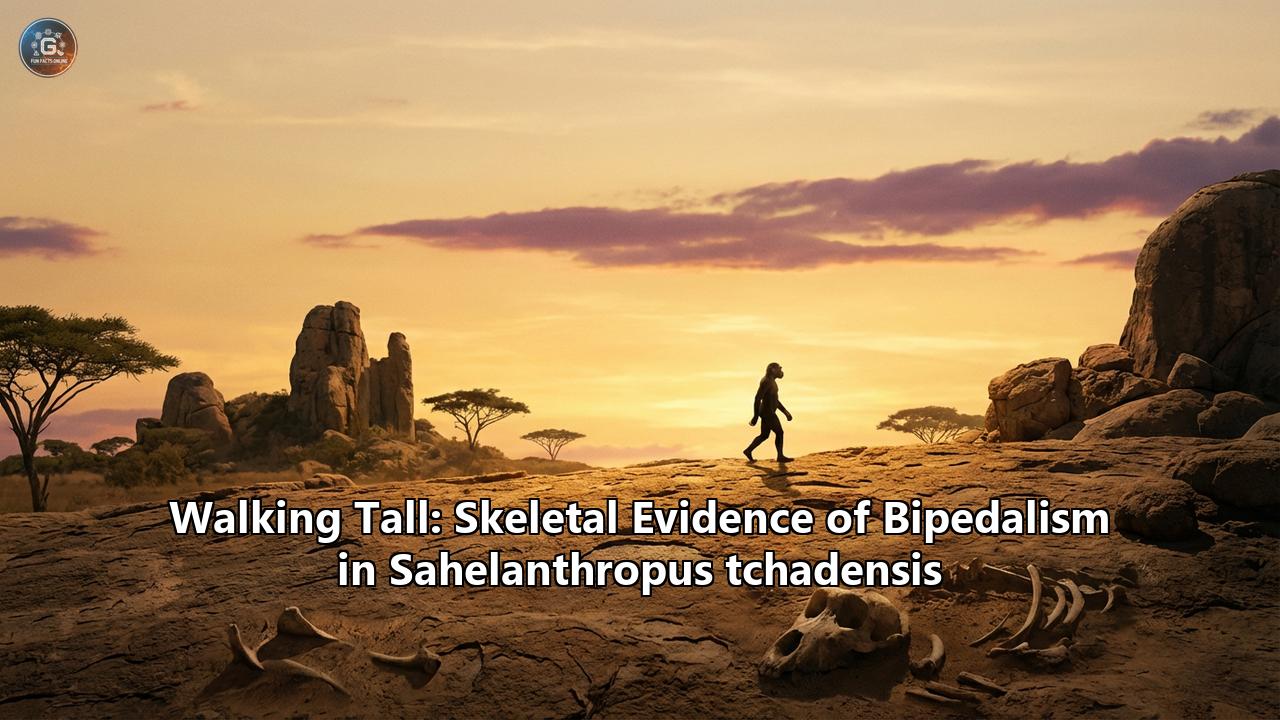
The wind in the Djurab Desert does not whisper; it scours. In this desolate expanse of northern Chad, sandstorms strip the earth down to its ancient bedrock, revealing secrets that have remained hidden for geological epochs. It is a landscape of blinding sun and shifting dunes, a place where life today clings precariously to existence. Yet, seven million years ago, this was a vibrant frontier—a mosaic of gallery forests, savannahs, and the shimmering waters of a mega-lake. It was here, in this lost world, that a creature took a step that would eventually lead to the moon, the atom, and the philosophy of existence.
The story of Sahelanthropus tchadensis is not merely a tale of a skull and a few bones; it is a scientific odyssey marked by triumph, controversy, and a fundamental rewriting of the human origin story. For decades, the search for the earliest human ancestors—hominins—had been confined to the Great Rift Valley of East Africa. The "East Side Story," popularized by Yves Coppens, posited that the rift created a geographical barrier: apes to the west stayed in the wet forests and remained apes, while those to the east adapted to the drying savannahs by standing up.
But on July 19, 2001, a team led by French paleontologist Michel Brunet shattered that narrative. In the Toros-Menalla fossiliferous region, a team member named Ahounta Djimdoumalbaye spotted a cranium encrusted in sediment. It was distorted, crushed by millions of years of geological pressure, but its significance was immediately apparent. It was nicknamed "Toumaï," a local Goran word meaning "hope of life," often given to children born just before the dry season.
Toumaï, cataloged as TM 266-01-060-1, was a bombshell. Radiometric dating of the sediments placed it between 6.8 and 7.2 million years old. This predated the previous record-holders for earliest hominin, Orrorin tugenensis and Ardipithecus ramidus, by millions of years. It stood right at the precipice of the divergence between the chimpanzee lineage and the human lineage. But with discovery came the immediate, burning question: Was Toumaï a human ancestor, or just another extinct ape? The answer lay not just in the face, but in how it moved.
Chapter 2: The Face of the Deep PastTo understand the magnitude of the Sahelanthropus discovery, one must look Toumaï in the face. The cranium presents a baffling mixture of primitive and derived traits—a "mosaic" anatomy that bedevils simple classification.
The braincase is small, approximately 360 to 370 cubic centimeters, roughly the size of a modern chimpanzee's. The back of the skull looks decidedly ape-like, with large muscle attachments for a thick neck. However, the face tells a different story. It is surprisingly flat (orthognathic), unlike the protruding snouts of chimps or gorillas. The brow ridge is massive, a continuous bar of bone above the eyes that rivals much later hominins like Homo erectus.
Most critically, the teeth broke the mold. In male chimpanzees and gorillas, the canine teeth are terrifying weapons—long, sharp, and self-sharpening against the lower premolars (a honing complex). Toumaï’s canines were small, worn down from the tip, and lacked the honing complex. This reduction in canine size is widely considered one of the very first hallmarks of the hominin lineage, signaling a shift in social structure and aggression.
But the "smoking gun" for bipedalism—walking on two legs—on a skull is the foramen magnum. This is the large opening at the base of the skull where the spinal cord exits to meet the vertebral column. In quadrupedal apes like chimps, this hole is positioned toward the back of the skull, angled backward, because the head hangs off the front of the body. In humans, the foramen magnum is positioned centrally underneath the skull, balancing the head like a golf ball on a tee.
Brunet and his team argued that Toumaï’s foramen magnum was anteriorly positioned. When reconstructed to correct for the distortion, the angle of the opening suggested the spinal cord descended vertically, not horizontally. This, they claimed, was the first proof that Sahelanthropus stood upright.
Critics were skeptical. The skull was heavily damaged. Without the postcranial bones—the femur (thigh bone), the tibia (shin bone), or the pelvis—claims of bipedalism remained a hypothesis based on geometry, not mechanics. The scientific community demanded the body.
Chapter 3: The Mystery of the FemurWhat followed is one of the most contentious episodes in modern paleoanthropology, often referred to as "The Femur Affair."
For over 15 years, the public narrative was that no limb bones had been found with the skull. This seemed statistically unlikely to many experts; if you find a skull, you often find other large bones nearby, especially in a lag deposit like Toros-Menalla.
In 2004, Aude Bergeret, a master’s student at the University of Poitiers, was examining unclassified bone fragments from the Toros-Menalla expedition. In a box of "indeterminates," she found a blackened, sediment-encrusted bone. It was a femoral shaft—a thigh bone lacking its ends (epiphyses). She identified it as a primate femur and brought it to the attention of her professor, Roberto Macchiarelli.
Macchiarelli realized the potential magnitude of the find. It was cataloged as TM 266-01-063. It was found in the same locality as the skull. It was the missing link to the missing link. However, the bone was not immediately published. Years passed. Rumors circulated at conferences. Was the bone being hidden because it didn't support the bipedalism hypothesis? Or was it simply a matter of the slow, grinding pace of academic analysis?
The silence broke in 2020 when Macchiarelli and colleagues published a paper in the Journal of Human Evolution arguing that the femur was that of a quadruped. They noted the curvature of the shaft and the lack of clear bipedal markers, suggesting Toumaï was not an upright walker but perhaps a female proto-gorilla.
This sparked a scientific firestorm. The original team, led by Brunet and his colleagues Franck Guy and Guillaume Daver, vehemently disagreed. They had been conducting their own exhaustive, high-tech analysis of the femur and two ulnae (forearm bones) that had also been identified. In August 2022, they published their definitive rebuttal in Nature, presenting a comprehensive case that Sahelanthropus was indeed a habitual biped.
Chapter 4: The Anatomy of WalkingThe 2022 analysis by Daver, Guy, and colleagues is a masterclass in forensic anatomy. Since the femur lacked the knee and hip joints (which provide the easiest proof of bipedalism), the team had to interrogate the shaft of the bone itself. They used micro-CT scanning to look inside the bone and geometric morphometrics to analyze its shape in 3D space.
Their argument for bipedalism rests on three pillars found in the femur:
- The Calcar Femorale and Cortical Bone Distribution:
Bones are not static; they are dynamic living tissues that remodel themselves in response to stress (Wolff’s Law). A bipedal creature places unique stress on the femoral neck and shaft. The team analyzed the cross-section of the femur and found a specific thickening of the cortical bone (the hard outer layer) and a structure called the calcar femorale. This internal buttressing is consistent with the weight-bearing loads of an upright stance, where force travels from the hip down through the leg, distinct from the load distribution in a knuckle-walking ape.
- Femoral Antetorsion:
This refers to the twist of the femoral neck relative to the knee. In humans and other bipeds, the femur is twisted in a way that orients the knee forward while the hip is flared to the side. This allows the foot to swing directly ahead during walking. The study found that the Sahelanthropus femur exhibited high antetorsion, falling within the range of modern humans and archaic hominins, and outside the range of most chimpanzees.
- The Femoral Tubercle:
Perhaps the most specific detail was the presence of a roughened patch of bone on the upper shaft: the femoral tubercle. This is the attachment site for the iliofemoral ligament (also known as the Ligament of Bigelow). In humans, this is the strongest ligament in the body. Its function is crucial: it prevents the trunk from falling backward when we stand upright. It "locks" the hip in extension, allowing us to stand with minimal muscular effort. A quadruped doesn't need this massive check-rein because their hip is rarely fully extended. The presence of a robust attachment site for this ligament on the Sahelanthropus femur is a strong biomechanical argument that this creature spent significant time with its hip fully extended—standing.
Chapter 5: The Arms of a ClimberHowever, the story of Sahelanthropus is not one of a creature that simply stood up and walked away from the trees. The same 2022 study also analyzed two ulnae (forearm bones). If the leg screamed "human," the arms whispered "ape."
The ulnae are robust and remarkably curved. In the animal kingdom, a straight bone is good for compression (like a pillar), while a curved bone is adapted to resist bending forces. The curvature of the Sahelanthropus ulnae closely resembles that of chimpanzees and orangutans. This suggests powerful forearm muscles used for grasping and hoisting the body.
Furthermore, the shape of the trochlear notch (the hinge where the ulna meets the humerus at the elbow) indicates a joint capable of high stability under tension. These are the arms of a creature that climbed. They are adapted for arboreal locomotion—likely clambering among branches, perhaps even some suspension.
This dichotomy—bipedal legs and arboreal arms—defines the concept of "facultative bipedalism." Sahelanthropus was not a biped in the way a modern human is. It didn't walk long distances across open plains. It likely lived a double life: safe in the canopy, moving on all fours or climbing, but descending to the ground to forage, where it moved on two legs.
Chapter 6: Defining the MosaicThis mix of traits, known as mosaic evolution, is exactly what evolutionary theory predicts for a transitional form, yet it is always shocking to see in reality.
For years, the "knuckle-walking" hypothesis dominated. It assumed that the common ancestor of humans and chimps was a knuckle-walker, and we lost that trait while chimps kept it. Sahelanthropus challenges this. If the earliest hominin was bipedal on the ground and arboreal in the trees, it suggests that knuckle-walking might be a specialized adaptation that evolved later in the chimp and gorilla lineages, rather than being the primitive state for all of us.
The Sahelanthropus postcrania suggest that the Last Common Ancestor (LCA) was not a chimp-like knuckle-walker, but a generalized orthograde (upright-torso) ape that was capable of climbing and perhaps palmar-walking (walking on palms) or bipedalism when on the ground.
Chapter 7: The Environment of OriginsWhy stand up? The environment of Toros-Menalla provides the context. Seven million years ago, this region was not a desert. It was the shore of "Lake Mega-Chad."
The fossil assemblage found alongside Toumaï is rich and diverse: ancient elephants, three-toed horses (Hipparion), giraffes, antelopes, monkeys, crocodiles, and fish. The flora and fauna indicate a gallery forest bordering a lake, transitioning into savannah and grassland further out.
This "edge habitat" is crucial. The "Savannah Hypothesis"—that we stood up to see over tall grass—has largely been discarded. The "Woodland Hypothesis" fits Sahelanthropus better. In a gallery forest, resources like fruit are patchy. A bipedal stance offers several advantages:
- Foraging Efficiency: Standing allows reaching fruit in low branches from the ground.
- Carrying: Moving between clumps of trees requires crossing open ground. Bipedalism frees the hands to carry food, tools (even simple sticks), or infants.
- Thermoregulation: By standing up, a hominin exposes less surface area to the direct midday sun and more to the cooling breeze, a vital adaptation if the forests were thinning.
- Orrorin tugenensis (6 Ma): Found in Kenya, the "Millennium Man" also boasts a femur that indicates bipedalism (specifically the long femoral neck). Orrorin reinforces the idea that bipedalism was established early.
- Ardipithecus kadabba (5.8-5.2 Ma) and ramidus (4.4 Ma): Found in Ethiopia, "Ardi" is the most complete picture of early evolution. Ardi had a grasping big toe (opposable hallux) but a bipedal pelvis.
Comparing Sahelanthropus to Ardipithecus is illuminating. Both show this mosaic of climbing and walking. However, Sahelanthropus is significantly older. Its existence proves that the split from the chimp lineage happened at least 7 million years ago, pushing back the molecular clock estimates which had previously suggested a 5-6 million year split.
Chapter 9: The Controversy That Never DiesDespite the 2022 publication, the debate lingers. Science is rarely about consensus; it is about the friction of competing ideas. Macchiarelli and others maintain that the femur is too ambiguous to claim habitual bipedalism definitively. They argue that features like the femoral neck-shaft angle are within the range of variation for some apes. They warn against "shoehorning" fossils into the human lineage simply because we want them to be there.
There is also the "Gorilla Hypothesis." Some researchers, noting the size and the environment, wonder if Sahelanthropus could be an ancestor of the gorilla, or an extinct side-branch that developed bipedal traits convergently (parallel evolution) but went extinct. If Sahelanthropus is a human ancestor, where are the chimp and gorilla ancestors? Their fossil record is virtually non-existent, likely because the acidic soil of the rainforests they inhabited destroyed their bones. This preservation bias makes it tempting to label every upright ape a "hominin," potentially cluttering our family tree with distant cousins who simply shared a similar trick of walking.
However, the combination of the canine reduction (a very strong hominin signal) and the bipedal adaptations in the cranium and femur makes the hominin classification the most parsimonious—the simplest explanation that fits the data.
Chapter 10: Conclusion Sahelanthropus tchadensis forces us to rethink what it means to be human. For a long time, we defined our lineage by our large brains. Then, with "Lucy" (Australopithecus afarensis), we realized that bipedalism came before big brains. Toumaï pushes that realization to its absolute limit.Seven million years ago, a creature with a brain no bigger than a chimp’s, with a face that was evolving away from aggression, stood up in the woodlands of Chad. It did not stand up to make tools, or to ponder the stars, or to run down prey. It stood up, likely, because it was an efficient way to survive in a changing world—a way to carry a little more food, to move a little more efficiently between the safety of the trees.
That small biomechanical shift, locked in the calcified structure of the TM 266 femur, set off a cascade of evolutionary changes. Free hands led to tool use; tool use and social complexity drove brain expansion; brain expansion led to language, culture, and eventually, us.
The dusty femur from Toros-Menalla, scarred by the teeth of carnivores and the passage of eons, is more than a bone. It is the first structural beam in the architecture of humanity. It tells us that we were walkers before we were thinkers. We were wanderers before we were conquerors. And in the silence of the Djurab Desert, the ghost of Sahelanthropus still walks, taking that first, tentative step into the unknown.
Reference:
- https://humanorigins.si.edu/evidence/human-fossils/species/sahelanthropus-tchadensis
- https://www.scienovate.com/articles/d41586-022-02313-7.pdf
- https://english.elpais.com/science-tech/2022-08-25/the-femur-shaking-up-the-history-of-human-evolution-were-our-ancestors-bipedal-as-far-back-as-seven-million-years-ago.html
- https://humangenesis.org/2020/11/30/the-mysterious-missing-femur/
- https://www.rathbiotaclan.com/new-limb-evidence-confirms-sahelanthropus-tchadensis-as-the-earliest-hominin-biped/
- https://www.eurekalert.org/news-releases/962503
- https://news.ssbcrack.com/new-study-provides-strong-evidence-that-sahelanthropus-tchadensis-was-capable-of-upright-walking/
- https://www.nyu.edu/about/news-publications/news/2026/january/anthropologists-offer-new-evidence-of-bipedalism-in-long-debated.html
- https://www.youtube.com/watch?v=lW8BtWICaS0
- https://australian.museum/learn/science/human-evolution/sahelanthropus-tchadensis/
- https://www.iflscience.com/mysterious-7-million-year-old-ape-may-be-earliest-hominin-to-walk-on-two-feet-82098
- https://popular-archaeology.com/article/limb-bones-confirm-the-earliest-discovered-hominin-walked-on-two-legs/
- http://paleotchad.chez.com/4.Toumaishowsangles.html