
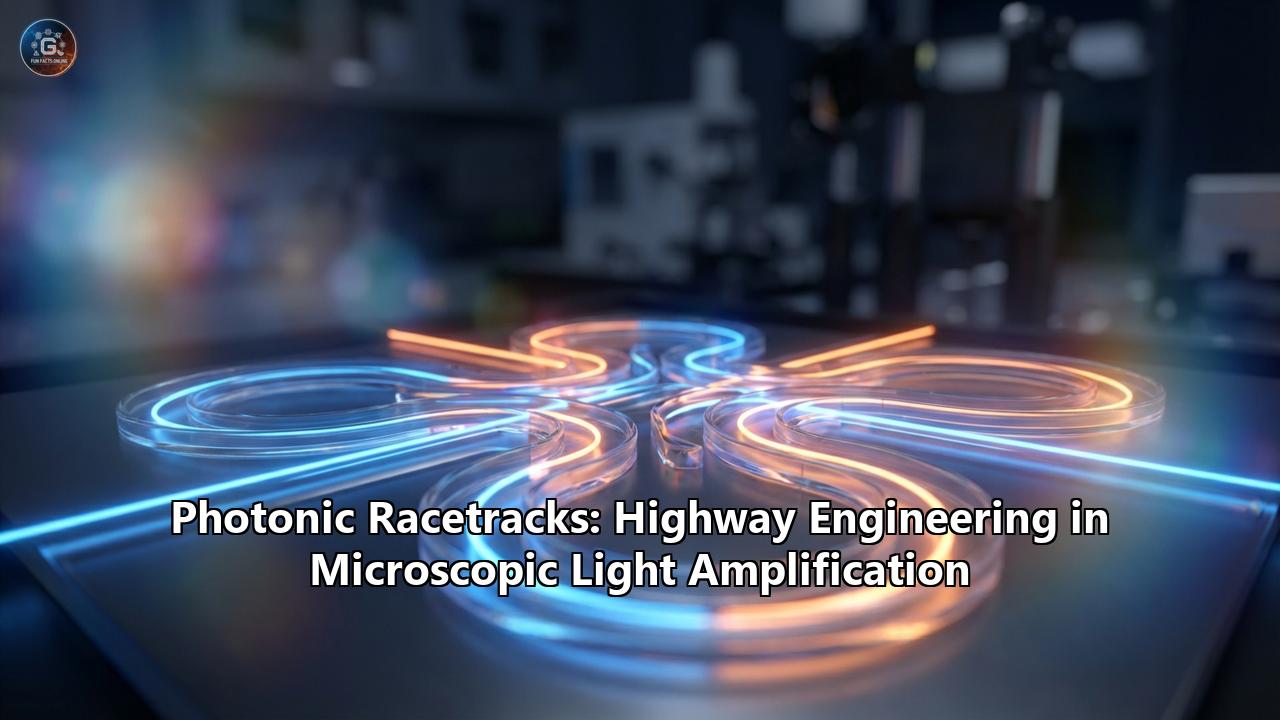
directly into light. By coupling highly sensitive microwave antennas to lithium tantalate photonic racetrack resonators, scientists have successfully transduced single microwave photons into optical photons at room temperature. This enables the creation of receivers with "sub-ambient noise" characteristics, allowing us to detect the faintest whispers of the cosmos or read ultra-delicate quantum states without the thermal interference inherent to standard electronic amplifiers.
The Convergence of Eras
It is a profound testament to the interconnected nature of human ingenuity that a mathematical principle established to keep massive, soot-belching steam trains safely on their tracks is now being utilized to shepherd massless particles of light around a semiconductor chip.
The photonic racetrack resonator stands as a pinnacle of multi-disciplinary engineering. It demands the raw materials of advanced material science, the nano-scale fabrication techniques of modern cleanrooms, the theoretical grounding of quantum optics, and the pragmatic geometric logic of civil highway construction.
As our society continues to hunger for ever-faster data transmission, ever-smarter artificial intelligence, and ever-more-sensitive environmental monitors, the era of relying solely on the electron is drawing to a close. The future of technology will not be dictated by the resistance of copper wires, but by the seamless, high-speed flow of photons. And thanks to the elegant geometry of the Euler curve, those photons finally have a pristine, frictionless highway upon which to race.
Reference:
- https://www.google.com/search?q=time+in+Deschutes+County,+US
- https://patentimages.storage.googleapis.com/f5/b8/4b/efaec2bc4d196e/US7877014.pdf
- https://www.researchgate.net/figure/Ring-and-racetrack-resonators-a-Circular-ring-resonator-with-a-3-m-bend-radius-b_fig7_3410220
- https://www.sciencedaily.com/releases/2026/02/260224015540.htm
- https://bioengineer.org/scientists-develop-ultra-efficient-optical-sensors-to-miniaturize-light-on-a-chip/
- https://www.findlight.net/blog/microresonators-configurations-and-applications/
- https://www.photonics.intec.ugent.be/download/pub_3105.pdf
- https://validate.perfdrive.com/?ssa=f9d9998a-5b60-ce14-d68d-9064bf4b0a56&ssb=16458204092&ssc=https%3A%2F%2Fopg.optica.org&ssi=2fd9ab7e-d3hy-5e91-915b-72a2a998e0b8&ssk=botmanager_support@radware.com&ssm=14020102500473800130552638148847&ssn=63d55bebaeb7f10a5ad57c53e6b866326d78a93abbc3-06f0-5221-bb1ac0&sso=e4f8021-bcd1-9db94cca1633982978c40b8dd9063feb83be4ef6d10cc620&ssp=80317687501771901701177199176881318&ssq=11795777826060056823078259457588665668976&ssr=MTgwLjE4OC4xNzQuMjg=&sst=python-requests%2F2.32.3&ssv=&ssw=
- https://www.eurekalert.org/news-releases/1116989
- https://par.nsf.gov/servlets/purl/10630567
- https://www.colorado.edu/engineering/2026/02/23/researchers-build-ultra-efficient-optical-sensors-shrinking-light-chip
- https://arxiv.org/pdf/2211.04077
- https://www.tandfonline.com/doi/full/10.1080/23746149.2021.1981155
- https://pubs.aip.org/aip/apl/article/122/8/081101/2872715/Compact-multimode-silicon-racetrack-resonators-for
- https://validate.perfdrive.com/?ssa=851da59b-1312-9a74-8d58-ff3701710511&ssb=04236245004&ssc=https%3A%2F%2Fopg.optica.org&ssi=8d437c2a-d3hy-85fb-20cf-3e0878f57f81&ssk=botmanager_support@radware.com&ssm=04158656606778128107224289745467&ssn=3454e6613e402a0f7f35f6e502a0005259d8bd7c1953-8877-f7bf-095b51&sso=b9b2abf-0933-90c0d14415641d10144697d58ade64abc547bef382ce3de9&ssp=11069118701771916565177197787803164&ssq=72328467827696400687678276154703780503887&ssr=MTgwLjE4OC4xNzQuMjg=&sst=python-requests%2F2.32.3&ssv=&ssw=