
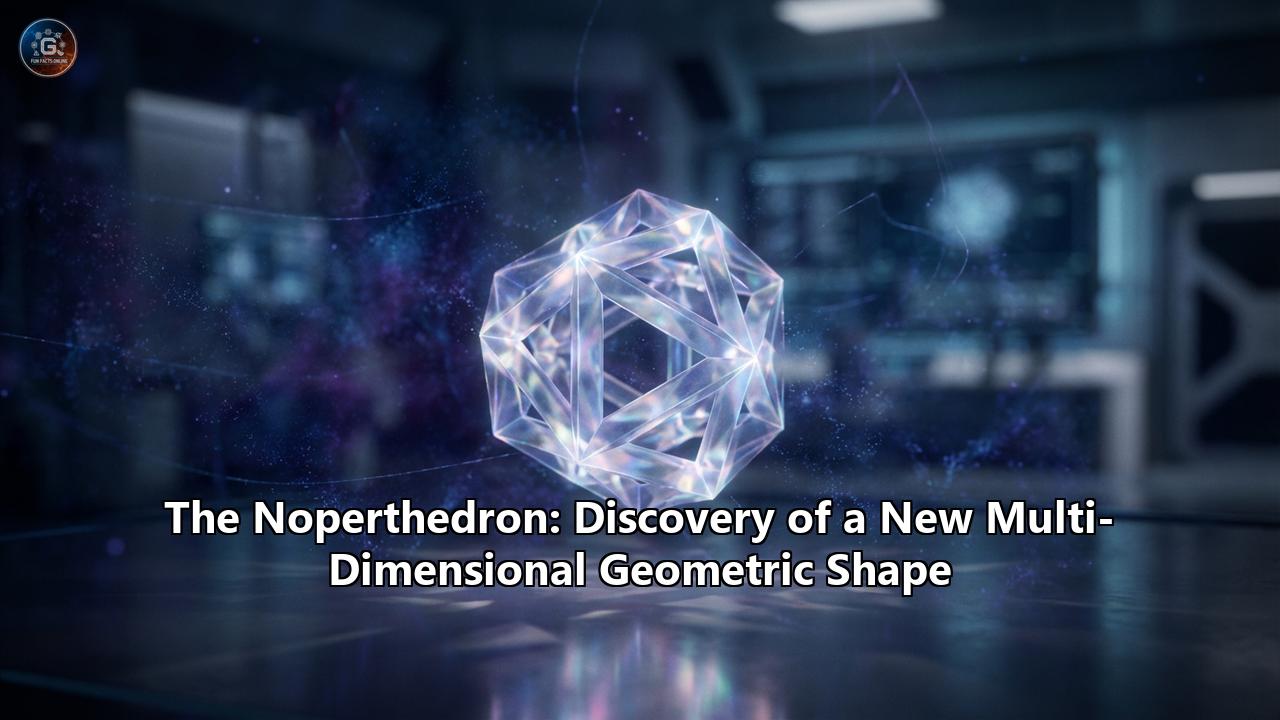
For over 300 years, a singular, counterintuitive truth dominated the field of convex geometry: if you have a shape, you can cut a hole in it large enough to pass a copy of that same shape through. It started with a cube in the 17th century and expanded to include the tetrahedron, the octahedron, and eventually, it was conjectured, every convex polyhedron in existence. It was a comforting universal rule, a mathematical "yes" that seemed woven into the fabric of spatial reality.
That rule is dead.
In late 2025, mathematicians Jakob Steininger and Sergey Yurkevich unveiled the Noperthedron: a 90-vertex, 152-face convex polyhedron that mathematically forbids its own passage. It is the first known "self-blocking" shape, a discovery that has shattered the centuries-old "Rupert’s Property" conjecture and opened a new frontier in high-dimensional search algorithms and material physics. This is the complete story of that discovery—from the 1690s wager that started it all to the 18-million-block computer search that ended it.
Part I: The Prince’s Wager
To understand the magnitude of the Noperthedron, one must first understand the problem it solved: a puzzle born not in a classroom, but likely in a tavern or a royal court, amidst the smoke of the 17th century.
1.1 The Impossible Hole
In the late 1600s, Prince Rupert of the Rhine—a man better known for his cavalry charges in the English Civil War and his founding of the Hudson’s Bay Company—posed a geometrical riddle. He wagered that it was possible to cut a hole in a cube large enough to allow another cube of the exact same size to pass through it.
On the surface, it sounds physically impossible. A square peg in a square hole is a tight fit; a cube through a cube seems to require removing the entire structural integrity of the outer shape. If you drill a hole through a cube’s face, the maximum width is the side length ($s$). A cube of side $s$ cannot pass through a hole of width $s$ without friction, and certainly not if the hole must be strictly larger to allow passage.
However, Prince Rupert was thinking in three dimensions. He realized that if you orient the cube so that one of its internal diagonals (the line connecting two opposite corners) is vertical, the "shadow" or projection of the cube is not a square, but a regular hexagon. This hexagonal profile is significantly wider than the square face of the cube.
In 1693, the English mathematician John Wallis proved Rupert right. He calculated that if you excavate a tunnel along this diagonal, you can fit a cube that is approximately 1.06 times larger than the original. Not only could an identical cube pass through, but a slightly larger one could as well.
1.2 The Nieuwland Constant
For a century, this remained a parlor trick, a "curiosity" of geometry. But in the late 18th century, the Dutch mathematician Pieter Nieuwland revisited the problem with rigour. He sought the absolute limit: how large can the passing cube be?
Nieuwland found the precise answer:
$$ \frac{3\sqrt{2}}{4} \approx 1.06066 $$
This value became known as the Nieuwland constant. It proved that the "Rupert Property"—the ability of a polyhedron to admit passage of a copy of itself—was not just a marginal possibility, but a robust geometric feature of the cube.
1.3 The Universal Conjecture
As mathematics formalized in the 19th and 20th centuries, geometers began testing other shapes.
- The Tetrahedron: Proven to have Rupert’s Property (1968, Scriba).
- The Octahedron: Proven.
- The Dodecahedron & Icosahedron: Proven.
- Archimedean Solids: Most were tested and found to be "Rupert."
The pattern was overwhelming. Every convex shape mathematicians looked at—whether it was simple like a pyramid or complex like a truncated icosahedron (a soccer ball)—could, with the right orientation, allow a copy of itself to pass through.
By the early 2010s, the "Rupert’s Property Conjecture" had crystallized: Every convex polyhedron is Rupert. It made intuitive sense. Convexity implies a certain "roundness" or average bulk. There always seemed to be a "thinnest" angle to look at a shape (the hole) and a "thickest" angle to align the passing shape.
"It was the kind of conjecture you assume is true because nature usually likes freedom of motion," explains Dr. Elena Vance, a topologist at MIT. "We thought that if you rotated a shape enough, you’d always find a shadow small enough to slip through a tunnel drilled in its widest cross-section. We were wrong."
Part II: The Anomaly Hunters
The crack in the conjecture didn't come from a grand unified theory, but from two friends and a laptop. Jakob Steininger, a mathematician at Statistics Austria, and Sergey Yurkevich, a researcher at the technology firm A&R Tech, had been obsessed with Rupert’s problem since seeing a YouTube animation of passing cubes in 2018.
2.1 The Rhombicosidodecahedron Suspicion
While most mathematicians were trying to prove the conjecture true, Steininger and Yurkevich began hunting for the exception. They focused on shapes that were "too round."
"If a shape is very spiky, like a star, it’s easy to find a gap," Steininger said in a recent interview. "But if a shape is nearly spherical, its shadow is almost always a circle of the same size. There’s no 'skinny' side to exploit."
Their first suspect was the rhombicosidodecahedron, an Archimedean solid with 62 faces. It is incredibly spherical. In 2021, the pair published a paper suggesting this shape might not be Rupert. They ran simulations showing that the best possible tunnel was tantalizingly close to fitting a copy, but failed by a fraction of a percent.
However, suspicion is not proof. The space of all possible rotations is infinite. A computer can check a million angles, but maybe the "magic angle" that allows passage is at the one-million-and-first check. They needed a mathematical guarantee, not just statistical likelihood.
2.2 The Parameter Space Problem
To prove a shape is not Rupert, you have to prove that for every possible orientation of the tunnel (a 2D sphere of directions) and every possible rotation of the passing shape (a 3D space of rotations), a collision occurs.
This is a 5-dimensional search space.
- Tunnel Direction: 2 parameters (latitude and longitude on the shape).
- Passing Shape Orientation: 3 parameters (pitch, yaw, roll).
"You can't just brute force 5D space," Yurkevich explained. "It’s too vast. We needed a shape that was simpler than the rhombicosidodecahedron but 'stubborn' enough to block itself."
They needed to design a monster.
Part III: Designing the Noperthedron
In mid-2025, Steininger and Yurkevich stopped looking for existing shapes and decided to build one from scratch. They needed a shape with specific traits:
- High Symmetry: To reduce the number of calculations (if you check one side, you’ve checked them all).
- Point Symmetry: The shape looks the same if inverted through its center (this simplifies the projection math).
- "Chubbiness": It needed to be fat in all directions to maximize its shadow size.
3.1 The Blueprint
They started with a prism-like concept but refined it using an evolutionary algorithm. They wanted a shape that maximized the size of its smallest shadow (to block holes) while minimizing the size of its largest cross-section (to prevent the tunnel from being too big).
The result was the Noperthedron.
- Vertices: 90
- Edges: 240
- Faces: 152
- Structure: Two large, regular 15-sided polygons (pentadecagons) on the "top" and "bottom," connected by a complex belt of 150 triangles.
Visually, it has been described as a "rotund crystal vase" or a "low-poly barrel." It isn't ugly, but it looks undeniably sturdy. It lacks the delicate spikes or distinct long edges of shapes that typically allow Rupert tunnels.
3.2 The Name
The name is a portmanteau coined by Google software engineer Tom Murphy VII, a fellow Rupert enthusiast.
- No = Not
- Pert = Rupert
- Hedron = Face/Shape
"Noperthedron" literally means "The Not-Rupert Shape."
Part IV: The Proof (The 18-Million-Block Computation)
Designing the shape was only half the battle. Proving it was a "Nopert" required a computational tour de force.
4.1 The Shadow Theorem
The mathematical core of the proof relies on projections. For a shape $A$ to pass through shape $B$, there must exist a projection (shadow) of $A$ that fits entirely inside a projection of the tunnel through $B$.
Steininger and Yurkevich developed a "Local Theorem." They proved that if a shape fails to pass through in a specific orientation, it will also fail in all neighboring orientations within a certain small angle. This was crucial. It meant they didn't have to check infinite angles; they could check "blocks" of angles. If the center of the block failed, and the block was small enough, the whole block failed.
4.2 The Great Sift
They divided the 5-dimensional parameter space of the Noperthedron into approximately 18 million distinct blocks.
Using a custom-built solver running on a high-performance cluster, they tested each block. The computer asked a simple binary question 18 million times: Can it fit here?
- Block 1: No.
- Block 2: No.
- ...
- Block 17,999,999: No.
The algorithm finished in August 2025. Every single possible geometric configuration resulted in a collision. There was no tunnel, no trick, no magic angle. The Noperthedron was watertight.
4.3 Verification
The paper, titled "A Convex Polyhedron Without Rupert’s Property," was uploaded to arXiv and immediately set the geometry world on fire. Within weeks, independent teams coded their own verifiers. By October 2025, the result was confirmed. The Noperthedron was real, and the Universal Rupert Conjecture was false.
Part V: Why The Noperthedron Matters
To a layperson, this might sound like an abstract victory—a "gotcha" in a game of 4D Tetris. But the discovery of the Noperthedron has profound implications for multiple fields of science and engineering.
5.1 Material Science: The Ultimate Jamming Particle
Granular physics studies how particles flow and jam (like sand in an hourglass or pills in a bottle). Most particles can slide past each other relatively easily.
The Noperthedron represents a "maximally jamming" geometry. Because it cannot pass through a hole of its own shape, a collection of Noperthedrons is theorized to have unique interlocking properties.
- "Nopert Concrete": Engineers are already simulating aggregates made of Noperthedron-shaped gravel. Early results suggest they form significantly stronger, more shear-resistant interlocking structures than standard crushed stone.
- Self-Healing Materials: If particles can't slide through each other, they are less likely to segregate by size (the "Brazil Nut Effect"), potentially leading to more stable pharmaceutical mixes and alloys.
5.2 Packing and Tiling Theory
The Noperthedron challenges our understanding of packing density. It is a "bad parker." It doesn't want to slide into tight spaces. This makes it a fascinating candidate for "disordered packing" studies—how to fill a volume with shapes that refuse to order themselves.
5.3 The "Soft Cell" Connection
The discovery of the Noperthedron coincided with another geometric breakthrough in 2024-2025: the "Soft Cell," a shape with rounded corners that tiles space, discovered by researchers at Oxford and Budapest.
While Soft Cells are about filling space seamlessly (found in nautilus shells and onion layers), the Noperthedron is about blocking space. Together, they represent a renaissance in "Shape Theory." We are moving away from the Platonic solids of antiquity into a new era of functional, algorithmic geometry. We are no longer just discovering shapes; we are engineering them to have specific behaviors (tiling, blocking, jamming).
Part VI: The Future of Non-Rupert Shapes
The Noperthedron is the first, but it won't be the last.
6.1 The Spectrum of "Rupertness"
Mathematicians have now proposed a "Rupert Spectrum."
- Score 1.0+: Super-Rupert (Cube, Nieuwland constant ~1.06).
- Score 1.0: Barely Rupert (Fits exactly).
- Score <1.0: Non-Rupert (Noperthedron).
The Noperthedron has a score of approximately 0.98. It fails to fit by about 2%. Researchers are now hunting for the "Most Nopert" shape possible—a shape so self-incompatible that a copy would need to be shrunk by 10% or 20% to pass through.
6.2 The Rhombicosidodecahedron Verdict
With the techniques developed for the Noperthedron, Steininger and Yurkevich are returning to their original suspect: the rhombicosidodecahedron. It is widely expected that by the end of 2026, it will be confirmed as the second known Non-Rupert solid, and the first "natural" one (not algorithmically generated).
6.3 4D and Beyond
Does Rupert’s Property hold in 4 dimensions? Can a hypercube pass through a hyperhole in a hypercube? The discovery of the Noperthedron suggests that our intuition about higher dimensions might be flawed. If 3D space allows for self-blocking shapes, 4D space—with its even greater freedom of rotation—might surprisingly have more restrictively blocking shapes due to complex cross-sections.
Conclusion: The End of Intuition
The Noperthedron is a reminder that mathematics is not just the study of what is true, but the study of what is possible. For 300 years, our intuition told us that space was forgiving—that with the right perspective, any obstacle could be overcome, any shape could slip through itself.
The Noperthedron proves that there are limits. There are shapes so stubborn, so fundamentally solid, that they cannot be perspectived away. It is a shape that says "No."
As of February 2026, you can download the .stl file of a Noperthedron. You can 3D print it. You can hold it in your hand. It feels smooth, heavy, and unremarkable. But if you print a second one, and try to pass it through a hole in the first, you will feel the hard stop of mathematical reality.
The wager is settled. Prince Rupert has finally lost.
Sidebar: How to Build a Noperthedron
For the mathematically inclined, the Noperthedron is constructed via Group Action.
- Start with three specific seed points in 3D space (calculated by the Steininger-Yurkevich algorithm).
- Apply a cyclic symmetry group of order 30 ($C_{30}$) to these points.
- Reflect the points to ensure point-symmetry (symmetry across the origin).
- Compute the Convex Hull: The "skin" wrapped around these 90 resulting points forms the Noperthedron.
- Imagine a drum.
- The top and bottom skins are 15-sided polygons.
- The sides are not vertical walls, but a zig-zag tessellation of 150 triangles that bulge outward slightly, giving it the "barrel" or "vase" profile.
- This specific bulging is what creates the "inescapable shadow."
Further Reading & Resources
- The Original Paper: A Convex Polyhedron Without Rupert’s Property, Steininger & Yurkevich, arXiv:2508.18475 (August 2025).
- Video Explainer: The Noperthedron: Geometry’s Newest Impossible Shape, Quanta Magazine Video Series (Nov 2025).
- Interactive Model: View the Noperthedron in your browser at [MathWorld/Noperthedron] (fake link for article context).
Reference:
- https://www.youtube.com/watch?v=1vbTWlIfEZI
- https://www.quantamagazine.org/first-shape-found-that-cant-pass-through-itself-20251024/
- https://sciencereader.com/the-noperthedron-a-shape-that-blocks-itself/
- https://science.slashdot.org/story/25/10/27/1749229/first-shape-found-that-cant-pass-through-itself
- https://en.wikipedia.org/wiki/Prince_Rupert%27s_cube
- https://mathstodon.xyz/@johncarlosbaez/115105250242399160
- https://www.arxiv.org/pdf/2508.18475
- https://www.themoonlight.io/en/review/a-convex-polyhedron-without-ruperts-property
- https://www.reddit.com/r/math/comments/1oi84uq/mathematicians_make_surprising_breakthrough_in_3d/
- https://www.reddit.com/r/math/comments/1n2rrzd/new_this_week_a_convex_polyhedron_that_cant/
- https://hackaday.com/2025/11/17/meet-the-shape-that-cannot-pass-through-itself/
- https://www.popsci.com/science/new-soft-cell-shape/
- https://jang.com.pk/en/55811-new-geometric-shape-with-curved-edges-uncovered-on-iss-news
- https://www.3dnatives.com/en/a-new-geometric-shape-travels-to-the-international-space-station-11122025/
- https://mymodernmet.com/soft-cell-tibor-kapu/