
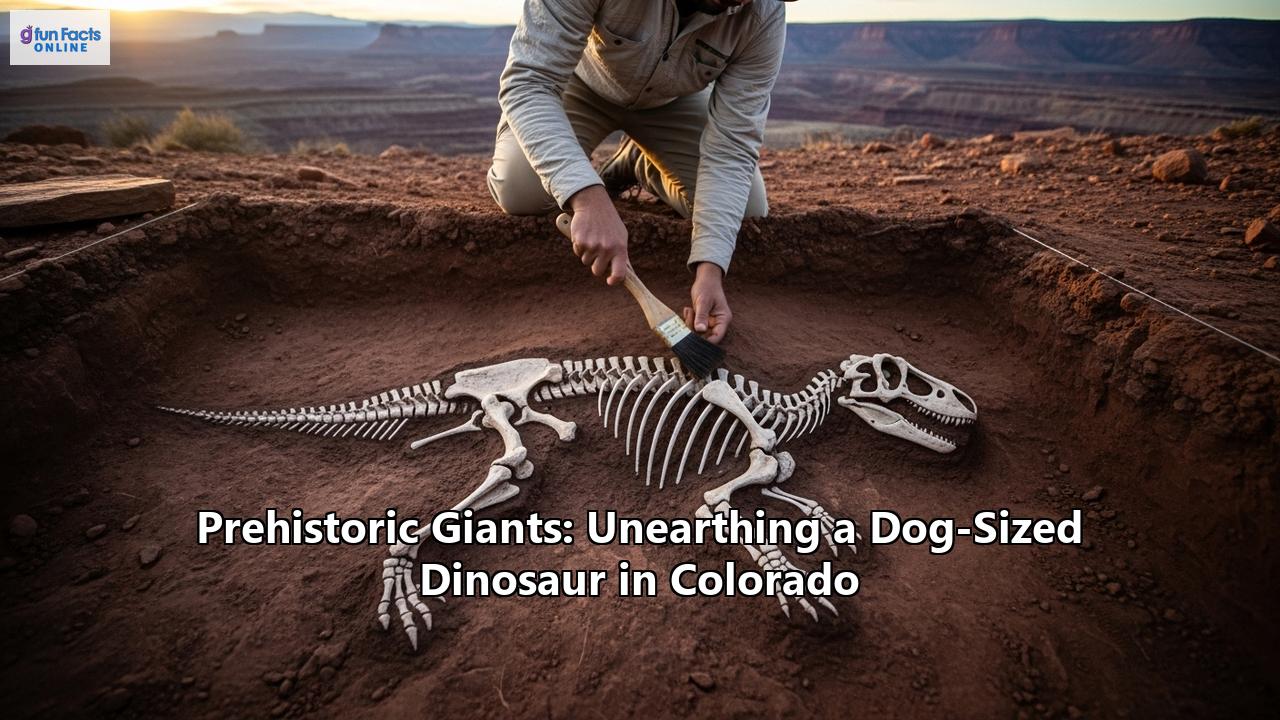
In the vast, rugged landscapes of Colorado, where mountains scrape the sky and canyons whisper tales of geologic time, a recent discovery has sent ripples of excitement through the world of paleontology. In the heart of the Morrison Formation, a treasure trove of Jurassic secrets, scientists have unearthed the remains of a creature that challenges our traditional image of the dinosaurian world. This is not a towering behemoth, a "prehistoric giant" in the conventional sense, but a nimble, dog-sized dinosaur that scurried in the shadows of its colossal contemporaries. The discovery of Enigmacursor mollyborthwickae, a "mysterious runner," opens a new window into the intricate ecosystems of the Late Jurassic, revealing a world far more diverse and complex than previously imagined.
A New Player on a Prehistoric Stage: The Discovery of Enigmacursor mollyborthwickae
In 2021, a team from a private fossil company, working in the rocky outcrops of Moffat County, Colorado, stumbled upon a partial skeleton that would soon captivate the scientific community. The fossil, remarkably well-preserved in three dimensions, included teeth, vertebrae, and limb bones. Initially, it was thought to be a specimen of Nanosaurus, another small dinosaur known from the Morrison Formation. However, upon its acquisition by the Natural History Museum in London, paleontologists Susannah Maidment and Paul Barrett embarked on a detailed analysis that would reveal its true identity.
Their research, published in the prestigious journal Royal Society Open Science, confirmed that this was not Nanosaurus, but an entirely new genus and species of dinosaur. They named it Enigmacursor mollyborthwickae. The genus name, a combination of the Latin words "enigma" (mystery) and "cursor" (runner), pays homage to the creature's elusive nature and its inferred speed. The species name, mollyborthwickae, honors Molly Borthwick, a generous donor whose contribution enabled the museum to acquire this invaluable specimen.
A Portrait of a "Mysterious Runner"
So, what was Enigmacursor mollyborthwickae like? Imagine a creature roughly the size of a Labrador retriever, measuring about one meter (a little over 3 feet) in length and standing about half a meter (1.6 feet) tall. Unlike the lumbering giants of its time, Enigmacursor was a lightly built, two-legged herbivore. Its long hind legs suggest it was a swift and agile runner, capable of making a quick escape from the formidable predators that shared its world.
The skeleton, though incomplete, offers tantalizing clues about its life. The vertebrae were not fully fused, indicating that this particular individual may have been a juvenile or a young adult at the time of its death. While its skull is missing, the discovery of some of its teeth has provided insights into its diet. As a herbivore, it would have browsed on the lush vegetation of the Jurassic floodplains.
The discovery of Enigmacursor is significant not just for the addition of a new species to the dinosaur family tree. It also highlights the "cryptic diversity" of small-bodied ornithischian dinosaurs in the Morrison Formation, suggesting that these smaller creatures were a more diverse and important part of their ecosystems than previously thought. The find has also prompted a re-evaluation of other small dinosaur fossils from the region, many of which are based on incomplete and poorly preserved remains.
The Land of Giants: Colorado's Rich Dinosaurian Heritage
The story of Enigmacursor unfolds against the backdrop of Colorado's rich paleontological history. For over a century, the state has been a focal point for dinosaur discoveries, earning it a reputation as a veritable "dinosaur central." The Morrison Formation, a vast expanse of sedimentary rock stretching across the western United States, is at the heart of this legacy.
The Morrison Formation: A Window into the Jurassic
The Morrison Formation, dating back to the Late Jurassic period (about 156 to 146 million years ago), is one of the most fossil-rich rock layers in the world. During this time, the region was a vast, semi-arid plain with rivers, streams, and seasonal lakes. This environment, subject to periodic floods, was ideal for the preservation of animal remains. The sediments deposited by these ancient waterways buried the bones of dinosaurs and other creatures, protecting them from the elements and allowing them to fossilize over millions of years.
The result is a remarkable snapshot of a vibrant and dynamic ecosystem. The formation has yielded a stunning array of fossils, from the colossal sauropods that shook the ground with their every step to the fearsome theropods that hunted them.
The Titans of the Morrison: Colorado's Prehistoric Giants
While the discovery of Enigmacursor shines a light on the smaller inhabitants of the Jurassic, Colorado is perhaps best known for its prehistoric giants. The Morrison Formation has produced some of the most iconic dinosaurs known to science:
- ---Stegosaurus---: Colorado's state fossil, this armored giant is famous for the distinctive plates on its back and the fearsome spikes on its tail. Fossils of Stegosaurus have been found throughout the Morrison Formation, providing a wealth of information about its anatomy and lifestyle.
- ---Diplodocus--- and ---Apatosaurus---: These long-necked sauropods were among the largest animals to ever walk the Earth. Their immense skeletons, found in quarries across Colorado, are awe-inspiring centerpieces in museums around the world.
- ---Allosaurus---: The apex predator of the Jurassic, Allosaurus was a large carnivorous dinosaur with a massive skull and sharp, serrated teeth. Its remains are commonly found in the Morrison Formation, offering a glimpse into the life of a prehistoric hunter.
- ---Brachiosaurus---: With its long front legs and giraffe-like neck, Brachiosaurus was another colossal herbivore of the Morrison Formation. Its discovery has helped paleontologists understand the incredible diversity of sauropod body plans.
The presence of these giants alongside smaller dinosaurs like Enigmacursor paints a picture of a complex food web with a wide range of ecological niches. The large herbivores would have browsed on the high-canopy vegetation, while smaller herbivores like Enigmacursor would have fed on lower-lying plants. The predators, in turn, would have hunted a variety of prey, from the young of the giant sauropods to the swift and agile smaller dinosaurs.
The Other Little Dinosaurs of Colorado: A Tale of Two Small Herbivores
Enigmacursor is not the only small dinosaur to have been discovered in Colorado. Another notable small-fry from the Morrison Formation is Fruitadens haagarorum, a tiny dinosaur that offers a fascinating point of comparison.Fruitadens haagarorum: The "Fruita Teeth"
Discovered in the 1970s near Fruita, Colorado, Fruitadens is one of the smallest known ornithischian dinosaurs. Adults are estimated to have been only 65 to 75 centimeters (26 to 30 inches) long and weighed a mere 0.5 to 0.75 kilograms (1.1 to 1.7 pounds). Its name, meaning "Fruita teeth," refers to the location of its discovery and its unique dentition.
Fruitadens was a heterodontosaurid, a group of dinosaurs known for having different types of teeth in their jaws. It had canine-like teeth at the front of its jaw and leaf-shaped teeth at the back, suggesting an omnivorous diet of both plants and small animals like insects. This is in contrast to the herbivorous Enigmacursor.Like Enigmacursor, Fruitadens was a swift, bipedal runner that would have darted through the undergrowth of the Jurassic forests. The discovery of fossils from at least four individuals of different ages has provided valuable insights into its growth and development.
The existence of both Enigmacursor and Fruitadens in the same ecosystem highlights the remarkable diversity of small dinosaurs in the Morrison Formation. These two diminutive dinosaurs, with their different diets and subtle anatomical variations, occupied distinct ecological niches, further enriching the complexity of this prehistoric world.
A Legacy of Discovery: The History of Paleontology in Colorado
The story of Colorado's dinosaurs is not just about the creatures themselves, but also about the people who discovered them. The state has a long and storied history of paleontological exploration, marked by fierce rivalries and groundbreaking discoveries.
The "Bone Wars"
The late 19th century saw a period of intense fossil hunting in the American West known as the "Bone Wars." This scientific feud pitted two prominent paleontologists, Othniel Charles Marsh and Edward Drinker Cope, against each other in a race to discover and name new dinosaur species. Colorado, with its rich fossil beds, became a key battleground in this scientific conflict.
The Bone Wars, though often acrimonious, led to a golden age of dinosaur discovery. Many of the iconic dinosaurs of the Morrison Formation, including Stegosaurus, Allosaurus, and Apatosaurus, were first discovered during this period. The rivalry between Marsh and Cope, while driving them to sometimes questionable practices, ultimately resulted in a massive expansion of our knowledge of the prehistoric world.
The Fruita Paleontological Area: A Microcosm of the Jurassic
In more recent times, the focus of paleontological research in Colorado has expanded to include the smaller, often overlooked creatures of the Jurassic. The Fruita Paleontological Area, where Fruitadens was discovered, is a prime example of this shift. This small but incredibly rich fossil site has yielded a remarkable diversity of small Jurassic animals, including lizards, crocodiles, mammals, and, of course, small dinosaurs.
The discoveries from the Fruita Paleo Area have provided a more complete picture of the Jurassic ecosystem, revealing the intricate web of life that existed in the shadows of the giant dinosaurs. These smaller fossils, though less spectacular than their larger counterparts, are in many ways more scientifically valuable, offering insights into the paleoenvironment and the evolution of a wide range of animal groups.
The Science of Discovery: From the Field to the Museum
The journey of a dinosaur fossil from its discovery in the field to its display in a museum is a long and painstaking process. The story of Enigmacursor provides a perfect illustration of this scientific endeavor.
It began with the careful excavation of the fossil from the rock in which it had been entombed for 150 million years. This delicate work requires skill and patience, as the fossils are often fragile and easily damaged. Once excavated, the fossils were transported to a laboratory for preparation. This involves removing the surrounding rock, a process that can take hundreds or even thousands of hours of meticulous work.
After preparation, the real scientific investigation begins. Paleontologists like Maidment and Barrett carefully studied the anatomy of the bones, comparing them to those of other known dinosaurs. This comparative analysis allowed them to identify the unique features that distinguished Enigmacursor as a new species.
The final step in the process is the publication of the findings in a scientific journal, sharing the new knowledge with the broader scientific community. The fossil itself, now a priceless scientific treasure, is housed in a museum, where it can be studied by other researchers and admired by the public. The display of the Enigmacursor skeleton at the Natural History Museum in London is a testament to the enduring power of these prehistoric creatures to capture our imagination.
The Enduring Mystery of the Dinosaurs
The discovery of Enigmacursor mollyborthwickae is a powerful reminder that the age of dinosaurs still holds many secrets. Even in a place as well-studied as the Morrison Formation, new and unexpected discoveries are still being made. Each new fossil, whether it be a towering giant or a diminutive runner, adds another piece to the puzzle of our planet's prehistoric past.
The story of the dog-sized dinosaur from Colorado is more than just a scientific curiosity. It is a story about the incredible diversity of life on Earth, the vastness of geologic time, and the enduring human quest to understand our place in the universe. As paleontologists continue to explore the rocky landscapes of Colorado and other fossil-rich regions around the world, we can only imagine what other prehistoric giants, and what other "mysterious runners," are waiting to be unearthed.
Reference:
- https://www.sacbee.com/news/nation-world/national/article309463175.html
- https://www.sci.news/paleontology/enigmacursor-mollyborthwickae-14021.html
- https://www.livescience.com/animals/dinosaurs/enigmatic-runner-dinosaur-from-colorado-helps-rewrite-understanding-of-several-jurassic-species
- https://en.clickpetroleoegas.com.br/dog-sized-dinosaur-discovered-flpc96/
- https://royalsocietypublishing.org/doi/10.1098/rsos.242195
- https://hirunews.lk/en/408654/a-new-discovery-about-a-dinosaur-species
- https://ground.news/article/archaeology-breakthrough-as-new-dog-size-dinosaur-species-discovered
- https://bioone.org/journals/bulletin-of-the-peabody-museum-of-natural-history/volume-66/issue-1/014.066.0102/A-Review-of-Nanosaurus-agilis-Marsh-and-Other-Small-Bodied/10.3374/014.066.0102.short
- https://en.wikipedia.org/wiki/List_of_dinosaurs_of_the_Morrison_Formation
- https://en.wikipedia.org/wiki/Fruitadens
- https://www.smithsonianmag.com/science-nature/fruitadens-and-the-dinosaur-diet-67518610/
- https://royalsociety.org/news/2009/tiny-dinosaurs/
- https://www.prehistoric-wildlife.com/species/fruitadens/
- https://www.gjhikes.com/2010/09/fruita-paleo-area.html
- https://www.smithsonianmag.com/science-nature/jurassic-boneyard-its-not-size-counts-180959293/
- https://www.smithsonianmag.com/smart-news/enigmatic-dog-sized-dinosaur-reveals-a-new-species-that-scampered-around-jurassic-north-america-180986895/