
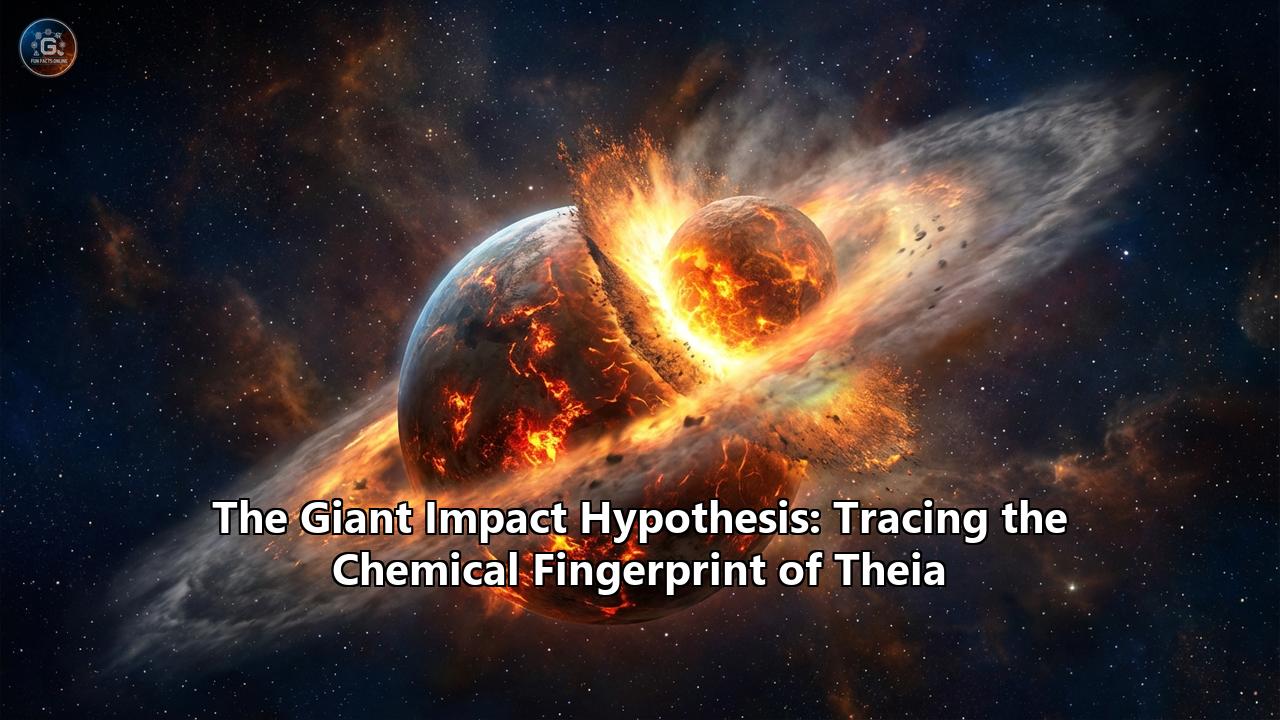
4.5 billion years ago, the solar system was a demolition derby. Protoplanets careened through the dark, smashing into one another in cataclysmic mergers that would eventually forge the stable worlds we know today. The most significant of these collisions happened here, at Earth. A Mars-sized wanderer, a planetary embryo we call Theia, slammed into the proto-Earth with such violence that it nearly destroyed both worlds. From the vaporized ruin of that impact, the Moon was born.
For decades, this Giant Impact Hypothesis has been the bedrock of lunar science. It elegantly explains the Moon’s large size, its lack of an iron core, and the angular momentum of the Earth-Moon system. But for nearly just as long, there has been a gaping hole in the theory—a forensic inconsistency that has kept planetary scientists awake at night. It is called the Isotopic Crisis.
If Theia was a separate planet formed in a different part of the solar system, it should have had a distinct chemical fingerprint, just as Mars, Vesta, and meteorites do. The Moon, formed largely from Theia’s debris, should carry this alien signature. Yet, for fifty years, every sample brought back by Apollo astronauts shouted the opposite: the Moon is not alien. Chemically, it looks almost exactly like Earth.
This article traces the scientific detective story of Theia, from the initial isotopic crisis to the stunning recent breakthroughs of the mid-2020s. We will explore how new high-precision measurements of obscure elements like molybdenum and thallium have finally revealed Theia’s true identity, and how a revolutionary discovery deep inside the Earth suggests that Theia isn't gone. It is still here, buried beneath our feet, forming the very foundations of our world.
Part I: The Isotopic Crisis
To understand the magnitude of the recent discoveries, we must first understand the problem that plagued the Giant Impact Hypothesis for decades.
The Oxygen Problem
In the solar system, oxygen is the standard of identity. Oxygen exists in three stable isotopes: O-16, O-17, and O-18. The ratio of these isotopes varies wildly depending on where in the solar nebula a planet formed. Mars has a distinct oxygen "flavor." The asteroids in the belt have another. Comets have yet another. These ratios are so distinct that if you hand a geochemist a rock, they can tell you purely by its oxygen isotopes whether it came from Earth, Mars, or a specific class of meteorite.
When the first Apollo samples were analyzed in the 1970s, scientists expected to see a mix. Standard models of the Giant Impact suggested the Moon should be composed of about 70% to 90% Theia material and only 10% to 30% proto-Earth material. Therefore, the Moon’s oxygen signature should look like Theia’s.
Instead, the results were shocking. The Earth and the Moon were isotopically indistinguishable. To the limits of the most precise mass spectrometers available, their oxygen ratios were identical.
This presented a paradox.
- Option A: Theia miraculously formed at the exact same distance from the Sun as Earth, using the exact same mixture of raw materials. The odds of this are astronomically low—less than 1%.
- Option B: The impact was so violent that it vaporized both worlds entirely, creating a donut-shaped cloud of super-critical rock vapor called a synestia. In this chaotic mixer, the gas of Earth and the gas of Theia thoroughly homogenized before the Moon condensed out of the fog.
For years, the "Synestia" model gained traction as the only way to solve the oxygen problem. But it required specific, extreme conditions.
The Titanium and Tungsten Confirmation
As technology improved, scientists moved beyond oxygen to heavier, more refractory elements like titanium (Ti-50) and tungsten (W-182). Titanium is incredibly stubborn; it doesn't vaporize easily. If the oxygen was mixed by a vapor cloud, the titanium should arguably still show differences if Theia was distinct.
Yet, again, the fingerprints matched. Earth and Moon shared the same titanium anomalies. The crisis deepened with tungsten. Tungsten-182 is produced by the decay of Hafnium-182, a short-lived isotope present only in the very early solar system. Because hafnium loves rock and tungsten loves iron, when a planet’s core forms, the tungsten sinks to the center while hafnium stays in the mantle.
The fact that Earth and the Moon share identical tungsten anomalies implies that their mantles have the same age and differentiation history. This was baffling. How could a small impactor like Theia have the exact same evolutionary history as the Earth?
Part II: The 2020s Breakthroughs – Tracing the Heavy Metals
The deadlock began to break in the early 2020s, accelerating into 2025, as researchers began employing "isotopic fine-tooth combs" on elements that tell a different story: nucleosynthetic anomalies.
Unlike oxygen, which is fractionation-dependent (changed by biological and geological processes), nucleosynthetic anomalies in heavy metals like molybdenum (Mo), ruthenium (Ru), and zirconium (Zr) are genetic tags. They represent the raw stardust mix—material forged in different supernovae—that existed in the cloud before the sun was even born. These cannot be changed by melting or mixing; they are the DNA of the planet.
The Molybdenum Fingerprint
In a landmark series of studies culminating in late 2025, researchers at the Max Planck Institute and Caltech analyzed molybdenum isotopes in lunar rocks. Molybdenum is a "siderophile" (iron-loving) element. When Earth’s core formed, almost all the molybdenum sank into the center. The molybdenum we find in the crust and mantle today was delivered late—by the impacts that happened after the core closed.
This makes molybdenum a perfect tracer for Theia. Since Theia hit Earth after Earth’s core had started to form, the molybdenum in the Moon should represent Theia’s composition, not the pre-existing Earth’s.
The results were a revelation.
- Theia was not from the outer solar system. Previously, some theorized Theia was a wet, carbonaceous body from beyond Jupiter that brought water to Earth. The molybdenum data ruled this out. Theia had a "non-carbonaceous" (NC) signature, meaning it was born in the dry, inner solar system, just like Earth.
- The Inner-Orbit Origin. The data went further. By comparing the subtle offset in iron and molybdenum isotopes, the 2025 study suggested Theia likely formed closer to the Sun than Earth—perhaps near the orbit of Venus or Mercury. It was an "inner sibling," cooked in a hotter part of the nebula before drifting outward to collide with Earth.
This solved the "Isotopic Crisis" not by demanding a total homogenization, but by proving that Theia and Earth were made of the same stuff to begin with. They were sisters, born from the same band of the protoplanetary disk.
The Potassium and Zinc Volatility
While heavy metals proved the "genetic" link, volatile elements like potassium (K) and zinc (Zn) revealed the violence of the event.
Recent analysis shows the Moon is drastically depleted in light isotopes of zinc and potassium compared to Earth. This is the classic signature of evaporation.
- When the impact occurred, temperatures exceeded 4,000 Kelvin.
- In this inferno, lighter isotopes of zinc and potassium boiled away into the vacuum of space, while the heavier isotopes were left behind to accrete into the Moon.
This confirms that the Moon was born from fire. It was not a gentle "capture" of a passing body, nor a fission caused by Earth spinning too fast. It was a high-energy cataclysm that processed the chemical soul of the Moon, leaving it dry and depleted compared to the water-rich Earth.
Part III: Theia’s Grave – The Blobs in the Deep
While chemists were hunting Theia in lunar rocks, geophysicists were hunting her using seismic waves inside the Earth. For decades, seismologists have known about two colossal structures deep in Earth’s mantle, sitting just above the core.
The LLSVPs (Large Low-Shear-Velocity Provinces)
There are two of them:
- The "Tuzo" Blob: Located beneath Africa.
- The "Jason" Blob: Located beneath the Pacific Ocean.
These blobs are massive—together they make up about 8% of Earth’s volume. They are denser than the surrounding mantle and chemically distinct. Seismic waves slow down when passing through them, indicating they are hot and heavy.
For years, scientists debated their origin. Were they just piles of subducted oceanic slabs? Or were they primordial piles of rock from Earth's formation?
The Yuan et al. (2023) Discovery
In a paper that shook the geophysics community, a team led by Qian Yuan proposed and modeled a startling hypothesis: The LLSVPs are the physical corpse of Theia.
The simulation works like this:
- The Impact: When Theia (roughly 10% of Earth's mass) hit, it sheared off its own outer layers to form the Moon.
- The Penetration: But Theia’s dense, iron-rich core and deep mantle didn't vaporize. They punched through Earth's magma ocean like a bullet.
- The Graveyard: Because Theia’s mantle was denser (richer in iron oxide) than Earth’s, these fragments didn't mix. They sank. They fell all the way to the bottom of the magma ocean, settling on top of Earth’s core.
- The Survival: Over 4.5 billion years, mantle convection swept these fragments into two large piles—the African and Pacific LLSVPs.
This hypothesis unifies the chemical and physical evidence. The "Isotopic Crisis" is solved because Theia was chemically similar to Earth (forming nearby). The "Missing Impactor" problem is solved because Theia isn't missing—we are standing on top of it.
Part IV: The Timeline of the Cataclysm
Synthesizing the latest chemical and physical models, we can now reconstruct the most accurate timeline of the Moon-forming event ever assembled.
T-Minus 10 Million Years:Theia forms in the inner solar system, likely near the orbit of Venus. It is dry, hot, and differentiated into an iron core and a rocky mantle. Gravitational perturbations from growing Jupiter or Venus destabilize its orbit, sending it spiraling outward toward Earth.
The Impact (T-0):Theia strikes the proto-Earth at a 45-degree angle at a speed of roughly 4 kilometers per second (9,000 mph). The energy released is equivalent to trillions of hydrogen bombs.
T-Plus 4 Hours:The collision liquefies the Earth’s surface down to the mantle. Theia is obliterated. Its metallic core shears apart and plunges into Earth’s core, instantly increasing Earth's density. A massive plume of vaporized rock—a mix of Theia and Earth—is ejected into orbit.
T-Plus 24 Hours:The debris forms a disk. Volatiles like water, zinc, and potassium begin to flash-boil away from the hot disk, escaping the system entirely. This "baking" process ensures the future Moon will be dry and barren.
T-Plus 100 Years:The debris disk rapidly cools and collapses. The Moon accretes incredibly fast—perhaps in as little as a few months or years. As it coalesces, it is molten magma ocean.
T-Plus 1 Billion Years:Inside the Earth, the dense fragments of Theia’s mantle settle at the core-mantle boundary. They begin to shape Earth’s convection currents, eventually driving the super-plumes that will break apart supercontinents and drive plate tectonics. Theia, in death, becomes the engine of Earth’s life.
Part V: The Water Paradox and Life
One of the most intriguing recent debates concerns water. If Theia was a dry, inner-solar-system planet (as the molybdenum data suggests), and the Moon is bone-dry, where did Earth get its oceans?
The "canonical" view was that comets brought water later. However, new isotopic studies of Ruthenium (published in late 2024/early 2025) suggest that Earth’s water was already here before the impact, locked in the hydrated minerals of the proto-Earth.
The Giant Impact was a double-edged sword. It boiled away the surface water, but the atmosphere it created—a heavy steam atmosphere—may have eventually rained back down. Furthermore, the "Theia Blobs" (LLSVPs) might play a crucial role in the Deep Water Cycle, acting as reservoirs or barriers for water cycling through the mantle.
Some astrobiologists now argue that the collision was essential for life.
- Plate Tectonics: The sinking of Theia’s dense material might have destabilized the mantle enough to kickstart plate tectonics, which regulates Earth’s climate.
- Magnetic Shield: The merger of Theia’s core with Earth’s core added the heat and energy necessary to sustain our geodynamo—the magnetic field that protects our atmosphere from solar wind. Without Theia, Earth might have ended up like Venus: stagnant and hellish.
Conclusion: The World is a Chimera
We used to think of the Moon as a separate child of the Earth, or a stranger caught in our gravity. The chemical evidence now tells a more intimate story. The Earth and Moon are a binary system, born from the fusion of two worlds.
We are not living on just "Earth." We are living on Earth-Theia.
The Moon is the "splash" of that union, frozen in the sky. But the bulk of Theia is down there, 1,800 miles beneath our feet. Every time a volcano erupts in Hawaii or Iceland, it is fueled by plumes rising from the edges of the LLSVPs—the ancient, hot remains of the planet that died to give us our moon.
The chemical fingerprint of Theia is no longer missing. It is written in the stone of the Moon, and it is beating in the heart of the Earth.
Visualizing the Science: A Summary of Isotopes
| Element | Isotope Studied | The Evidence | What It Means |
| :--- | :--- | :--- | :--- |
| Oxygen | O-17 / O-16 | Identical Earth/Moon ratios | Theia and Earth formed at the same distance from the Sun, or mixed thoroughly. |
| Molybdenum | Mo-97 | Nucleosynthetic anomaly | Theia was from the Inner Solar System (NC type), not the outer system. |
| Zinc | Zn-66 / Zn-64 | Moon enriched in heavy isotopes | The lighter isotopes boiled away in a high-energy Giant Impact. |
| Tungsten | W-182 | Radiogenic (Hf-W decay) | Earth and Theia had similar core-formation timings; implies a shared history. |
| Titanium | Ti-50 | Nucleosynthetic anomaly | Confirms the close genetic kinship between Earth and the impactor. |
Future Horizons: Artemis and Beyond
The next chapter of this story will be written by the Artemis III astronauts. Unlike Apollo, which landed in the equatorial maria (seas), Artemis will target the Lunar South Pole. Here, deep in the shadowed craters, lie rocks that may represent the Moon’s deep mantle—material that has not been melted or altered by subsequent asteroid impacts.
If we can retrieve a piece of the Moon’s pure mantle, we might finally hold a piece of unmixed Theia in our hands. Until then, we can look up at the Moon and down at the ground with a new understanding: they are two halves of the same ancient catastrophe, a collision that destroyed two worlds to create the one habitable oasis in our solar system.
Reference:
- https://timesofindia.indiatimes.com/science/the-moon-was-born-when-earths-sister-planet-died-in-a-violent-collision-scientists-reveal-tragic-origin/articleshow/125584914.cms
- https://www.space.com/18103-moon-formation-giant-impact-zinc.html
- https://www.hou.usra.edu/meetings/lpsc2015/pdf/2827.pdf
- https://www.zmescience.com/science/news-science/the-lost-planet-that-gave-birth-to-the-moon-may-have-been-earths-next-door-neighbor/
- https://www.theweek.in/news/sci-tech/2023/11/03/ancient-planet-s-remains-discovered-deep-within-earth-s-core.html
- https://www.earth.com/news/unlocking-the-origin-story-of-theia-the-planet-that-made-the-moon/
- https://www.discovermagazine.com/earth-and-the-mysterious-planet-theia-were-likely-close-neighbors-before-the-moon-formed-48301
- https://www.sci.news/space/moon-forming-protoplanet-theia-inner-solar-system-14370.html
- https://www.thebrighterside.news/post/scientists-reveal-theias-origins-before-it-struck-early-earth-and-formed-the-moon/
- https://www.universetoday.com/articles/new-research-suggest-earth-and-theia-were-neighbors-before-they-collided
- https://www.smithsonianmag.com/smart-news/a-planet-slammed-into-earth-4-billion-years-ago-forming-the-moon-the-projectile-may-have-been-our-neighbor-180987740/
- https://www.astronomy.com/science/giant-impact-hypothesis-an-evolving-legacy-of-apollo/
- https://pmc.ncbi.nlm.nih.gov/articles/PMC4128260/
- https://news.asu.edu/20231101-asu-researchers-discover-earths-blobs-are-remnants-ancient-planetary-collision
- https://www.sciencedaily.com/releases/2023/11/231101134924.htm
- http://www.psrd.hawaii.edu/Dec12/Zn-isotopes-EarthMoon.html