
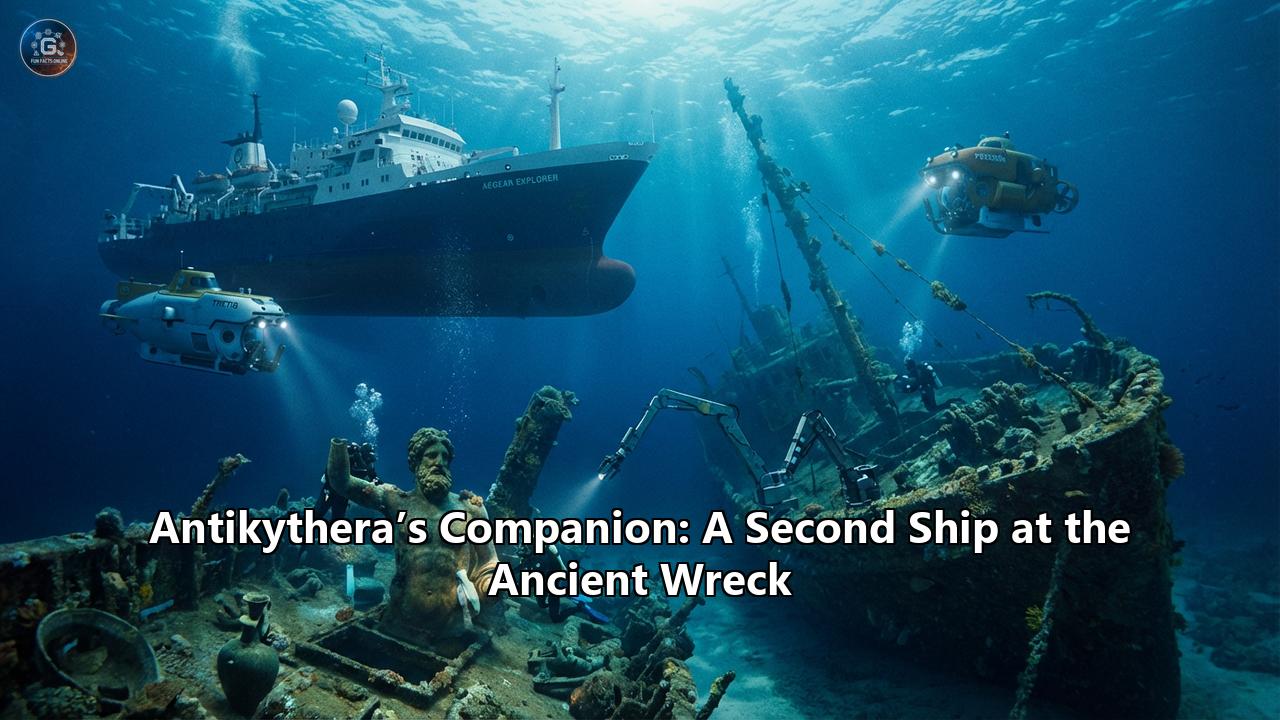
The Aegean Sea, a vast expanse of azure stretching between the Greek mainland and the Cretan archipelagos, has long been a graveyard of antiquity. But among its thousands of silent, submerged tombs, one site reigns supreme: the Antikythera shipwreck. For one hundred and twenty-five years, this Roman-era leviathan, resting precariously on a steep underwater slope off the tiny island of Antikythera, has captivated the world. It gave us the Antikythera Mechanism—an astronomical computer of such staggering complexity that it rewrote the history of technology. It surrendered bronze masterpieces, marble gods, and the bones of its doomed crew.
Just when the world believed the "Titanic of the Ancient World" had given up its greatest secrets, the seabed whispered a new one.
In the excavations of 2024 and 2025, a team of international archaeologists made a discovery that has sent shockwaves through the scientific community. The Antikythera ship did not die alone. Lying some two hundred meters away from the main wreckage, hidden beneath centuries of crushed pottery and sediment, lies the ghost of a second vessel. And within the main wreck itself, mysterious, thin hull planks suggest a third, smaller boat—perhaps a ship’s boat or a companion craft—was dragged down in the same cataclysm.
This is the story of "Antikythera’s Companion," a revelation that transforms a singular maritime tragedy into a complex historical event, painting a vivid new picture of ancient Roman luxury, the logistics of high-stakes trade, and the terrifying final moments of a convoy caught in the wrath of the sea.
Part I: The Ever-Giving Wreck
To understand the magnitude of the new discovery, one must first appreciate the legend of the site itself. In the spring of 1900, a group of sponge divers from Symi, blown off course by a violent gale, sought shelter off the jagged coast of Antikythera. When the storm abated, a diver named Elias Stadiatis donned his heavy canvas suit and copper helmet to check the seabed for sponges. He surfaced moments later, trembling and babbling about a "heap of rotting corpses" on the ocean floor.
Stadiatis hadn’t found a mass grave of men, but of gods. He had stumbled upon a Roman shipwreck laden with the finest Greek art of the 1st century BCE. The "corpses" were bronze and marble statues, tarnished and crusted with marine life, staring up from the abyss.
Since that initial, heroic salvage operation—the first major underwater archaeological excavation in history—the site has been visited sporadically. Jacques-Yves Cousteau dived there in 1976, recovering the famous "Antikythera Youth" and hull planks. But for decades, the depth (55 meters and sloping deeper) and the treacherous currents kept the wreck’s full footprint a mystery.
It was only with the "Return to Antikythera" project, a modern, high-tech collaboration between the Swiss School of Archaeology in Greece (ESAG), the Ephorate of Underwater Antiquities, and partners like the Aikaterini Laskaridis Foundation, that the site began to undergo a systematic, scientific autopsy.
The 2021-2025 five-year program was ambitious. Armed with closed-circuit rebreathers allowing for longer dive times, and remotely operated vehicles (ROVs) capable of precise 3D mapping, the team aimed to define the boundaries of the wreck. They expected to find more scattered cargo. They did not expect to find a second ship.
Part II: The Ghost in Area B
The breakthrough came when archaeologists expanded their survey zone. The main wreck site, known as "Area A," is a chaotic spill of amphorae, marble fragments, and hull timbers. But roughly 650 feet (200 meters) to the south, in a zone previously thought to be barren, the team’s acoustic scans and visual surveys picked up an anomaly.
Designated "Area B," this zone contained a concentration of pottery that mirrored the cargo of the main ship. At first, it was dismissed by some as merely "spillover"—debris that had rolled down the steep underwater cliff during the sinking or subsequent earthquakes. But as divers began to carefully excavate the sediment in 2024, the theory of spillover collapsed.
Beneath the layer of amphorae in Area B, they struck wood.
These were not random drift-wood fragments. They were structural timbers—frames and planks of a ship’s hull, lying in situ, pinned beneath the weight of its own cargo. The orientation and preservation of the wood confirmed that this was not a fragment of the main ship that had drifted away; it was a separate vessel entirely, one that had come to rest and disintegrated in its own distinct location.
The implications were immediate and profound. The Antikythera wreck was not the site of a solitary disaster. It was a debris field of a convoy.
Part III: The Companion Theory
Why were two ships traveling together? The discovery of the second ship in Area B has ignited a firestorm of scholarly debate regarding ancient maritime logistics.
The Convoy HypothesisIn the 1st century BCE, the Mediterranean was a dangerous place. While the Roman Republic was tightening its grip on the sea, the threat of piracy—particularly from the notorious Cilician pirates—was a constant reality. A ship as wealthy as the Antikythera vessel, laden with priceless bronzes, silver coins, glassware, and the mechanism itself, would have been a floating treasure chest. It is highly plausible that such a high-value transport would travel in a convoy for protection. The second ship could have been a military escort, a smaller, faster vessel designed to intercept pirate skiffs while the heavy merchantman made its escape.
The Heavy-Lift LogisticsAnother theory suggests a logistical partition. The main Antikythera ship was a giant of its time, a "grain freighter" class vessel modified to carry heavy art. Perhaps the cargo was simply too massive for one keel. The second ship might have been a "tender" or a secondary freighter, carrying the overflow of goods—the wine, the grain, and the olive oil—while the primary ship carried the ultra-high-value statuary and the Mechanism. The pottery found in Area B supports this; it includes commercial amphorae from Rhodes, Kos, and Chios, mirroring the supplies found on the main ship, suggesting they were provisioned at the same ports for the same journey.
The "Double Tragedy" ScenarioThe proximity of the wrecks suggests they died together. The Antikythera strait is infamous for its unpredictable currents and violent winds. If a sudden squall, a "medricane," struck the convoy, the ships would have battled the same waves. If the lead ship lost its rudder or shattered its mast, the companion vessel might have tried to assist, only to be dragged into the same fatal embrace of the cliffs. The discovery of the second ship paints a cinematic picture of the final moments: two captains shouting across the roaring waves, one ship watching the other succumb, before being smashed against the rocks itself.
Part IV: The "Third" Vessel? The Mystery of the Thin Planks
As if one new ship wasn't enough, the excavation of the main wreck (Area A) in 2024 and 2025 yielded a puzzle within a puzzle. Divers recovered a section of hull planking that defied expectations.
The fragments, measuring about 0.40 meters wide and 0.70 meters long, were connected to a frame (a nomeas) with copper pins. But the planks were remarkably thin—less than 5 centimeters thick. This is significantly flimsier than the massive, 10-centimeter-thick hull planks recovered by Cousteau in 1976.
Archaeologists are currently wrestling with three possibilities for these "thin planks":
- The Upper Deck: They could represent the upper superstructure or the bulwarks of the massive main ship, parts of the vessel that are rarely preserved. If so, they offer a rare glimpse into the architecture of Roman super-freighters.
- The Lifeboat: They could belong to a lembus, a large ship’s boat carried on deck or towed behind. In ancient shipwrecks, the "ship's boat" often went down with the mothership.
- A Third Ship: The tantalizing possibility exists that these planks belong to yet another small vessel, a third member of the convoy that was smashed directly on top of the main carrier.
The construction of these planks confirmed a vital technological detail: the ship was built "shell-first." In this ancient method, the outer planking was assembled and pinned together with thousands of mortise-and-tenon joints before the internal skeleton of ribs was inserted. This required master craftsmanship—a labor-intensive technique that created incredibly strong, watertight hulls, contrasting with the faster, "skeleton-first" method that would dominate later medieval shipbuilding.
Part V: Re-uniting a God—The Hercules Connection
While the hull timbers speak to the naval architects, the cargo speaks to the art historians. The 2024/2025 seasons produced one of the most emotional "reunions" in archaeological history.
In 1900, the sponge divers retrieved a headless marble statue of a weary, muscular man leaning on a club. It was identified as a copy of the famous "Farnese Hercules," a depiction of the demigod resting after his Twelve Labors. For over a century, this headless torso (Inventory No. 5742) stood silently in the National Archaeological Museum in Athens, a broken masterpiece.
In 2022, divers found a massive marble head, bearded and eroded, buried in the sand. In 2024, they found more fragments, including parts of the base and limbs.
Digital analysis and 3D modeling have now all but confirmed the match: the head belongs to the body. After 2,000 years of separation—one part in a museum, the other in the Aegean mud—Hercules is whole again.
The discovery of the head is significant not just for its aesthetic value, but for what it tells us about the violence of the wrecking. The fact that the head was found some distance from the torso, buried under different strata of debris, suggests the ship broke apart violently as it hit the seabed, scattering its heavy marble passengers like toys. It also reinforces the nature of the cargo: this was not just trade goods; this was looted or commissioned high art, destined for the villas of the ultra-wealthy Roman elite.
Part VI: The Mechanism’s New Narrative
For decades, the Antikythera Mechanism was viewed as a singular anomaly—a piece of "out-of-place" technology that seemed too advanced for its time. It was often romanticized as the possession of a lone genius astronomer traveling on the ship.
The discovery of a second ship (and potentially a third) reframes the Mechanism’s presence. It was likely part of an extremely high-value, secure official transport.
The Mechanism was not a trinket; it was the supercomputer of its age, capable of predicting eclipses, tracking planetary motions, and timing the Panhellenic games. Such a device would have been worth a king's ransom. If the Antikythera convoy was indeed a fleet carrying the spoils of war (perhaps from Sulla’s campaigns in Athens, or later commercial looting of Asia Minor), the Mechanism was likely just one item on a manifest of treasures.
The convoy theory suggests that the transport of this device was a carefully planned logistical operation. It wasn't just thrown into the hold of a tramp steamer; it was likely packed in a secure chest (bronze fragments of which have been found), guarded, and transported alongside other priceless works like the Hercules and the Antikythera Youth. The loss of this convoy would have been a financial catastrophe for the Roman sponsor—a loss equivalent to a modern container ship full of Ferraris and Picassos sinking today.
Part VII: Life and Death in the Deep
The new excavations have also brought us closer to the ghosts of the crew. Among the conglomerations of metal and wood, archaeologists found human teeth.
These teeth are time capsules. Through isotopic analysis and DNA sequencing, scientists hope to determine the origins of the crew. Were they Greeks from the islands? Egyptians? Slaves or free men?
The discovery of a clay mortar (basin) used for food preparation, along with olive stones and cooking pots in the recent dig, paints a picture of daily life on the convoy. We can imagine the crew of the companion ship signaling to the main vessel, sharing meals of olive oil, wine, and fish sauce (garum) stored in the Lamboglia 2 amphorae found in the wreck.
We also found evidence of their tools: sounding leads for measuring depth, huge lead anchor stocks, and iron nails. These men were skilled mariners, navigating without magnetic compasses, relying on the stars—the very stars the Antikythera Mechanism was designed to track.
Part VIII: The Tech Behind the Trek
The 2024/2025 discoveries were made possible only by a leap in underwater technology. The site is too deep for standard scuba diving; divers have only minutes of bottom time on air before nitrogen narcosis sets in.
The team utilized "closed-circuit rebreathers" (CCRs), which recycle exhaled gas, remove carbon dioxide, and add oxygen. This allowed divers to stay down for over 30 minutes at 50+ meters, carefully brushing away sand with paintbrushes rather than industrial vacuums.
Furthermore, the "Hublot Xplorations" program provided custom-built drones and underwater robots. These ROVs acted as the eyes of the team, scanning the seabed with multibeam sonar to penetrate the layers of sand and detect the density of objects buried beneath. It was this "X-ray vision" that first hinted at the existence of the hull timbers in Area B, invisible to the naked eye.
The team also established a "field micro-geoarchaeology lab" on the island of Antikythera itself. Instead of waiting months for analysis, sediment samples could be examined immediately for microscopic traces of spices, resins, or tar, giving real-time feedback to the divers about where to dig next.
Part IX: The Roman Hunger
To understand why these ships were there, we must look to Rome in the 1st Century BCE. The Republic was transitioning into an Empire. The Roman elite had an insatiable appetite for Greek culture. To be a civilized Roman was to own Greek art, to speak Greek, and to display Greek bronzes in your atrium.
The Antikythera convoy was a pipeline for this cultural appropriation. The cargo list reads like a museum catalog:
- Bronze Statues: The Antikythera Youth, the Philosopher.
- Marble Giants: Hercules, Apollo, horses.
- Luxury Furniture: Bronze couches with intricate fulcra (headrests).
- Glassware: Exquisite mosaic glass bowls from the Levant.
- Technology: The Mechanism.
The route is now clearer than ever. The amphorae types (Coan, Rhodian, Ephesian) suggest the fleet stopped at the major trading hubs of the Aegean—Kos, Rhodes, Ephesus—picking up supplies and perhaps consolidating cargo before making the dangerous crossing of the open Mediterranean towards Italy.
The second ship confirms the scale of this trade. This wasn't a one-off shipment; it was industrial-scale import/export. The fact that they risked the Antikythera strait—a notorious shortcut—rather than the safer coastal route suggests urgency. Was the buyer waiting? Was it a gift for Julius Caesar’s triumphal parade? The timeline (circa 60-50 BCE) tantalizingly overlaps with the rise of Caesar.
Conclusion: The Bottomless Archive
As the 2021-2025 program concludes, the Antikythera shipwreck has proven once again that it is not just a site, but an archive. It is a time capsule that refuses to be fully read.
The discovery of the "Second Ship" in Area B is not the end of the story; it is a new chapter. It implies that the seabed around Antikythera may hide even more vessels. If there was a convoy, could there be a third ship? A fourth?
The "Companion" vessel has transformed our understanding of the wreck from a lonely accident into a fleet-wide tragedy. It has reunited the body of Hercules with his head. It has shown us the shell-first hull construction of the ancients in unprecedented detail.
But perhaps most poignantly, it reminds us of the fragility of human endeavor. The Antikythera Mechanism, the device that calculated the heavens, could not predict the storm that would bury it. And the two ships, sailing together for safety in numbers, found only a shared grave in the dark waters of the Aegean.
As the artifacts from the 2025 season undergo conservation, the world waits. The ocean floor is vast, and the Antikythera convoy may yet have more ghosts to surrender.
Reference:
- https://hyperallergic.com/massive-head-of-hercules-pulled-from-historic-shipwreck/
- https://en.wikipedia.org/wiki/Ancient_Mediterranean_piracy
- https://learningenglish.voanews.com/a/ancient-shipwrecks-tell-story-of-trade-routes/4609382.html
- https://www.newsweek.com/hercules-head-statue-found-ancient-shipwreck-roman-greece-antikythera-1717974
- https://www.livescience.com/antikythera-mechanism-shipwreck-new-artifacts