
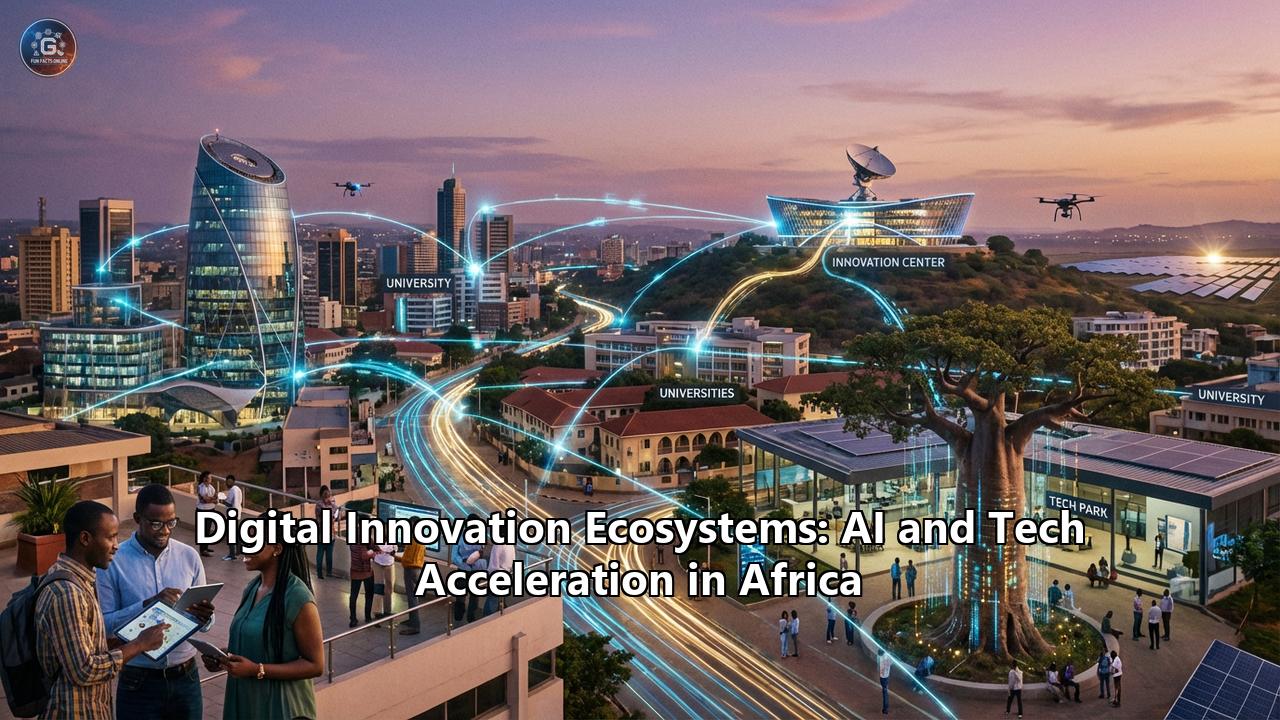
The narrative of African technology has fundamentally shifted. For the better part of the last decade, the global perception of Africa’s digital landscape was anchored by the revolutionary, yet singular, success of mobile money platforms like M-Pesa. Today, as we navigate through 2026, the continent is no longer just a testing ground for basic digital financial inclusion; it is a sprawling, sophisticated, and fiercely competitive digital innovation ecosystem. Driven by a demographic dividend—where over 60% of the population is under the age of 25—rapid urbanization, and an unstoppable wave of entrepreneurial ambition, Africa is leapfrogging legacy infrastructure directly into the era of Artificial Intelligence (AI) and DeepTech.
The digital renaissance occurring across the continent is not a monolith. It is a highly localized, fiercely innovative, and dynamically funded web of tech hubs, accelerators, venture capital networks, and government policy frameworks. From the geothermal-powered data centers of Kenya’s Silicon Savannah to the bustling, hyper-creative streets of Yaba in Lagos, and from the sophisticated financial corridors of Cape Town to the emerging “AI Lab” of Kigali, Rwanda, Africa’s tech ecosystem is maturing at an unprecedented pace.
This comprehensive exploration delves into the anatomy of Africa’s tech acceleration, the tidal wave of AI adoption reshaping legacy industries, the realities of the venture capital landscape, the crucial role of government policies, and the challenges that founders must navigate in a tightening, yet highly lucrative, global market.
The Macro View: A Resilient Venture Capital Landscape
To understand the scale of digital innovation in Africa, one must first examine the capital fueling it. After a period of global economic turbulence, rising interest rates, and a worldwide venture capital winter that squeezed emerging markets between 2023 and 2024, African tech has demonstrated remarkable resilience and structural maturity.
According to the Partech Africa Tech VC Report, total investment in the continent’s startup ecosystem reached an impressive $4.1 billion in 2025, marking a 25% jump from the previous year and the strongest funding level since 2022. However, the headline numbers tell only half the story. The composition of this capital has undergone a radical transformation.
Equity funding—the traditional cornerstone of venture capital—grew modestly by 8% to $2.4 billion across 462 deals. The explosive growth came from an entirely different asset class: venture debt. African tech startups raised a record $1.64 billion in debt financing in 2025, a massive 63% increase from the year before. Debt now accounts for 41% of total capital deployed, up from a mere 17% in 2019. This shift is monumental. It signifies that African tech companies are maturing past the early-stage, cash-burning phases. Companies utilizing debt financing are those with predictable revenue streams, solid unit economics, and tangible cash flows—a stark contrast to the "growth at all costs" mentality of the early 2020s.
The "Big Four" and the Rise of the Rest
Capital distribution remains heavily concentrated in what is affectionately known as the "Big Four": Kenya, South Africa, Egypt, and Nigeria. Together, these powerhouses captured 72% of total funding in 2025.
- Kenya led the continent, pulling in $1.04 billion (a 72% year-over-year jump), heavily fueled by massive debt rounds for infrastructure and green energy projects.
- South Africa maintained its dominance in equity funding and deal volume, leveraging its advanced financial markets.
- Egypt continued to attract capital with its strategic position bridging the Middle East and North Africa.
- Nigeria, while experiencing a recalibration in deal sizes, maintained its status as the volume leader for consumer tech and fintech.
Yet, the ecosystem is democratizing. Francophone Africa is rising rapidly, capturing 68% of equity outside the main hubs. Countries like Senegal, Morocco, and Rwanda each surpassed the $50 million funding mark in 2025, proving that investors are looking beyond the traditional giants for untapped potential.
Local Capital Takes the Wheel
One of the most encouraging trends heading into 2026 is the surge of local African investors. According to the African Private Capital Association (AVCA), local funds were the most active players in the market for the second consecutive year. With 188 African investors backing companies on the continent, the reliance on fickle foreign capital is waning. Firms like Launch Africa Ventures (Mauritius), All On (Nigeria), and ESquared Investments (South Africa) are consistently leading seed and Series A rounds. This local capital provides a buffer against global macroeconomic shocks; African family offices, local banks, and pension funds are filling the gaps left by retreating international tourists, making the ecosystem more self-reliant and intimately tied to local socioeconomic realities.
The AI Acceleration: Redefining African Industries
If mobile money defined the 2010s, Artificial Intelligence is undeniably the architect of the 2020s. However, AI in Africa is not about generating deepfakes or writing poetry via chatbots; it is about survival, efficiency, and solving deeply rooted infrastructural deficits. Startups are boldly and responsibly applying AI to tackle challenges in healthcare, agriculture, financial inclusion, and logistics.
With over 2,400 AI-focused companies on the continent as of recent data, AI adoption is transitioning from a buzzword to a fundamental operational layer. A Microsoft AI report highlights that South Africa currently leads the continent with a 21.1% AI adoption rate, followed by Egypt (13.4%), Morocco (10.9%), and Nigeria (9.3%). The economic stakes are astronomical—projections suggest that AI could add $2.9 trillion to the global economy, and Nigeria alone is targeting 43% of Africa's projected $136 billion in AI-driven productivity gains by 2030.
Agritech: Climate Resilience and Food Security
Agriculture employs over 60% of Sub-Saharan Africa's workforce but contributes disproportionately low yields due to reliance on rain-fed farming, lack of data, and climate change vulnerabilities. AI is flipping this narrative. Agritech startups in Nigeria and Kenya have seen rapid growth, connecting farmers directly to markets and reducing post-harvest losses by up to 20%.
Innovators are bringing precision agriculture to smallholder farmers. Startups like Shamba Records in Kenya are utilizing AI-powered platforms to empower over 50,000 farmers with smart credit, direct market access, and climate-resilient data. In Rwanda, Smartel Agri Tech equips farmers with solar-powered, AI-driven devices that detect crop pests and diseases early, sending automated SMS alerts to basic feature phones—a brilliant marriage of high-tech algorithms and low-tech delivery. Similarly, Senegal’s TOLBI leverages AI and satellite imagery to provide precise crop yield forecasts, allowing governments and cooperatives to plan for food security proactively.
By analyzing localized weather patterns, soil pH levels, and historical crop data, African AI models are moving farmers from reactive subsistence farming to proactive, commercial-grade agriculture.
Healthcare: Bridging the Doctor-to-Patient Gap
Africa suffers from a severe shortage of medical professionals. The World Health Organization notes that Africa carries 25% of the global disease burden but has only 3% of the world's health workers. AI-powered healthtech is stepping into this massive void.
Nigerian startup Myltura utilizes AI to power a digital health platform that enables remote care, diagnostic test access, and seamless health data management, specifically designed for low-bandwidth environments. In Ethiopia, YeneHealth is streamlining access to affordable medications and maternal healthcare services through an AI-optimized platform. South Africa’s Rapid Human AI is drastically cutting software development time for healthcare providers, turning design-thinking ideas into deployable code in days rather than months.
These platforms use machine learning algorithms to triage patients, analyze medical imagery (like X-rays and ultrasounds) with high accuracy, and predict disease outbreaks by analyzing regional mobility and symptom data. The result is a democratization of world-class medical diagnostics, accessible via a smartphone in a remote village.
Fintech: From Transactions to Intelligence
Fintech remains the undisputed heavyweight champion of African tech, attracting nearly $1.5 billion in funding in 2025 alone. However, the nature of fintech is evolving. The first wave was about digitizing cash and moving it from point A to point B. The current wave is about what you can do with the data generated by those transactions.
Enter Enterprise AI. Startups like Nigeria’s Pastel are delivering enterprise-grade AI services, including fraud detection and anti-money laundering tools, tailored specifically for African financial institutions. In a continent where identity verification has historically been a stumbling block for credit access, AI-driven alternative credit scoring is revolutionary. Startups are utilizing machine learning to analyze mobile money usage, utility payments, and even smartphone behavioral data to build credit profiles for the unbanked.
Furthermore, cross-border payments are being hyper-optimized. With the operationalization of the African Continental Free Trade Area (AfCFTA), borderless commerce is a priority. Fintechs like LemFi, which raised an astounding $53 million in January 2025, are using AI to navigate complex, multi-currency regulatory environments, allowing a trader in Lagos to seamlessly pay a supplier in Abidjan with a 0.5% fee. AI algorithms dynamically route these payments through the cheapest and most efficient liquidity corridors, bypassing the traditional, sluggish correspondent banking system.
Infrastructure, Logistics, and Compliance
The fragmentation of Africa's supply chains has long been a barrier to intra-continental trade. Today, AI is smoothing out the friction. Startups like Apexloads in Kenya provide SaaS solutions for freight stakeholders, using AI to match cargo with vetted logistics partners efficiently. Middleman in Nigeria utilizes AI for secure import payments and procurement, primarily bridging the complex trade routes between Africa and China.
Moreover, regulatory compliance—a notorious headache for scaling businesses across Africa's 54 distinct legal frameworks—is being automated. Ghana’s Regulon has developed an AI-powered compliance and onboarding platform designed to simplify regulatory processes for businesses expanding across Africa and the EMEA region, dramatically reducing the time it takes to enter new markets.
The Accelerator Engine: Nurturing the Ecosystem
The maturation of these startups is not happening in a vacuum. It is being meticulously cultivated by a robust network of over 600 active tech hubs, incubators, and corporate accelerators. These institutions provide the vital scaffolding—co-working spaces, cloud credits, mentorship, and investor access—that transforms a raw idea into a scalable enterprise.
Global technology behemoths have recognized that the next billion digital users will come from Africa, and they are investing heavily in the ecosystem's foundational layers. A prime example is the Google for Startups Accelerator: Africa. In its 2025 cohort, Google doubled down on AI, selecting 15 startups from countries spanning South Africa, Nigeria, Kenya, Rwanda, Ghana, and Senegal. These programs offer non-equity support, providing founders with direct access to Google's AI/ML engineers, cloud architecture, and global investor networks.
Beyond corporate accelerators, global intergovernmental initiatives are stepping up. The AI Hub for Sustainable Development Co-Design, an initiative co-led by the Italian G7 Presidency and the United Nations Development Programme (UNDP), recently launched a startup acceleration pilot focusing exclusively on African AI. This program targets the three critical bottlenecks of AI development in Africa: data, compute, and talent pipelines. By focusing on solutions that put sustainability at the center, the program aims to ensure that AI development does not become an extractive industry, but rather one that directly benefits local communities.
Funding mechanisms are also diversifying. Startups now have access to a rich tapestry of financial instruments, from non-equity grants provided by impact investors (like the Mastercard Foundation and various climate resilience funds) to early-stage equity from specialized venture studios. This layered funding ecosystem ensures that founders building deep, structural innovations—which often require longer gestation periods than consumer apps—have the runway they need to succeed.
Government Policy: The Race for AI Readiness
Innovation often outpaces regulation, but African governments are acutely aware that to harness the economic windfall of AI, they must build cohesive, ethical, and forward-thinking regulatory frameworks. As of late 2025, 16 out of 54 African countries have officially launched national AI strategies, with countries like Kenya, Rwanda, Ghana, and Senegal leading the charge. The narrative is shifting from Africa being a passive consumer of global technology to an active architect of its digital future.
Rwanda: Africa's AI Lab
Rwanda is rapidly positioning itself as the continent's premiere tech sandbox. Through the Rwanda Information Society Authority (RISA), the country has launched a comprehensive National AI Policy focusing on six critical sectors: agriculture, public administration, health, education, energy, and financial services. Rwanda’s approach is deeply tied to digital governance; they are developing frameworks to ensure AI systems are transparent, secure, and aligned with human rights. By investing heavily in public-sector applications, such as urban mobility and health diagnostics, Kigali is proving that government can be a prime consumer and catalyst for AI innovation.
Kenya: The Data Engine of East Africa
Kenya, widely recognized as the Silicon Savannah, is leveraging its status as a green energy powerhouse to attract AI infrastructure. With massive investments in geothermal-powered data centers, Kenya is addressing one of AI's biggest global bottlenecks: the immense energy requirement for training large language models. The Kenyan government’s task force on the National AI and Robotics Strategy is focusing heavily on data-driven innovation in agriculture and logistics. With over 600,000 individuals already trained in fundamental AI skills, Kenya’s adoption rate is projected to climb steadily, supported by progressive reforms in data protection.
Nigeria: The Volume Player
Nigeria, the continent's most populous nation and largest economy, approaches AI through the lens of sheer scale and productivity. The Federal Ministry of Communication, Innovation, and Digital Economy has taken an inclusive approach, actively co-creating its National Artificial Intelligence Strategy with a global network of Nigerian researchers and tech founders. The draft policy prioritizes skills training, local language model development, and massive cloud infrastructure rollouts. Despite systemic challenges like electricity access, Nigeria’s goal to capture a massive slice of the $136 billion AI productivity pie by 2030 underscores the aggressive ambition of its ecosystem.
Ghana and South Africa: Ethics and Infrastructure
Ghana has unveiled its National AI Strategy alongside an Emerging Technologies Bill aimed at harmonizing data governance, cybersecurity, and AI ethics. By integrating AI curricula into secondary and tertiary education, Ghana is proactively combating the digital skills gap. Meanwhile, South Africa, which boasts the highest AI adoption rate on the continent (21.1%), is leveraging its highly developed corporate sector and robust digital infrastructure. While it has not yet passed specific AI laws, comprehensive 2024 discussion documents outline a stakeholder-driven approach to regulation, ensuring that innovation is not stifled by premature red tape.
The Reality Check: A Tightening Market and Ecosystem Challenges
Despite the soaring funding numbers and policy advancements, the African digital ecosystem is not without its harsh realities. The record $4.1 billion raised in 2025 must be contextualized within a broader global shift toward financial discipline. The "easy money" era of 2021—where startups could raise multi-million dollar seed rounds on the back of a slick pitch deck and a charismatic founder—is definitively over.
The market in 2025 and moving into 2026 has shown a drastically reduced tolerance for poor governance, unsustainable unit economics, and growth without profitability. This tightening was laid bare by the collapse of several high-profile startups. Startups that relied heavily on continuous venture capital injections to subsidize customer acquisition found themselves stranded when the music stopped.
For instance, companies like Medsaf in Nigeria shut down after failing to close an acquisition due to a lack of operational runway. Kenya's buy-now-pay-later firm Lipa Later entered administration when investors refused to fund further losses. South Africa's Banxso faced collapse following massive regulatory penalties. These failures, while painful, are indicative of a healthy, maturing ecosystem. Investors are no longer willing to rescue distressed companies that lack a clear path to sustainability. Acquisitions are no longer a guaranteed safety net for failing startups; buyers are enforcing rigorous due diligence, and trust has become fragile.
The Infrastructure and Talent Deficit
Furthermore, foundational challenges remain. Africa currently hosts less than 1% of the world’s data center capacity, making cloud computing and AI model training prohibitively expensive for local startups, who must rely on servers in Europe or the US. Add to this the reality that over 80% of Sub-Saharan Africa still struggles with reliable electricity access, and the physical constraints on digital innovation become stark.
Then there is the issue of talent. While Africa produces brilliant engineers, there is a continuous "brain drain" to the global North, where tech salaries are exponentially higher. To counter this, organizations and startups are investing heavily in local talent pipelines. Communities like DataProphet, Zindi, and InstaDeep are fostering a generation of data scientists capable of building world-class algorithms from the continent. By democratizing access to education through platforms like ALX and Andela, the ecosystem is attempting to build a self-sustaining talent engine that views Africa not as a stepping stone, but as the final destination for deep tech careers.
The Rise of Digital Public Infrastructure and AfCFTA
A critical accelerant for the 2026 ecosystem is the convergence of Digital Public Infrastructure (DPI) and the African Continental Free Trade Area (AfCFTA). DPI—comprising digital identity systems, interoperable payment rails, and data exchange platforms—reduces the friction of doing business. As governments roll out national digital IDs, startups can seamlessly KYC (Know Your Customer) new users, dramatically lowering customer acquisition costs.
The AfCFTA, aimed at creating a single market for goods and services across 1.3 billion people, is the ultimate catalyst for tech scaling. Historically, an African startup scaling from Nigeria to Kenya had to build entirely new infrastructure, navigate a new central bank, and integrate with new local telcos. Today, pan-African fintechs and logistics platforms are utilizing the regulatory harmonization brought by AfCFTA to scale seamlessly. The ability to move capital, goods, and digital services across borders with minimal friction is transforming local champions into pan-African titans.
Looking Ahead: The African Tech Narrative of 2030
As we look toward the end of the decade, the trajectory of Africa’s digital innovation ecosystem points toward monumental economic integration. The projected exponential growth is backed by irreversible market fundamentals: by 2050, Africa will be home to a third of the world's young people, and its digital economy is estimated to reach an astounding $712 billion.
The startups that survive the current period of consolidation will be battle-tested, financially disciplined, and deeply embedded in the continent's critical infrastructure. They will not be building "the Uber of Africa" or "the Stripe of Africa"; they will be building entirely novel business models tailored to the unique economic realities of the global South.
Moreover, African innovation is increasingly achieving global relevance. Products built for the rugged, low-bandwidth, and fragmented realities of African markets are proving highly adaptable in other fast-growing emerging markets in Latin America and Southeast Asia. The continent is no longer just a testing ground; it is a premium source of durable, competitive innovation.
The ecosystem is transitioning from volume to value. It is characterized by record Mergers & Acquisitions (M&A) activity, where stronger companies absorb the weak, creating consolidated powerhouses capable of competing on a global scale. With layoffs stabilizing and operational efficiency becoming the new mantra, African tech has found its sustainable footing.
In conclusion, the acceleration of digital innovation and AI in Africa is not a fleeting trend; it is a structural revolution. It is being driven by debt-ready, mature startups, a surging class of local venture capitalists, forward-thinking government policies, and a relentless demographic engine. The challenges of infrastructure and governance remain real, but they are no longer insurmountable barriers—they are the very friction points that African entrepreneurs are turning into multi-billion-dollar opportunities. As the physical and digital infrastructure of the continent continues to fuse, the African digital ecosystem stands ready to not only participate in the global digital economy but to actively redefine its future.
Reference:
- https://mohacafrica.org/tech-startups-in-africa/
- https://africa.com/powering-innovation-and-economic-growth-in-africa/
- https://furtherafrica.com/2025/11/07/ghana-rwanda-and-kenya-pioneer-national-ai-strategies-for-inclusive-growth/
- https://www.techinafrica.com/microsoft-ai-report-top-african-countries-ai-readiness/
- https://www.techinafrica.com/african-tech-funding-hits-4-1b-in-2025-whats-really-driving-the-growth/
- https://partechpartners.com/africa-reports/2025-africa-tech-venture-capital-report
- https://www.ecofinagency.com/news-finances/1402-52907-africa-vc-funding-climbs-to-3-9bn-in-2025-led-by-local-funds-avca
- https://blog.google/intl/en-africa/company-news/outreach-and-initiatives/meet-the-15-startups-joining-the-2025-google-for-startups-accelerator-africa-cohort/
- https://techcultureafrica.com/african-ai-startups
- https://www.digital-africa.co/en/blog/african-tech-startups-raise-289-million-in-january-2025-a-powerful-start-to-the-year
- https://aipreneurs.org/ai-grants-and-funding-opportunities-for-african-startups-2025/
- https://aiforgood.itu.int/a-new-accelerator-for-ai-in-africa-submit-your-start-up-now/
- https://intelpoint.co/insights/only-16-african-countries-have-launched-national-ai-strategies-as-of-july-2025/
- https://graysilicon.com/the-status-of-ai-specific-policies-and-regulations-in-countries-across-africa/
- https://www.dabafinance.com/en/news/africa-tech-failed-deals-2025-discipline
- https://www.africanleadershipmagazine.co.uk/africas-tech-ecosystem-to-record-712-billion-growth-by-2050-report/
- https://insights.techcabal.com/the-state-of-tech-in-africa-h1-2025-1-42b-raised-amid-record-ma-activity/