
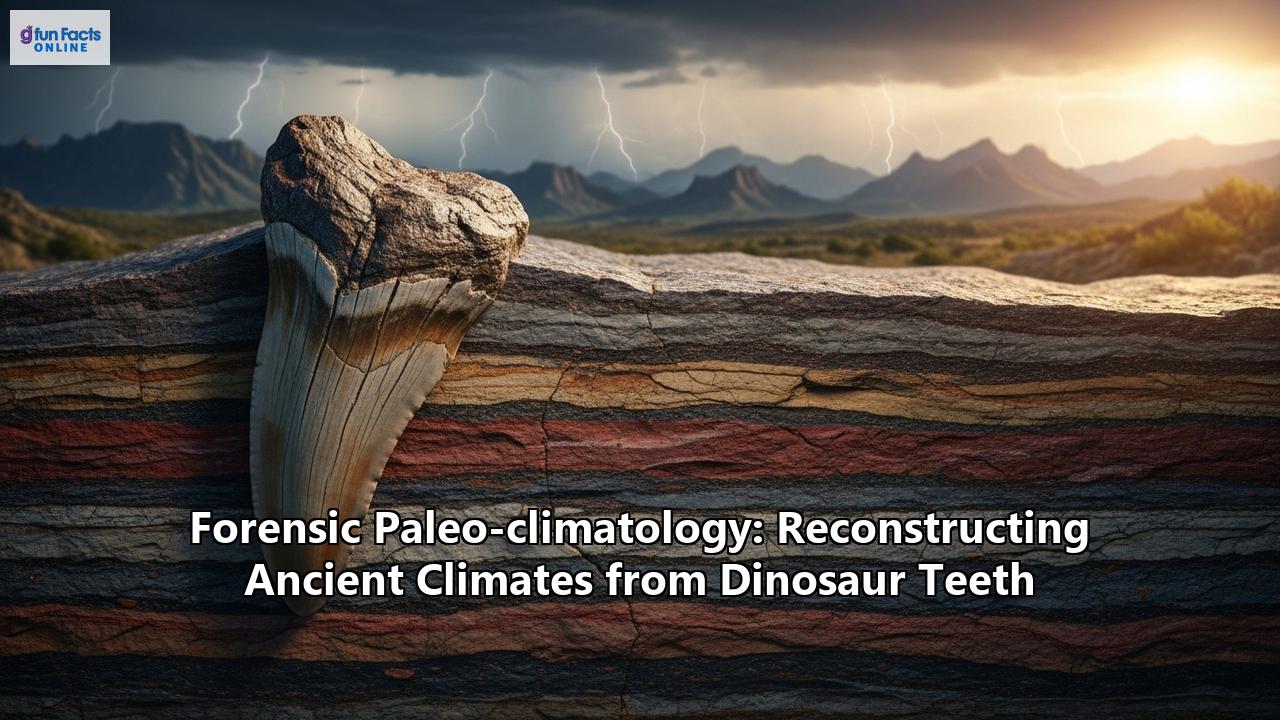
An incredible journey into the deep past is being led not by time machines, but by the fossilized teeth of the colossal creatures that once roamed our planet. In the burgeoning field of forensic paleo-climatology, scientists are unlocking the secrets of ancient climates, ecosystems, and the very air that dinosaurs breathed, all from the microscopic and chemical clues preserved within their dental remains. These are not just lifeless fossils; they are intricate, natural archives, recording the world of the Mesozoic Era with astonishing fidelity. This article delves into the cutting-edge techniques that are transforming dinosaur teeth into powerful tools for reconstructing the prehistoric world, revealing a planet of dynamic climate shifts, volcanic upheavals, and atmospheric compositions that challenge our understanding of Earth's history.
The Tooth as a Time Capsule: Nature's Hard Drive
Fossilized teeth, particularly their enamel, are a treasure trove for paleontologists and climate scientists alike. Tooth enamel is one of the most resilient biological substances, capable of surviving for hundreds of millions of years with minimal alteration. This durability makes dinosaur teeth robust time capsules, preserving chemical and physical signatures of the environment in which the dinosaur lived. Unlike bones, which are more porous and susceptible to contamination from the surrounding rock and groundwater over geological time, enamel's dense crystalline structure provides a more pristine record.
The different components of a tooth—enamel, dentine, and cementum—offer various avenues of investigation. Enamel, being the hardest and most mineralized tissue, is particularly resistant to diagenesis, the post-mortem alteration of fossils. This makes it the preferred material for many geochemical analyses. Dentine, which constitutes the bulk of the tooth, contains microscopic tubules that can sometimes be infiltrated by secondary minerals during fossilization. However, even dentine can yield valuable information, especially about the animal's growth and development.
Paleontologists have long known that the dentine of dinosaurs contains incremental growth lines, but it is the recent advancements in analytical techniques that have allowed for a more detailed and nuanced interpretation of these features. The convergence of paleontology, geochemistry, and advanced imaging technologies is allowing scientists to read these dental archives with unprecedented precision, opening new windows into the lost world of the dinosaurs.
Isotopic Analysis: Deciphering the Chemical Language of Climate
Perhaps the most powerful tool in the forensic paleo-climatologist's arsenal is isotopic analysis. Isotopes are variants of a particular chemical element that differ in neutron number. The relative abundance of different isotopes in a dinosaur's tooth can reveal a wealth of information about the temperature, diet, and even the composition of the atmosphere during the dinosaur's lifetime.
Oxygen Isotopes: A Thermometer for the Mesozoic
The analysis of oxygen isotopes, particularly the ratio of the heavier oxygen-18 (¹⁸O) to the lighter oxygen-16 (¹⁶O), is a cornerstone of paleoclimate research. This ratio in the tooth enamel of a dinosaur is directly related to the isotopic ratio of the water it drank. The water sources for dinosaurs, such as rivers, lakes, and the plants they consumed, were ultimately derived from local precipitation. The oxygen isotope ratio of rainwater is, in turn, heavily influenced by temperature, providing a direct link between the chemistry of a dinosaur's tooth and the climate of its habitat.
A groundbreaking development in this area is the use of triple oxygen isotope analysis, which measures the abundance of all three stable oxygen isotopes: ¹⁶O, ¹⁷O, and ¹⁸O. This technique has allowed scientists to reconstruct not just temperature, but also the concentration of carbon dioxide (CO₂) in the Mesozoic atmosphere. A recent study published in the Proceedings of the National Academy of Sciences (PNAS) utilized this method on dinosaur teeth from the Late Jurassic and Late Cretaceous periods, revealing that atmospheric CO₂ levels were significantly higher than today. During the Late Jurassic, around 150 million years ago, CO₂ concentrations were estimated to be about four times pre-industrial levels, and in the Late Cretaceous, they were roughly three times higher.
These findings have profound implications for our understanding of ancient climates. Higher CO₂ levels are associated with a stronger greenhouse effect, leading to warmer global temperatures. The study also found that global photosynthesis was occurring at about twice the rate seen today, likely fueled by the higher CO₂ concentrations and warmer temperatures. This suggests a much more productive biosphere during the age of dinosaurs, which would have been necessary to support the immense size of many of these creatures.
Furthermore, the triple oxygen isotope analysis of some teeth, including those of Tyrannosaurus rex and a sauropod relative named Kaatedocus siberi, showed unusual isotopic compositions. These anomalies are interpreted as evidence of short-term spikes in atmospheric CO₂, potentially linked to massive volcanic eruptions, such as those of the Deccan Traps in modern-day India towards the end of the Cretaceous. This technique, therefore, not only provides a baseline for the Mesozoic climate but also captures evidence of dramatic environmental events.
Another innovative technique, known as clumped isotope thermometry, offers a way to directly measure a dinosaur's body temperature. This method analyzes the tendency of heavy isotopes of carbon (¹³C) and oxygen (¹⁸O) to "clump" together in the carbonate mineral lattice of tooth enamel. The degree of this clumping is dependent on the temperature at which the mineral formed. Studies using this technique on sauropod teeth from the Jurassic have indicated body temperatures between 36°C and 38°C, similar to modern mammals. This provides crucial insights into the debate about whether dinosaurs were warm-blooded or cold-blooded, suggesting a capacity for thermoregulation.
Carbon and Strontium Isotopes: Reconstructing Diets and Ecosystems
The analysis of carbon isotopes (¹³C/¹²C) in tooth enamel provides clues about a dinosaur's diet. Plants utilize different photosynthetic pathways (C3, C4, and CAM), which results in different carbon isotope ratios in their tissues. Herbivores that consume these plants incorporate these isotopic signatures into their own bodies, including their teeth. By analyzing the carbon isotopes in a dinosaur's tooth, scientists can infer the types of plants it was eating.
This information is not only valuable for understanding the diet of individual species but also for reconstructing entire ecosystems. For example, by analyzing the carbon and strontium isotopes in the teeth of various herbivorous dinosaurs from the same fossil site, researchers can investigate niche partitioning—how different species coexisted by utilizing different food resources. This helps to explain the incredible diversity of herbivorous dinosaurs found in many fossil formations.
A study on the dinosaur fauna of the Carnegie Quarry in the Morrison Formation used calcium isotopes to investigate niche partitioning. The results suggested that different herbivores may have specialized in feeding at different heights, reducing competition for food.
Growth Rings: A Seasonal Diary in Dentine
Much like the rings of a tree, the incremental growth lines in the dentine of dinosaur teeth, known as von Ebner's lines, can provide a record of the animal's life. It is widely believed that these lines represent daily growth increments. By counting these lines, paleontologists can determine how long it took for a dinosaur's tooth to form and be replaced. This information is valuable for understanding the biology and metabolism of these animals.
The study of these growth increments, a field known as sclerochronology, also holds the potential to reconstruct paleoseasonality. Just as tree rings can be wider in favorable growing seasons and narrower in times of stress, the spacing and composition of von Ebner's lines could reflect seasonal changes in the environment. For example, variations in food availability or water stress due to dry or cold seasons might be recorded in the growth of the dentine.
While the interpretation of seasonal signals from von Ebner's lines is still a developing area of research, some studies have shown promising results. For instance, cyclical variations in oxygen isotope compositions have been observed along the growth axis of theropod teeth, which are interpreted as reflecting seasonal changes in the isotopic composition of ingested water. One study on a theropod tooth from the Nemegt Formation in Mongolia revealed a seasonal pattern similar to that of modern cold temperate and continental climates. In contrast, a tooth from the high-latitude Kakanaut Formation in Russia showed dampened seasonal variations, likely due to the moderating influence of the ocean.
The analysis of growth rings is not without its challenges. The lines can be very fine and require high-resolution microscopy to be seen clearly. Furthermore, it can be difficult to distinguish between daily growth lines and other features in the dentine. Despite these difficulties, the potential of sclerochronology to unlock the secrets of Mesozoic seasonality is a compelling area of ongoing research.
Dental Microwear: Scratches and Pits that Tell a Story
The surface of a dinosaur's tooth is not a pristine, unworn surface. The act of eating leaves behind a microscopic landscape of scratches and pits, a field of study known as dental microwear analysis. These microscopic textures can reveal a surprising amount of detail about a dinosaur's diet and feeding behavior in the last few weeks or months of its life.
The development of Dental Microwear Texture Analysis (DMTA) has been a game-changer in this field. This technique uses high-resolution 3D imaging to quantify the complexity and roughness of the tooth's surface. Different types of food leave behind different microwear patterns. For example, tough, fibrous vegetation tends to create long, parallel scratches, while hard objects like nuts, seeds, or bone result in a higher density of pits.
By comparing the microwear patterns on dinosaur teeth to those of modern animals with known diets, scientists can make inferences about what the dinosaurs were eating. For instance, a study on hadrosaurids, or duck-billed dinosaurs, found a shift towards rougher dental microwear textures in the Late Cretaceous. This suggests a dietary shift towards more abrasive foods, possibly due to the increased prevalence of angiosperms (flowering plants) that contain abrasive silica bodies called phytoliths.
Dental microwear can also provide insights into an animal's habitat and behavior. A recent study on sauropod dinosaurs from the Late Jurassic of the USA, Portugal, and Tanzania found that wear patterns could indicate whether a species was migratory. The teeth of camarasaurid sauropods showed remarkably consistent wear patterns across different climate regimes, suggesting that these dinosaurs may have migrated to follow their preferred food sources. In contrast, the more variable wear patterns on the teeth of diplodocids suggest they were more stationary, adapting their diet to seasonally available plants.
Furthermore, the presence of grit and dust on vegetation can also contribute to tooth wear. In the semi-arid environments of the Tendaguru Formation in Tanzania, the high levels of abrasive wear on sauropod teeth are thought to be the result of a diet contaminated with wind-blown sand. Thus, dental microwear can not only tell us what a dinosaur ate, but also provide clues about the aridity and dustiness of its environment.
Case Studies: Bringing Ancient Worlds to Life
The application of these forensic techniques to specific fossil localities and dinosaur species has provided some of the most vivid reconstructions of prehistoric life.
The Morrison Formation: A Tale of Two Sauropods
The Late Jurassic Morrison Formation of western North America is famous for its rich dinosaur fauna, including the iconic sauropods Camarasaurus and Diplodocus. For a long time, paleontologists have wondered how so many giant herbivores could have coexisted in the same ecosystem. Dental microwear analysis has provided some answers. Studies have shown that Camarasaurus, with its more robust teeth, had a diet that included tougher vegetation, while the more delicate, peg-like teeth of Diplodocus were better suited for browsing on softer plants. This dietary niche partitioning would have reduced competition between the two giants, allowing them to thrive in the same habitat. The aforementioned evidence of migratory behavior in Camarasaurus versus the more sedentary nature of Diplodocus further illustrates how these animals carved out their own ecological niches.
The Hell Creek Formation: The World of T. Rex
The Hell Creek Formation, which spans parts of Montana, Wyoming, and the Dakotas, preserves the last dinosaur ecosystems before the mass extinction event at the end of the Cretaceous. It is here that the remains of Tyrannosaurus rex are found. Isotopic analysis of T. rex teeth has contributed to the recent groundbreaking findings about the high CO₂ levels and dynamic climate of the Late Cretaceous. Dental microwear studies on T. rex have also provided insights into its feeding behavior. While it was clearly a predator capable of crushing bone, the microwear on its teeth can help to determine the frequency of such behavior and whether it varied with age. For example, some research suggests that juvenile tyrannosaurids may have had different feeding strategies than adults, possibly scavenging more frequently.
The Kem Kem Beds: The River Giant of Africa
The Kem Kem beds of Morocco have yielded a wealth of fossils from a unique river system that existed during the Cenomanian stage of the Late Cretaceous. This ecosystem was dominated by a plethora of large predators, including the enigmatic Spinosaurus. With its conical, crocodile-like teeth and elongated snout, Spinosaurus has long been thought to have been a fish-eater. Oxygen isotope analysis of Spinosaurus teeth has provided strong evidence for a semi-aquatic lifestyle. The isotopic composition of its teeth is more similar to that of coexisting semi-aquatic crocodilians and turtles than to other terrestrial theropod dinosaurs from the same environment. This suggests that Spinosaurus spent a significant amount of its time in the water, which would have allowed it to coexist with other large predators by exploiting different resources. More recent studies on the dentine of Spinosaurus teeth have even attempted to reconstruct high-resolution paleoenvironmental changes by tracking isotopic variations along the tooth's growth axis.
Challenges and the Future: Pushing the Boundaries of Paleo-Climatology
While the use of dinosaur teeth in forensic paleo-climatology has yielded incredible results, the field is not without its challenges. The primary hurdle is diagenesis, the alteration of fossils over millions of years. The chemical composition of a tooth can be changed by the minerals in the surrounding sediment and groundwater, potentially obscuring the original biological and climatic signals. This is why careful screening of fossils is crucial, and why enamel is the preferred tissue for geochemical analysis due to its greater resistance to diagenesis.
Another challenge lies in the interpretation of the data. For example, while von Ebner's lines are believed to be daily, their formation can be influenced by a variety of factors, making the interpretation of seasonal patterns complex. Similarly, dental microwear can be influenced by a single meal, so a large sample size of teeth is needed to get a representative picture of an animal's diet.
Despite these challenges, the future of forensic paleo-climatology using dinosaur teeth is incredibly bright. The integration of multiple proxies from a single tooth is a particularly exciting avenue of research. For example, combining isotopic analysis with dental microwear and growth line studies can provide a much more holistic picture of a dinosaur's life and its environment.
New technologies are also pushing the boundaries of what is possible. Advanced imaging techniques, such as synchrotron-based X-ray microscopy, can provide even more detailed information about the internal structure and chemistry of teeth without damaging the fossil. Artificial intelligence is also being used to analyze the vast datasets generated by these techniques, helping to identify patterns that might be missed by the human eye.
As these methods are refined and applied to more fossils from around the world, we can expect to gain an even more detailed and nuanced understanding of the ancient world. The teeth of dinosaurs, once seen merely as tools for eating, are now being recognized for what they truly are: invaluable archives of Earth's deep past. They are a testament to the incredible resilience of biological materials and the ingenuity of the scientists who are learning to read their stories. Through the forensic analysis of these remarkable fossils, we are not just reconstructing ancient climates; we are coming face-to-face with the lost worlds that the dinosaurs inhabited. And in doing so, we are gaining a deeper appreciation for the long and complex history of our planet, and the forces that continue to shape it today.
Reference:
- https://www.smithsonianmag.com/smart-news/dinosaur-teeth-provide-key-clues-to-earths-climate-past-revealing-high-levels-of-carbon-dioxide-180987119/
- https://www.sci.news/paleontology/mesozoic-carbon-dioxide-levels-photosynthesis-dinosaur-tooth-enamel-14167.html
- https://www.eurekalert.org/news-releases/1093641
- https://www.youtube.com/watch?v=l776n7fMyWY
- https://www.pnas.org/doi/10.1073/pnas.2504324122
- https://scienmag.com/dinosaur-teeth-unlock-secrets-of-ancient-climates/
- https://www.mdpi.com/2075-163X/12/2/180
- https://www.researchgate.net/publication/223355627_Physical_properties_geochemistry_and_diagenesis_of_xenarthran_teeth_Prospects_for_interpreting_the_paleoecology_of_extinct_species
- https://pubs.geoscienceworld.org/gsa/geology/article-abstract/38/2/139/130188/Oxygen-isotope-evidence-for-semi-aquatic-habits
- https://igg.cas.cn/sourcedb_igg_cas/cn/zjrck/200907/W020120622356922971023.pdf
- https://pmc.ncbi.nlm.nih.gov/articles/PMC26184/
- https://www.yourweather.co.uk/news/trending/scientists-find-signs-of-earth-s-climate-millions-of-years-ago-in-dinosaur-teeth.html
- https://www.eurekalert.org/news-releases/1095848
- https://www.thebrighterside.news/post/fossilized-dinosaur-teeth-reveal-atmospheric-co2-levels-from-the-jurassic-and-cretaceous-periods/
- https://api.repository.cam.ac.uk/server/api/core/bitstreams/84b34ff1-ef58-4479-bf06-1fa30cad1a39/content
- https://www.researchgate.net/publication/291955600_Preliminary_Investigation_of_Seasonal_Patterns_Recorded_in_the_Oxygen_Isotope_Compositions_of_Theropod_Dinosaur_Tooth_Enamel
- https://www.researchgate.net/figure/Life-restoration-of-Spinosaurus-aegypticus-Fauna-based-upon-the-Kem-Kem-region-of_fig3_235679976
- https://pmc.ncbi.nlm.nih.gov/articles/PMC9718793/
- https://www.researchgate.net/publication/392846859_Calcium_isotopes_reveal_niche_partitioning_within_the_dinosaur_fauna_of_the_carnegie_quarry_Morrison_formation
- https://www.researchgate.net/publication/232799231_Growth_rings_in_dinosaur_teeth
- https://pubmed.ncbi.nlm.nih.gov/8962103/
- https://www.researchgate.net/publication/365965636_Multi-proxy_dentition_analyses_reveal_niche_partitioning_between_sympatric_herbivorous_dinosaurs
- https://pmc.ncbi.nlm.nih.gov/articles/PMC7188693/
- https://www.semanticscholar.org/paper/Incremental-lines-of-von-Ebner-in-dinosaurs-and-the-Erickson/c11b4037b46869ea2d10731bd1988de20b85aa68
- https://www.youtube.com/watch?v=EQYNQhI9q6Y&vl=de
- https://www.researchgate.net/publication/390318898_The_effectiveness_of_oxygen_isotopes_in_Spinosaurus_tooth_dentine_for_high-resolution_palaeoenvironmental_reconstructions
- https://anthropology.ucsd.edu/_files/Faculty%20Files/schoeninger-publications/Kohn%20etal.%201999.pdf
- https://www.researchgate.net/publication/252628376_The_diet_of_sauropod_dinosaurs_-_Implications_from_carbon_isotope_analysis_of_teeth_bones_and_plants
- https://news.rub.de/english/2025-08-05-geological-history-dinosaur-teeth-give-glimpse-early-earths-climate
- https://www.oralhealthgroup.com/clinical/dental-research/thanks-to-oxygen-trapped-in-dinos-teeth-scientists-recreate-prehistoric-air-from-millions-of-years-ago-1003988811/
- https://palaeo-electronica.org/content/pdfs/1041.pdf
- https://en.yabiladi.com/articles/details/147690/scientists-ai-based-method-study-dinosaur.html
- https://scienmag.com/dinosaur-teeth-reveal-insights-into-early-earths-climate/
- https://www.youtube.com/watch?v=6wngIpRFUEU