
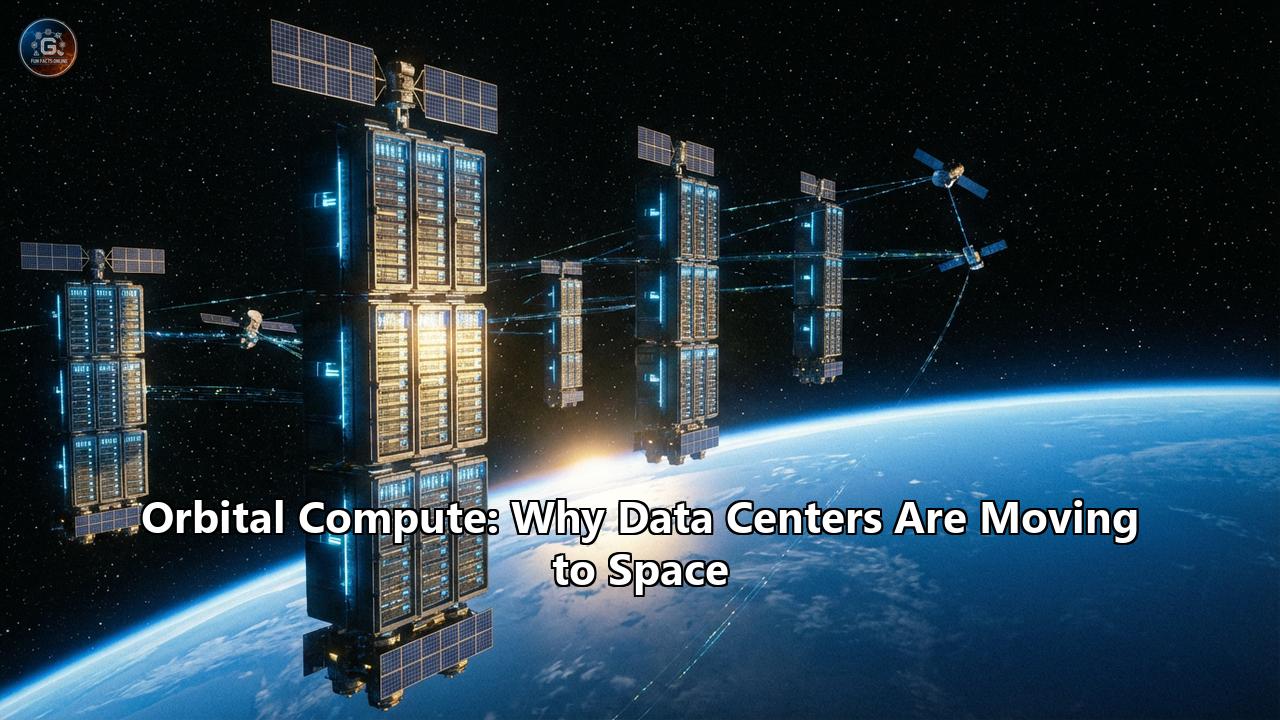
The sheer scale of the energy crisis facing the artificial intelligence industry has birthed a solution that, until recently, existed only in the pages of science fiction: lifting the physical infrastructure of the internet off the surface of the Earth.
We are witnessing the dawn of Orbital Compute.
As of early 2026, the race to build data centers in space is no longer a theoretical exercise. It is a capitalized, engineered, and actively deploying industrial sector. Driven by the insatiable power demands of Large Language Model (LLM) training and the plummeting costs of heavy-lift launch vehicles, tech giants and agile startups alike are looking upward.
This article provides a comprehensive deep dive into why data centers are moving to space, the economics driving this shift, the players involved, and the immense engineering challenges they are overcoming.
Part 1: The Terrestrial Breaking Point
To understand why we are going to space, we must first understand the crisis on Earth. The digital economy has hit a physical wall.
The AI Energy Cliff
For two decades, data center growth was linear. Then came the AI boom. Training a single leading-edge model requires gigawatt-hours of electricity—enough to power a small town for a year. By late 2025, terrestrial data centers were consuming over 2% of the world's total electricity, with projections suggesting this could double by 2030. In emerging AI hubs like Northern Virginia or Ireland, data centers already consume vast percentages of the local grid, leading to moratoriums on new construction.
The Water Problem
Heat is the enemy of computation. On Earth, removing that heat requires water—billions of gallons of it. A typical hyperscale facility consumes the water equivalent of a small city to keep its servers from melting. In a world facing increasing drought and water scarcity, this usage has become a political and environmental liability.
The Land and Latency Trap
NIMBYism (Not In My Backyard) effectively halts data center construction in many developed nations. Furthermore, the physics of light limits us. If you want to service a global economy, you need data centers everywhere. But building them in every jurisdiction involves a nightmare of zoning, power negotiation, and bureaucratic red tape.
Part 2: The Orbital Advantage
Space is not just a void; it is a resource-rich environment for computing, provided you can get there.
1. Infinite, Clean Energy
In Low Earth Orbit (LEO), particularly in Sun-Synchronous Orbits (SSO), a satellite can remain in near-perpetual sunlight. Unlike solar farms on Earth, which suffer from night cycles, cloud cover, and atmospheric scattering, a solar array in space operates at peak efficiency 24/7.
- The Statistic: Solar panels in space can generate up to 8x more power per square meter than on Earth over a year.
- The Implication: A data center in orbit doesn't need a battery backup, a diesel generator, or a connection to a coal-fired grid. It plugs directly into the sun.
2. The Ultimate Heat Sink
Space is cold. While the vacuum acts as an insulator (making conduction difficult), it is perfect for radiative cooling. By facing radiators toward deep space (which sits at roughly 3 Kelvin, or -270°C), data centers can dump waste heat purely through infrared radiation without using a single drop of water.
3. Data Sovereignty and Security
The European Union’s ASCEND feasibility study (Advanced Space Cloud for European Net zero emission and Data sovereignty) highlighted a unique legal benefit: Space Data Centers (SDCs) are not on foreign soil. For nations worried about the US Cloud Act or data privacy, a sovereign data center in orbit offering encrypted downlink provides the ultimate "offshore" account.
Part 3: The Economic Pivot (The Starship Factor)
Why now? Why didn't we do this ten years ago?
The answer is Launch Cost.
In the Space Shuttle era, lifting a kilogram to orbit cost $50,000. In the Falcon 9 era, it dropped to $2,500.
With the operational maturity of SpaceX’s Starship and competitors like Blue Origin’s New Glenn entering the fray in 2025/2026, the cost is approaching $200 per kilogram.
The Break-Even Analysis
Analysts at Thales Alenia Space and startups like Starcloud (formerly Lumen Orbit) have crunched the numbers:
- Terrestrial CAPEX: High land cost, expensive cooling infrastructure, grid connection fees.
- Terrestrial OPEX: extremely high electricity bills (often 50% of total lifetime cost).
- Orbital CAPEX: High launch costs, expensive radiation-hardened hardware.
- Orbital OPEX: Near zero. Sunlight is free. Cooling is passive.
Part 4: The Key Players and Projects (2025-2026)
The ecosystem is diverse, ranging from government-backed mega-studies to agile Silicon Valley-backed startups.
1. Starcloud (formerly Lumen Orbit)
One of the most aggressive players, Starcloud (rebranded from Lumen Orbit in late 2025 following a massive funding round) has moved from PowerPoint to hardware.
- The Vision: Constellations of modular data centers. Not just one big station, but hundreds of 40-megawatt clusters.
- Status: Their demonstrator satellite, launched in May 2025, successfully proved that high-density GPUs could operate in the thermal environment of LEO.
- Backing: Heavy venture capital interest, capitalizing on the "AI in the Sky" narrative.
2. NTT & SKY Perfect JSAT (Space Compass)
Japan is taking a different approach: The Space Integrated Computing Network.
- The Tech: Instead of just storage/compute, they are building an Optical Mesh. Using high-speed laser inter-satellite links (OISL), they aim to create a computing fabric where data hops between satellites at the speed of light in a vacuum (which is 30% faster than light in fiber optic cables on Earth).
- Goal: A 6G infrastructure where processing happens "on the edge" in space, reducing the need to downlink raw data.
3. Thales Alenia Space & The EU (Project ASCEND)
This is the heavyweight institutional player.
- Focus: Sustainability. The ASCEND study concluded that for space data centers to be truly "green," the launchers themselves must be low-emission. They are designing the standards for modular assembly in orbit, using robotics to click together server racks like Lego bricks.
- Timeline: Deployment of gigawatt-scale capacity targeted for the 2030s.
4. HPE (Hewlett Packard Enterprise) & OrbitsEdge
While others dream of constellations, HPE is already there.
- Spaceborne Computer-2: This commercial-off-the-shelf (COTS) supercomputer has been running on the International Space Station (ISS) for years. It proved a crucial fact: standard servers can survive space if you protect them with software hardening.
- OrbitsEdge: A Florida-based company providing the "SatFrame"—a ruggedized chassis that acts as a physical shield and thermal regulator, allowing companies to launch standard rack-mounted servers without redesigning the chips.
5. Google (Project Suncatcher)
In late 2025, Google Research published the "Suncatcher" paper, outlining a constellation of ~80 satellites dedicated to AI training.
- The Innovation: "Train in Space, Infer on Earth." Google posits that space is best for the latency-insensitive, high-energy workload of training models. You upload the dataset, the satellite cluster crunches it for a month using free solar power, and then beams down the finished weight file.
Part 5: The Engineering Stack
Building a data center in space is not as simple as putting a server in a waterproof box. The engineering challenges are distinct.
1. Thermal Management (The Radiator Challenge)
On Earth, you blow air over a chip. In space, there is no air.
- Solution: Fluid loops. A liquid coolant circulates over the GPU, absorbs the heat, and flows to massive deployable radiator panels. These panels must be enormous—often larger than the solar arrays—to radiate the heat away as infrared light.
- Innovation: Companies are developing "droplet radiators" and advanced materials that maximize emissivity while minimizing mass.
2. Radiation Hardening
Cosmic rays and the Van Allen belts can flip bits in memory or destroy transistors.
- Old Way: Use ancient, radiation-hardened chips (slow, expensive).
- New Way (Software-Defined Resilience): Use modern NVIDIA or AMD chips but run three of them in parallel (Triple Modular Redundancy). If one calculates "2+2=5" due to a radiation hit, the other two overrule it. This allows space data centers to use cutting-edge AI silicon.
3. Connectivity (The Laser Backbone)
RF (Radio Frequency) is too slow for big data.
- The solution is FSO (Free Space Optical) communication. Lasers link the satellites to each other and to ground stations. This allows for bandwidths comparable to terrestrial fiber (terabits per second).
- The Challenge: Pointing a laser at a ground station from a satellite moving at 17,000 mph requires incredible precision.
Part 6: The Environmental Paradox
Is it actually green?
Critics rightly point out that launching rockets creates carbon emissions. The soot (black carbon) from kerosene-fueled rockets in the upper atmosphere is a potent greenhouse agent.
The Counter-Argument:- Amortization: A rocket launch is a one-time carbon cost. A terrestrial data center emits carbon every hour of its 15-year life if it relies on a mixed grid.
- Cleaner Fuels: The shift to Methalox (Methane/Oxygen) engines, like those used by Starship, burns cleaner than the Kerosene (RP-1) of the past.
- Net-Zero Potential: If the rocket fuel is produced using direct air capture (synthetic methane), the launch itself can be near carbon-neutral.
The ASCEND study suggests that for the environmental equation to work, we need "Green Launchers" that are 10x less emissive than current standards. This is the next frontier of aerospace engineering.
Part 7: The Future Vision (2030 and Beyond)
We are moving toward an Orbital Economy.
In the next decade, we will likely see:
- Lunar Data Centers: As part of the Artemis program, backup data vaults on the Moon (Projected by Axiom and NASA) to preserve human knowledge in a geologically inert environment.
- Edge Computing for Debris Removal: Satellites processing visual data of space junk in real-time to navigate autonomous cleanup drones.
- The "Cloud" becoming literal: Your phone might one day offload a complex AI query not to a server farm in Virginia, but to a constellation passing overhead.
Conclusion
Orbital Compute is no longer a fantasy; it is a necessity born of terrestrial constraints. As AI demands more power than Earth's grids can easily provide, and as launch costs collapse, the logic of the market is pointing upward.
We are witnessing the decoupling of information from geography. The data center of the future has no address, no water bill, and no carbon footprint. It simply orbits, silent and cold, powered by the stars.
Reference:
- https://www.informationweek.com/it-infrastructure/will-space-based-data-centers-launch-a-new-phase-of-sustainability-
- https://en.thairath.co.th/money/tech_innovation/tech_companies/2903603
- https://www.livescience.com/technology/artificial-intelligence/putting-the-servers-in-orbit-is-a-stupid-idea-could-data-centers-in-space-help-avoid-an-ai-energy-crisis-experts-are-torn
- https://www.networkworld.com/article/3594676/lumen-orbit-wants-to-deploy-data-centers-in-space.html
- https://angadh.com/space-data-centers-1
- https://ntt-review.jp/archive/ntttechnical.php?contents=ntr202212fa1.pdf&mode=show_pdf
- https://www.thalesaleniaspace.com/en/press-releases/thales-alenia-space-reveals-results-ascend-feasibility-study-space-data-centers-0
- https://newsflash.tdsynnex.co.uk/it-infrastructure/feasibility-study-could-signal-lift-off-for-space-based-data-centres/6385