
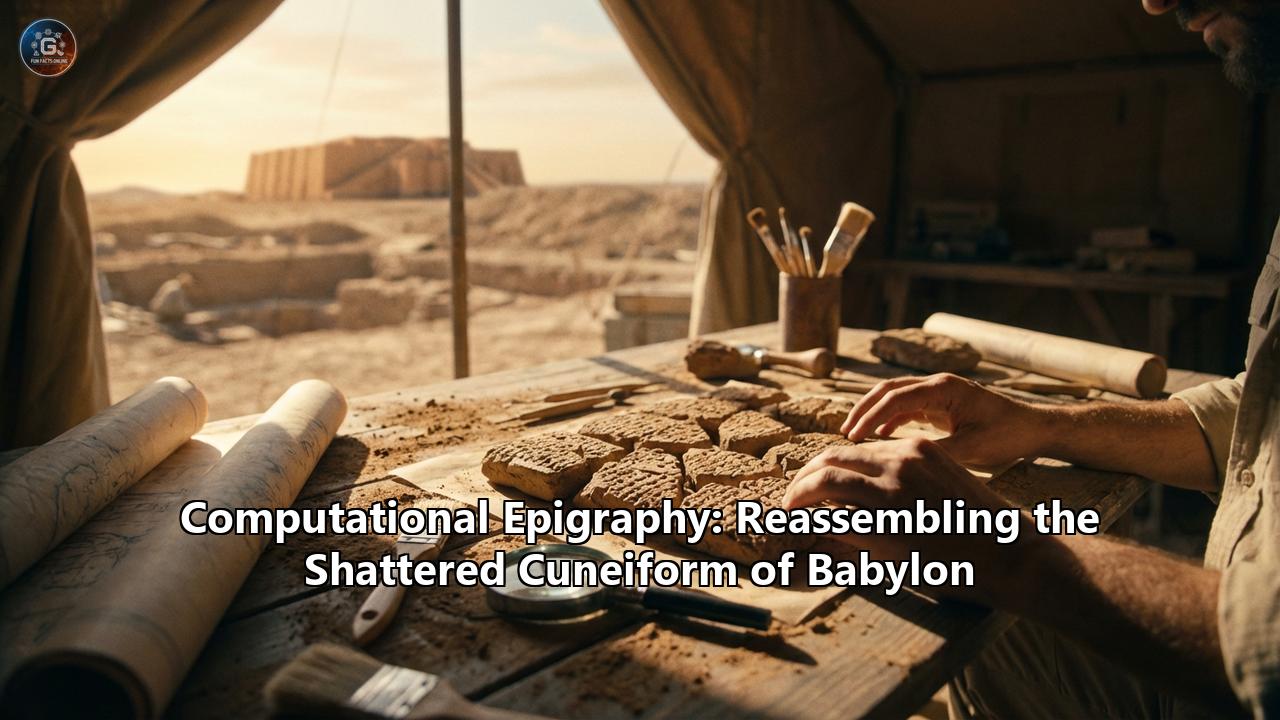
In the year 612 BCE, the world ended. At least, it did for the scribes of Nineveh. A coalition of Babylonians, Scythians, and Medes had breached the walls of the Assyrian capital, intent on erasing the empire from history. They made for the Palace of King Ashurbanipal, the self-proclaimed "King of the World," and set his royal library ablaze.
It was an act of cultural annihilation, but it backfired beautifully.
Ashurbanipal’s books were not made of papyrus or parchment, but of clay. When the palace burned, the fierce heat did not turn the library to ash; it baked it into ceramic. The fire that was meant to destroy the knowledge of Mesopotamia instead preserved it, hardening the clay tablets against the rot of centuries.
However, there was a price. The library did not survive intact. As the palace walls collapsed, the baked tablets were crushed, shattered, and scattered. The "Library of Ashurbanipal"—the oldest surviving royal library in the world—became a debris field of millions of jagged fragments.
For the last 170 years, since British archaeologists first unearthed these shards in the 1850s, scholars have faced a jigsaw puzzle from hell. They have sat in the backrooms of the British Museum and the Iraq Museum, sorting through crates of "rubbish," trying to match a fragment the size of a thumb to another the size of a fist, hoping to reconstruct the Epic of Gilgamesh or the Enuma Elish. It has been a slow, agonizing, and often impossible task. It is estimated that of the hundreds of thousands of cuneiform tablets discovered, 90% remain untranslated.
But in the last five years, a new scribe has entered the scriptorium. It does not sleep, it does not strain its eyes, and it possesses a memory that spans every known fragment simultaneously. It is Artificial Intelligence.
Welcome to the dawn of Computational Epigraphy, the science of using algorithms to reassemble the shattered mind of Babylon.
Part I: The Jigsaw Puzzle from Hell
To understand why the "Fragmentarium"—the AI-driven project at Ludwig Maximilian University (LMU) in Munich—is such a revolution, one must first appreciate the impossible difficulty of cuneiform.
Invented by the Sumerians around 3400 BCE, cuneiform is not an alphabet. It is a logo-syllabic system, a nightmare of complexity where a single wedge-shaped sign can represent a sound, a whole word, or a "determinative" that gives a clue about the category of the following word. A sign like KA can mean "mouth," but also "tooth," "word," "speak," or "shout," depending entirely on context.
Now, imagine this script is written not on flat paper, but on 3D clay objects. Now imagine those objects have been smashed into twenty pieces. Now imagine the pieces have been mixed with the fragments of ten thousand other tablets.
"An old Assyriological joke states that one day we will realize there was only one tablet at Nineveh, but it was broken into very small pieces," says Enrique Jiménez, the Professor of Ancient Near Eastern Literatures at LMU and the architect of the Fragmentarium.
For decades, the method of reconstruction was "memory and luck." A scholar would read a fragment in London, memorize its shape and text, and then, perhaps years later, spot its mate in a drawer in Baghdad or Berlin. It was a process of serendipity. The reconstruction of the Epic of Gilgamesh, humanity’s oldest great work of literature, has been a 150-year crawl, with new lines added only once every few decades.
The sheer volume of data overwhelmed the human brain. There are approximately 30,000 tablets and fragments in the Ashurbanipal collection alone, and countless more from sites like Sippar and Uruk. No human can memorize them all. But a neural network can.
Part II: The Ghost in the Machine
The breakthrough came with the Electronic Babylonian Literature (eBL) project. The team, led by Jiménez, realized that while computers struggle with the ambiguity of translation, they excel at pattern recognition.
The process begins with digitization. This is not as simple as taking a photo. Cuneiform is a 3D script; the meaning is in the depth and angle of the wedges. A flat photo often flattens the shadows, making the text unreadable. While 3D scanning is the gold standard, it is slow and expensive. The eBL team utilized advanced composite photography and algorithms that can infer depth from 2D images, creating a massive database of "digital shards."
Then comes the Fragmentarium.
The AI ignores the meaning of the words and looks at the sequence of the signs. It uses a method called n-gram matching. In computational linguistics, an n-gram is a contiguous sequence of n items from a given sample of text. The AI scans the transliterated signs of thousands of fragments, looking for overlapping sequences.
If Fragment A ends with the signs ...šá-ba-la... and Fragment B starts with ...la-tu-ú..., the AI calculates the probability that they are part of the same sentence (e.g., šá-ba-la-tu-ú). It does this millions of times a second, across thousands of fragments held in museums separated by continents.
It acts like a super-powered visual matcher. It doesn't just look for text; it looks for the unique geometry of the break. It can predict that a specific jagged edge in the British Museum fits perfectly into a void on a tablet in the Yale Babylonian Collection.
The results were immediate and staggering. In 2018, the system began spitting out "joins"—matches between fragments—at a rate that no human could match. It identified hundreds of new manuscripts and filled in thousands of missing lines in the corpus of Babylonian literature.
But its greatest triumph was the resurrection of a city.
Part III: The Hymn to Babylon
For two thousand years, the "Hymn to Babylon" was a ghost. Scholars knew it existed—it was referenced in other texts—but the work itself was considered lost, scattered into the dust of history.
In 2024, the Fragmentarium changed that. The AI identified a connection between a fragment in the British Museum and several others in Baghdad. When the scholars verified the match, they realized they weren't just looking at a dry administrative text. They were looking at a masterpiece.
The Hymn to Babylon is a 250-line poetic composition that offers a heartbreakingly beautiful glimpse into the civic soul of the ancient metropolis. It is not a prayer to a distant god, but a love letter to a city.
The City of Joy
The text, now largely reconstructed, paints Babylon not as the "Whore of Babylon" depicted in the Bible, but as a vibrant, gem-like center of civilization. The hymn describes the city as a "mountain of lapis lazuli," glittering in the sun. It speaks of the Euphrates River not just as a water source, but as the bringer of the harvest, describing in rare detail how the river swells in spring to fertilize the fields.
This focus on nature is incredibly rare in Mesopotamian literature, which usually focuses on gods and kings. The hymn describes the "burgeoning meadows" and the "orchards heavy with fruit," revealing a people who were deeply in tune with the ecological rhythms of their delta home.
The Women of the Temple
Perhaps most surprisingly, the AI-reconstructed text sheds new light on the role of women. The hymn contains specific stanzas dedicated to the priestesses of Babylon—the ugbakkātu, nadâtu, and qašdātu.
It describes them with a reverence that challenges modern assumptions about ancient patriarchy. They are praised for their "devotion and discretion," and recognized as pillars of the city's spiritual health. We see them moving through the temple of Esagil, not as shadows, but as essential guardians of the sacred rites, their songs intermingling with the bustle of the streets.
The Sanctuary of Strangers
In a stanza that resonates powerfully with the modern world, the Hymn to Babylon praises the city’s cosmopolitanism. It asserts that Babylon is a sanctuary where "foreigners are respected." It describes a city of diverse tongues and peoples, held together by the "protection of the vulnerable."
This contradicts the Biblical narrative of Babylon as a place of oppression. To its citizens, Babylon was a bastion of order and justice, a "cosmic city" where the laws protected the orphan and the widow, and where even the outsider could find a home under the gaze of Marduk.
Part IV: Gilgamesh and the Daily Grind
The Fragmentarium has not stopped at Babylon. It has also turned its gaze to the Epic of Gilgamesh.
The epic, which tells of a king’s futile quest for immortality, is the backbone of ancient literature. For a century, the text has been full of "lacunae"—gaps where the tablet is broken, leaving the reader to guess what happens next.
Using the AI, Jiménez’s team has filled in dozens of these gaps. One newly discovered fragment adds a comedic and humanizing scene where Gilgamesh and his wild companion Enkidu are traveling to the Cedar Forest. In the previous version, they were simply anxious. In the restored text, we see them bickering like an old married couple, with Enkidu trying to talk Gilgamesh out of the dangerous mission, and Gilgamesh nervously cracking jokes to hide his fear.
It makes the heroes feel less like statues and more like men.
Beyond the epics, the AI is revolutionizing our understanding of daily life. It is reassembling medical texts, revealing complex treatments for ailments ranging from depression to kidney stones. It is piecing together omen lists, which serve as a psychological map of the Babylonian mind, showing us what they feared (eclipses, malformed births) and what they hoped for.
It has even touched the Al-Yahudu tablets, a collection of texts that document the lives of Judean exiles in Babylon. These texts, now clearer than ever, confirm that the "Babylonian Captivity" was not a period of dungeon imprisonment. The exiles were entrepreneurs, traders, and royal officials. They signed contracts, bought land, and integrated into the economy, just as the prophet Jeremiah advised them to ("Build houses and settle down...").
Part V: The Democratization of the Past
The most radical aspect of the Fragmentarium is not that it uses AI, but that it is open access.
In the past, cuneiform tablets were the jealousy guarded domain of a few elite professors. If you wanted to see a text, you had to fly to London, get special permission, and sit in a dusty room.
The Electronic Babylonian Literature project has placed the reconstructed texts online. Anyone—from a high school student in Ohio to a history buff in Osaka—can log in, browse the Epic of Gilgamesh, click on a line, and see the photograph of the original clay fragment that contains it. They can see where the AI has made a "join" and read the translation.
This is the democratization of Assyriology. It invites the world to participate in the reconstruction of human history. There are still thousands of unidentified fragments in the database. It is entirely possible that a curious amateur, playing with the tool from their living room, could spot a connection that an algorithm missed, identifying a lost line of poetry from 3,000 years ago.
Conclusion: The New Immortality
The Babylonians were obsessed with immortality. Gilgamesh sought it in a magical plant; the kings sought it in stone monuments. They failed. The plant was eaten by a snake; the monuments crumbled into sand.
But they also sought immortality in writing. The scribes of Nineveh and Babylon believed that "the scribe is the one who lives forever," because their words could outlast the clay they were pressed into.
For 2,000 years, that faith seemed misplaced. Their libraries were burned, their language forgotten. But today, through the marriage of silicon chips and clay shards, they are speaking again.
Computational Epigraphy is doing more than just solving a puzzle. It is proving the scribes right. The fire that destroyed their city could not silence them. The breaking of the tablets only made the puzzle harder, not impossible. And as the AI scans the shattered remnants of the first great civilization, we are finding that the people of Babylon—with their love of nature, their bustling streets, their fear of death, and their pride in their city—are not so different from us.
The shattered library is reassembling itself. And this time, it is digital, decentralized, and indestructible. Babylon has risen.
Reference:
- https://www.lmu.de/en/newsroom/news-overview/news/hymn-to-babylon-discovered-df846555.html
- https://archaeologymag.com/2025/07/hymn-to-babylon-discovered/
- https://www.sciencealert.com/classic-hymn-deciphered-from-ancient-babylonian-library
- https://www.researchgate.net/publication/247122032_Pattern_Matching_Using_n-gram_Sampling_Of_Cumulative_Algebraic_Signatures_Preliminary_Results
- https://ompramod.medium.com/exploring-n-grams-the-building-blocks-of-natural-language-understanding-d40a7a309d12
- https://www.cambridge.org/core/services/aop-cambridge-core/content/view/B477D54E6554CA35718880339B3736CD/S0021088924000238a.pdf/literary_texts_from_the_sippar_library_v_a_hymn_in_praise_of_babylon_and_the_babylonians.pdf
- https://www.cambridge.org/core/journals/iraq/article/literary-texts-from-the-sippar-library-v-a-hymn-in-praise-of-babylon-and-the-babylonians/B477D54E6554CA35718880339B3736CD
- https://www.iflscience.com/hymn-to-babylon-missing-mesopotamian-text-dating-back-nearly-3000-years-discovered-79850
- https://www.worldatlas.com/landmarks/5-strange-discoveries-about-the-ruins-of-babylon.html