
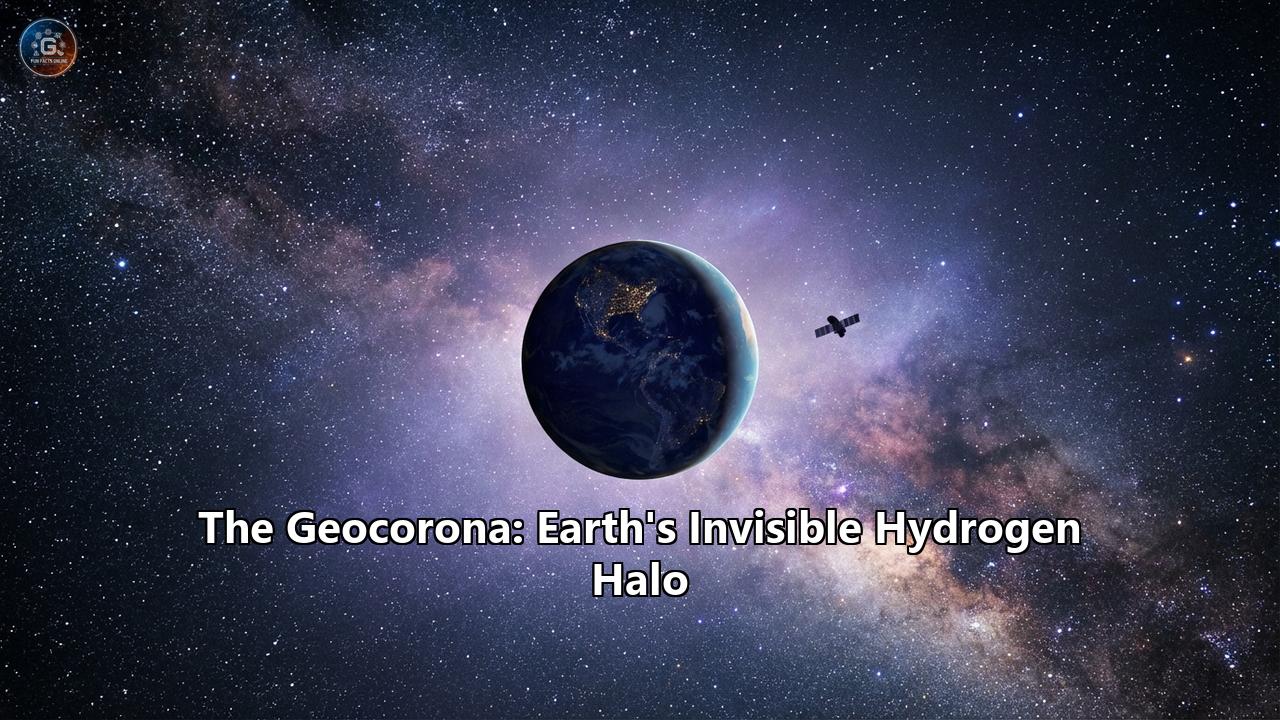
When we imagine Earth from space, we typically picture the "Blue Marble"—a distinct sphere of rock and water wrapped in a thin, fragile veil of blue atmosphere. We are taught that this atmosphere thins out and effectively ends at the Kármán line, about 100 kilometers (62 miles) up, giving way to the black vacuum of space.
But this boundary is a lie.
In reality, our planet is much larger, fuzzier, and more imposing than we ever realized. Earth is not a lonely marble in the dark; it is the heart of a colossal, glowing ghost. Surrounding our world is a massive cloud of hydrogen atoms that extends almost twice as far as the Moon. This invisible, luminous envelope is called the Geocorona.
For decades, we believed the Moon orbited in the vacuum of deep space. We now know that when astronauts stood on the lunar surface, they were technically still standing inside Earth's atmosphere.
The Ghost in the Machine: What is the Geocorona?
The geocorona is the luminous, outermost part of Earth's atmosphere, specifically the region known as the exosphere. It is a vast cloud composed primarily of neutral hydrogen atoms that glow in far-ultraviolet light.
To the human eye, the geocorona is completely invisible. The hydrogen atoms that make up this halo emit a specific wavelength of ultraviolet light known as Lyman-alpha radiation. This light is produced when sunlight interacts with the hydrogen atoms, exciting them and causing them to scatter the solar photons. Because Earth’s lower atmosphere (the air we breathe) absorbs this ultraviolet light, the geocorona cannot be seen from the ground. It can only be observed from space, looking back at Earth or outwards from a high orbit.
While we often think of "atmosphere" as the air we breathe—a mix of nitrogen, oxygen, and other gases—the geocorona is something far more tenuous. It is not a gas in the traditional sense; it is a collection of individual atoms following ballistic trajectories, bound by Earth's gravity but rarely colliding with one another.
The 2025 Revolution: A New Era of Visibility
As of late 2025, our understanding of this phenomenon has shifted from theoretical models and grainy archival data to high-definition reality. The recent success of NASA’s Carruthers Geocorona Observatory has brought the geocorona into sharp focus for the first time in history.
Launched in September 2025, the Carruthers Observatory (formerly known as the GLIDE mission) was designed with a singular purpose: to image Earth’s exosphere from a vantage point nearly one million miles away, at the gravitational balance point known as Lagrange Point 1 (L1).
Just recently, in November 2025, the observatory sent back its "first light" images. These breathtaking ultraviolet portraits reveal Earth not as a hard-edged rock, but as the nucleus of a fuzzy, glowing sphere. For the first time, we can see the full extent of our hydrogen halo breathing and shifting in real-time, responding to solar storms and the solar wind. These images have confirmed what scientists had long suspected but could never fully visualize: the geocorona is a dynamic, living extension of our planet.
A History of Hidden Light
While the Carruthers Observatory is giving us our best look yet, the discovery of the geocorona is a detective story that spans half a century.
Apollo 16: The First Glimpse (1972)
The first photographic evidence of the geocorona was captured not by a robotic probe, but by a human hand. In April 1972, during the Apollo 16 mission, astronauts John Young and Charles Duke set up a small, gold-plated telescope on the lunar surface. This instrument, the Far Ultraviolet Camera/Spectrograph, was designed by the visionary physicist Dr. George Carruthers (for whom the 2025 observatory is named).
From their vantage point on the Moon, the astronauts pointed the camera back toward Earth. The resulting image was ghostly and beautiful: Earth appeared surrounded by a bright, diffuse glow of ultraviolet light. At the time, however, the astronauts and scientists believed they were looking at the geocorona from the outside. They assumed the hydrogen cloud ended somewhere between Earth and the Moon. They had no idea that they were standing right in the middle of it.
The SOHO Revelation (2019)
The true scale of the geocorona remained hidden in archival data for decades. It wasn't until 2019 that a team of researchers, led by Igor Baliukin of Russia’s Space Research Institute, made a startling discovery while digging through data from the Solar and Heliospheric Observatory (SOHO).
SOHO, a joint mission by ESA and NASA launched in 1995, carries an instrument called SWAN (Solar Wind Anisotropies). SWAN was designed to map hydrogen across the entire solar system, but it also inadvertently captured detailed data of Earth’s immediate neighborhood.
When the researchers analyzed the SWAN data, they found that the hydrogen signal from Earth didn't fade away as quickly as expected. Tracing the Lyman-alpha glow, they realized the geocorona extends out to a staggering 630,000 kilometers (391,000 miles) from Earth.
Given that the Moon orbits at an average distance of 384,400 kilometers (238,855 miles), this meant the Moon is deeply embedded within Earth's atmosphere.
The Physics of the Halo
How does an atmosphere stretch so far? The physics of the geocorona are governed by the delicate balance between gravity, solar radiation, and the thermal energy of atoms.
1. The Source: Water and MethaneThe hydrogen in the geocorona ultimately comes from water vapor ($H_2O$) and methane ($CH_4$) near Earth's surface. As these molecules rise into the upper atmosphere, they are broken apart by sunlight in a process called photodissociation. This releases hydrogen atoms, which are light enough to float to the very top of the atmosphere.
2. The Ballistic DanceAt the exobase (the bottom of the exosphere, about 500-1000 km up), the air is so thin that atoms stop behaving like a fluid. They don't bump into each other and "flow"; instead, they launch like tiny cannonballs. Some fall back toward Earth, but others have enough energy to soar hundreds of thousands of kilometers into space before gravity slowly pulls them back. A small fraction escapes Earth entirely, lost to the solar wind forever.
3. Solar SculptingThe geocorona is not a perfect sphere. It is sculpted by the Sun.
- The Day Side: Solar radiation pressure (the physical push of sunlight) compresses the hydrogen cloud on the side facing the Sun. Here, the geocorona is denser but "squashed," extending roughly 60,000 km.
- The Night Side: On the side facing away from the Sun, the pressure is released, and the geocorona stretches out into a long, comet-like tail. This is the region that engulfs the Moon.
Despite its immense size, the geocorona is incredibly tenuous. We call it an "atmosphere," but it is thinner than the best vacuum we can create in a laboratory on Earth.
- Density at 60,000 km: ~70 atoms per cubic centimeter.
- Density at the Moon: ~0.2 atoms per cubic centimeter.
For comparison, the air you are breathing right now contains about $10^{19}$ (10 quintillion) molecules per cubic centimeter. So, while the Moon is "inside" the atmosphere, there is no wind, no air pressure, and certainly no breathability. It is a vacuum, but a vacuum filled with a faint, tell-tale signature of our home world.
Implications: Why Does the Invisible Halo Matter?
The existence of the geocorona is more than just a piece of space trivia. It has profound implications for astronomy, space travel, and the search for alien life.
1. The Fog of Astronomy
For astronomers, the geocorona is a nuisance. Space telescopes like Hubble or the James Webb Space Telescope often want to observe the ultraviolet universe to study distant stars and galaxies. However, because these telescopes orbit within the geocorona, they are constantly looking through a "fog" of glowing hydrogen.
This background noise acts like light pollution. Just as city lights make it hard to see faint stars, the geocorona's Lyman-alpha glow can drown out faint UV signals from the early universe. The recent realization that the geocorona extends past the Moon means that even a lunar-based telescope would not be free from this interference. To truly escape Earth's halo, a UV telescope would need to be sent deep into interplanetary space or to the L2 Lagrange point (where JWST sits), and even then, careful calibration is required.
2. Searching for "Earths" Elsewhere
Perhaps the most exciting application of geocorona research lies in the hunt for exoplanets.
We know that Earth's hydrogen halo is a byproduct of water vapor breaking down in the lower atmosphere. Therefore, if we see a similar hydrogen geocorona surrounding a rocky exoplanet, it could be a "smoking gun" for the presence of water oceans on its surface.
Astronomers are already using this technique. When a planet passes in front of its star (a transit), we can look for the absorption of Lyman-alpha light. If we see a massive cloud of hydrogen bleeding off the planet, it tells us the planet is losing its atmosphere and likely has water vapor to spare. Understanding the shape and behavior of our own geocorona gives us the "ground truth" needed to interpret these signals from light-years away.
3. Magnetic Storm Warning
The geocorona also acts as a visible monitor for space weather. When a solar storm (Coronal Mass Ejection) hits Earth, it compresses the magnetosphere and energizes the exosphere. The Carruthers Observatory is now allowing us to watch this happen in real-time. By observing how the geocorona brightens and shifts during a solar storm, scientists can better predict how these storms will affect satellites, GPS, and power grids on Earth.
Conclusion: The Infinite Boundary
The discovery and visualization of the geocorona challenge our fundamental perception of Earth. We are conditioned to think of boundaries—borders on maps, the shoreline of the ocean, the edge of the atmosphere. But nature rarely deals in hard lines.
The Earth does not end at the ground, nor at the clouds, nor even at the Kármán line. It fades. It feathers out into the cosmos, creating a bridge of hydrogen that links us to our satellite and the solar wind beyond.
When we look up at the Moon tonight, we are not looking across empty space. We are looking through the outer reaches of our own home. We are looking through the geocorona—Earth's invisible, protective, and ever-expanding halo.
Reference:
- https://www.youtube.com/watch?v=iB9hXlxOjmE
- https://www.sciencealert.com/earth-s-atmosphere-is-so-big-that-it-actually-engulfs-the-moon
- https://www.youtube.com/watch?v=QPBHfBLv7DU
- https://sci.esa.int/web/soho/-/61130-earth-atmosphere-stretches-out-to-the-moon-and-beyond
- https://www.zmescience.com/science/the-earths-atmosphere-extends-twice-as-far-as-the-moon-technically/
- https://www.sci.news/space/earths-hydrogen-geocorona-06932.html
- https://soho.nascom.nasa.gov/hotshots/2019_02_20/
- https://spaceweather.ssl.berkeley.edu/geospace/
- https://www.accuweather.com/en/space-news/what-is-the-heliosphere-a-new-mission-could-unravel-the-mysteries-of-this-complex-cosmic-environment/1819357
- https://eos.org/research-spotlights/how-geomagnetic-storms-light-up-the-geocorona
- https://science.nasa.gov/science-research/heliophysics/nasas-carruthers-geocorona-observatory-reveals-first-light-images/
- https://en.wikipedia.org/wiki/Geocorona
- https://www.universetoday.com/articles/did-you-know-the-earths-atmosphere-extends-beyond-the-orbit-of-the-moon
- https://www.esa.int/Science_Exploration/Space_Science/Earth_s_atmosphere_stretches_out_to_the_Moon_and_beyond
- https://www.youtube.com/watch?v=UUL8z4vWSGI
- https://en.yenisafak.com/technology/nasa-observatory-captures-images-of-earths-hydrogen-halo-3711966
- https://www.space.com/earth-atmosphere-extends-beyond-moon.html
- https://www.space.com/nasa-geocorona-mission-honor-george-carruthers
- https://www.skyatnightmagazine.com/news/earth-invisible-halo-geocorona-carruthers
- https://www.youtube.com/watch?v=jpuTizjSTgU