
For more than two millennia, the collective imagination of humanity has been held captive by a singular, glittering dream: the transmutation of base metals into gold. It was the magnum opus of the alchemists, a quest that drove men like Zosimos of Panopolis, Geber, and even the great Isaac Newton to spend their nights amidst bubbling alembics and sulphurous fumes. They sought the Lapis Philosophorum—the Philosopher’s Stone—a legendary substance capable of perfecting the imperfect, of elevating the "sick" metal of lead into the "noble" metal of gold. For centuries, this pursuit was dismissed as the folly of mystics and charlatans, a pseudo-scientific dead end that chemistry had long since buried.
But history, it seems, has a sense of irony.
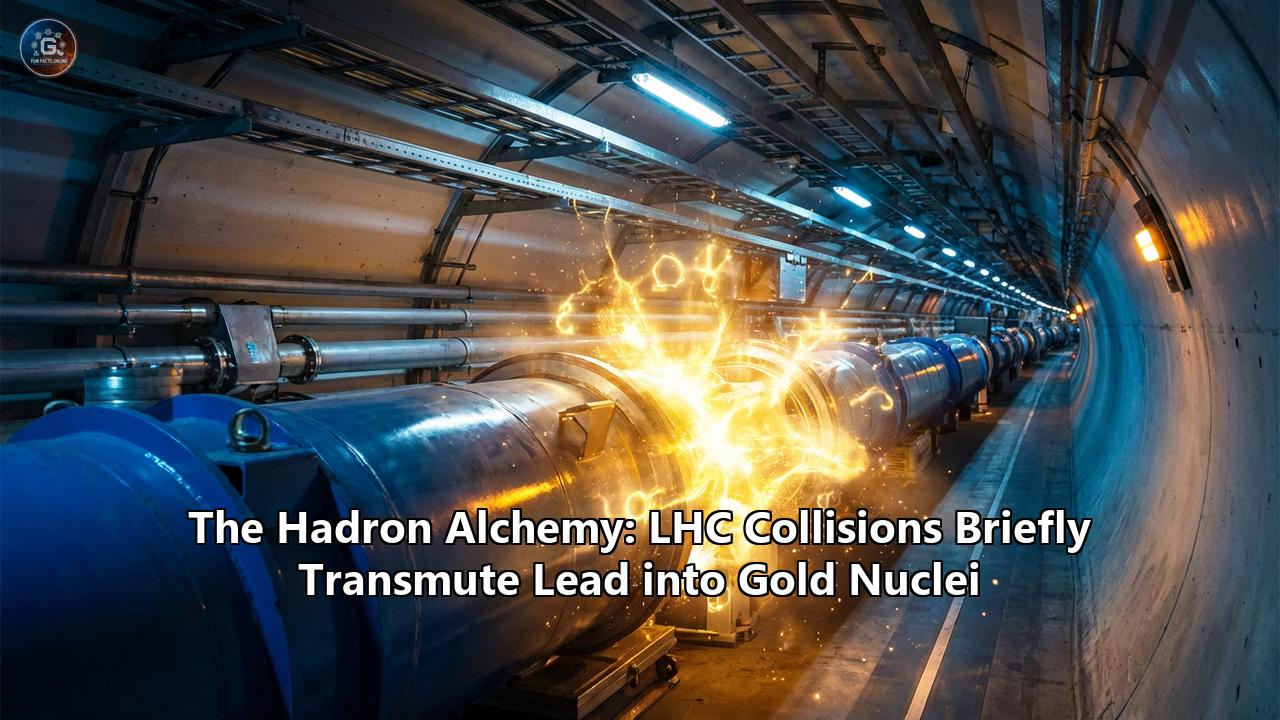
In the cavernous, sub-zero tunnels beneath the Franco-Swiss border, modern physics has inadvertently achieved what the alchemists could not. At the Large Hadron Collider (LHC), the crown jewel of the European Organization for Nuclear Research (CERN), scientists have confirmed the synthesis of gold nuclei from lead. There were no incantations, no mystical powders, and no red stones involved. Instead, the agents of this transmutation were the most violent forces humans have ever harnessed: ultra-relativistic heavy ions moving at 99.999993% of the speed of light.
This is not a story of infinite wealth. The gold produced at the LHC appears for mere fractions of a nanosecond, exists in vanishingly small quantities—amounting to perhaps 29 picograms over several years of operation—and is often highly unstable, disintegrating almost as soon as it is born. Yet, the observation of these "hadron alchemy" events marks a profound moment in our understanding of matter. It is the ultimate vindication of the idea that the elements are not immutable, but rather malleable forms of energy that can be reshaped if struck with a hammer of sufficient weight.
In this exploration, we will descend into the quantum mechanics of this modern miracle. We will trace the arc of history from the soot-stained workshops of medieval Europe to the gleaming silicon detectors of the ALICE experiment. We will examine the violent "near-miss" collisions that strip protons from lead nuclei, the intricate calorimetry that detected the tell-tale signature of gold, and the sobering economic reality that keeps this breakthrough firmly in the realm of science rather than commerce. We will see that while we have found the Philosopher’s Stone, it is not a rock we can hold, but a machine spanning 27 kilometers of superconducting magnets.
Part I: The Event
1.1 The Machine at the Edge of Physics
To understand how lead becomes gold, one must first understand the vessel in which the transformation occurs. The Large Hadron Collider is often described as a "Big Bang machine," a device designed to smash protons together to hunt for the Higgs boson or dark matter candidates. However, for one month each year, the LHC switches its ammunition. Instead of protons—the light, singular nuclei of hydrogen—the collider accelerates the massive nuclei of lead-208.
Lead-208 is a monster of an isotope. It contains 82 protons and 126 neutrons, making it "doubly magic" in nuclear physics parlance, meaning its shells of protons and neutrons are perfectly filled, granting it exceptional stability. It is the heaviest stable isotope in existence. When the LHC is in "Heavy Ion Mode," it strips lead atoms of all their electrons, leaving behind naked, positively charged cores. These ions are then injected into the 27-kilometer ring and whipped up to energies of 5.02 tera-electronvolts (TeV) per nucleon pair.
When these ions collide head-on, the result is a "Little Bang." The protons and neutrons melt into a soup of quarks and gluons, a state of matter known as Quark-Gluon Plasma (QGP), which last existed microseconds after the birth of the universe. Studying this plasma is the primary goal of the ALICE (A Large Ion Collider Experiment) detector.
But the gold was not found in the fire of the head-on collision. It was found in the shadows, in the "near misses."
1.2 The Ultra-Peripheral Collision
In the subatomic world, "touching" is a relative concept. Most of the time, when two beams of lead ions cross paths, the nuclei miss each other. The spaces between them are vast compared to their size. However, because these ions are highly charged (each carrying a charge of +82e) and moving at nearly the speed of light, they carry with them an immense electromagnetic field.
According to the theory of Special Relativity, as an object approaches the speed of light, its length contracts in the direction of motion. To a stationary observer (or a passing nucleus), the spherical electric field of a lead ion is flattened into a thin, intense pancake of electromagnetic energy. As this pancake flies past another nucleus, the changing electric field is so rapid and so intense that it behaves like a pulse of light—a swarm of "virtual" photons.
This phenomenon is known as the Weizsäcker-Williams effect. Essentially, a high-energy lead nucleus acts like a supremely bright flashbulb.
When two lead nuclei pass each other without colliding physically—a scenario physicists call an Ultra-Peripheral Collision (UPC)—they can still interact through these photon clouds. A photon from one lead nucleus can strike the other lead nucleus. This is not a gentle nudge; these are gamma-ray photons of extreme energy.
1.3 Electromagnetic Dissociation: The Mechanism of Alchemy
When this high-energy photon strikes the opposing lead nucleus, it imparts a massive jolt of energy. The nucleus becomes "excited." It enters a state known as a Giant Dipole Resonance, where the protons and neutrons inside the nucleus begin to oscillate against each other, sloshing back and forth like water in a shaken bucket.
To relieve this excess energy and return to stability, the lead nucleus must "cool down." It does this by evaporating particles. It might spit out a neutron. It might spit out two. But in rare, high-energy events, the photon strikes with enough violence to knock out protons as well.
This is the moment of transmutation.
The identity of a chemical element is defined solely by the number of protons in its nucleus (the atomic number, Z).
- Lead (Pb) has an atomic number of 82.
- Gold (Au) has an atomic number of 79.
To turn lead into gold, one must simply subtract three protons.
The data analyzed by the ALICE collaboration revealed that in these ultra-peripheral collisions, the electromagnetic shockwave was occasionally strong enough to eject exactly three protons (along with several neutrons) from a lead projectile.
Mathematically, the reaction looks something like this:
$$ ^{208}\text{Pb} + \gamma \rightarrow ^{203}\text{Au} + 3p + 2n $$
(Note: The exact isotope of gold depends on how many neutrons are ejected alongside the protons. $^{203}\text{Au}$ is a common candidate in these high-energy spallation events, though others like $^{197}\text{Au}$—stable gold—are statistically possible but much rarer due to the need to shed many more neutrons).
In that split second, as the lead ion races through the vacuum pipe at light speed, it ceases to be lead. It has been hammered by light into a nucleus of gold.
Part II: The Hunt
2.1 The ALICE Detector
Detecting a single atom of gold amidst the chaos of a particle collider is a challenge that makes finding a needle in a haystack look like child's play. The ALICE detector is a behemoth, weighing 10,000 tons and packed with sensitive tracking chambers, calorimeters, and time-of-flight detectors. However, the standard detectors are designed to look "sideways"—to measure the spray of particles exploding outward from a head-on collision.
The gold nuclei, however, are formed in near-misses. They don't explode; they continue flying down the beam pipe, almost keeping pace with the original lead beam. They are moving too fast and at too shallow an angle for the main central barrel of ALICE to see them.
To find them, physicists had to look downstream.
2.2 The Zero Degree Calorimeters (ZDCs)
Located 112.5 meters on either side of the main interaction point are a set of specialized detectors called Zero Degree Calorimeters (ZDCs). These devices sit right next to the beam pipe, in the "zero degree" direction—the direction the beam is traveling.
Their primary job is usually to measure the "spectator" neutrons—neutrons that are knocked off in collisions and keep flying straight. But for the alchemy analysis, the ALICE team used them in a novel way. They looked for specific patterns of energy deposition that corresponded to the "missing" particles.
When a lead nucleus transforms into gold, it ejects three protons and some neutrons. These ejected particles don't just vanish; they fly into the detectors or the surrounding material. By correlating the signals in the neutron calorimeters (ZN) and the proton calorimeters (ZP), the scientists could reconstruct exactly what happened to the lead nucleus.
They looked for a specific "trigger": an event where the main detector saw nothing (because there was no head-on explosion), but the downstream detectors registered the specific energy signature of protons and neutrons consistent with a "minus-3-proton" loss.
2.3 The Signal
The analysis, which focused on data collected during "Run 2" of the LHC (2015–2018), required sifting through billions of events. The researchers categorized the events by how many neutrons and protons were lost.
- 1 proton lost: The lead (Z=82) becomes Thallium (Z=81).
- 2 protons lost: The lead becomes Mercury (Z=80).
- 3 protons lost: The lead becomes Gold (Z=79).
The data showed clear peaks for each of these elements. Thallium was the most common byproduct, followed by Mercury. But there, distinct and statistically significant, was the signature of Gold.
The ALICE collaboration estimated that during the few weeks of heavy ion running in Run 2, the LHC produced approximately 86 billion gold nuclei.
While "86 billion" sounds like a staggering number, in the world of atoms, it is nothing. The mass of a single gold atom is roughly $3.2 \times 10^{-22}$ grams. Multiplied by 86 billion, the total yield of gold produced by the world's most expensive machine over four years was 29 picograms.
To put that in perspective: 29 picograms is $0.000000000029$ grams. It is about one-trillionth the weight of a grain of sand.
Part III: The History of the Dream
To fully appreciate the gravity of this discovery, one must step back from the tera-electronvolts of the 21st century and return to the charcoal fires of the 1st century.
3.1 Chrysopoeia
The art of making gold, known as chrysopoeia (from the Greek khrusos, "gold," and poiein, "to make"), was the central pillar of alchemy. The alchemists did not view matter as we do, as rigid assemblies of protons and electrons. They viewed matter as a combination of principles—Mercury (fluidity, intellect) and Sulfur (combustibility, soul), often grounded by Salt (solidity, body). They believed that all metals were essentially the same substance in different stages of maturity. Lead was simply "unripe" or "sick" gold.
The goal of the alchemist was to accelerate nature's process, to cure the lead of its impurities and elevate it to the perfection of gold. This was to be achieved via the Lapis Philosophorum, a catalyst of immense power.
For centuries, this pursuit was as spiritual as it was chemical. But it was also a magnet for fraud. By the Middle Ages, kings and emperors were so wary of "multipliers" (alchemists who claimed they could multiply gold) devaluing their currency that they often outlawed the practice. In 1404, King Henry IV of England passed the Act Against Multipliers, making it a felony to create gold and silver. Ironically, the LHC's operation would have been a capital offense in 15th-century England.
3.2 The Death of Alchemy and the Birth of the Element
The dream died in the late 18th century with the rise of modern chemistry. Antoine Lavoisier, the father of modern chemistry, established the definition of an element: a substance that cannot be broken down into simpler substances by chemical means. If gold was an element, and lead was an element, then one could never become the other. They were distinct species, separated by an unbridgeable gulf.
Dalton's atomic theory drove the final nail into the coffin. Atoms were immutable spheres. An atom of lead was an atom of lead forever. Alchemy was relegated to the dustbin of history, labeled as a pseudo-science of wishful thinking.
3.3 The Resurrection: Rutherford and Soddy
The tomb of alchemy was reopened in the early 20th century, not by mystics, but by the pioneers of radioactivity. In 1901, at McGill University in Montreal, a young physicist named Ernest Rutherford and a chemist named Frederick Soddy were studying the radioactive element thorium. They realized that as thorium emitted radiation, it was turning into a different element (radium, and eventually lead).
The story goes that when Soddy realized the implication, he shouted, "Rutherford, this is transmutation!"
Rutherford, fearful of the scientific stigma, shot back, "For Mike's sake, Soddy, don't call it transmutation. They'll have our heads off as alchemists!"
They called it "transformation" instead, but the barrier was broken. Elements could change. Nature was an alchemist.
3.4 The 20th Century Transmutations
Once it was understood that an element's identity was defined by its nucleus, scientists began trying to force the change.
- 1924: Japanese physicist Hantaro Nagaoka attempted to derive gold from mercury using high-voltage discharges. He reported success, as did German scientist Adolf Miethe. However, later analysis suggested their "gold" was likely contamination from their electrodes or the mercury itself.
- 1941: American physicists bombarded mercury with neutrons. They successfully produced gold, but it was unstable and radioactive.
- 1980: The most famous pre-LHC success came from Glenn Seaborg, a Nobel laureate at Lawrence Berkeley National Laboratory. Seaborg used a particle accelerator to bombard bismuth (atomic number 83) with carbon and neon nuclei. By knocking out four protons, he successfully transmuted bismuth into gold.
Seaborg’s experiment was the first to use near-relativistic collisions to strip protons, a direct ancestor to the LHC's method. However, Seaborg famously noted the economics of his alchemy. He was using thousands of dollars of electricity per hour to produce microscopic isotopes that had to be detected via radiation counters. "I would say," Seaborg told the Associated Press, "that we have cornered the market on the world's most expensive gold."
Part IV: The Science of the New Alchemy
The LHC's production of gold differs from Seaborg's work in energy and mechanism. Seaborg used "stripping" reactions at lower energies. The LHC uses ultra-relativistic electromagnetic dissociation. This is alchemy by light.
4.1 The Virtual Photon Cloud
The key to the LHC's unique method is the "virtual photon." In quantum field theory, electromagnetic interactions are mediated by photons. A static electric field, like the one around a battery, consists of "virtual" photons that exist only to carry the force.
However, when a charge moves at the speed of light, these virtual photons gain so much energy and momentum that they behave almost exactly like "real" photons (particles of light). A lead ion at the LHC is effectively a laser pulse of gamma rays.
The intensity of this photon flux scales with the square of the nuclear charge ($Z^2$). Since lead has a massive charge ($Z=82$), the flux is enormous ($82^2 = 6,724$ times stronger than a proton's field). This is why heavy ions are required. You cannot do this with hydrogen.
4.2 The Giant Dipole Resonance (GDR)
When one of these high-energy photons hits a nucleus, it excites a mode called the Giant Dipole Resonance. Imagine the nucleus as a sphere of positive protons and neutral neutrons mixed together. The electric field of the photon grabs the positively charged protons and pulls them one way, while the neutrons (being neutral) are left behind.
This creates a collective oscillation—the protons sloshing against the neutrons. This vibration is incredibly energetic. The nucleus is now "hot." To cool down, it boils off particles.
In the vast majority of cases, the nucleus just spits out a neutron.
$ ^{208}\text{Pb} \rightarrow ^{207}\text{Pb} + n $
This is boring. It’s still lead.
But if the photon is energetic enough (a "hard" photon), or if the nucleus absorbs multiple photons (a distinct possibility in the dense fields of the LHC), the violence of the oscillation can eject protons.
Ejecting a proton is harder than ejecting a neutron because the protons are held in by the "Coulomb barrier"—the electrical repulsion of the other protons tries to push them out, but the Strong Nuclear Force holds them in. Once a proton gets enough energy to crest that barrier, it flies out.
When the dice roll just right, and three protons are ejected, the nucleus drops from Z=82 to Z=79.
4.3 The Fate of the Gold
So, what happens to this newly minted gold nucleus?
It is traveling at 99.999993% of the speed of light. It has a mass slightly different from the lead beam it was part of. Because the LHC's magnets are finely tuned to bend lead nuclei (with a specific charge-to-mass ratio) around the ring, the gold nucleus is a "rogue" particle. Its magnetic rigidity is wrong.
It will spiral out of the correct orbit. Within a fraction of a second—often less than a single turn around the 27km ring—the gold nucleus will stray too far and slam into the beam pipe, a collimator, or a protection magnet.
Upon impact with the metal wall of the accelerator, the gold nucleus interacts with the atoms of the wall. At these energies, it doesn't just stick like a plating. It undergoes nuclear fragmentation, shattering into a shower of protons, neutrons, and pions.
The gold is born, flies for a few microseconds, and then dies in a blaze of radiation. It is a fleeting existence, detected only by the "shrapnel" it left behind in the ZDC detectors moments before its death.
Part V: Why We Can’t Pay Off the National Debt
Whenever the words "lead," "gold," and "science" appear in the same sentence, the public interest inevitably turns to economics. Could this be a way to manufacture gold?
The answer is a resounding, categorical no. The reasons are threefold: Energy, Yield, and Stability.
5.1 The Energy Deficit
The Large Hadron Collider consumes about 120 megawatts of electricity when running—roughly the consumption of a small city like Geneva. It costs hundreds of millions of euros annually to operate.
In return for this massive energy investment, we received 29 picograms of gold over four years.
A gram of gold contains roughly $3 \times 10^{21}$ atoms.
The LHC produced $8.6 \times 10^{10}$ atoms.
To produce one single gram of gold at the LHC's current rate, we would need to run the machine for approximately 35 million years.
The electricity cost would be in the quintillions of dollars. The resulting gram of gold would be worth about $65 (at 2025 market prices).
The return on investment is approximately $-99.99999999999\%$.
5.2 The Isotope Problem
Even if energy were free, the gold produced is not the gold you want in a wedding ring. Natural gold consists of a single stable isotope: Gold-197 (79 protons, 118 neutrons).
The LHC process is messy. It strips particles violently. Lead-208 has 126 neutrons. To get to Gold-197, you need to lose 3 protons and 8 neutrons.
However, the electromagnetic dissociation process often knocks out fewer neutrons than that. A common product might be Gold-203 (79 protons, 124 neutrons).
Gold-203 is radioactive. It has a half-life of 53 seconds. If you made a ring out of it, it would decay into mercury within minutes, blasting your finger with beta radiation in the process. Other isotopes produced might have half-lives of days or years, making the gold dangerously radioactive for a long time.
5.3 The "Frankenstein" Gold
This highlights a general truth about nuclear transmutation: it rarely produces clean, stable isotopes. It produces "Frankenstein" nuclei—imbalanced, jittery combinations of protons and neutrons that desperately want to decay back into something else. Seaborg’s bismuth gold was radioactive. The 1941 mercury gold was radioactive. The LHC gold is radioactive.
Nature, it seems, has put a very high price on the Philosopher’s Stone: radiation.
Part VI: The True Value of the Discovery
If we can't sell the gold, why does this matter? Why did the ALICE collaboration spend years analyzing this data?
The value lies not in the metal, but in the knowledge.
6.1 Probing the Strong Force
These "near-miss" collisions provide a unique laboratory for studying the Strong Nuclear Force—the force that binds protons and neutrons together. By seeing exactly how much energy is required to knock out 3 protons versus 2 or 1, physicists can tune their models of nuclear structure. It tests our understanding of the "binding energy" of heavy nuclei under extreme relativistic conditions.
6.2 Understanding Cosmic Rays
The universe is full of natural particle accelerators. Supernovae, neutron stars, and active galactic nuclei fire heavy ions across the cosmos at speeds far exceeding the LHC. When these heavy cosmic rays hit the photons of the Cosmic Microwave Background or the atmosphere of Earth, they undergo the exact same electromagnetic dissociation process observed at ALICE.
By measuring the rate of gold production in the LHC, astrophysicists can better estimate the composition of cosmic rays reaching Earth. It helps us understand how heavy elements survive (or don't survive) the journey across the galaxy.
6.3 Accelerator Safety
On a practical level, this "hadron alchemy" is actually a headache for accelerator engineers. The "rogue" gold nuclei created in the beam pipe are a form of beam loss. If too many lead nuclei turn into gold, they can crash into the magnets and deposit heat, potentially causing the superconducting magnets to "quench" (lose their superconductivity and shut down).
Understanding exactly how many gold atoms are produced helps engineers design better collimators (beam cleaners) to catch these strays safely. It is essential engineering data for the next generation of machines, like the proposed Future Circular Collider (FCC), which will be three times larger than the LHC.
Part VII: Beyond the LHC
While the LHC has given us the most recent headline, the quest for transmutation continues in other forms.
7.1 The Fusion Dream
Recent startups and fusion research initiatives (such as the theoretical proposals by companies like "Marathon Fusion") have looked at transmutation as a potential byproduct of fusion energy. High-energy neutrons from fusion reactors could, in theory, be used to bombard mercury targets to produce gold or platinum group metals. While currently speculative and unproven, this represents the next evolution of the idea: using the "waste" radiation of a fusion sun to drive the alchemical process.
7.2 The Super-Heavy Elements
The true modern alchemy is not turning lead into gold, but turning lead into elements that never existed before. By fusing lead with other elements, scientists at GSI in Germany and JINR in Russia have created elements 108 (Hassium), 110 (Darmstadtium), and beyond. These are the "super-heavy" elements, the true expansion of the periodic table. In this context, making gold is a "downward" transmutation, a look backward. The future is building up.
Conclusion: The Golden Knowledge
The news that the LHC turns lead into gold is a beautiful scientific vignette. It connects the deepest, most primal desires of our pre-scientific ancestors with the most sophisticated machinery ever built by human hands.
The medieval alchemist believed that the transmutation of lead into gold was a spiritual process, one that required the purification of the alchemist’s soul. In a strange way, they were right. We could not achieve this with greed or crude fires. We achieved it only when we set aside the desire for wealth and sought the pure understanding of the universe.
We built a cathedral of science 100 meters underground. We cooled it to temperatures colder than deep space. We guided particles with magnetic fields strong enough to lift aircraft carriers. And in that pursuit of pure knowledge—in the hunt for the quark-gluon plasma and the secrets of the Big Bang—nature granted us a tiny, fleeting miracle.
For a few nanoseconds, in the cold dark of the beam pipe, the lead shed its skin and became gold.
It is radioactive. It is microscopic. It is utterly worthless on the market. But it is real. And it stands as a testament to the fact that when humanity applies its collective mind to the laws of physics, even the impossible becomes merely an engineering challenge. The alchemists were right about the possibility; they just underestimated the voltage required.
In the end, the gold produced at the LHC is not a commodity. It is a trophy. A glowing, subatomic trophy that says: We understand. And that is worth more than all the bullion in Fort Knox.
Reference:
- https://www.discovermagazine.com/turning-lead-into-gold-42921
- https://www.youtube.com/watch?v=NCiVT9qGfiw
- https://www.reddit.com/r/askscience/comments/1nypu4/how_did_seaborg_change_bismuth_into_gold_at/
- https://www.youtube.com/watch?v=dTgPa9LKe8I
- https://www.youtube.com/watch?v=QvQcrpGq1y0
- https://learn.apmex.com/learning-guide/science/turning-lead-into-gold/
- https://www.researchgate.net/publication/397380219_The_Golden_Frontier_Innovative_Methods_for_Mercury_to_Gold_Transmutation
- https://www.apparentlyapparel.com/news/are-nuclear-power-plants-secretly-manufacturing-gold
- https://en.wikipedia.org/wiki/Gold
- https://en.wikipedia.org/wiki/Synthesis_of_precious_metals
- https://www.laphamsquarterly.org/magic-shows/miscellany/alchemy-and-nobel-prizes
- https://www.alchemywebsite.com/nelson2_7.html
- https://www.reddit.com/r/todayilearned/comments/iyro6d/til_hantaro_nagaoka_synthesized_gold_in_1924/
- https://felixonline.co.uk/articles/an-alchemists-dream/
- https://storymaps.arcgis.com/stories/2578890a1d1a4736b14a8b66ee3227bc