
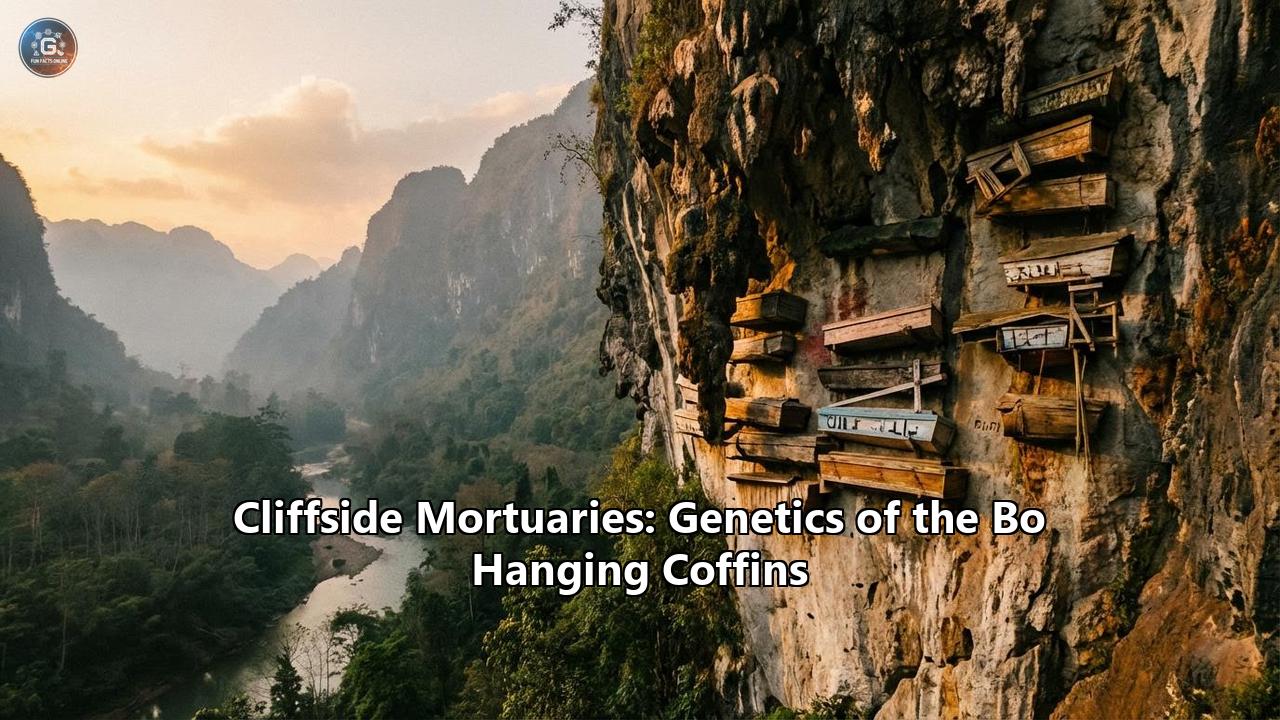
High above the winding rivers and emerald valleys of southern China, an impossible sight defies both gravity and the passage of time. Jutting out from sheer, vertical limestone cliff faces, hundreds of wooden coffins hang suspended in the mist, perched precariously on wooden stakes driven deep into the bedrock or resting quietly in inaccessible crevices. For millennia, these cliffside mortuaries have stood as silent sentinels over the gorges below, presenting one of the most profound archaeological mysteries of the ancient world. Who were the people who went to such extraordinary lengths to elevate their dead? How did they hoist solid wooden caskets, some weighing hundreds of pounds, hundreds of meters up unscalable cliff walls? And most intriguingly, what happened to the civilization that created them?
For generations, local folklore whispered that these suspended tombs were the work of a mythical race of beings capable of flight. Regional legends referred to them reverently as the "Subjugators of the Sky" and the "Sons of the Cliffs". Historical records eventually identified the architects of this breathtaking funerary tradition as the Bo people, a vibrant and prosperous ethnic group that thrived in southwestern China before suddenly vanishing from the historical record hundreds of years ago. Thought to have been completely wiped out by imperial massacres during the Ming Dynasty, the Bo people and their hanging coffins became a tragic enigma, an ancient dead end relegated to the pages of myth.
That is, until the silent genomes of the dead were finally coaxed into revealing their secrets.
In a groundbreaking convergence of archaeology, history, and advanced genetics, scientists have recently extracted ancient DNA from the perilous cliffside coffins. The resulting data, published in late 2025, has sent shockwaves through the historical and scientific communities. Not only does the genetic evidence map a sweeping, 3,000-year-old saga of migration and cultural exchange across Southeast Asia, but it also reveals a stunning truth: the Bo people never truly vanished. Their direct descendants are still walking the earth today, carrying the unbroken genetic legacy of the original "Sons of the Cliffs" within their very cells.
To truly understand the magnitude of this genetic revelation, one must first look at the sheer logistical and cultural marvel of the hanging coffins themselves. Known in Mandarin as xuanguan, the practice of elevating the dead was far from a localized anomaly; it was a sprawling mortuary tradition that spanned across southern China, Southeast Asia, and even into parts of the Pacific.
The visual impact of these cliffside cemeteries is hauntingly beautiful. The coffins, usually carved from a single, massive tree trunk, are found in various states of suspension. Some rest on thick wooden cantilever beams wedged into cracks in the stone; others are tucked away in natural karst caves, while some sit on precarious rocky outcroppings. The heights at which they are placed are dizzying. While the lowest coffins hover around 10 meters above the ground, others are suspended at a staggering 130 to 300 meters high, entirely invisible from the valley floor until modern observation methods brought them into view.
The motivation behind such an extreme burial practice has long been a subject of scholarly debate. Practical theories suggest that elevating the dead kept the remains safe from scavenging beasts and discouraged grave robbers who might seek to steal the artifacts interred with the deceased. However, the primary driving force was almost certainly spiritual. In ancient belief systems, the sheer verticality of the cliffs served as a literal and metaphorical bridge between the earthly realm and the divine. By placing their loved ones high in the air, the Bo people believed they were bringing the spirits of the deceased closer to heaven.
This spiritual motivation was corroborated by a Chinese scholar named Li Jing, who recorded observations of the region during the Yuan Dynasty (1279–1368 CE). In his Brief Chronicles of Yunnan, Li Jing wrote: "Coffins set high are considered auspicious. The higher they are, the more propitious for the dead. And those whose coffins fell to the ground sooner were considered to be more fortunate". The elevation was a mark of supreme honor; the more revered the individual, the closer to the sky they were placed.
Yet, the mechanical reality of how the Bo people achieved this feat remains an enduring puzzle. Scholars have proposed multiple theories, none of which fully account for the ingenuity required. Some hypothesize that the ancient builders constructed massive earthen ramps or gentle slopes up to the cliff faces, though the sheer scale of manpower required for this makes it highly improbable for a relatively small minority group. Others suggest complex systems of scaffolding or the use of ropes to lower the heavy caskets from the mountaintops above. Regardless of the method, the creation of a single hanging coffin was a monumental community effort, underscoring a society possessing both sophisticated engineering skills and an unshakeable devotion to their ancestors.
The people behind this breathtaking custom were far from primitive. The Bo were a dynamic, non-Han ethnic group indigenous to southern China long before the southward conquests of the Qin and Han empires. Ancient Chinese texts describe them as a remarkably prosperous society. They were skilled farmers who cultivated the lush, challenging terrain of the region, and they were also renowned as accomplished horsemen and fierce warriors. Their cultural influence was profound; around 1100 BCE, the early Bo people even allied with the Western Zhou to help overthrow the oppressive Yin rulers at the twilight of the Shang Dynasty, cementing their place in the geopolitical landscape of ancient China.
For thousands of years, the Bo thrived in the rugged borderlands of the Sichuan and Yunnan provinces, cultivating a unique identity that stood in stark contrast to the surrounding Han majority. They endured centuries of political upheaval, wars, crop failures, and natural disasters. However, their independence and distinct way of life eventually drew the ire of the expanding imperial powers.
During the Ming Dynasty (1368–1644 CE), the Bo people faced an existential threat. Imperial forces, seeking to consolidate control over the southwestern frontiers, launched brutal campaigns of subjugation against the fiercely independent minority. In 1573, the Ming imperial army carried out a devastating massacre, hunting down the Bo in a systemic genocide. Fleeing for their lives, the surviving Bo were forced to abandon their ancestral homelands and their sacred cliffside mortuaries. To avoid detection and total annihilation, the survivors changed their names, intermarried, and assimilated into the local populations of neighboring regions.
Following this violent erasure, the Bo people disappeared entirely from historical records by the dawn of the seventeenth century. Their language was lost to time, their rituals ceased, and the grand tradition of hanging coffins came to an abrupt end. For over 400 years, the Bo were considered an extinct civilization, surviving only as a ghost story told in the shadow of the silent, rotting wooden caskets hanging high above the rivers.
Despite their apparent extinction, murmurs of the Bo's survival persisted into the modern era. Deep in the mountains of southeastern Yunnan Province, specifically in Qiubei County, a small community of a few thousand people maintained a quiet, peculiar oral history. Officially classified by the modern Chinese government as a branch of the Yi ethnic minority, this group possessed unique linguistic traits and traditions that set them apart from their neighbors. Most intriguingly, their ancestral folklore stubbornly claimed that they were the true descendants of the ancient cliff-burial architects.
However, many within the community itself doubted this oral history. It seemed impossible to reconcile their modern, earth-bound existence with the mythical "Subjugators of the Sky" who were said to fly up the cliff faces. Furthermore, their modern funerary customs did not involve hauling wooden caskets up vertical rock walls. Instead, they practiced a ritual known as "soul cave burial." In this tradition, the spiritual essence of the dead was represented by copper plates, which were reverently placed into dark, ancestral caves. While symbolic, the connection to the grand, perilous cliff burials of antiquity seemed tenuous at best.
For decades, archaeologists and anthropologists theorized about a potential link, but without a written language left by the Bo and with the physical remains hanging out of reach, the truth remained buried. It was not until the dramatic advancements in paleogenomics—the study of ancient DNA—that science could finally bridge the gap between myth and reality.
Extracting usable DNA from the hanging coffins was an incredibly formidable task. Unlike remains buried deep within the permafrost or sealed in temperature-controlled stone tombs, the bodies within the cliffside coffins had been exposed to the harsh, humid, and fluctuating climate of southern China for centuries. Furthermore, many of the oldest coffins were heavily degraded, their contents scattered or damaged by the elements.
Undeterred, a massive collaborative effort was launched, led by Zhang Xiaoming and his team at the Kunming Institute of Zoology (under the Chinese Academy of Sciences) and researchers from Fudan University in Shanghai. The team embarked on a highly ambitious project to sequence the genomes of the ancient coffin builders and compare them with the living populations of Southeast Asia.
The researchers carefully gathered ancient genetic material from 11 individuals recovered from four distinct hanging coffin sites across the Yunnan and Guangxi provinces. Recognizing that this mortuary tradition extended beyond modern Chinese borders, they also collaborated with Thai scientists to extract DNA from four individuals found in ancient "log coffins" hidden within caves in northwestern Thailand, the oldest of which dated back an astonishing 2,300 years. To complete the puzzle, the researchers performed whole-genome sequencing on 30 present-day individuals from the Qiubei County community who identified as Bo descent.
When the results were published in the prestigious journal Nature Communications in November 2025, the findings were nothing short of revolutionary.
The genomic data definitively shattered the 400-year-old assumption that the Bo people were extinct. The comparative analysis revealed that the present-day Bo individuals inherited a massive proportion of their ancestry—ranging from 43% to 79%—directly from the ancient populations who practiced the hanging coffin tradition. The f-statistics and admixture models painted a picture of undeniable genetic continuity.
"Approximately 600 years after the custom vanished from historical records, we found that the Bo people are the direct descendants of the Hanging Coffin custom's practitioners," the research team proudly announced. The oral traditions that had been passed down through generations in Qiubei County were not mere fables or appropriated myths; they were the accurate, living memory of a civilization that had survived genocide.
The discovery also reframed the modern Bo people's "soul cave burial" ritual. No longer seen as a disparate practice, anthropologists now recognize the placement of copper plates into ancestral caves as a direct cultural echo of the hanging coffin tradition. Stripped of the resources and safety required to hang massive log coffins during their persecution, the survivors adapted their sacred rites. They maintained the core spiritual necessity of elevating their ancestors in stone caves, condensing the physical body into a symbolic copper plate—a beautiful, tragic adaptation born of survival.
Beyond proving the survival of the Bo people, the genetic data unlocked a far older and grander narrative, mapping the prehistoric origins of the hanging coffin culture. By analyzing the deep-time genetic markers of the ancient remains, researchers were able to trace the roots of the cliff builders back over three millennia.
The DNA revealed that both the ancient hanging coffin practitioners and the modern Bo people shared an elevated genetic affinity with Neolithic ("New Stone Age") coastal populations from southern East Asia. These ancient coastal peoples, often referred to as "Tanshishan-like" in genetic terms, lived between 4,000 and 4,500 years ago and are widely recognized by geneticists as the ancestral source of modern Tai-Kadai and Austronesian speaking populations.
This genetic signature aligns perfectly with archaeological timelines. The oldest known evidence of the hanging coffin tradition does not actually come from the inland cliffs of Sichuan or Yunnan, but rather from the Wuyi Mountains in China's southeastern coastal province of Fujian, dating back approximately 3,600 years.
"The genetic traces left behind provide compelling evidence of a shared origin and cultural continuity that transcends modern national boundaries," the researchers noted. The data supports a sweeping narrative of demic migration: the ancestors of the Bo people originated on the southeastern coasts of ancient China. Over the centuries, carrying their unique mortuary traditions with them, they slowly migrated westward into the rugged Yunnan-Guizhou Plateau, and southward into the lush landscapes of Thailand, Laos, and Vietnam.
This migration was not a simple, isolated journey. The DNA of the ancient cliff-dwellers reveals a rich tapestry of admixture. As the Bo ancestors moved across the continent, they interacted and intermingled with Iron Age Hòabìnhian hunter-gatherers and the ancient farming communities of the Yangtze River valley. The log coffins found in the caves of northwestern Thailand showed remarkable genetic similarities to the hanging coffins of southern China, proving that the spread of this tradition was not merely cultural diffusion—where ideas are traded between separate groups—but rather a physical movement of related peoples carrying their sacred rites across vast geographic distances.
Perhaps the most surprising revelation from the ancient DNA came from a specific hanging coffin site in Zhaotong, Yunnan, known as the Wa Shi site. Here, researchers analyzed the genomes of two individuals who had been buried with the same cultural reverence, suspended high above the earth approximately 1,200 years ago, during the height of the Tang Dynasty.
Given their shared burial context, one would expect these two individuals to share a similar genetic background. However, the DNA told a radically different story. While they were united in death by the Bo mortuary tradition, their genetic origins were worlds apart. One individual's genome linked them directly to ancient agriculturalists from the Yellow River region of northern China. The other individual carried strong genetic markers linking them to the nomadic populations of Northeast Asia and the Mongolian Plateau.
This stunning diversity found within a single cliffside mortuary offers a profound new perspective on ancient southern China. It suggests that during the Tang Dynasty (618–907 CE)—an era renowned for its cosmopolitanism and the opening of the Silk Road—the regions of Yunnan and Sichuan were highly dynamic cultural crossroads. The Bo people were not a closed, xenophobic society hiding in the mountains. Instead, their communities featured remarkable cultural inclusivity. People migrating from the frozen steppes of the north and the river valleys of the east were apparently welcomed into the Bo society, assimilating so deeply that they were honored with the highest, most sacred funerary rites of their adopted people.
The story of the Bo people and their hanging coffins is a testament to the resilience of human culture and the inescapable truths hidden within our DNA. For centuries, the cliffside mortuaries were viewed simply as a beautiful, eerie anomaly—the decaying remnants of a "lost" people who had been violently swept away by the tides of imperial history. The coffins hanging over the Yangtze and Luxi rivers were treated as monuments to extinction.
Today, thanks to the pioneering advancements in genomic sequencing, those monuments have been transformed into symbols of survival. The genetic link bridging the ancient Neolithic coasts, the 3,000-year-old cliffs of Fujian, the Tang Dynasty crossroads of Yunnan, and the ancient caves of Thailand has finally been completed, culminating in the living, breathing Bo people of Qiubei County.
The "Sons of the Cliffs" did not vanish; they merely stepped back from the precipice, carrying the souls of their ancestors in copper plates and hiding their lineage in the quiet safety of the mountains. Their survival—proven definitively by the microscopic spirals of their DNA—forces us to rethink the finality of written history. It reminds us that while empires may burn records and armies may drive populations into the shadows, the biological and cultural memories of a people are incredibly difficult to erase. High above the mist-covered valleys of southern China, the hanging coffins continue their silent vigil, no longer just a mystery of the dead, but a soaring tribute to the living.
Reference:
- https://www.popularmechanics.com/science/archaeology/a69649788/china-hanging-coffins/
- https://owlcation.com/humanities/hanging-coffins-bo-people-ancient-china
- https://www.livescience.com/archaeology/ancient-hanging-coffin-people-in-china-finally-identified-and-their-descendants-still-live-there-today
- https://archaeology.org/news/2025/12/10/dna-analysis-confirms-oral-history-of-chinas-bo-people/
- https://global.chinadaily.com.cn/a/202511/25/WS69250e2fa310d6866eb2b3d1.html
- https://en.wikipedia.org/wiki/Hanging_coffins
- https://archaeologymag.com/2025/11/true-origins-of-mysterious-hanging-coffin-tradition/
- https://communities.springernature.com/posts/genetics-trace-the-living-descendants-of-china-s-ancient-hanging-coffin-culture
- https://www.sixthtone.com/news/1017924
- https://arkeonews.net/ancient-dna-reveals-living-descendants-of-chinas-mysterious-hanging-coffin-builders/
- https://377.medium.com/the-mystery-of-chinas-hanging-coffins-and-the-demise-of-the-bo-people-27a36632470d
- https://www.dnagenics.com/ancestry/publications/details/fbfeb70c-061b-4b54-9f3a-b563108fb414