
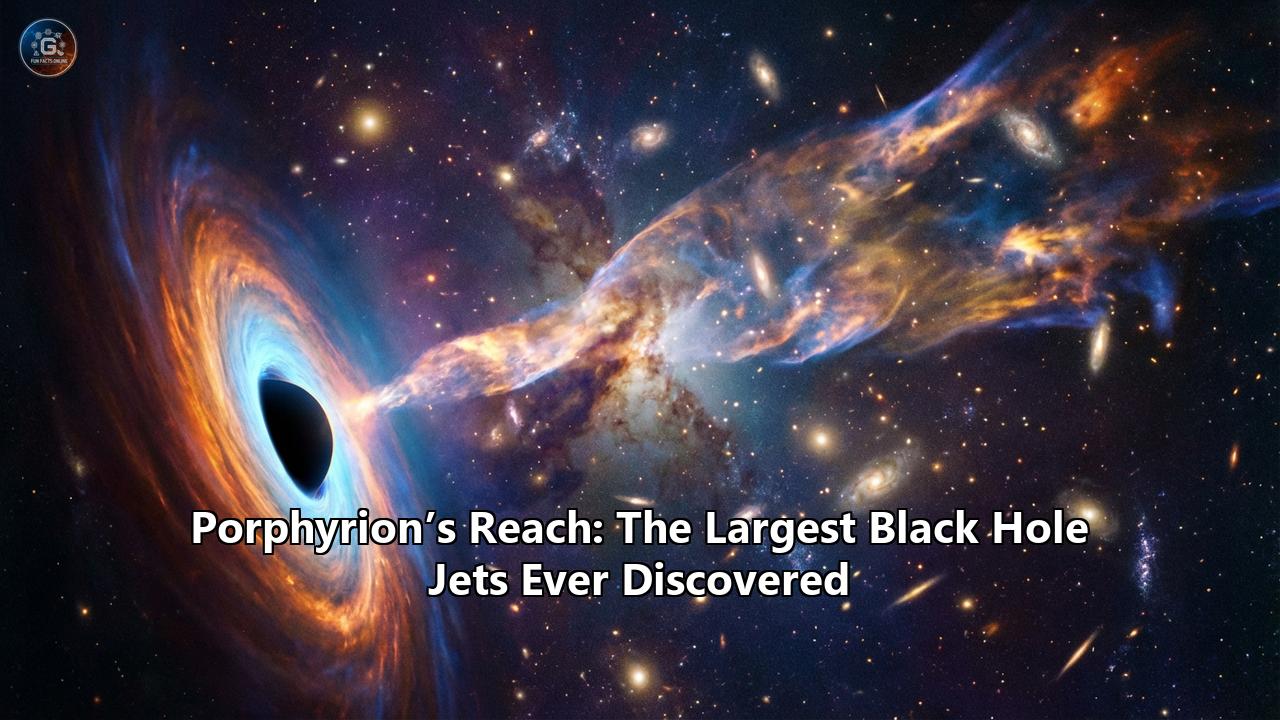
The Titan That Swallowed the Void
In the vast, silent theater of the cosmos, astronomers have just pulled back the curtain on a structure so immense it defies the conventional limits of astrophysical imagination. It is a pair of bipolar jets violently ejected from a supermassive black hole—a structure that does not merely span a galaxy, but bridges the unfathomable emptiness between them.
Its name is Porphyrion.
Named after the king of the Giants in Greek mythology who waged war against the Olympian gods, this celestial titan stretches 23 million light-years from end to end. To visualize this scale is nearly impossible, but consider this: if you were to line up 140 Milky Way galaxies side-by-side, they would barely cover the length of these jets. It is the largest structure of galactic origin ever discovered, a finding that is currently rewriting the textbooks on how black holes shape the universe.
The Discovery: Hunting Ghosts in the Radio Sky
The revelation of Porphyrion did not happen through the lens of a traditional optical telescope. The visible light we see with our eyes tells only a fraction of the universe’s story. To find a monster like this, scientists had to look at the sky in radio waves—the frequency of the invisible, high-energy drama of the cosmos.
The discovery was made using LOFAR (Low Frequency Array), a vast network of radio antennas spread across Europe, centered in the Netherlands. Unlike the dish telescopes of the past, LOFAR acts as a giant, singular eye that scans the low-frequency radio sky, picking up the faint whispers of ancient plasma.
An international team, led by Caltech postdoctoral scholar Martijn Oei, was not explicitly looking for Porphyrion. They were conducting a massive survey of the northern sky, hunting for the faint filaments of the "cosmic web"—the tenuous strands of matter that connect galaxies. What they found instead was a hidden population of giants.
Using machine learning algorithms to sift through the data, followed by the meticulous eyes of citizen scientists and experts, the team identified over 10,000 new giant radio galaxies. But one stood out above all others. A faint, ghostly line cutting across the radio images, so large it seemed like a glitch. It wasn't a glitch. It was a single, coherent object of terrifying power.
Anatomy of a Leviathan
Porphyrion is not a galaxy; it is an event. At its center lies a galaxy roughly 10 times more massive than our own Milky Way, located about 7.5 billion light-years from Earth. This means we are seeing Porphyrion as it existed when the universe was less than half its current age—a time of chaotic growth and cosmic density.
Deep within this host galaxy sits a supermassive black hole. As matter falls toward this gravitational abyss, not all of it is consumed. Through complex interactions of magnetic fields and extreme gravity, a fraction of this matter is diverted and blasted outward from the black hole's poles at near-light speed.
These are the jets.
In most active galaxies, these jets sizzle out after a few thousand or million light-years, dispersed by the intergalactic medium. But Porphyrion’s engine is different. For reasons astronomers are still debating, this black hole managed to keep its "foot on the gas" for approximately one billion years.
It spewed a continuous, stable stream of high-energy plasma that punched through its host galaxy, exited the galactic halo, and pierced deep into the intergalactic void. The jets remained tightly collimated—focused like a laser beam—over a distance that is cosmologically absurd.
Shattering the Record Books
Before Porphyrion, the title for the largest known jet system belonged to Alcyoneus, another giant discovered by the same team in 2022. Alcyoneus spans about 16 million light-years, a size that already puzzled scientists. Porphyrion obliterates this record, measuring 23 million light-years (7 megaparsecs).
To put this in perspective:
- The distance from the Milky Way to our nearest major neighbor, the Andromeda Galaxy, is about 2.5 million light-years. Porphyrion is 10 times longer than the gap between us and Andromeda.
- The jets are so large that they extend across a significant percentage of the "cosmic voids"—the massive, empty bubbles that make up the volume of the universe.
The "Impossible" Engine: A Radiative Surprise
The sheer size of Porphyrion is not the only thing that has stunned the scientific community. It is how it grew so big.
Astronomers classify supermassive black holes into two main modes of operation:
- Jet-Mode: These black holes sip on fuel slowly. They are efficient and typically produce jets, but usually not of this magnitude.
- Radiative-Mode: These are the gluttons. They devour material frantically, shining brightly as "quasars." Standard models suggested that the chaotic environment of a radiative-mode black hole would destabilize any jets, preventing them from growing very large.
When the team used the W. M. Keck Observatory in Hawaii and the Giant Metrewave Radio Telescope (GMRT) in India to analyze Porphyrion’s host galaxy, they found a shocker. Porphyrion emerged from a radiative-mode black hole.
This finding disrupts a long-held consensus. It proves that a violently feeding black hole—one that is blasting out energy in all directions—can still maintain the discipline to launch a stable, cohesive jet that endures for a billion years. It suggests our understanding of black hole accretion disks and magnetic field alignment is incomplete.
The Cosmic Web Connection: Action at a Distance
The most profound implication of Porphyrion is not about the black hole itself, but about what it does to the universe around it.
We live in a universe structured like a sponge. Galaxies are not scattered randomly; they are strung along filaments of dark matter and gas known as the Cosmic Web. Between these filaments lie the Cosmic Voids—vast expanses of nothingness.
Porphyrion is so large that it reaches beyond the cosmic web. Its jets are injecting heat, magnetic fields, and heavy elements deep into the cosmic voids.
This is a form of "action at a distance" that cosmologists hadn't fully accounted for. If a single black hole can heat up and magnetize a chunk of the universe 23 million light-years away, it means black holes are not just local gardeners pruning their own galaxies. They are the landscapers of the entire cosmos.
- Magnetism: The origin of magnetism in the void of space is a mystery. Porphyrion suggests that giant jets act as mechanisms to spread magnetic fields throughout the universe, seeding the intergalactic medium with the forces necessary for future structure formation.
- Star Formation: By dumping energy into the voids, these jets might heat the gas that would otherwise cool and fall into galaxies to form stars. Porphyrion could be responsible for stifling the birth of galaxies billions of light-years away from its source.
A Universe Teeming with Giants
Perhaps the most exciting realization is that Porphyrion is likely not alone.
"We are seeing the tip of the iceberg," Martijn Oei noted upon the discovery. The LOFAR survey found over 10,000 giant radio galaxies, though none as large as Porphyrion. However, since we are looking 7.5 billion years into the past, many more such monsters may be obscured by the limits of our current technology.
As the universe expands, the cosmic web stretches. In the early universe, filaments were closer together. Porphyrion shows us that in those early epochs, black hole jets could bridge the gaps between filaments, creating a connected network of energy transfer that shaped the evolution of the modern universe.
The Future of the Search
Porphyrion’s discovery is a clarion call for radio astronomy. With the upcoming Square Kilometre Array (SKA)—a radio telescope project that will be far more sensitive than LOFAR—astronomers expect to find hundreds more of these "super-giants."
We are entering a new golden age of understanding the dark, violent, and invisible forces that sculpt our reality. Porphyrion stands as a testament to the power of nature: a single point of infinite density, generating a structure that dwarfs galaxies, conquers the void, and challenges the human mind to comprehend the true scale of the infinite.
For now, Porphyrion reigns as the King of the Giants—a 23-million-light-year scar across the face of the deep past, reminding us that in space, even the nothingness is not safe from the reach of a black hole.
Reference:
- https://www.sciencealert.com/largest-black-hole-jets-ever-seen-create-a-galactic-structure-that-will-blow-your-mind
- https://www.futuretimeline.net/blog/2024/09/23-largest-black-hole-jets-ever-seen-are-23-million-light-years-in-length.htm
- https://www.youtube.com/watch?v=icL_dN0EkHs
- https://universemagazine.com/en/as-long-as-140-milky-ways-the-largest-black-hole-jet-is-found/
- https://www.techexplorist.com/biggest-pair-black-hole-jets-ever-seen/90023/
- https://www.caltech.edu/about/news/gargantuan-black-hole-jets-are-biggest-seen-yet
- https://en.wikipedia.org/wiki/Porphyrion_(radio_galaxy))
- https://scitechdaily.com/beyond-imagination-140-milky-ways-spanned-by-record-breaking-black-hole-jets/
- https://www.courthousenews.com/astronomers-discover-massive-record-breaking-black-hole-jets/
- https://scitechdaily.com/astronomers-stunned-by-discovery-of-colossal-black-hole-jets-spanning-23-million-light-years/
- https://www.iflscience.com/truly-supermassive-black-hole-has-jets-spanning-23-million-light-years-the-biggest-ever-seen-76006
- https://medium.com/starts-with-a-bang/longest-strongest-black-hole-jets-of-all-time-discovered-aea31a18d1a3
- https://keckobservatory.org/porphyrion/
- https://www.smithsonianmag.com/smart-news/astronomers-discover-record-breaking-jets-escaping-a-black-hole-the-longest-ever-seen-180985111/
- https://thecrusadernews.ca/2024/11/16/porphyrion-where-size-meets-cosmic-mystery/
- https://www.sciencenews.org/article/universe-largest-black-hole-jets