
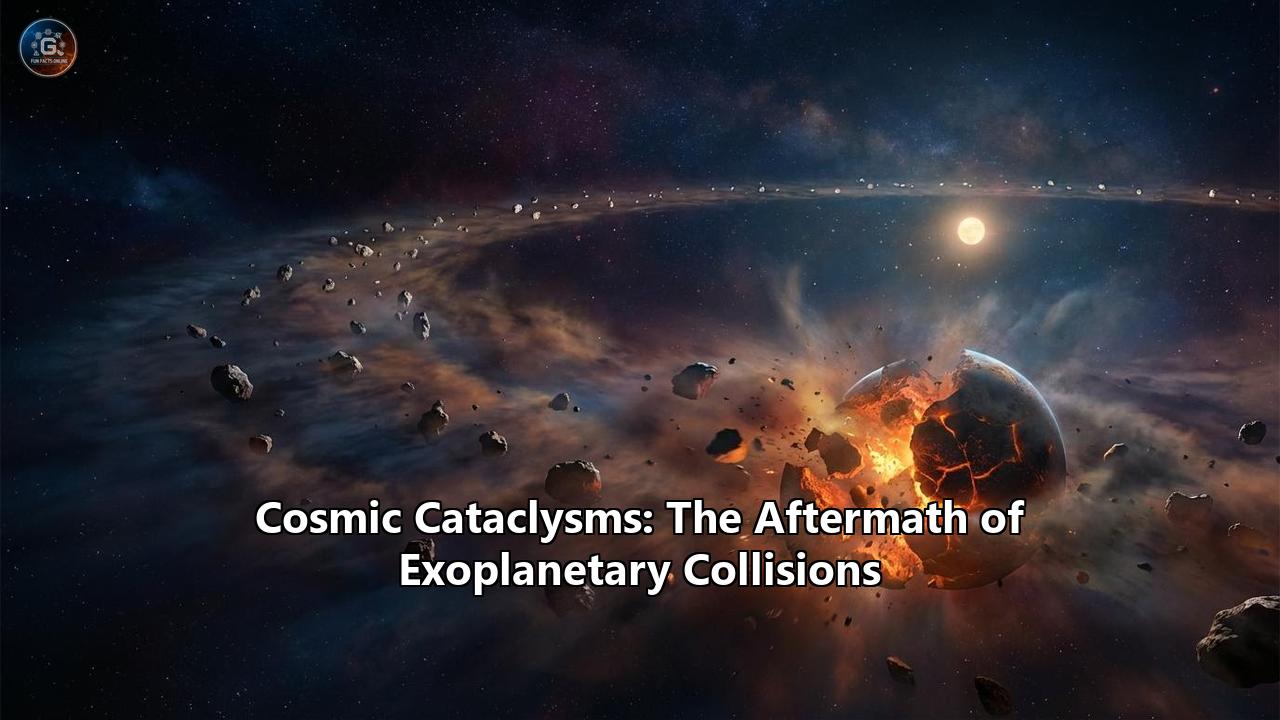
To peer into the deep cosmos is to look upon a battlefield. For centuries, humanity envisioned the universe as a silent, clockwork mechanism—a serene expanse where celestial bodies traced perfect, unending ellipses around their host stars. However, modern astronomy has shattered this tranquil illusion. The universe is not a static diorama; it is a violent, dynamic cosmic forge. At the heart of this transformative violence are exoplanetary collisions. These titanic clashes between worlds, packing the kinetic energy of billions of nuclear detonations, are not mere anomalies. They are a fundamental mechanism of planetary evolution, dictating the ultimate fate of solar systems, the architecture of alien worlds, and perhaps even the genesis of life itself.
For a long time, the only evidence we had of planetary collisions came from the scars left in our own cosmic backyard. We see the aftermath in the strange, sideways rotation of Uranus, knocked on its side by an ancient impactor. We see it in the anomalously oversized iron core of Mercury, a world likely stripped of its rocky mantle by a glancing blow. Most intimately, we see it when we look up at the night sky: Earth’s own Moon is widely believed to be the cooling embers of a spectacular crash between the proto-Earth and a Mars-sized object named Theia some 4.5 billion years ago.
But what was once a theory confined to the history of our Solar System has now become an observable reality across the Milky Way. Armed with next-generation observatories like the James Webb Space Telescope (JWST), the Spitzer Space Telescope, and the Atacama Large Millimeter/submillimeter Array (ALMA), astronomers are no longer just searching for exoplanets—they are watching them die, merge, and be reborn in real time.
The Anatomy of a Cataclysm
What exactly happens when two planets collide? The physics of a giant impact are so extreme that they defy everyday intuition. When planetary bodies, ranging from the size of the Moon to several times the mass of Earth, cross paths, they are traveling at cosmic velocities—often exceeding 10 to 50 kilometers per second (upwards of 22,000 to 110,000 miles per hour).
At the moment of impact, the solid crusts of the planets do not merely shatter; they behave like fluids. The staggering release of kinetic energy instantaneously flash-melts the planetary mantles, turning continents into oceans of magma. Deep within the colliding worlds, shockwaves ripple through iron cores, generating temperatures that rival the surfaces of stars. If the collision is energetic enough, vast portions of the planets are vaporized entirely, transitioning from solid rock to a superheated, glowing gas.
Depending on the angle and speed of the collision, several outcomes can unfold. A direct, high-speed, head-on collision can obliterate both bodies, leaving behind nothing but an expanding debris disk of dust, gas, and molten droplets. A low-speed, grazing impact might result in a "hit-and-run," where the planets tear deep gouges into each other before gravity pulls them back together into a chaotic, merged super-world.
In the most energetic impacts, the colliding bodies lose their spherical shapes entirely. They merge into a rapidly spinning, boiling, donut-shaped mass of vaporized rock known as a synestia. Within a synestia, there is no solid surface. It is a terrifying, beautiful phase of planetary evolution where the boundary between a planet and a disk of debris ceases to exist. Over thousands of years, the synestia radiates its immense heat into the vacuum of space, cooling and coalescing into a new, scarred world, often surrounded by a newly formed ring of debris that will eventually clump together to form moons.
Kepler-107c: The Naked Iron Cannonball
One of the most profound confirmations of exoplanetary collisions comes from the Kepler-107 system, located approximately 1,700 light-years away in the constellation Cygnus. Orbiting a Sun-like star are four planets, but two of them—Kepler-107b and Kepler-107c—caught the attention of astronomers because they presented a baffling physical paradox.
By all standard measurements, Kepler-107b and Kepler-107c are twins in size, both boasting a radius about 1.5 times that of Earth. However, their masses are wildly divergent. Kepler-107b weighs in at roughly 3.5 Earth masses, giving it a density of 5.3 grams per cubic centimeter—very similar to Earth's. Its twin, Kepler-107c, is a staggering 9.4 times the mass of Earth, resulting in a density of 12.6 grams per cubic centimeter. To put that into perspective, Kepler-107c is more than twice as dense as Earth, and significantly denser than solid lead.
In planetary physics, such a density discrepancy between two planets of the same size, in the same system, is an anomaly. Normally, if a planet is extremely dense, it is because stellar winds and radiation from the host star have photoevaporated its lighter, outer gaseous layers, leaving only a heavy rocky core. But Kepler-107c is located further from the star than Kepler-107b. If stellar radiation were responsible, the inner planet should be the denser one.
The only logical explanation was a cataclysmic act of planetary violence. Astronomers concluded that Kepler-107c was once a much larger world, complete with a thick, lighter silicate mantle. Sometime in its history, it was struck by another massive planet in a high-speed, head-on collision. The impact was so severe that it ripped the entire outer rocky mantle off the planet, ejecting billions of tons of silicate into space. What remained behind was the heavy, iron-rich heart of the planet. Today, Kepler-107c is essentially a naked planetary core, composed of up to 70% iron, wandering its star system as a testament to the brutality of planetary formation.
HD 172555: The Scent of a Vaporized Atmosphere
While Kepler-107c offers a look at the long-term evolutionary scars of a giant impact, other systems offer a much fresher look at the immediate aftermath. Located just 95 light-years from Earth in the constellation Pavo is HD 172555, a young, blazing white-hot star only about 23 million years old. Because of its youth, the HD 172555 system is in the throes of its terrestrial planet-forming phase—the exact era when planetary smashups are most frequent.
When the Spitzer Space Telescope observed HD 172555, it detected something highly unusual: massive amounts of glassy silica, similar to obsidian or tektites on Earth. Tektites are uniquely forged in the extreme heat and sudden cooling of meteorite impacts. Furthermore, observations from the ALMA radio telescope array in Chile detected a massive ring of carbon monoxide gas swirling around the star.
Astronomers pieced the forensic evidence together. At least 200,000 years ago—a mere blink of an eye in cosmic timescales—a terrestrial planet roughly the size of Earth was struck by a smaller impactor at speeds exceeding 22,000 miles per hour (10 km/s). The sheer force of the impact melted the rock into glass and blew a massive portion of the larger planet's atmosphere out into the void of space. The carbon monoxide gas detected by ALMA is the lingering breath of that dying world. This discovery marked the first time astronomers had directly detected an atmosphere stripped away by a giant impact, providing critical real-world data to back up hydrodynamic simulations of planetary destruction.
ASASSN-21qj: The Ice Giant Inferno
Perhaps the most dramatic and visually stunning evidence of a planetary collision unfolded quite recently, and its discovery was aided not just by professional astrophysicists, but by the keen eyes of amateur astronomers.
In 2021, a network of telescopes known as the All-Sky Automated Survey for Supernovae (ASAS-SN) noticed that a relatively unremarkable, 300-million-year-old Sun-like star named ASASSN-21qj was rapidly fading. The star's optical light was being blocked by something massive. As professional astronomers began discussing the mystery on social media, an amateur astronomer named Arttu Sainio combed through archival data from NASA’s NEOWISE mission and made a startling connection. About two and a half years before the star began to dim in visible light, it had flared up brightly in the infrared spectrum.
This dual-signature—an infrared flash followed years later by optical dimming—was the exact fingerprint of an exoplanetary collision.
Models and observations suggest that two ice giant planets, similar in mass to Neptune or Uranus, suffered a catastrophic collision. When these massive, icy worlds slammed into one another, they completely pulverized each other, forming a single, expanded, post-impact body. This newly forged, boiling mass of material expanded to an astonishing 750 times the radius of Earth and glowed at a blistering 1000 Kelvin (about 1340°F). It was the thermal radiation from this glowing, super-sized synestia that caused the massive infrared spike observed by NEOWISE.
But the impact also threw off a colossal cloud of debris, ice, and dust. Because the collision happened at a distance of roughly 2 to 16 astronomical units (AU) from the host star, it took time for that expanding debris cloud to travel along its orbit. Roughly 1,000 days after the collision, the thickest part of the debris cloud finally passed directly between the star and Earth. The dust blotted out the star’s visible light, causing the dramatic dimming event that initially caught astronomers' attention.
The ASASSN-21qj event is a watershed moment in astrophysics. For the first time, humanity watched the entire lifecycle of a giant impact unfold sequentially: the fiery glow of the initial smashup, the cooling of the planetary remnant, and the subsequent transit of the shattered debris. Over the coming years, astronomers will continue to monitor the ASASSN-21qj system as the dust clears, eagerly waiting to see what new, merged Frankenstein-world will emerge from the wreckage.
The Role of Destruction in Creation
It is tempting to view these cosmic cataclysms purely as engines of destruction. A collision can strip a planet of its life-sustaining atmosphere, vaporize oceans, and turn a potentially habitable world into a sterile, molten hellscape. However, in the grand calculus of the cosmos, destruction and creation are deeply intertwined.
Planetary collisions are a primary driver behind the vast diversity of exoplanets we observe today. Astronomers have long puzzled over the "radius valley"—a mysterious lack of exoplanets sized between 1.5 and 2 times the radius of Earth. Planetary impacts provide a compelling solution to this mystery. Many planets are born as "Sub-Neptunes," featuring rocky cores shrouded by thick, voluminous envelopes of hydrogen and helium gas. When these planetary systems become unstable, these Sub-Neptunes collide with one another. Because gas is easily stripped away by the kinetic energy of an impact, these collisions blow the thick hydrogen atmospheres into space, leaving behind smaller, denser, rocky "Super-Earths". The violence of the cosmos actively sculpts the demographics of planetary systems.
Furthermore, these collisions are the ultimate delivery mechanisms for the chemical building blocks of planets. In the early days of a planetary system, water, carbon, and organic molecules are often trapped in the outer, colder reaches of the stellar disk. Giant impacts and gravitational scattering can send comets, asteroids, and icy protoplanets careening into the inner system. When these bodies collide with rocky, terrestrial worlds, they deliver oceans of water and the volatile chemicals necessary for life. Without a healthy dose of cosmic bombardment, Earth might have remained a dry, barren rock.
We must also consider the architectural legacy of these impacts: moons. The Giant Impact Hypothesis regarding our own Moon illustrates how crucial an impact can be for the long-term habitability of a world. When Theia struck the proto-Earth, the resulting debris ring eventually coalesced into a massive satellite. The gravitational influence of our Moon acts as an anchor for Earth's axial tilt. Without the Moon, Earth’s tilt would wobble chaotically over millions of years, leading to extreme, unpredictable climate shifts that would make the evolution of complex life exceedingly difficult. By watching exoplanetary collisions, astronomers are essentially watching the birth of exomoons—satellites that might one day stabilize an alien world long enough for life to take root.
A New Era of Planetary Geology
We are standing on the precipice of a new era in astronomy. For the first two decades of exoplanet research, the focus was simply on discovery—cataloging the shadows and gravitational tugs of unseen worlds to prove they existed. Today, the field has evolved into an observational science of planetary geology and atmospheric chemistry.
Telescopes like JWST and ALMA possess the spectral resolution needed to dissect the chemical makeup of post-collision debris clouds. By analyzing the light filtering through these clouds, scientists can detect specific minerals, vaporized metals, and gases. We are no longer just guessing what alien planets are made of; we are waiting for them to be cracked open in giant collisions so we can examine their spilled guts. We are looking for the spectral signatures of vaporized iron, the glow of shock-heated silica, and the tell-tale presence of stripped carbon monoxide.
As we look up at the night sky, it is humbling to realize that the twinkling lights are not peaceful beacons, but the fiery hearths of cosmic forges. The universe is a place of infinite, unyielding recycling. Planets are born from dust, shattered by their neighbors, and melted down to be cast anew. Out of the chaos of vaporized rock and stripped atmospheres comes the exquisite, tailored diversity of the cosmos—a violence that, against all odds, sets the stage for the creation of new worlds, new moons, and perhaps, eventually, new life. The aftermath of an exoplanetary collision is not a graveyard; it is the ultimate crucible of creation.
Reference:
- https://www.hou.usra.edu/meetings/lpsc2019/pdf/2655.pdf
- https://dg.dk/en/sac-enormt-planetsammenstoed-kan-forklare-tvillingplaneter/
- https://www.earth.com/news/afterglow-of-a-huge-planetary-collision-captured-by-telescope-for-the-first-time/
- https://en.wikipedia.org/wiki/HD_172555
- https://www.astronomy.com/science/astronomers-find-the-first-evidence-of-a-giant-collision-between-exoplanets/
- https://news.mit.edu/2021/astronomers-detect-atmosphere-stripped-planet-giant-impact-1020
- https://research-information.bris.ac.uk/en/studentTheses/collisions-of-super-earth-and-sub-neptune-planets/
- https://astrobites.org/2019/07/29/an-interplanetary-collision-in-a-distant-planetary-system/
- https://www.eurekalert.org/news-releases/631326
- https://www.aanda.org/articles/aa/full_html/2012/10/aa19745-12/aa19745-12.html
- https://www.universetoday.com/articles/amateur-astronomers-found-planets-crashing-into-each-other
- https://en.wikipedia.org/wiki/ASASSN-21qj
- https://www.sci.news/astronomy/asassn-21qj-collision-two-ice-giant-exoplanets-12347.html
- https://telescope.live/blog/discovery-first-exoplanetary-collision
- https://circularastronomy.com/home/