
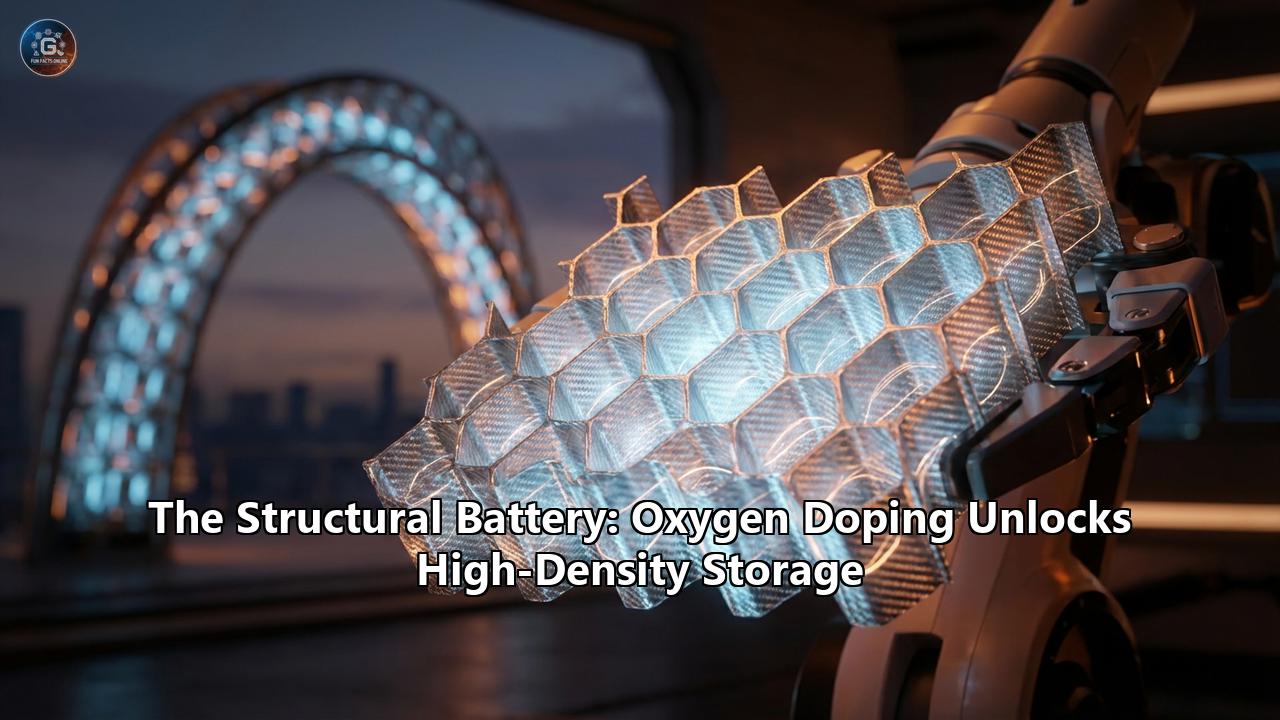
The transition from "energy storage as a cargo" to "energy storage as a structure" represents one of the most profound shifts in engineering history. For over a century, our machines—from the Model T to the Boeing 787—have been designed as rigid skeletons that carry fuel or battery packs as dead weight. The structural battery changes this fundamental equation. It suggests a future where the chassis of a car, the wings of a plane, or the casing of a smartphone are not just passive containers, but the energy source itself.
At the heart of this revolution lies a specific, nanoscale breakthrough that has recently catapulted the technology from a laboratory curiosity to a commercially viable powerhouse: Oxygen Doping.
This article explores the comprehensive science, engineering, and implications of the structural battery, focusing on how oxygen doping has unlocked the high-density storage capability necessary to power the next generation of human mobility.
Part I: The Burden of Dead Weight
To understand the magnitude of the structural battery, one must first understand the "tyranny of the rocket equation" that applies to all electric mobility. In a standard electric vehicle (EV), the battery pack is the single heaviest component, often weighing between 400 to 900 kilograms. This mass requires a heavier chassis to support it, heavier brakes to stop it, and more powerful motors to move it—all of which demand more energy, requiring a bigger battery, which adds more weight. This is the vicious cycle of parasitic mass.
Current lithium-ion batteries are chemically excellent but structurally useless. They are delicate chemical sandwiches that must be protected by heavy steel or aluminum cases. They contribute nothing to the stiffness or crash safety of the vehicle; in fact, they are a liability.
The concept of "massless" energy storage proposes a radical solution: if the battery is the structure, then the effective weight of the energy storage is zero. You were going to build a door or a roof anyway; if that door or roof stores energy, the "battery" adds no extra weight to the vehicle.
Part II: The Structural Battery Architecture
A structural battery is a multifunctional composite material. It must perform two roles simultaneously and perfectly: it must carry mechanical loads (stress, strain, torsion) and it must store electrochemical energy.
The architecture typically consists of:
- The Negative Electrode (Anode): Carbon fiber. This is the magic material. It is strong, stiff, and conductive.
- The Positive Electrode (Cathode): A lithium-metal-oxide coated onto a thin metal foil (often aluminum), which also serves as a current collector.
- The Electrolyte: This is where the magic happens. Unlike the liquid electrolytes in standard batteries (which drip and leak), structural batteries use a "structural electrolyte." This is a semi-solid polymer matrix that transfers lithium ions between the anode and cathode while simultaneously transferring mechanical loads (shear forces) between the fibers.
- The Separator: A thin layer of glass fiber or porous polymer that prevents short circuits but allows ion flow.
For years, the development of this technology was stalled by a brutal trade-off: Stiffness vs. Energy.
To make a carbon fiber strong (high Young’s modulus), you need the carbon atoms to be aligned in perfect, crystalline graphite sheets. However, lithium ions struggle to penetrate these perfect sheets to store energy.
To make a carbon fiber a good battery electrode, you want it to be "amorphous" (disordered), with plenty of gaps and defects for lithium ions to hide in. But amorphous fibers are weak and floppy.
Engineers were stuck. They could make a strong battery that held no power, or a powerful battery that was too weak to build a car with.
Part III: The Breakthrough — Oxygen Doping
The solution that has unlocked high-density storage in structural batteries is the precise electrochemical modification of the carbon fiber surface, specifically through Oxygen Doping.
1. The Mechanism of Oxygen Doping
Oxygen doping involves the controlled introduction of oxygen-containing functional groups—such as carbonyl (C=O), carboxyl (-COOH), and hydroxyl (-OH)—onto the surface and into the lattice of the carbon fibers. This is not merely "rusting" the fiber; it is a precise nano-engineering process often achieved via plasma treatment, electrochemical oxidation, or chemical vapor deposition.
Why does this matter?
- Pseudocapacitance: The oxygen groups act as "docking stations" for lithium ions. In a standard carbon anode, lithium ions must squeeze between the carbon layers (intercalation), a slow process that requires specific spacing. Oxygen functional groups allow for surface redox reactions. The lithium binds directly to the oxygen site (e.g., Li+ + C=O + e- ↔ C-O-Li). This surface storage is fast and doesn't require the carbon lattice to expand and contract as much.
- Defect Engineering: The doping process introduces controlled defects into the stiff crystalline carbon. These defects act as tunnels, allowing lithium ions to diffuse deeper into the fiber without requiring the entire fiber to be amorphous. This allows the core of the fiber to remain highly crystalline (strong) while the outer layers become highly active (energy-dense).
- Wettability: Structural electrolytes are often viscous polymers. They struggle to wet (soak into) pristine, smooth carbon fibers. Oxygen groups are polar; they attract the electrolyte, ensuring perfect contact between the "dry" carbon fiber and the structural electrolyte. This lowers the internal resistance of the battery significantly.
2. Breaking the Trade-off
The result of oxygen doping is a carbon fiber that retains approximately 90-95% of its structural stiffness (because the core lattice is preserved) while increasing its energy storage capacity by 300-400% compared to untreated structural fibers.
This "Oxygen Unlock" means we no longer have to choose between a strong material and an energy-dense one. We can have both.
Part IV: Performance Metrics
With oxygen-doped carbon fibers, the performance metrics of structural batteries have shifted from "experimental" to "competitive."
- Energy Density: Early structural batteries struggled to reach 24 Wh/kg. The new generation, utilizing oxygen-doped anodes and advanced high-nickel cathodes, is targeting 75 Wh/kg to 100 Wh/kg at the material level.
Note: While 75 Wh/kg sounds low compared to a Tesla 4680 cell (approx. 270 Wh/kg), it is misleading. Since the structural battery replaces the steel chassis (which stores 0 Wh/kg), the system-level energy density is effectively infinite compared to the dead mass it replaces.
- Elastic Modulus (Stiffness): The materials are achieving stiffness ratings of 25 to 75 GPa. For context, aluminum is around 69 GPa. This means the battery is as stiff as the aluminum frame it replaces.
- Cycle Life: Oxygen doping stabilizes the surface chemistry, preventing the breakdown of the electrolyte. Prototypes are showing cycle lives exceeding 1,000 cycles, sufficient for automotive applications.
Part V: Applications and Implications
1. The Infinite-Range Electric Vehicle
The immediate application is the automotive sector. By manufacturing the roof, doors, bonnet, and floor pan out of oxygen-doped structural batteries, an EV can shed 500kg of weight.
- Range Extension: Lighter cars need less energy. A "massless" battery car could achieve 70% more range than a standard EV with the same total energy capacity, simply because it isn't hauling a 900kg battery pack.
- Design Freedom: Designers are no longer constrained by the need for a massive, flat "skateboard" battery pack at the bottom of the car.
2. Aerospace: The Killer App
Electric aviation (eVTOLs and regional planes) is currently impossible for long distances because batteries are too heavy. Jet fuel is 50x more energy-dense than batteries.
However, if the fuselage, wings, and internal ribs of the aircraft are the battery, the weight penalty disappears. Oxygen-doped structural composites are the only technology that can theoretically make large-scale electric aviation viable. Every gram saved in aerospace is worth its weight in gold; structural batteries save tons.
3. Consumer Electronics
Imagine a laptop that is as thin as a credit card because the casing itself is the battery. Or a smartphone where the back glass and aluminum frame power the device, freeing up internal space for better cooling or cameras.
Part VI: Manufacturing Challenges
The shift to oxygen-doped structural batteries requires a complete retooling of manufacturing.
- Curing vs. Charging: Structural composites are "cured" in autoclaves at high heat and pressure. Batteries hate heat. Manufacturers must develop "low-temperature curing" structural electrolytes or electrolytes that can be infused after* the structure is built.
- Wiring the Chassis: If your car door is a battery, it needs to be wired into the main bus. This adds complexity to the electrical architecture. The car becomes a "microgrid" of distributed energy storage rather than having a single central tank.
Part VII: Safety and Sustainability
Safety: Ironically, structural batteries may be safer than liquid Li-ion packs. The structural electrolyte is a solid polymer, which is far less flammable than liquid organic solvents. furthermore, the energy is distributed. Puncturing one door (one cell) releases a tiny amount of energy compared to puncturing a centralized 100kWh pack.However, "Crash Safety" takes on a new meaning. If you crash a structural battery car, you are essentially crushing a live electrochemical cell. The oxygen-doped carbon fibers must be designed to fracture in a way that electrically isolates the system instantly to prevent short circuits.
Sustainability: Carbon fiber is notoriously difficult to recycle. Adding lithium, phosphorous, and polymer resins makes it harder. Research is currently underway into "reversible" resin systems that allow the structural battery to be dissolved and separated into its constituent fibers and minerals at the end of its life.Conclusion
The oxygen-doped structural battery is more than just a better battery; it is a new category of matter. It blurs the line between "material" and "machine." By using oxygen to trick stiff carbon crystals into storing ions, we have unlocked a future where energy storage is massless, invisible, and ubiquitous.
As this technology matures from the labs of Chalmers University and MIT into the factories of Volvo and Airbus, we will look back at the era of "heavy batteries" as a primitive transition period. The future is light, strong, and electric.
Detailed Technical Analysis: Oxygen Doping in Carbon Fiber Anodes
To truly appreciate the "unlock," we must dive deeper into the electrochemistry. Standard carbon fibers (polyacrylonitrile-based, or PAN) are graphitized at temperatures above 2000°C. This aligns the graphene planes, creating high tensile modulus (stiffness). However, these tightly packed planes (d-spacing < 0.34 nm) are difficult for lithium ions (0.76 nm radius) to intercalate into.
Oxygen doping modifies this via:
- Opening the Interlayer Spacing: The introduction of oxygen functional groups forces the graphene layers slightly apart, increasing the d-spacing and reducing the energy barrier for lithium insertion.
- Faradaic Reactions: The reaction Li+ + e- + O-group <-> Li-O-group creates a pseudo-capacitive effect. Unlike intercalation (which is diffusion-limited and slow), this surface reaction is fast. This gives the structural battery high "power density" (burst power) in addition to energy density.
- SEI Stabilization: The Solid Electrolyte Interphase (SEI) is a passivation layer that forms on the anode. On bare carbon fiber, the SEI can be unstable and thick, consuming lithium. Oxygen-doped surfaces promote the formation of a thin, robust, inorganic-rich SEI (dominated by LiF and Li2CO3 rather than organic alkyl carbonates), which protects the electrolyte from continuous decomposition.
The Role of the Structural Electrolyte
The oxygen-doped fiber is useless without a partner: the structural electrolyte. This is typically a bicontinuous heterophasic polymer.
- Phase 1: A rigid polymer skeleton (often an epoxy or vinyl ester) that carries the mechanical load.
- Phase 2: A liquid or gel electrolyte percolating through the pores of the skeleton, carrying the ions.
The innovation here is optimizing the interface between the oxygen-doped fiber and the liquid phase. The oxygen groups make the fiber "hydrophilic" (or "lyophilic" to the organic electrolyte), drawing the liquid phase into the deepest microscopic grooves of the fiber bundle. Without oxygen doping, the electrolyte would merely sit on the surface, leaving the inner fibers "dry" and electrically dead.
Future Roadmap
2026-2028: Niche high-end applications. Premium electric hypercars and military drones will adopt structural composite panels to gain competitive performance advantages. Cost will be high due to the specialized "doping" autoclaves required. 2029-2032: Mass adoption in consumer electronics. Laptops and tablets will feature structural battery casings, doubling battery life without increasing thickness. 2035+: Mainstream automotive and aerospace. As manufacturing costs drop, the "skateboard" chassis will disappear. Cars will be unibody structures made entirely of energy-storing composites. Electric aircraft will begin replacing regional turboprops.The structural battery, powered by the invisible chemistry of oxygen doping, is the key to breaking the weight barrier. It turns the very structure of our world into a reservoir of power.
Reference:
- https://www.researchgate.net/publication/350214750_Carbon_Fiber_Reinforced_Zn-MnO2_Structural_Composite_Batteries
- https://d-nb.info/1246414112/34
- https://pmc.ncbi.nlm.nih.gov/articles/PMC8438096/
- https://pubs.acs.org/doi/10.1021/acsomega.2c00639
- https://pubs.acs.org/doi/10.1021/acsami.4c17922
- https://www.chalmers.se/en/current/news/f-3d-battery-imaging-reveals-the-secret-real-time-life-of-lithium-metal-cells/
- https://pubs.aip.org/aip/jcp/article/158/4/041101/2876480/Kinetic-enhanced-carbon-fiber-for-rechargeable
- https://www.mdpi.com/2313-0105/11/5/203