
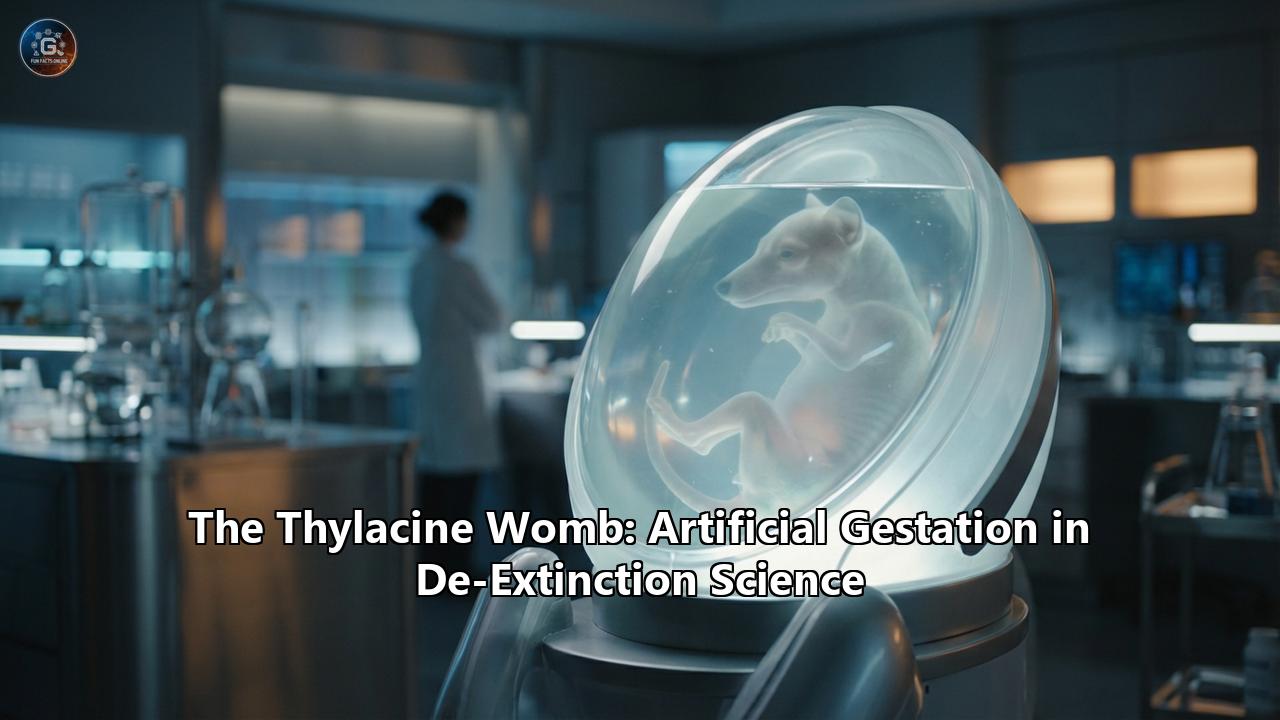
In a sterile, temperature-controlled laboratory at the University of Melbourne, a small, unassuming device hums with a rhythmic, mechanical pulse. To the uninitiated, it looks like a sleek, black box—an industrial piece of hardware that might house a server or a centrifuge. But inside this "black box," illuminated by soft amber LEDs, lies the frontier of biological resurrection. It is a humid, nutrient-rich sanctuary designed to bridge the gap between the living and the dead.
This is the Thylacine Womb.
For nearly a century, the thylacine (Thylacinus cynocephalus), or Tasmanian tiger, has been a ghost story—a striped phantom that vanished from the wilds of Tasmania, with the last known individual, "Benjamin," dying of exposure in a concrete pen at the Hobart Zoo in 1936. But today, thanks to a partnership between the Texas-based biotechnology firm Colossal Biosciences and the Thylacine Integrated Genetic Restoration Research (TIGRR) Lab, that ghost is being summoned back into the flesh.
While the headlines often focus on the genetic wizardry—the CRISPR editing and the reconstruction of ancient DNA—the true bottleneck of de-extinction has always been birth. How do you birth an animal that has no living mother? For the thylacine, a marsupial with a unique reproductive strategy, the answer does not lie in a simple surrogate. It lies in the creation of an entirely new biological infrastructure: the artificial exo-pouch.
The Marsupial Paradox: Why Surrogacy Isn't Enough
To understand the necessity of the Thylacine Womb, one must first understand the biology of the animal itself. Unlike placental mammals (like humans or elephants), which gestate their young deep within the womb for months, marsupials have a reproductive strategy that is effectively a "two-stage" pregnancy.
The first stage is a remarkably short internal gestation. In the thylacine, this period was estimated to be less than a month. The result is a neonate that is shockingly underdeveloped—a hairless, blind, jelly-bean-sized embryo weighing less than a gram. This "joey" must then crawl from the birth canal, up the mother’s fur, and into the pouch, where it fuses its mouth to a teat. There, in the second stage of development, it remains for months, growing from a fetal speck into a fully formed predator.
"This reproductive biology is both a blessing and a curse for de-extinction," explains Dr. Andrew Pask, head of the TIGRR Lab. "It’s a blessing because we don't need to grow a full-sized animal inside a uterus, which is incredibly complex. But it’s a curse because we need a pouch. And we don't have a thylacine pouch."
The closest living relative to the thylacine is the fat-tailed dunnart (Sminthopsis crassicaudata), a mouse-sized marsupial that weighs about as much as a carrot. While the dunnart shares a significant portion of its DNA with the thylacine, the physical disparity is comical. A dunnart could perhaps carry a thylacine embryo for the initial few weeks of gestation, given the tiny size of the neonate. But once that joey is born, it would quickly outgrow the dunnart’s pouch, threatening the life of both the surrogate and the precious clone.
"You can't ask a mouse to carry a wolf," says Ben Lamm, CEO of Colossal Biosciences. "We needed an external system that could take over where biology hits a wall."
Genesis in a Box: The Artificial Uterus
The journey of the resurrected thylacine begins not in a pouch, but in a bioreactor. The first hurdle the scientific team faced was creating an environment that could support the initial cellular division and early embryonic development of a marsupial outside a living body.
In early 2025, the team achieved a "mid-gestation" milestone that sent shockwaves through the scientific community. Using a prototype artificial uterus, they successfully cultured fertilized single-cell embryos of the fat-tailed dunnart (the model species) past the halfway point of their natural pregnancy.
This device is far more than a warm tank. It utilizes microfluidic technology—a network of microscopic channels that mimic the vascular system of a uterus. These channels deliver a precise cocktail of nutrients, oxygen, and signaling molecules directly to the developing embryo, while simultaneously whisking away metabolic waste products.
"The environment inside a marsupial uterus is dynamic," notes Dr. Pask. "It changes hour by hour. The oxygen tension shifts; the glucose levels spike and drop. Our device has to replicate that choreography perfectly. If we miss a beat, the embryo stops developing."
The success with dunnart embryos proved that the concept was sound. The team is now adapting the protocols for the thylacine’s specific genetic requirements. But the artificial uterus is only the prologue. The true innovation—the "Thylacine Womb"—is the device designed to replace the pouch.
The Exo-Pouch: Engineering a Second Skin
The "Exo-pouch" is arguably one of the most complex pieces of bio-engineering ever attempted. It is not merely an incubator; it is an active, biological interface.
When a thylacine joey is "born" from the artificial uterus (or harvested from a dunnart surrogate), it is effectively a fetus. It has no immune system, no ability to regulate its body temperature, and its skin is so thin it is permeable to water. In the wild, the pouch provides a sterile, humid, and antimicrobial environment.
The artificial version, developed by Colossal’s "Exogenous Development" team, replicates these conditions with space-age precision.
1. The Artificial Teat and Milk MatrixThe most critical component of the exo-pouch is the nutrient delivery system. Marsupial lactation is notoriously complex. Unlike cow’s milk, which remains relatively stable, marsupial milk changes its composition drastically over the course of the joey's development.
"In the early days, the milk is rich in carbohydrates and specific proteins designed to build the immune system," explains Dr. Bethany Vance, a lead researcher on the project. "As the joey grows, the milk transitions to become high-fat and high-protein to fuel rapid muscle and bone growth. We have to synthesize these changes artificially."
The team has developed a "smart teat" system. It is a soft, silicone-based interface that the tiny joey can latch onto. Behind the teat, a computer-controlled mixing system adjusts the formula of the artificial milk in real-time, based on the joey's growth markers. This "dynamic lactation" ensures that the developing thylacine gets exactly the nutrients it needs at every hour of its life.
2. The Microbial ShieldA natural pouch is lined with skin that secretes antimicrobial peptides, protecting the vulnerable joey from infection. The exo-pouch mimics this with a synthetic lining infused with bio-active compounds. The air inside the device is HEPA-filtered and humidity-controlled to prevent the joey from dehydrating, a constant risk for a creature with skin as thin as tissue paper.
3. The "Black Box" DesignVisually, the device has been described as "underwhelming" by Pask himself—a black box with rotating components. However, the rotation is functional. In a natural pouch, the mother moves, shifts, and grooms. Complete stillness is unnatural for a developing marsupial. The exo-pouch gently rocks and rotates, stimulating the joey’s vestibular system and encouraging muscle tone development even before the animal can walk.
The Genetic Blueprint: 99.9% and Closing
None of this hardware would matter without the software: the DNA. The thylacine project has benefited from a stroke of luck—the preservation of exceptional specimens.
One specimen in particular, a 110-year-old thylacine head preserved in ethanol at the Museum Victoria, proved to be a genetic goldmine. Unlike dried skins or taxidermy, which yield fragmented DNA, the ethanol-preserved soft tissue allowed scientists to extract long strands of DNA and, crucially, RNA.
"RNA gives us the instruction manual," says Pask. "DNA is the list of parts; RNA tells you how those parts are used in different tissues—the brain, the muscle, the eye."
By late 2024, the team had assembled a genome that is 99.9% complete, with fewer than 45 gaps remaining. This is the most complete ancient genome ever reconstructed. Using CRISPR-Cas9 technology, the scientists are now editing the genome of the fat-tailed dunnart, swapping out dunnart genes for thylacine traits.
They have already made over 300 distinct edits, creating a cell line that is becoming less "dunnart" and more "thylacine" by the day. These cells will eventually be used to create the embryo that will be placed into the artificial womb.
Conservation Spillover: Saving the Living
Critics of de-extinction often argue that the millions of dollars spent on resurrecting the dead should be used to save the living. Colossal and TIGRR argue that the two goals are not mutually exclusive—in fact, they are symbiotic.
The "Thylacine Womb" technology is already being positioned as a lifeline for endangered marsupials that are still with us.
"Take the Tasmanian Devil," says Lamm. "Devils give birth to 20 or 30 joeys, but the mother only has four teats. The vast majority of those babies die simply because there is no room at the inn. With our exo-pouch technology, we could rescue those 'surplus' joeys and hand-rear them, exponentially increasing the population of an endangered species."
The technology could also be used to help the Northern Quoll, a species being decimated by invasive cane toads. The gene-editing tools developed for the thylacine are being used to engineer quolls that are resistant to toad toxin, a project that is already well underway.
Furthermore, the advancements in artificial gestation have implications for human medicine. The microfluidic life-support systems designed for a gram-sized marsupial could inform the development of better incubators for extremely premature human babies, blurring the line between zoology and neonatology.
The Ecological Endgame: Return to Tasmania
The ultimate goal of the Thylacine Womb is not a zoo exhibit; it is rewilding. The thylacine was the apex predator of Tasmania, a biological keystone that held the ecosystem together. Since its extinction, the ecosystem has unraveled. Invasive species like feral cats and foxes have flourished, and diseases like the Devil Facial Tumor Disease have spread unchecked.
"The ecosystem is missing its boss," Pask asserts. "The return of the thylacine could stabilize the Tasmanian bush in a way that human intervention never could."
The project has established the Tasmanian Thylacine Advisory Committee, a group of local stakeholders, Aboriginal leaders, and conservationists, to plan for the eventual release. They are modeling release sites, studying the potential impact on livestock (historically the friction point that led to the thylacine's doom), and preparing the public for the return of the tiger.
The Ethics of "Playing God"
The sight of a thylacine joey growing inside a machine inevitably raises ethical hackles. Is this nature, or is it engineering? Are we restoring a lost masterpiece, or creating a biological Frankenstein?
"We are not creating a monster," argues Lamm. "We are fixing a mistake. Humans destroyed this animal. We hunted it to the last individual. We have a moral obligation to use our technology to undo that damage."
There are valid concerns about the behavior of these animals. A thylacine raised in a black box, fed by a silicone teat, and raised without a mother—will it know how to be a thylacine? Will it know how to hunt? How to socialize?
Colossal admits this is a challenge. "Nature vs. Nurture is a big question for us," says Vance. "We are planning to use 'surrogate mentors'—other marsupial carnivores—and perhaps even robotic or puppet-based socialisation tools to teach these animals how to be predators."
A Future in the Box
As the lights dim in the Melbourne lab, the artificial wombs continue their silent work. Inside one of them, a cluster of cells is dividing, following a genetic script that hasn't been read in ninety years.
The Thylacine Womb is more than a piece of technology; it is a symbol of a new era in conservation. It represents a shift from "preservation"—trying to hold onto what is left—to "restoration"—actively rebuilding what was lost.
If successful, the first thylacine born in the 21st century will not take its first breath in a den of eucalyptus leaves, but in a sterile chamber of glass and steel. It will be a child of two worlds: the ancient past and the high-tech future. And as it opens its eyes, it will look out onto a world that thought it had seen the last of the Tasmanian Tiger.
The box is humming. The tiger is waking up.
Reference:
- https://www.youtube.com/watch?v=Jl0iG1YbW-Y
- https://au.news.yahoo.com/device-inside-black-box-holds-secret-to-mind-blowing-tasmanian-tiger-breakthrough-190021367.html
- https://colossal.com/thylacine/
- https://pubmed.ncbi.nlm.nih.gov/30641029/
- https://www.unimelb.edu.au/newsroom/news/2024/october/new-milestones-help-drive-solutions-to-extinction-crisis
- https://www.selectscience.net/article/colossal-achieves-multiple-scientific-firsts-in-progress-towards-thylacine-de-extinction
- https://www.pharmavoice.com/news/dire-wolves-colossal-ben-lamm-pharma-drug-form-bio/802526/
- https://en.wikipedia.org/wiki/Colossal_Biosciences
- https://colossal.com/education/