
In 2023, an image of the Pope wearing a stylish, puffy white Balenciaga jacket went viral. It was funny, it was harmless, and it was completely fake. But for security experts and information scientists, that "puffy coat" moment was a warning shot. If an AI generator could fool millions with a fashion statement, what happens when it generates a politician declaring war, a CEO announcing a bankruptcy, or a piece of evidence in a murder trial?
We have entered the Age of Synthetic Media. Generative AI tools like Midjourney, Sora, and GPT-4 have democratized the ability to create hyper-realistic content. In doing so, they have dissolved the implicit trust we once placed in "seeing is believing." As the lines between the physical and the digital blur, society is scrambling for an anchor—a way to tether digital assets to their origins.
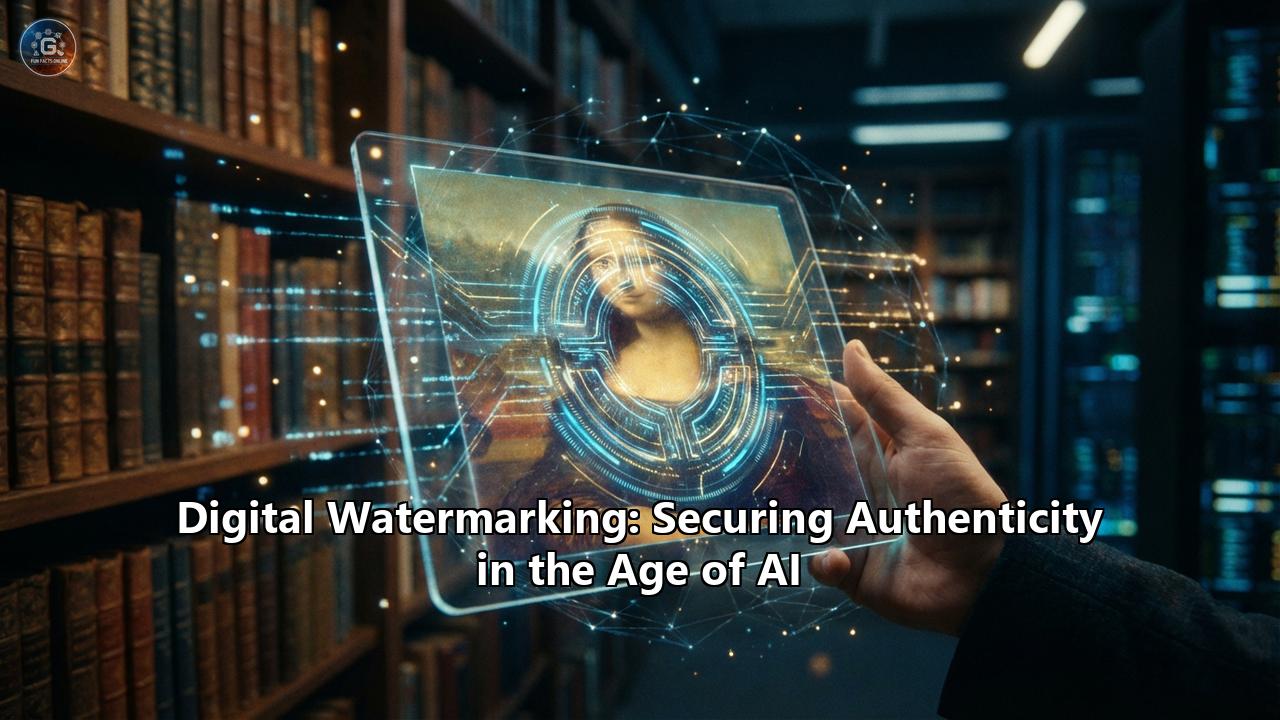
Enter Digital Watermarking and Content Provenance. Once a niche tool for copyright protection, this technology has morphed into the bedrock of digital civilization. It is no longer just about protecting a photographer's royalties; it is about protecting the concept of shared reality itself.
This comprehensive guide explores the mechanisms, the "arms race" of attacks and defenses, the global regulatory landscape, and the profound ethical questions surrounding the technology that promises to secure authenticity in the age of AI.
Part I: The Mechanics of Invisibility
To understand how we secure the future, we must understand the technology that hides in plain sight. Digital watermarking is the science of embedding information into a signal (audio, video, image, or text) in a way that is difficult to remove but easy to detect—for those who know where to look.
1. The spectrum of Visibility
Watermarking is not a monolith. It exists on a spectrum of perceptibility and intent:
- Visible Watermarks: The classic "stock photo" overlay. These are overt declarations of ownership, designed to deter theft by degrading the aesthetic value of the image. In the AI era, however, visible watermarks are easily removed by "inpainting" AI tools that can fill in the gaps where a logo used to be.
- Invisible (Imperceptible) Watermarks: This is where the modern battle is fought. These watermarks are woven into the very fabric of the data. They rely on the limitations of human perception. For example, the human eye cannot distinguish between a pixel with a Red value of 255 and one with 254. By subtly shifting these values across millions of pixels, algorithms can encode binary data without altering the image's appearance.
- Fragile vs. Robust Watermarks:
Robust Watermarks are the armor. They are designed to survive compression, resizing, cropping, and even re-encoding. They are used for copyright and provenance tracking.
Fragile Watermarks are the seal. They are designed to break the moment a single bit of the file is altered. These are crucial for tamper detection in legal and forensic contexts. If the watermark is broken, the evidence is compromised.
2. Under the Hood: The Algorithms
Modern watermarking goes far beyond simple pixel manipulation. It operates in the frequency domain, mathematically transforming the image into waves and frequencies.
- DCT (Discrete Cosine Transform): The same math that powers JPEG compression. An image is broken into blocks of frequencies. The watermark is embedded into the "middle" frequencies—too significant to be compressed away, but not significant enough to be visible to the eye.
- DWT (Discrete Wavelet Transform): A more advanced method that decomposes an image into different resolution layers. This allows the watermark to be embedded in a way that scales naturally, making it highly resistant to resizing attacks.
- Spread Spectrum Audio: In audio watermarking, a pseudo-random noise sequence (the watermark) is spread across the entire frequency spectrum of the audio file. Because the energy is spread so thin, it is inaudible to the human ear (masked by the louder audio content) but easily detectable by a computer that knows the "key" to the pattern.
3. The Challenge of Text
Watermarking text generated by Large Language Models (LLMs) like ChatGPT is significantly harder than images. You cannot change a pixel in a word. You can only change the word itself.
- The "Green List" Method: Researchers have developed statistical watermarking. When an LLM generates the next word in a sentence, it usually chooses from a top-tier of likely words. A watermarking algorithm randomly divides these words into a "Green List" and a "Red List." It forces the AI to choose words from the Green List slightly more often than natural probability would dictate.
- The Detection: A human reader sees a normal sentence. But a computer analyzing the text will notice a mathematical anomaly: "Why did this author choose a 'Green List' word 80% of the time, when a human would only do it 50% of the time?" This statistical bias is the watermark.
Part II: The Global Standard — C2PA and the "Nutrition Label"
While invisible watermarks are powerful, they are proprietary. A Google watermark cannot be read by an OpenAI detector. To solve this, the tech industry has united behind an open standard: C2PA (Coalition for Content Provenance and Authenticity).
1. The Anatomy of a Manifest
Think of C2PA not as a hidden code, but as a digital chain of custody—a "nutrition label" for content.
- Assertions: These are statements of fact bound to the file. "This photo was taken by a Nikon Z9." "This photo was cropped in Adobe Photoshop." "This photo was generated by DALL-E 3."
- The Manifest Store: These assertions are bundled into a "manifest" that travels with the file.
- Cryptographic Binding: The crucial element. The manifest is cryptographically signed. If someone changes a single pixel of the image without updating the manifest, the cryptographic signature fails. The "tamper seal" is broken.
2. Glass-to-Glass Trust
The ultimate vision of C2PA is "Glass-to-Glass" authentication—from the glass lens of the camera to the glass screen of your phone.
- Hardware Integration: Camera giants like Sony (a9 III), Nikon (Z9), and Leica (M11-P) have begun integrating C2PA chips directly into their hardware. These cameras digitally sign the image at the moment of capture. This creates a "secure original."
- The Edit Trail: When a photojournalist opens that secure original in Photoshop, the software reads the signature. If they adjust the brightness, Photoshop adds a new assertion: "Brightness Adjusted." It does not destroy the original history; it appends to it.
- The Viewer: When the final image reaches a news website or social media feed, the user can click a small "Cr" (Content Credentials) icon to see the entire history: who took it, when, where, and exactly what edits were made.
Part III: The Arms Race — Attackers vs. Defenders
No security technology is perfect. As watermarking advances, so do the methods to destroy it. We are currently in a high-stakes game of cat-and-mouse.
1. The Attack Vectors
- The "Washing" Attack: Adversaries can use "diffusion purification." By adding a small amount of noise to a watermarked image and asking an AI to "clean it up," the AI often scrubs the watermark out, interpreting it as noise.
- Model Extraction: Hackers try to steal the "DNA" of an AI model. By querying an API thousands of times, they can train a "clone" model. Watermarks are used here as "radioactive tracers"—if the clone model starts spitting out watermarked content, the company knows their IP was stolen.
- Spoofing: The danger of C2PA. If a hacker steals a photographer's private cryptographic key, they can sign fake AI images as "authentic photos." This necessitates robust secure hardware (like the dedicated security chips in modern cameras) to protect these keys.
2. The Defense: Adversarial Robustness
- Deep Learning Watermarks: Newer watermarks are not just mathematical patterns; they are trained neural networks. They are designed to survive the specific distortions that AI generators produce.
- Soft Binding: Companies are now combining C2PA (metadata) with invisible watermarking (pixel data). If the metadata is stripped (a common occurrence when you upload a photo to Instagram), the invisible watermark remains. A cloud crawler can spot the watermark, look up the original metadata in a database, and "reattach" the history to the image.
Part IV: The Geopolitics of Truth
Watermarking is no longer just a technical standard; it is law. The world is fracturing into different regulatory regimes regarding AI transparency.
1. China: The Strict Controller
China has moved faster than any other nation. The 2023 Deep Synthesis Provisions require both "explicit" (visible) and "implicit" (invisible) labeling of all AI-generated content.
- The Goal: Social stability and state control. The government demands the ability to trace any piece of synthetic media back to its creator and the service provider.
- The Reality: Platforms like TikTok (Douyin) and WeChat impose strict watermarking rules. If you generate an AI image in China without a watermark, you are violating the law.
2. The European Union: The Regulator
The EU AI Act (Article 50) mandates transparency. AI systems must be designed so that their outputs are marked in a machine-readable format.
- The Approach: Consumer protection. The EU wants citizens to have the "right to know" if they are interacting with a machine.
- The Friction: Open-source developers argue that mandating watermarks on open models is impossible to enforce. If you download the code for an AI model, you can simply delete the line of code that adds the watermark.
3. The United States: The Standard-Setter
The US approach, led by Executive Order 14110, focuses on government procurement and voluntary standards.
- The Strategy: Market dominance through standards. By pushing C2PA (backed by US giants like Adobe and Microsoft), the US hopes to set the de facto global standard for how authenticity is handled, rather than creating strict top-down laws like China.
Part V: Sectors on the Frontline
1. Journalism: The Fight for History
In the fog of war, truth is the first casualty. The Starling Lab, a partnership between Stanford and USC, is using watermarking and cryptography to preserve history.
- 78 Days Project: During the turbulent transition from the Trump to Biden administration, Reuters photographers used prototype cameras to cryptographically sign photos of protests and political events. These photos were hashed and stored on a decentralized blockchain (Filecoin), ensuring that no government or hacker could ever retroactively alter the historical record.
- Genocide Testimony: The same tech is being used to authenticate video testimony of genocide survivors, ensuring that deepfakes cannot be used to deny these atrocities in the future.
2. The Legal System: The Chain of Custody
Courts operate on evidence. As deepfakes become perfect, "I didn't say that" becomes a plausible defense for anyone caught on tape.
- Admissibility: Courts are beginning to look at C2PA metadata as the modern "chain of custody." A video file without a cryptographic signature may soon be considered inadmissible hearsay, while a signed video carries the weight of verified evidence.
3. Art and Creativity: Glaze and Nightshade
Artists are using watermarking not just to track, but to fight back.
- Glaze: A tool that adds an invisible "style cloak" to artwork. To a human, the art looks normal. To an AI training on the internet, the art looks like a different style (e.g., an oil painting looks like a charcoal sketch). This prevents the AI from successfully mimicking the artist's style.
- Nightshade: An offensive watermark. It "poisons" the training data. If an AI trains on Nightshade-protected images of dogs, it might start believing that "dog" means "cat," corrupting the model's ability to generate accurate images.
Part VI: The Privacy Paradox & The Future
The Dissident's Dilemma
There is a dark side to perfect attribution. If every photo and video can be traced back to its creator, what happens to the whistleblower? What happens to the protestor in an authoritarian regime?
- Anonymity vs. Authenticity: Privacy advocates warn that a watermarked web is a surveillance web. If C2PA becomes mandatory, a dissident filming police brutality could be instantly identified by the cryptographic signature of their camera.
- The Solution: "Selective Disclosure." The C2PA standard includes mechanisms for redaction, allowing a journalist to verify a photo is real without revealing who took it. However, implementing this correctly is a matter of life and death.
The Future: A Web of Trust
We are moving toward a Two-Tiered Internet.
- The Wild Web: The vast ocean of unverified, likely synthetic content. Fun, chaotic, and untrustworthy.
- The Verified Web: A layer of news, banking, and official communications where every pixel and packet is signed, watermarked, and authenticated.
In this future, the "Green Lock" icon in your browser won't just mean "Secure Connection." It will mean "Verified Reality."
Digital watermarking is not a silver bullet. It will be hacked. It will be circumvented. But it is currently the only shield we have against the erosion of truth. As AI scales to infinity, the value of human-verified, cryptographically-anchored reality will become the most precious resource of the 21st century.
Reference:
- https://wildmediajournal.com/2024/01/keeping-it-real-camera-manufacturers-tackle-ai-images-with-new-tech/
- https://www.starlinglab.org/
- https://www.europarl.europa.eu/RegData/etudes/BRIE/2023/757583/EPRS_BRI(2023)757583_EN.pdf757583_EN.pdf)
- https://www.aclu.org/issues/free-speech/internet-speech/online-anonymity-and-identity
- https://datajournalism.com/read/handbook/verification-1/additional-materials/verification-and-fact-checking
- https://filecoin.io/assets/case-studies/case-study-starling-lab.pdf
- https://www.starlinglab.org/journalism/
- https://blog.adobe.com/en/publish/2024/10/14/5-year-anniversary-content-authenticity-initiative-what-it-means-whats-ahead
- https://www.starlinglab.org/fellowship/
- https://contentauthenticity.org/how-it-works
- https://www.techrepublic.com/article/ai-cryptography-watermarking/
- https://contentauthenticity.org/blog/adobe-co-founds-the-coalition-for-content-provenance-and-authenticity-c2pa-standards-organization
- https://www.pcmag.com/news/sony-camera-updates-make-it-easier-to-track-photo-manipulation
- https://www.scworld.com/perspective/how-c2pa-can-safeguard-the-truth-from-digital-manipulation
- https://www.scmp.com/news/china/politics/article/3302477/china-mandates-labels-all-ai-generated-content-fresh-push-against-fraud-fake-news
- https://www.chinalegalexperts.com/news/china-deep-synthesis-regulation
- https://www.mlgts.pt/en/knowledge/legal-alerts/Legal-Alert-European-commission-launches-public-consultation-for-guidelines-and-code-of-practice-on/26259/
- https://www.imatag.com/blog/ai-act-legal-requirement-to-label-ai-generated-content
- https://datainnovation.org/2024/07/the-ai-acts-ai-watermarking-requirement-is-a-misstep-in-the-quest-for-transparency/
- https://www.mofo.com/resources/insights/251201-eu-digital-omnibus
- https://www.tocsinmag.com/post/the-right-to-digital-shadows-why-internet-anonymity-is-democracy-s-last-line-of-defense
- https://www.getclarity.ai/ai-deepfake-blog/white-house-executive-order-demands-watermarking-of-ai-content
- https://cdt.org/insights/privacy-principles-for-digital-watermarking/