
Ninety-three million miles from where you sit, a continuous thermonuclear explosion is taking place. It is a violent, chaotic, and terrifyingly beautiful event that has sustained all life on Earth for nearly four billion years. To the naked eye, the Sun appears as a static, yellow disk—a constant companion in our sky. But to the eyes of a physicist, it is a roaring beast of magnetized plasma, twisting and writhing in agony as it sheds its outer layers into the void. This shedding is not merely a gentle evaporation; it is a supersonic gale known as the solar wind, a stream of charged particles that bathes the entire solar system, strips atmospheres from unshielded planets, and defines the very boundaries of our heliosphere.
For decades, humanity has studied this wind. We have tasted it with spacecraft near Earth; we have flown through it with probes like Voyager; we have even touched its outer edge with the Parker Solar Probe. Yet, despite sixty years of the Space Age, a fundamental mystery remains at the heart of solar physics—a "ghost" in the machine of our star. We know the solar wind exists, and we know it accelerates to speeds exceeding a million miles per hour. But we do not know how.
The laws of thermodynamics tell us that as gas expands, it should cool and slow down. The solar wind does the opposite. As it leaves the Sun’s surface, it is hot. As it expands into the vacuum of space, it should cool adiabatically. Instead, it remains inexplicably hot, and more perplexingly, it accelerates. Somewhere between the surface of the Sun and a distance of about ten solar radii (roughly 4 million miles out), a hidden engine kicks in. Energy is dumped into the plasma, decoupling its thermal profile from its velocity profile, heating it up and hurling it outward.
This region—the "acceleration zone"—has been invisible to us. It is too close to the Sun for traditional in-situ spacecraft to survive for long, and too faint for standard telescopes to analyze in detail. It is the "blind spot" of heliophysics.
Enter CODEX.
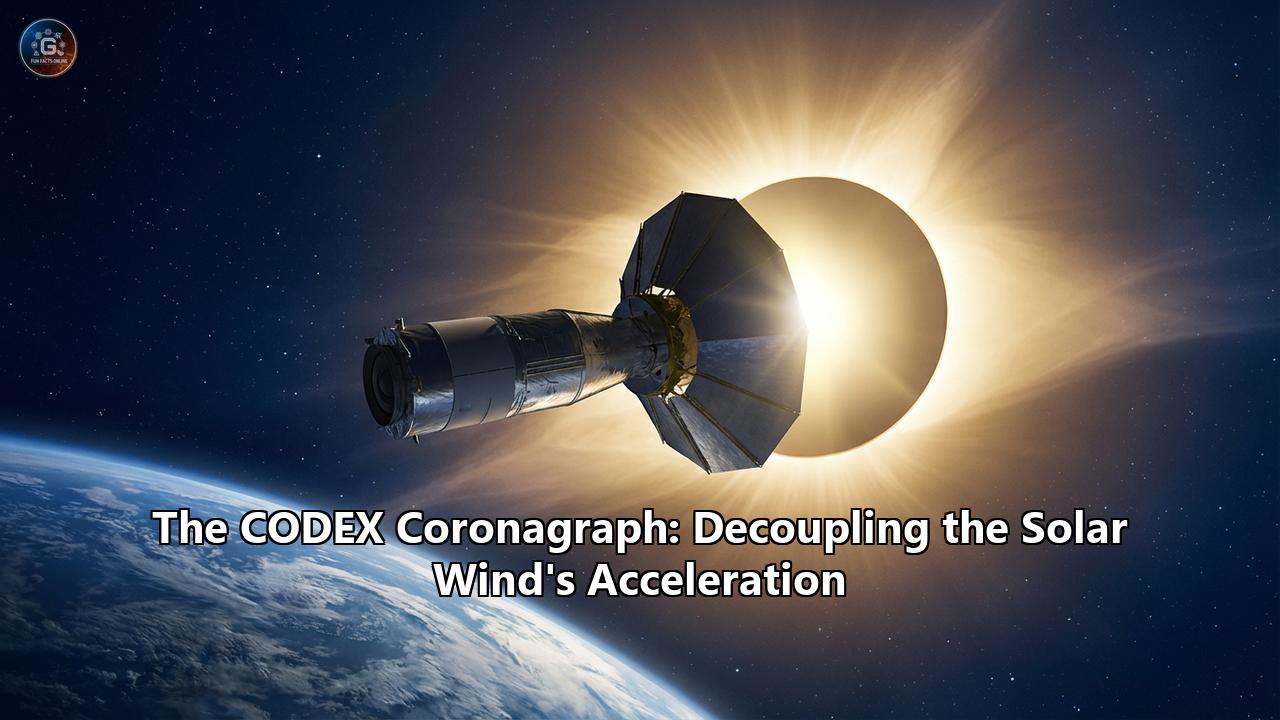
The Coronal Diagnostic Experiment (CODEX) is not just another telescope. It is a technological scalpel designed to slice into this mystery with unprecedented precision. Launched in November 2024 and mounted on the International Space Station (ISS), CODEX is the first instrument capable of simultaneously measuring the density, temperature, and velocity of the solar wind in this critical formation zone. By doing so, it promises to decouple the mechanisms of heating from the mechanisms of acceleration, solving a riddle that has baffled scientists since Eugene Parker first penned the theory of the solar wind in 1958.
This article serves as a definitive chronicle of the CODEX mission. We will explore the physics of the solar corona, the ingenuity of the filter-ratio technique, the engineering marvel of the instrument itself, and the profound implications its data will have for our understanding of the universe.
Part I: The Physics of the Impossible
To understand why CODEX is necessary, one must first appreciate the absurdity of the solar corona. The surface of the Sun, the photosphere, is a blistering 6,000 degrees Celsius. Logic dictates that as you move away from a heat source, it should get cooler. If you walk away from a campfire, you do not expect the air 100 feet away to suddenly ignite into a million-degree inferno.
Yet, this is exactly what happens in the Sun’s atmosphere. Just a few thousand kilometers above the relatively cool photosphere, the temperature skyrockets to over 1 million Kelvin. This superheated plasma forms the corona, a tenuous halo of ionized gas that is visible during a total solar eclipse.
The Coronal Heating ProblemThis "coronal heating problem" is one of the most famous unsolved problems in astrophysics. The energy required to maintain the corona at these temperatures is enormous. For decades, two primary theories have battled for dominance:
- Wave Turbulence (The "Slow Burn"): This theory suggests that the Sun’s magnetic field lines, rooted in the churning convection zone below, are shaken like guitar strings. These magnetic waves (Alfvén waves) propagate upward into the corona. When they collide and interact, they generate turbulence, cascading energy down to smaller and smaller scales until it dissipates as heat, boiling the plasma off into space.
- Interchange Reconnection (The "Explosive Release"): This theory posits that the heating is impulsive. It suggests that "closed" magnetic loops (arches of plasma with both ends rooted in the Sun) collide with "open" magnetic field lines (lines that stretch out into the solar system). When they touch, they "reconnect," snapping into a new configuration. This snap releases a burst of hot plasma and energy, like a rubber band breaking, flinging material outward.
The problem is that both mechanisms can theoretically produce a solar wind. To distinguish between them, you cannot just look at the amount of wind; you have to look at its history. You need to know:
- Was the gas hot before it started moving fast? (Suggesting steady heating via waves).
- Did it get hot and fast at the exact same moment? (Suggesting an explosive reconnection event).
This requires measuring two things at the same time: Temperature (T) and Velocity (V).
Historically, coronagraphs—telescopes that block the Sun’s disk to see the faint corona—could only measure Density (n). They worked by counting photons (brightness). A bright spot meant more electrons (higher density). They could see structures moving (like a cloud drifting in the wind), but they couldn't tell you the temperature of the gas or the speed of the bulk flow itself, only the speed of the "clumps" within it.
This is the "coupling" problem. Without independent T and V measurements, we cannot tell which physical process is driving the wind. We are like meteorologists trying to understand a hurricane by only looking at black-and-white photos of clouds, without a thermometer or a Doppler radar.
CODEX changes the game. It is the first "Doppler radar" for the solar wind.
Part II: The CODEX Instrument – A Technological Marvel
Designing an instrument to look next to the Sun is like trying to take a picture of a firefly hovering next to a searchlight. The Sun is about a million times brighter than the corona. Any stray light—diffraction from the telescope’s edges, scattering from dust on the lens—will completely wash out the signal.
CODEX, a collaboration between NASA’s Goddard Space Flight Center and the Korea Astronomy and Space Science Institute (KASI), with support from Italy’s INAF, employs a suite of innovations to achieve its goals.
The Coronagraph ReinventedA standard coronagraph uses an external occulter (a disk in front of the telescope) to block direct sunlight. However, light acts like a wave; it bends around the edges of the disk (diffraction), creating a bright ring that ruins the view close to the Sun.
CODEX uses a multi-stage approach to kill this stray light:
- External Occulter: The first line of defense, blocking the main disk.
- Internal Occulter: A secondary block inside the instrument.
- Lyot Stop: A specialized aperture that blocks the diffracted light from the edges of the objective lens.
- The Focal Mask (The Secret Weapon): Unlike previous missions like SOHO/LASCO, CODEX adds a fourth element—a focal mask at the telescope’s prime focus. This mask is essentially a "hole" that allows only the coronal light to pass while blocking the residual diffracted light from the external occulter. This suppression is critical because CODEX isn't just taking pictures; it’s doing spectroscopy (analyzing light colors), which requires a much higher Signal-to-Noise Ratio (SNR) than simple imaging.
The light we see from the corona comes from two sources:
- K-Corona: Light scattered by electrons. This is the signal we want. It is highly polarized.
- F-Corona: Light scattered by dust (interplanetary dust). This is the "noise." It is unpolarized.
To separate them, CODEX uses a Polarization Camera utilizing a Sony IMX253MZR CMOS detector. In older instruments, a mechanical wheel with polarizing glass would rotate in front of the camera, taking three separate images (0°, 60°, 120°) to calculate polarization. This was slow and introduced vibration. The Sony chip has micropolarizers built directly onto the pixels. Every four pixels form a "superpixel" with different polarization orientations. This allows CODEX to measure the polarization state of the light instantly, in a single exposure, eliminating motion blur and mechanical failure points.
The Filter WheelThe heart of CODEX is its filter wheel. It contains narrow bandpass filters centered at specific wavelengths:
- 393.5 nm & 405.0 nm: Used for temperature measurements.
- 398.7 nm & 423.3 nm: Used for velocity measurements.
These wavelengths were not chosen at random. They are the keys to the "Filter-Ratio Technique."
Part III: The Diagnostic Method – Cram, Reginald, and the Filter-Ratio Technique
How do you measure the temperature of a gas you cannot touch? You look at its "fingerprint" in light.
The light coming from the Sun’s photosphere is not a smooth rainbow. It is crossed by thousands of dark lines called Fraunhofer lines. These are caused by cooler atoms in the Sun’s lower atmosphere absorbing specific colors of light.
When this sunlight hits the free electrons in the hot corona, it gets scattered toward Earth (Thomson Scattering). But the electrons in the corona are not sitting still. They are zipping around at tremendous speeds due to the high temperature (millions of degrees).
Measuring Temperature (Thermal Broadening):Imagine a tennis ball machine firing balls (photons) at a wall (electrons). If the wall is stationary, the balls bounce back at the same speed. But if the wall is vibrating wildly (hot electrons), some balls get a "kick" and come back faster (bluer), while others hit a receding part of the wall and come back slower (redder).
This "thermal motion" smears out the sharp Fraunhofer lines. A deep, narrow absorption line in the photospheric spectrum becomes a shallow, broad dip in the coronal spectrum. The hotter the electrons, the more "smeared" the spectrum becomes.
By comparing the brightness of the corona through two different filters—one inside a spectral absorption dip (like the Calcium H & K lines near 393 nm) and one in the continuum (405 nm)—CODEX can measure how "filled in" the dip is. This ratio gives the Electron Temperature (Te) directly. This theory was first formalized by L.E. Cram in 1976.
Measuring Velocity (The Doppler Dimming/Shift):Now, imagine the entire wall is moving away from you (solar wind outflow). This adds a Doppler shift to the entire spectrum, shifting it toward the red.
However, measuring this shift is incredibly hard because the lines are already so smeared out by the temperature. It’s like trying to see if a blurry cloud has moved slightly to the left.
This is where the genius of Nelson Reginald (2001) comes in. Reginald extended Cram’s theory to show that while the shape of the spectrum is dominated by temperature, the ratio of intensities at specific "red wing" and "blue wing" wavelengths changes sensitively with bulk velocity.
CODEX uses filters at 398.7 nm and 423.3 nm to sample these wings. By comparing these intensities to the temperature-derived model, the algorithm can isolate the Radial Flow Velocity (V).
The "Decoupling" AccomplishedFor the first time, we have a single instrument that outputs three simultaneous global maps:
- Density Map (Ne): From total brightness.
- Temperature Map (Te): From the Cram filter ratio (smearing).
- Velocity Map (V): From the Reginald filter ratio (red-shift).
This triple-threat dataset is the "Rosetta Stone" needed to decipher the solar wind’s origin.
Part IV: The Science – A Tale of Two Theories
With these maps, scientists can finally test the competing theories of solar wind acceleration.
Scenario A: The Wave Turbulence ModelIf the solar wind is driven by Alfvén wave turbulence, the CODEX maps should show:
- A gradual rise in temperature as we move out from the Sun (wave dissipation).
- A smooth, steady acceleration profile.
- Velocity vectors that align perfectly with the magnetic field lines.
- Broad, uniform heating across large regions (coronal holes).
In this view, the "wind" is like a pot of water on a stove (the Sun) that is being stirred vigorously. The stirring (waves) heats the water until it boils over the rim.
Scenario B: The Interchange Reconnection ModelIf the wind is driven by interchange reconnection, the maps will look very different:
- Bursty Structures: We should see "blobs" or distinct packets of plasma that are significantly hotter than their surroundings.
- Impulsive Acceleration: The velocity maps should show sharp jumps in speed—regions where gas suddenly snaps from 0 to 500 km/s.
- Temperature Spikes: The heating should be localized at the boundaries of magnetic structures (the "separatrix web"), not uniformly distributed.
CODEX will be able to see these "signatures." If it sees hot, fast blobs moving through a cooler background, it validates the Reconnection model. If it sees a smooth, hot flow, it validates the Wave model. Most likely, it will find a complex hybrid, revealing that the Sun uses different engines for different types of wind (Fast Wind vs. Slow Wind).
The "Streamer Belt" MysteryOne specific target for CODEX is the "streamer belt"—those long, pointy helmet-shaped rays seen during eclipses. We know the "Slow Solar Wind" comes from around here, but we don't know if it oozes out of the top of the streamers or if it leaks out the sides via reconnection. CODEX’s velocity map will act like a traffic camera, catching the plasma in the act of escaping and revealing the exact exit ramps it takes.
Part V: The Synergy – The "Great Observatory" of Heliophysics
CODEX does not work alone. It is the central piece of a grand puzzle, connecting the dots between two other major NASA missions: Parker Solar Probe (PSP) and PUNCH.
Parker Solar Probe (The Touch):PSP is a daredevil. It dives deep into the corona, getting as close as 9 solar radii. However, PSP is an in-situ spacecraft. It can only measure the plasma that directly hits it. It’s like a blindfolded person trying to understand a rollercoaster by sticking their hand out the window. It knows exactly what is happening right there, but it has no context of the larger structure it is passing through.
PUNCH (The Wide Angle):The Polarimeter to Unify the Corona and Heliosphere (PUNCH) is a future mission designed to image the "outer" solar wind, from about 20 solar radii out to Earth. It sees the "weather" once it has already formed and is blowing through the system.
CODEX (The Bridge):CODEX sits in the middle. It images the region from 3 to 10 solar radii.
- It sees the plasma before it reaches Parker Solar Probe.
- It sees the "birth" of the structures that PUNCH will track later.
Imagine a relay race. The Sun passes the baton (plasma). CODEX watches the handoff (acceleration). PSP verifies the speed of the runner. PUNCH watches the runner cross the finish line (Earth).
By combining CODEX images with PSP data, scientists can do "connection science." They can see a blob in CODEX, calculate its speed, predict when it will hit PSP, and then check PSP’s data to see if the "ground truth" matches the remote observation. This verifies the accuracy of our remote sensing models, which is crucial because we can’t send probes to every star in the universe. We have to learn to trust our telescopes.
Part VI: The Engineering Journey – From Wallops to Orbit
The road to the ISS was not easy. The development of CODEX required overcoming significant engineering hurdles.
The Thermal NightmareThe International Space Station is a terrible place for a telescope. It orbits Earth every 90 minutes, cycling between scorching sunlight and freezing darkness 16 times a day. This "thermal snapping" causes metal to expand and contract, which can throw a sensitive optical instrument out of focus.
The CODEX team, led by engineers at Goddard and KASI, had to design a robust thermal control system. They used active heaters and specialized insulation to keep the optical bench at a stable temperature, ensuring that the filter wavelengths (which can drift with temperature) remained locked on their atomic targets.
The Pointing ChallengeThe ISS is also noisy. Astronauts exercise on treadmills, supply ships dock, and reaction wheels spin. The station vibrates. For a coronagraph, which must keep a tiny metal disk perfectly aligned with the Sun to block its light, this vibration is disastrous.
CODEX employs a sophisticated Auto-Guiding System. It has a separate "guide telescope" that locks onto the Sun’s limb. A fast-steering mirror inside the instrument compensates for the ISS’s jitters in real-time, keeping the image stable to within arcseconds.
Installation via RobotCODEX was not installed by a spacewalking astronaut. It was launched in the "trunk" of a SpaceX Cargo Dragon (CRS-31) in November 2024. Once docked, the Canadarm2 robotic arm reached into the trunk, grabbed the washing-machine-sized instrument, and plugged it into the ELC-3 (ExPRESS Logistics Carrier) on the port side of the station’s truss. This "plug-and-play" installation highlights the versatility of the ISS as a platform for cutting-edge science.
Part VII: Why It Matters – The Future of Space Weather
Why should the average person care about the temperature of the corona? Because the corona is the muzzle of the gun that fires space weather at Earth.
Protecting the GridCoronal Mass Ejections (CMEs) are billion-ton clouds of plasma that can slam into Earth’s magnetic field, causing geomagnetic storms. These storms can fry power grids (as happened in Quebec in 1989), disrupt GPS signals, and endanger astronauts.
Currently, our prediction models are "kinematic"—we see a CME leave the Sun and we guess its speed based on its initial push. But we don't know how much acceleration it will undergo on its way out.
CODEX’s velocity maps will provide the "ground truth" for drag and acceleration in the inner corona. By feeding CODEX data into computer models, we can vastly improve the accuracy of our arrival time predictions. Instead of a 12-hour window of uncertainty, we might narrow it down to a few hours, giving power grid operators crucial time to prepare.
Understanding the UniverseThe Sun is the only star we can study up close. But there are billions of stars like it in the galaxy. Many of them have "stellar winds" that strip the atmospheres of orbiting exoplanets, rendering them uninhabitable.
By solving the physics of the solar wind with CODEX, we are learning the "Universal Rules of Star-Planet Interaction." We can apply the CODEX findings to stars like Proxima Centauri or TRAPPIST-1. If we know that "Mechanism A" drives the wind, we can calculate if an Earth-like planet around a red dwarf would keep its atmosphere or be blasted barren. CODEX is, in this sense, a tool for astrobiology.
Conclusion: The First Light of Understanding
As CODEX begins its science operations, streaming gigabytes of data down to the Science Operations Center at Goddard and the data center at KASI, we are entering a golden age of heliophysics.
For the first time, we are not just watching the solar wind; we are dissecting it. We are peeling back the layers of blinding light to reveal the hidden machinery of our star. The "ghost" of acceleration is being exorcised by the rigor of data.
The decoupling of heating and acceleration is more than just a technical achievement; it is a shift in perspective. It moves us from a descriptive era of solar physics (drawing what the corona looks like) to a physical era (calculating what the corona is).
In the coming years, as the 393.5 nm filter clicks into place and the polarization camera captures the faint ghost-light of the K-corona, CODEX will likely reveal things we didn't even know to ask. It may find new waves, new types of reconnection, or entirely new states of plasma turbulence. But whatever it finds, one thing is certain: the wind that touches our faces, lights up our auroras, and defines our existence in the cosmos will never look the same again.
Reference:
- https://openaccess.inaf.it/server/api/core/bitstreams/2b185135-0553-438a-bb8f-1d530cb69301/content
- https://science.nasa.gov/mission/codex/
- https://cpaess.ucar.edu/sites/default/files/punch-5-presentations/casti-m-codex.pdf
- https://www.researchgate.net/publication/226622708_Determination_of_the_temperature_of_the_solar_corona_from_the_spectrum_of_the_electron-scattering_continuum
- https://www.nathanielwelsh.com/codex
- http://codex.kasi.re.kr/eng/codex/mission.php
- https://techport.nasa.gov/projects/95780
- https://pmc.ncbi.nlm.nih.gov/articles/PMC5422629/
- https://ntrs.nasa.gov/api/citations/20230015141/downloads/paper1.pdf
- https://science.gsfc.nasa.gov/671/staff/bios/cs/Nelson_Reginald/Chapter1.pdf
- https://ntrs.nasa.gov/citations/20230014008
- https://science.gsfc.nasa.gov/671/staff/bios/cs/Nelson_Reginald/Chapter5.pdf
- https://science.gsfc.nasa.gov/671/staff/bios/cs/Nelson_Reginald/Chapter2.pdf
- https://www.researchgate.net/publication/258474420_Technique_to_Measure_the_Coronal_Electron_Temperature_and_Radial_Flow_Speed