
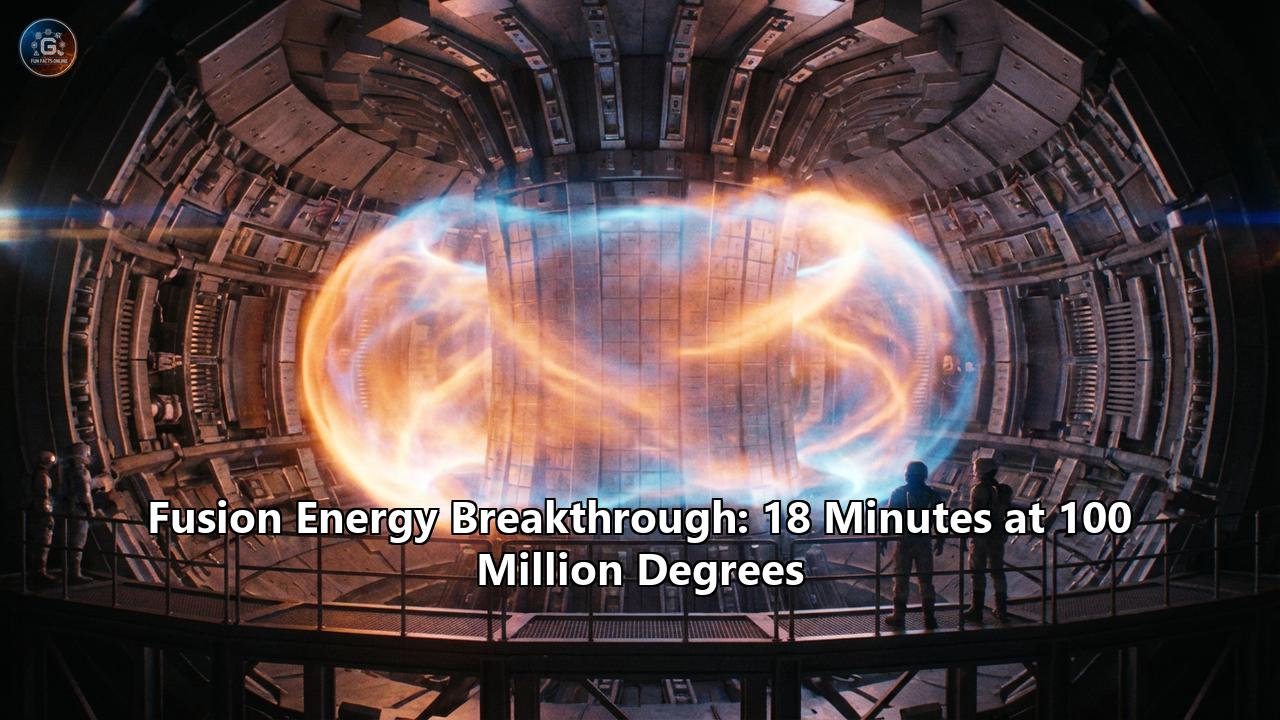
It is a number that sounds almost mundane in the context of a commute or a coffee break: eighteen minutes. But in the world of nuclear physics, where unstable reactions usually last for fractions of a second, eighteen minutes is an eternity.
Earlier this year, in January 2025, scientists at the Institute of Plasma Physics of the Chinese Academy of Sciences (ASIPP) shattered the world’s expectations. Their Experimental Advanced Superconducting Tokamak (EAST)—affectionately known as the "Artificial Sun"—did not just flicker into life; it roared. For a staggering 1,056 seconds, the reactor sustained a roiling loop of plasma at temperatures exceeding 100 million degrees Celsius.
To put this in perspective: that is nearly seven times hotter than the core of our own Sun, held stable for a duration long enough to bake a pizza.
This achievement is not merely a new entry in the record books; it is the "Kitty Hawk" moment for fusion energy. After decades of promises that fusion is "always 30 years away," the physics of the stars has finally been tamed on a timescale that implies continuous operation is possible. We are no longer just lighting matches in the dark; we have built a lantern that stays lit.
Part I: The "Artificial Sun" and the 18-Minute Miracle
The Event
The breakthrough occurred at the EAST facility in Hefei, China. For years, EAST has been a workhorse in the global fusion community, trading records with South Korea’s KSTAR and Europe’s JET. But the January run was different. The team utilized a new operational mode, optimizing the magnetic field configuration to suppress the chaotic instabilities that usually cause plasma to collapse (or "quench") after a few seconds.
Maintaining 100 million degrees is the "magic threshold" for nuclear fusion on Earth. While the Sun fuses hydrogen at a relatively cool 15 million degrees due to its immense gravitational pressure, Earth-bound reactors must compensate for their lack of gravity with extreme heat. At 100 million degrees, the atomic nuclei of deuterium and tritium are stripped of their electrons and slam into each other with enough force to overcome their natural magnetic repulsion, fusing into helium and releasing a burst of energy.
Why 18 Minutes Matters
In the past, fusion records were measured in milliseconds. Then, we moved to seconds. In 2024, South Korea’s KSTAR stunned the world by holding this temperature for 48 seconds.
Jumping from 48 seconds to over 17 minutes (1,056 seconds) is not an incremental step; it is a logarithmic leap.
- Thermal Equilibrium: In 48 seconds, the components of the machine are still heating up. By minute 10, the reactor has reached a "steady state." The walls, the magnets, and the divertors are fully heat-soaked. If the machine survives 18 minutes, it proves it can likely survive 18 hours or 18 days, provided the engineering holds.
- Plasma Physics: This duration proves that we can control "edge localized modes" (ELMs)—violent bursts of energy that act like solar flares inside the reactor—over long periods.
- Control Systems: It demonstrated that AI-driven magnetic control systems can react faster than the plasma can destabilize, effectively juggling a bar of soap made of lightning for nearly twenty minutes.
Part II: The Science of the Stars
To understand the magnitude of this achievement, we must descend into the atomic realm.
The Impossible Bottle
The fundamental challenge of fusion is containment. You are trying to bottle a substance that destroys anything it touches. No physical material—not titanium, not tungsten, not diamond—can withstand contact with 100 million-degree plasma.
The solution is Magnetic Confinement. The device used, a Tokamak (a Russian acronym for "toroidal chamber with magnetic coils"), is shaped like a donut. Massive superconducting magnets surround the donut, creating a magnetic field cage. Because the superheated fuel is a plasma (an electrically charged gas), it is forced to follow the magnetic field lines, spiraling endlessly around the donut without ever touching the walls.
The Fuel
The reaction powering these machines is typically the Deuterium-Tritium (D-T) reaction:
- Deuterium: A stable isotope of hydrogen found abundantly in seawater. A single gallon of seawater contains enough deuterium to equal the energy of 300 gallons of gasoline.
- Tritium: A radioactive isotope of hydrogen with two neutrons. It is rare in nature but can be "bred" from lithium.
When these two fuse, they produce:
- A Helium nucleus (Alpha particle).
- A high-energy Neutron.
- Energy.
The helium remains in the plasma, keeping it hot (self-heating), while the neutron escapes the magnetic cage (since it has no charge) and slams into the reactor walls. This kinetic energy is captured as heat to drive steam turbines, generating electricity.
Part III: The Engineering of Hell
The 18-minute record was not just a triumph of physics, but of material science. The inside of a fusion reactor is arguably the harshest environment in the universe—hotter than a star, yet surrounded by magnets cooled to near absolute zero (-269°C) just a few meters away.
The Tungsten Divertor
The hero of recent fusion records, including KSTAR's 2024 run and the recent EAST breakthrough, is a component called the Divertor. Located at the bottom of the donut, the divertor acts as the "exhaust pipe" for the reactor. It is where waste helium and excess heat are siphoned off.
For decades, reactors used carbon tiles because carbon resists heat well. But carbon acts like a sponge, soaking up the tritium fuel, which is dangerous and inefficient. The industry has now shifted to Tungsten.
- Why Tungsten? It has the highest melting point of any metal (3,422°C).
- The Problem: Tungsten is brittle and, if it melts, it contaminates the plasma instantly, cooling it down (a "radiative collapse").
- The Solution: The 18-minute run proved that new manufacturing techniques have created tungsten tiles capable of withstanding heat fluxes of 10-20 Megawatts per square meter—comparable to the heat load on a spacecraft re-entering the atmosphere, but sustained continuously rather than for a few minutes.
Superconducting Magnets
The "bottle" is made of Niobium-Tin or Niobium-Titanium superconducting coils. These electromagnets carry massive currents with zero electrical resistance. The recent success relies on maintaining these magnets at cryogenic temperatures while the plasma inches away is burning at 100 million degrees. The thermal isolation required is an engineering marvel.
Part IV: The Global Fusion Race
China’s EAST reactor may have set the duration record, but they are not alone. The road to commercial fusion is a competitive collaboration.
KSTAR (South Korea)
The "Korean Artificial Sun" held the record until recently. Their focus has been on stability and high-performance modes. KSTAR is often considered the "pilot light" for the massive ITER project, testing the exact magnet and divertor technologies that will be used on a larger scale. Their goal remains to hit 300 seconds of high-performance plasma by 2026, focusing on quality of confinement over pure duration.
JET (United Kingdom / EU)
The Joint European Torus (JET) recently concluded its operations, but not before setting a record for energy output. While EAST focuses on duration, JET focused on power. In its final runs, it produced 69 Megajoules of energy. JET showed us that fusion can make power; EAST is showing us it can run all day.
ITER (International Thermonuclear Experimental Reactor)
The Goliath of the group. Under construction in southern France, ITER is a collaboration between 35 nations (including the US, China, EU, India, Japan, Korea, and Russia). It is massive—ten times the volume of any existing tokamak.
The 18-minute record from EAST is vital data for ITER. It confirms that the physics models ITER is built upon are valid. ITER’s goal is not just to run, but to achieve Q > 10—producing ten times more energy than is put in.
The Private Sector
While governments build the giants, private companies are building the speedboats.
- Commonwealth Fusion Systems (CFS): Spun out of MIT, they are building "SPARC," a compact reactor using new High-Temperature Superconducting (HTS) tapes. These magnets are much stronger than those in EAST or ITER, allowing for smaller, cheaper reactors.
- Helion Energy: They are pursuing a different approach (magneto-inertial fusion) and have contracts to provide fusion power to Microsoft.
- Zap Energy: Using "Z-pinch" technology to compress plasma without massive magnets.
The EAST record validates the fundamental science that these companies are banking on.
Part V: The Implications of Infinite Energy
Why do we spend billions on machines that effectively do nothing but heat water? Because the payoff is civilization-altering.
1. The Climate Solution
Fusion is carbon-free. Unlike fossil fuels, it produces no CO2. Unlike solar or wind, it is baseload power—it runs 24/7, regardless of the weather. The fuel (hydrogen isotopes) is virtually limitless. A bathtub of water and the lithium from a laptop battery could provide a lifetime of energy for an average European.
2. Energy Security
Fossil fuels are geographically concentrated, leading to wars and geopolitical leverage. Deuterium is everywhere. Fusion democratizes energy. No nation can blockade the ocean (the source of deuterium).
3. Safety
Fusion is not fission. There is no risk of a Chernobyl or Fukushima.
- No Meltdown: If containment fails, the plasma expands, cools, and the reaction stops instantly. It is like blowing out a candle; the flame doesn't spread, it just vanishes.
- Waste: Fusion produces no long-lived high-level radioactive waste. The reactor walls become radioactive over time, but the materials can be recycled or safely stored for 100 years (vs. 10,000+ years for fission waste).
Part VI: The Remaining Hurdles
We have held the plasma for 18 minutes. Are we ready to plug in the grid? Not quite.
1. The Tritium Bottleneck
Tritium is incredibly rare. The current global supply is estimated at less than 50 kilograms. Future commercial reactors must function as "breeders," using the neutrons from the reaction to split lithium in the reactor walls into new tritium fuel. This "closed fuel cycle" has never been demonstrated at scale.
2. Neutron Damage
The high-energy neutrons produced by fusion act like subatomic bullets. Over months of operation, they degrade the atomic structure of the steel and tungsten walls, making them brittle. We need new materials—perhaps self-healing ceramic composites—that can withstand this bombardment for years without needing replacement.
3. Net Energy Gain (Q > 1)
EAST kept the plasma hot for 18 minutes, but it likely consumed more electricity to power the magnets and heaters than the fusion reaction produced. The holy grail is Net Energy, where the plasma heats itself enough to keep burning with minimal external input. This is the goal of ITER and the next-generation "DEMO" power plants.
Conclusion: The Fire Promethean
The achievement of 18 minutes at 100 million degrees is a message from the future. It tells us that the physics works. The "instabilities" that plagued researchers for 50 years are being solved. The materials are holding. The magnets are holding.
We are currently in the "transistor moment" of fusion. Just as the first transistors were clunky and expensive before revolutionizing electronics, fusion reactors are currently massive and complex. But the path from experiment to industry is now visible.
As we look toward 2026 and beyond, the question has shifted. It is no longer "Is fusion possible?"
The EAST reactor has answered that with a resounding yes.
The question now is simply: "How fast can we build it?"
For a world hungry for clean energy, the Artificial Sun is finally rising.
Reference:
- https://www.youtube.com/watch?v=1rgKmnwt9pk
- https://www.thetechoutlook.com/science/china-creates-history-as-its-artificial-sun-sustains-100-million-degree-heat-for-nearly-18-minutes-on-earth/
- https://www.sustainability-times.com/energy/heat-beyond-control-scientists-recoil-as-chinas-fusion-reactor-hits-100-million-degrees-in-unprecedented-artificial-sun-achievement/
- https://www.nucnet.org/news/south-korean-researchers-set-new-record-at-kstar-reactor-4-3-2024
- https://www.sciencealert.com/korean-fusion-reactor-sets-new-record-for-sustaining-100-million-degree-plasma
- https://www.spacedaily.com/reports/Korean_Fusion_Experiment_KSTAR_Enhances_Capability_with_New_Tungsten_Divertor_999.html
- https://fusionenergyinsights.com/blog/post/kstar-tokamak-achieves-100-million-degree-plasma-for-record-48s
- https://www.space.com/nuclear-fusion-reactor-south-korea-runs-48-seconds
- https://www.world-nuclear-news.org/articles/new-world-record-set-in-jet-s-final-fusion-experim
- https://www.eurekalert.org/news-releases/1029937
- https://qedfusion.org/FPA/ARC24/fpn24-05.shtml
- https://www.youtube.com/watch?v=F8OQ2r5fw1A
- https://www.newsweek.com/chinas-artificial-sun-achieves-temperatures-100-million-degrees-nuclear-1216514