
1. Introduction: The Cat That Broke the Speed Limit
On December 11, 2023, a 15-second video clip made history, traversing 19 million miles of vacuum to reach a screen at NASA’s Jet Propulsion Laboratory (JPL) in Southern California. The video did not feature a world leader, a scientific chart, or a profound message for extraterrestrial intelligence. It featured Taters, an orange tabby cat, chasing a red laser pointer across a couch.
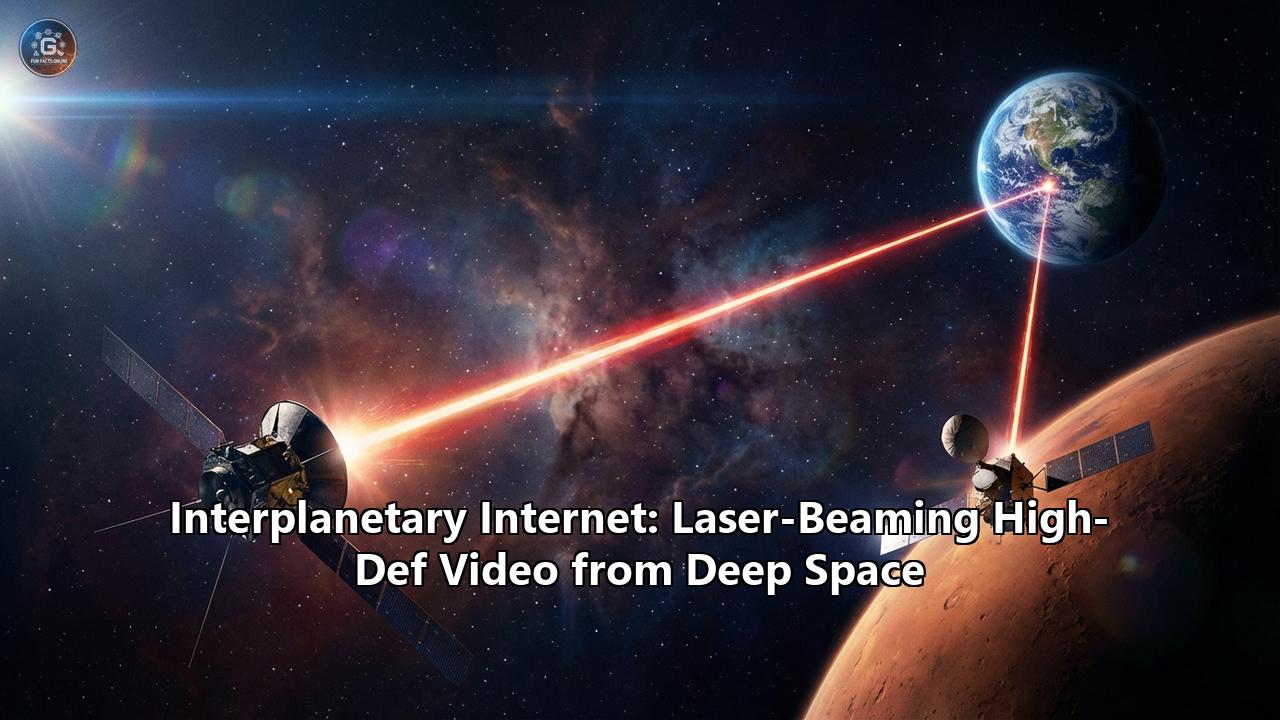
While the content was whimsical—a nod to the early days of television test broadcasts featuring Felix the Cat—the technology behind it was revolutionary. The video was transmitted not via the radio waves that have carried humanity's voice since the dawn of the Space Age, but via a near-infrared laser beam. This transmission, part of NASA’s Deep Space Optical Communications (DSOC) experiment aboard the Psyche spacecraft, achieved a data downlink speed of 267 megabits per second (Mbps).
To put that in perspective, 267 Mbps is likely faster than the broadband internet connection in your home. It is roughly 10 to 100 times faster than the best radio frequency systems currently used in deep space. And it was achieved across a distance 80 times greater than the gulf between the Earth and the Moon.
For decades, space exploration has been governed by a "data drought." Our most advanced rovers on Mars, machines capable of capturing 4K video and terabytes of geological data, are forced to trickle their findings back to Earth at speeds reminiscent of a 1990s dial-up modem. They must wait for relay orbiters to pass overhead, upload a packet of data, and then wait as that orbiter slowly beams it back to the Deep Space Network (DSN) on Earth using radio frequencies. This bottleneck has fundamentally limited our ability to explore the cosmos. It forces scientists to choose which images are "worth" sending and which must be left behind in the digital dust.
The transmission of Taters the cat marked the end of that era and the beginning of a new one. It was the "first light" of the Interplanetary Internet—a high-speed, optical backbone that will eventually connect Earth to the Moon, Mars, and beyond. This technology promises to transform space travel from a robotic, low-fidelity endeavor into a high-definition, immersive human experience. It will allow future astronauts on Mars to video chat with their families, enable researchers to tele-operate rovers in near real-time, and let humanity stream the first steps on the Red Planet in Ultra High Definition.
But achieving this requires overcoming engineering challenges of staggeringly epic proportions. It involves pointing a laser at a moving target millions of miles away with such precision that it’s equivalent to hitting a dime from a mile away. It requires detectors cooled to one degree above absolute zero to catch individual particles of light. And it requires a completely new internet protocol, co-designed by one of the fathers of the terrestrial internet, Vint Cerf, to handle the unique physics of the solar system.
This is the story of how we are building the Interplanetary Internet.
2. The Bottleneck: Why We Can’t Skype Mars (Yet)
To understand the revolution of laser communication, we must first understand the tyranny of radio. Since the launch of Sputnik in 1957, radio waves have been the lifeblood of space communication. From Neil Armstrong’s crackling "One small step" to the haunting images of the Pillars of Creation sent by the Hubble Telescope, every bit of data has traveled on waves of electromagnetic radiation in the radio spectrum (typically S-band, X-band, or Ka-band).
The "Drinking Straw" Problem
Radio waves are reliable. They propagate well, they are not easily stopped by clouds or atmospheric interference, and the technology to send and receive them is mature. However, they suffer from a fundamental physical limitation: frequency.
Data transmission rates are directly related to the frequency of the wave carrying the data. The higher the frequency, the more "cycles" per second, and the more data you can encode into that wave. Radio waves have relatively long wavelengths and low frequencies. As our spacecraft have become more sophisticated, carrying hyperspectral imagers and 4K cameras, the amount of data they generate has exploded. Yet, the "pipe" we use to send that data back—radio waves—has remained largely the same size.
NASA engineers often compare this to trying to drain a swimming pool through a drinking straw. The Perseverance rover on Mars might collect gigabytes of data in a day, but it can only transmit a fraction of that back to Earth. This forces mission planners into a painful daily triage, deleting precious scientific data simply because there is no bandwidth to send it home.
Beam Spread and Power Loss
The second problem with radio is beam spread. When you transmit a radio signal from Mars, it doesn't travel in a straight line like a bullet; it expands like a cone. By the time a radio signal from deep space reaches Earth, the beam has spread out over such a vast area that it might cover the entire diameter of our planet and then some.
This expansion means that the energy of the signal is diluted across millions of square kilometers. The antenna on Earth—even a massive 70-meter dish like those in NASA's Deep Space Network—only catches a tiny, microscopic fraction of the energy that was sent. To compensate, spacecraft must use massive, heavy antennas and pump significant amounts of electrical power into their transmitters, just to "shout" loud enough to be heard.
In the world of spacecraft engineering, where every gram of weight costs thousands of dollars to launch and every watt of power is precious, these large radio systems are a heavy burden. They limit the amount of scientific instruments a probe can carry and shorten the lifespan of the mission.
The Spectrum Crunch
Finally, there is the issue of congestion. The radio spectrum is a finite resource. It is crowded not only with spacecraft but with terrestrial communications, military satellites, and astronomical observations. As commercial space companies like SpaceX launch thousands of satellites into Low Earth Orbit (LEO), the "noise" in the radio spectrum is reaching a crescendo. Finding a quiet frequency to listen for the whisper of a distant probe is becoming increasingly difficult.
The solution to all these problems lies higher up the electromagnetic spectrum. It lies in light.
3. The Physics of Light: How Optical Communication Works
Optical communication, or laser communication, works on the exact same physical principles as radio communication. Both use electromagnetic waves to carry data. The difference is simply the wavelength.
NASA’s DSOC system uses near-infrared light, specifically at the 1,550-nanometer wavelength. This is the same "C-band" infrared light used in the fiber-optic cables that carry the terrestrial internet beneath our streets and oceans. However, in space, there is no glass fiber to guide the light. It must travel through "free space"—the vacuum between worlds.
The Frequency Advantage
Infrared light has a frequency hundreds of thousands of times higher than radio waves. This higher frequency allows engineers to pack significantly more data into the signal. If radio is a narrow dirt road, infrared laser light is a multi-lane superhighway. This is what enables the 10x to 100x increase in data rates.
The Gain of Directionality
The most critical advantage of laser communication in deep space, however, is directivity.
Because the wavelength of laser light is so short, it can be focused into an incredibly tight beam. Unlike radio waves that spread out to engulf the Earth, a laser beam fired from Mars might spread to a width of only a few hundred kilometers by the time it reaches us.
This "tightness" of the beam means that the energy is not wasted. Almost all of the power transmitted by the spacecraft is directed straight at the receiver. This allows for two transformative benefits:
- Lower Power: The spacecraft can use a much lower-power transmitter (a 4-watt laser vs. a 100-watt radio) and still deliver a strong signal.
- Smaller Size: The telescope needed to send the laser can be much smaller than a radio antenna. The DSOC flight transceiver on Psyche uses a 22-centimeter (8.6-inch) aperture telescope, whereas a comparable radio system would require an antenna meters across.
This reduction in Size, Weight, and Power (SWaP) creates a virtuous cycle. A lighter communications system means a cheaper launch or more room for scientific instruments. A lower power requirement means smaller solar panels or batteries.
Modulation: The Language of Light
How do you actually put a cat video into a laser beam? You don't just turn the light on and off like a telegraph. DSOC uses a sophisticated scheme called Pulse Position Modulation (PPM).
In deep space, signals are weak. By the time the light from Psyche reaches Earth, it has traveled millions of miles and arrives as a stream of individual photons (particles of light). Standard telecommunications methods that rely on the amplitude (brightness) of the light don't work well when you are counting single photons.
PPM works by dividing time into incredibly short "slots" (measured in nanoseconds). To send a byte of data, the laser pulses during one specific slot within a "frame" of many possible slots. The position of the pulse tells the receiver what the data is.
- If the pulse arrives in slot 1, it means "00".
- If it arrives in slot 2, it means "01".
- And so on.
This method is incredibly "photon efficient." You can convey a lot of information with very few photons, provided your timing synchronization between Mars and Earth is perfect. And "perfect" here means synchronized to within fractions of a billionth of a second.
4. The Engineering Marvel: Inside the DSOC Experiment
The Deep Space Optical Communications (DSOC) technology demonstration is not a standalone mission; it is a "passenger" instrument bolted onto the side of the Psyche spacecraft, which is headed to explore a metal-rich asteroid between Mars and Jupiter.
The system is a triad of engineering feats located on the spacecraft and at two locations on Earth.
The Flight Laser Transceiver (FLT)
Mounted on the Psyche spacecraft is the Flight Laser Transceiver. It looks like a shiny silver cylinder, roughly the size of a large dorm room trash can. Inside is a 22-centimeter telescope that acts as both a transmitter and a receiver.
The FLT is isolated from the rest of the spacecraft by a set of specialized struts. Spacecraft are noisy environments; reaction wheels spin, thrusters fire, and solar arrays flex, causing tiny vibrations (micro-vibrations). For a radio antenna, a little jitter doesn't matter. For a laser beam that needs to hit a specific telescope on Earth from 200 million miles away, even a microscopic vibration would cause the beam to miss the planet entirely. The isolation struts dampen these vibrations, acting like high-tech shock absorbers.
The FLT contains a 4-watt laser transmitter. To put that in context, a standard laser pointer is about 0.005 watts. This laser is powerful, but not blindingly so; its power lies in its focus.
The Ground Laser Transmitter (GLT)
To communicate with the spacecraft, Earth must send a signal up. This is done from the Table Mountain Facility in the San Gabriel Mountains of California. Here, a 1-meter telescope fires a high-power near-infrared laser beacon (5 kilowatts) up into the sky.
This uplink beacon serves two purposes:
- Command: It can send low-rate data and commands to the spacecraft.
- Reference: It acts as a "lighthouse" for the spacecraft. The spacecraft looks for this bright laser star coming from Earth and uses it to orient itself.
The Ground Laser Receiver (GLR)
The downlink—the high-speed video data—is received at the famous Palomar Observatory near San Diego. NASA retrofitted the massive 200-inch (5.1-meter) Hale Telescope, a legendary instrument used by Edwin Hubble, to act as the receiver.
Because the laser signal is so faint by the time it returns to Earth, the Hale Telescope acts like a giant "light bucket," scooping up as many photons as possible. These photons are then funneled into a specialized detector (discussed in Chapter 7) that is one of the most sensitive instruments ever built.
5. The Cosmic Bullseye: Pointing, Acquisition, and Tracking
The single greatest challenge of interplanetary optical communication is pointing.
Imagine you are standing in Los Angeles and you want to hit a dime held by a person in New York City with a laser pointer. Now, imagine that person is moving at 60,000 miles per hour. Now, imagine you are also moving at 60,000 miles per hour in a different direction.
This is the reality of the Acquisition, Tracking, and Pointing (ATP) system.
The Point-Ahead Angle
In radio communication, the beam is so wide that you simply point your antenna at where Earth is, and you'll hit it. With a laser, the beam is so narrow that you cannot point at where Earth is; you must point at where Earth will be.
Light takes time to travel. At the distance of Mars, light can take up to 20 minutes to reach Earth. If the spacecraft points its laser at the Earth it sees, by the time the light gets there 20 minutes later, Earth will have moved thousands of miles along its orbit. The laser would miss completely.
Therefore, the DSOC system must calculate a point-ahead angle. It must aim its laser into the empty darkness of space, leading the target just like a quarterback leads a receiver in football. The computer on board calculates exactly where Earth will be based on orbital mechanics and adjusts the mirrors to fire into the void.
Closing the Loop
The process starts with the "Acquisition" phase. The ground station at Table Mountain fires its high-power beacon. The Psyche spacecraft scans the darkness until its camera detects this faint infrared star. Once "acquired," it locks on ("Tracking").
However, the spacecraft cannot just lock onto the beacon and fire back along the same path, or it would miss due to the light-travel time mentioned above. It uses the beacon as a stable reference point and then uses a fast-steering mirror (FSM) to offset its own laser by the calculated point-ahead angle ("Pointing").
This entire dance happens automatically, stabilized by the isolation struts and refined hundreds of times per second. If the lock is lost for even a fraction of a second, the connection drops.
Beaconless Pointing: The Future
Currently, DSOC relies on the Earth station firing a powerful beacon to help the spacecraft aim. This works, but it limits the system. It requires expensive ground infrastructure and clear skies at the transmitter site.
Future iterations of the technology, such as those proposed for the "Mars Telecommunications Orbiter," aim to use beaconless pointing. In this scenario, the spacecraft would use ultra-precise star trackers—cameras that recognize the constellations—to determine its orientation with absolute perfection. Combined with highly accurate ephemeris data (maps of planetary orbits), the spacecraft could blindly calculate where Earth is and fire the laser without needing a guide star from the ground. This would significantly reduce the complexity of the ground network.
6. The Software of the Stars: Delay/Disruption Tolerant Networking (DTN)
If lasers are the hardware of the Interplanetary Internet, Delay/Disruption Tolerant Networking (DTN) is the software that makes it usable.
The internet on Earth runs on a suite of protocols called TCP/IP (Transmission Control Protocol/Internet Protocol). Vint Cerf, who co-invented TCP/IP in the 1970s, realized in the late 1990s that his creation would break in deep space.
Why TCP/IP Fails in Space
TCP/IP is a "chatty" protocol. It assumes a continuous connection and low latency. When you load a webpage, your computer sends a request, the server says "I heard you," your computer says "Great, send the data," and the server starts sending packets. If a packet is missing, your computer immediately shouts "Stop! I missed one, send it again!"
In space, this conversation is impossible.
- Latency: If the round-trip light time to Mars is 40 minutes, a simple "handshake" to establish a connection would take nearly an hour. The "stop and wait" mechanism of TCP would result in data rates dropping to near zero.
- Disruption: Planetary rotation means a lander on Mars is cut off from Earth for 12 hours every day (when it's on the far side of the planet). Solar conjunctions (when the Sun is between Earth and Mars) cut off comms for weeks. TCP/IP interprets these disconnects as broken networks and gives up.
The "Store-and-Forward" Solution
To solve this, Cerf and a team at JPL and the IETF developed the Bundle Protocol (BP), the core of DTN.
DTN operates like a futuristic postal service rather than a telephone call. It does not require an end-to-end path to be open at the same time. Instead, it uses a store-and-forward mechanism.
Imagine a rover on Mars wants to send a video to a scientist in Paris.
- Hop 1: The rover sends the data "bundle" to a Mars Orbiter passing overhead. The Orbiter stores the data on its hard drive.
- The Wait: The Orbiter waits 4 hours until it has a line of sight to Earth.
- Hop 2: The Orbiter beams the bundle via laser to a ground station in California.
- Hop 3: The California station sends it via terrestrial internet to Paris.
If a link breaks—say, a dust storm blocks the laser—the node (the Orbiter) does not discard the packet (as a standard router would). It holds onto it ("custody transfer") and keeps it safe until the link is re-established. It ensures that no data is ever lost, only delayed.
This protocol was successfully tested on the International Space Station (ISS) and is now the standard for the emerging solar system internet. It allows for an automated network where nodes can dynamically route data based on which planets and satellites are currently visible to each other.
7. The Detectors: Catching Single Photons at Absolute Zero
The most unsung hero of the DSOC mission sits at the bottom of the Hale Telescope at Palomar. It is the Superconducting Nanowire Single-Photon Detector (SNSPD).
When the laser beam from Psyche arrives at Earth, it has traveled so far that the light has dimmed by a factor of trillions. It doesn't arrive as a continuous beam, but as a sparse rain of individual photons. To decode the video of Taters the cat, the receiver must detect these individual photons with incredibly high timing precision.
The Nanowire
The detector consists of a microscopic wire made of a tungsten-silicide superconducting material. This wire is about 1/1000th the width of a human hair.
The Big Chill
For the material to be superconducting, it must be cooled to cryogenic temperatures. The detector at Palomar sits inside a cryostat that keeps it at 1 Kelvin (–458°F or –272°C). This is colder than the vacuum of deep space itself.
At this temperature, the wire has zero electrical resistance. A current flows through it effortlessly. However, the wire is biased right on the edge of stopping its superconductivity. When a single photon from deep space hits the wire, it imparts just enough energy to create a tiny "hot spot." This hot spot momentarily breaks the superconductivity, creating electrical resistance.
This sudden resistance causes a voltage spike. The electronics register this spike as a "click"—a photon has arrived.
Time Slicing
The SNSPD is capable of resetting itself in nanoseconds. This allows it to count hundreds of millions of photons per second. By analyzing the exact arrival time of each photon (mapped against the Pulse Position Modulation scheme), the computer reconstructs the 0s and 1s of the digital video file.
This technology represents the bleeding edge of quantum physics and materials science, repurposed for interplanetary communication.
8. A History of Light: From Lunar Reflections to Deep Space
The road to the "Taters" video was paved with decades of incremental tests. While the idea of optical communication dates back to the invention of the laser in 1960, space is a harsh mistress, and proving the technology took time.
The Early Days: Galileo and GOPEX
In 1992, JPL conducted the Galileo Optical Experiment (GOPEX). They fired two lasers from Earth at the Galileo spacecraft as it sped away from Earth. The spacecraft’s camera successfully detected the flashes. It was a one-way, low-fidelity test, roughly equivalent to signaling a ship with a flashlight, but it proved the geometry worked.
LLCD: The Moon Shot (2013)
The true breakthrough came in 2013 with the Lunar Laser Communications Demonstration (LLCD). Flying aboard the LADEE spacecraft orbiting the Moon, this system achieved a downlink rate of 622 Mbps. It downloaded a movie from the Moon in seconds that would have taken radio hours. It proved that atmospheric turbulence (the shimmering of air that makes stars twinkle) could be corrected for using adaptive optics and multiple ground telescopes.
OPALS: The Space Station Test (2014)
NASA then launched OPALS to the International Space Station. The primary goal was to test how to track a fast-moving target in Low Earth Orbit. The ISS moves so fast that it crosses the sky in minutes, requiring incredibly agile pointing mechanisms. OPALS successfully beamed a video ("Hello World!") to a ground station, proving that low-cost optical terminals were feasible.
LCRD: The Relay (2021)
The Laser Communications Relay Demonstration (LCRD) was launched into Geosynchronous Orbit (22,000 miles up). Unlike previous tests, this was a long-duration relay satellite. It was designed to test the longevity of optical components in the harsh radiation of space and to practice "switching" data between optical and RF links. It acted as a simulated "Mars Relay" but parked safely above Earth.
TBIRD: The Speed Demon (2022)
In 2022, a small CubeSat called TBIRD (TeraByte InfraRed Delivery) shattered all records. Flying in Low Earth Orbit, it achieved a burst data rate of 200 Gigabits per second (Gbps). While short-range compared to Psyche, it proved that small, cheap satellites could handle massive data throughputs, paving the way for commercial optical networks.
And finally, DSOC (2023) took these lessons into deep space, facing the "inverse square law" of distance that makes signals millions of times weaker than those from the Moon.
9. The Future Architecture: Building the Solar System Wide Web
The success of DSOC is not just a scientific curiosity; it is the cornerstone of NASA’s roadmap for Mars. The agency, along with commercial partners, is sketching out an architecture that looks remarkably like the terrestrial internet infrastructure.
The Mars Telecommunications Orbiter (MTO)
Future Mars missions will not carry massive direct-to-Earth antennas. Instead, landers and rovers will carry small, low-power optical terminals. They will beam their data up to a dedicated Mars Telecommunications Orbiter (or a constellation of them).
Companies like Blue Origin and SpaceX are already proposing commercial versions of these relays. Blue Origin's "Blue Ring" platform and concepts for a dedicated Mars Relay visualize tugs that sit in high Mars orbit, aggregating data from the surface and blasting it back to Earth via high-power lasers.
The Earth Relay Network
On Earth, the "Last Mile" problem is the atmosphere. Clouds block lasers. If it's cloudy at Palomar, the link is dead. To solve this, the Interplanetary Internet will rely on a distributed network of ground stations.
- Geographical Diversity: Stations will be built in deserts around the world—Chile, Spain, Australia, South Africa, and the US Southwest. If it's cloudy in California, the network automatically routes the laser to a clear sky in Australia.
- Orbital Relays: Eventually, we may skip the ground entirely. Satellites in Earth orbit (like the LCRD) will catch the laser from Mars above the atmosphere and then relay it down to Earth via RF or fiber-linked ground stations.
Artemis and O2O
The next big test will be O2O (Orion Artemis II Optical Communications System). When humans return to the Moon on the Artemis II mission, they will use a laser terminal to stream 4K video of the lunar surface back to Earth. This will be the first operational use of the technology for human spaceflight, moving it from "experimental" to "mission critical."
Commercial Constellations: Starlink in Space
Closer to home, SpaceX’s Starlink constellation is already using "Optical Inter-Satellite Links" (laser links) to pass data between thousands of satellites in Low Earth Orbit. This creates a mesh network in space, a vacuum-based internet backbone that is actually faster than fiber optics on Earth (because light travels roughly 40% faster in a vacuum than in glass).
The technology matured by Starlink—cheap, mass-produced laser terminals—is expected to be adapted for deep space. We are moving from bespoke, billion-dollar science instruments to mass-manufactured commodity hardware.
10. Conclusion: The Human Connection
Why does this matter? Is it just about getting more high-res photos of rocks?
The implications of the Interplanetary Internet go far beyond geology. It is about presence.
For all of human history, exploration has been a lonely endeavor. Explorers sailed over the horizon and were gone for years. But when humans go to Mars, they will not be cut off. Laser communication means that an astronaut on Mars can have a telemedicine conference with a specialist on Earth to guide a surgery. It means they can video call their children on birthdays (albeit with a delay).
It means that we, the billions staying behind, will not just hear about the mission; we will see it. We will ride along in 4K resolution as the first human boots kick up red dust. We will see the sunsets of a new world in high dynamic range.
The "Taters" video was a playful test, but it symbolized a profound shift. We have built the first optical bridge across the solar system. The "drinking straw" of radio is being replaced by the "fire hose" of light.
As we stand on the brink of becoming a multi-planetary species, the Interplanetary Internet ensures that no matter how far we go, we remain connected. The silence of the void is being filled with light, data, and eventually, the voices of humanity. The future is bright, and it is beaming towards us at the speed of light.
Reference:
- https://arxiv.org/html/2409.02356v1
- https://validate.perfdrive.com/?ssa=0c9bf50e-7c7b-0e6d-6330-c391d0efd757&ssb=02008264922&ssc=https%3A%2F%2Fopg.optica.org&ssi=c88c1cae-d3hy-84a9-6e5e-98de7faa7eb5&ssk=botmanager_support@radware.com&ssm=48158518842118241139262294470982&ssn=5964a355d9131f2533aadebee61af89a36a3be255c78-e311-d19c-3b5476&sso=92b329c-3ae0-af48e0e15c3e2c728dbf007bd17fbab6fbb4df991627b1f5&ssp=52918296851767058832176700180196860&ssq=85786055592290994054555921343695797085165&ssr=MTI0LjIxNy4xODkuMTE5&sst=python-requests%2F2.32.3&ssv=&ssw=
- https://issnationallab.org/upward/8-2-interplanetary-internet-cerf/
- https://www.psicopolis.com/boxtesti/intint.pdf
- https://www.exail.com/
- https://www.nasa.gov/goddard/esc/o2o/
- https://www.youtube.com/watch?v=Vfa6T2pfx4g
- https://www.youtube.com/watch?v=qNrM-3zY1Ns
- https://www.blueorigin.com/mars-telecommunications-orbiter
- https://www.nasa.gov/directorates/stmd/tech-demo-missions-program/laser-communications-relay-demonstration-lcrd-overview/
- https://www.quantamagazine.org/vint-cerfs-plan-for-building-an-internet-in-space-20201021/
- https://www.nasa.gov/centers-and-facilities/goddard/nasa-laser-communications-innovations-a-timeline/
- https://www.spiedigitallibrary.org/conference-proceedings-of-spie/13355/133550O/Flight-system-acquisition-tracking-and-pointing-results-from-the-deep/10.1117/12.3043389.full
- https://www.researchgate.net/publication/263035899_Pointing_Acquisition_and_Tracking_architecture_tools_for_Deep-Space_Optical_Communications
- https://web.njit.edu/~rojasces/publications/2018kayrocomst.pdf
- https://stellarproject.space/laser-communication-pills-2-historical-milestones-in-laser-communication/