
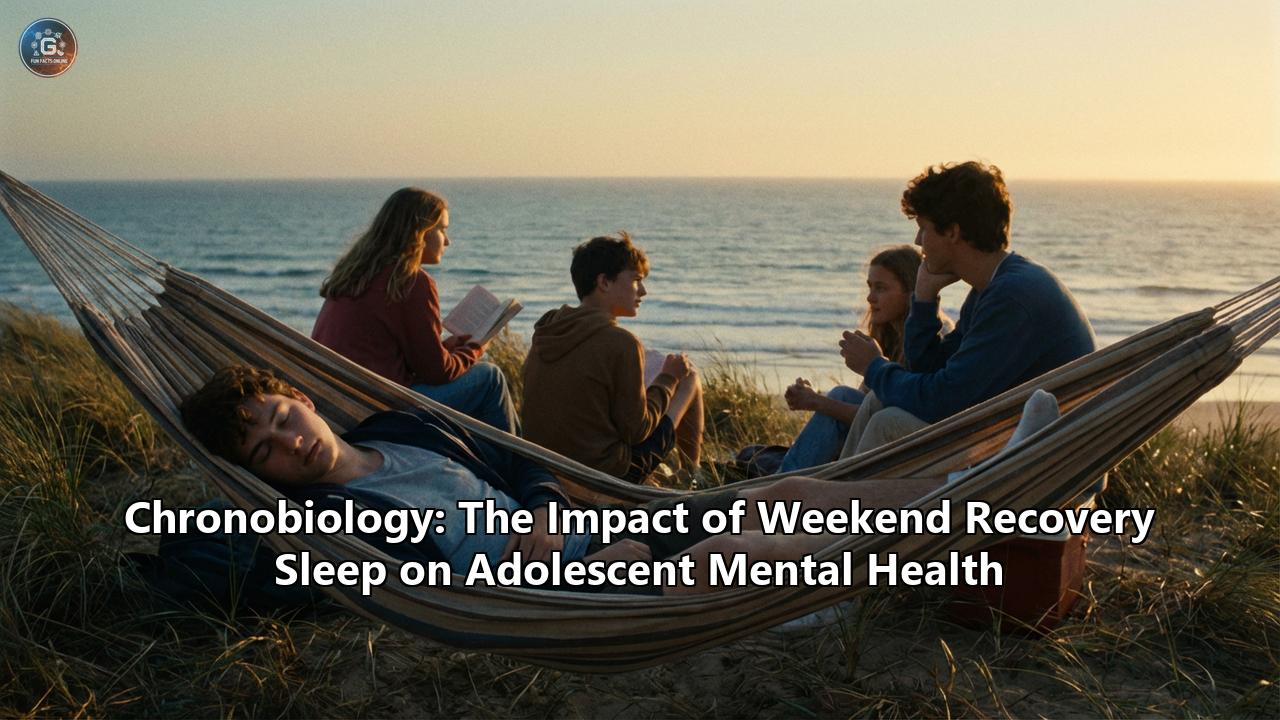
The alarm blares at 6:00 AM. Outside, it is pitch black. Inside the room, a sixteen-year-old struggles to rise from the depths of a sleep that finally arrived only four hours ago. This is not a scene of occasional negligence; it is the daily reality for millions of adolescents worldwide. For five days a week, they operate in a state of chronic circadian misalignment, a phenomenon researchers have termed "social jetlag." Then comes Saturday. The alarm is silenced. The curtains remain drawn. The teenager sleeps until noon, banking twelve hours of slumber in a desperate attempt to repay a debt accumulated over the school week.
For decades, sleep hygienists and pediatricians have preached a singular gospel: consistency. "Wake up at the same time every day," they urged, warning that sleeping in on weekends would only further confuse the body clock, making Monday mornings even more treacherous. It was a logical directive, grounded in the mechanics of adult circadian rhythms.
However, a new wave of research—spearheaded by landmark studies in 2024 and 2025—has upended this traditional wisdom. We are discovering that for the developing adolescent brain, the rules of chronobiology are fundamentally different. Recent findings suggest that "weekend recovery sleep" (WCS) is not merely a sign of laziness or poor discipline; it may be a critical biological buffer, a neuroprotective mechanism that significantly lowers the risk of depression and suicidal ideation in teens.
This article explores the complex, high-stakes intersection of adolescent chronobiology and mental health. We will journey into the suprachiasmatic nucleus of the teenage brain, unpack the debate between circadian stability and homeostatic recovery, and offer a comprehensive roadmap for navigating the sleep crisis that defines modern adolescence.
Part I: The Great Sleep Recession
The Invisible Epidemic
If you walked into a high school classroom today, you would be looking at a room full of people suffering from clinically significant sleep deprivation. The Centers for Disease Control and Prevention (CDC) and similar global health bodies consistently report that fewer than 30% of high school students get the recommended 8 to 10 hours of sleep. The vast majority average between 6 and 7 hours, with upperclassmen often surviving on 5.
This is not a trivial deficit. In the context of a developing brain, a loss of two hours of sleep per night is catastrophic. It is the equivalent of a neurological recession, where the resources needed for emotional regulation, memory consolidation, and impulse control are systematically stripped away.
The Perfect Storm: Biology vs. Society
Why is this happening? The answer lies in a collision between evolutionary biology and modern societal structure.
- Biological Delay: During puberty, adolescents experience a "phase delay" in their circadian rhythms. The secretion of melatonin—the hormone that signals sleep onset—shifts roughly two hours later. A child who was sleepy at 9:00 PM becomes a teenager who is physiologically alert until 11:00 PM or midnight. This is not a behavioral choice; it is a biological imperative driven by the maturation of the reproductive and endocrine systems.
- Societal Advance: Just as the teenager's body is pushing their wake-up time later (to around 8:00 or 9:00 AM), the school system pushes their wake-up time earlier. High schools often start between 7:00 and 8:00 AM, requiring wake times that are biologically equivalent to 4:00 AM for an adult.
- The Digital Accelerator: Into this misalignment drops the blue light of smartphones and laptops. The teenage eye is more sensitive to light suppression of melatonin than the adult eye. The "second wind" of alertness that teens feel at 10:00 PM is amplified by social media scrolling, creating a state of hyperarousal that pushes sleep onset even later.
The result is a weekly accumulation of "sleep debt." By Friday afternoon, the average teen may be missing 10 to 15 hours of necessary sleep. This is where the weekend comes in.
Part II: The Science of Chronobiology
To understand why the "weekend sleep-in" is so controversial—and potentially so vital—we must understand the two forces that regulate human sleep: Process S and Process C.
Process S: The Homeostatic Sleep Drive
Process S is essentially a pressure valve. From the moment we wake up, adenosine accumulates in the brain. The longer we are awake, the higher the pressure to sleep. When we sleep, adenosine is cleared, and the pressure resets.
For teens during the school week, Process S is never fully resolved. They wake up with residual sleep pressure. Over five days, this pressure builds to dangerous levels, impairing cognitive function and emotional stability. The weekend "binge sleep" is an attempt by Process S to forcefully clear the backlog of adenosine.
Process C: The Circadian Rhythm
Process C is the 24-hour internal clock located in the suprachiasmatic nucleus (SCN) of the hypothalamus. It dictates when we want to sleep, independent of how tired we are. It uses light and dark signals to synchronize the body's temperature, hormone release, and digestion.
The conflict arises because the teen's Process C is naturally set to a "late" chronotype (night owl). When they sleep in on weekends (e.g., waking at 12:00 PM), they are getting the light exposure that signals "morning" at noon. This pushes their Process C even later, potentially making it harder to fall asleep on Sunday night.
This conflict—Process S needing recovery vs. Process C needing stability—is the heart of the "Social Jetlag" debate.
Part III: Social Jetlag and the "Monday Morning Blues"
Social Jetlag refers to the discrepancy between a person's biological time (determined by their internal clock) and their social time (dictated by school or work). It is quantified by calculating the difference in the midpoint of sleep on workdays versus free days.
- Example: A teen sleeps 11 PM to 6 AM on weekdays (Midpoint: 2:30 AM). On weekends, they sleep 1 AM to 11 AM (Midpoint: 6:00 AM). The Social Jetlag is 3.5 hours.
For years, researchers viewed high Social Jetlag as a villain. Studies showed it correlated with obesity, metabolic risk, and lower academic grades. The logic was that the "yo-yo" schedule was metabolically taxing, similar to flying from New York to London and back every single week.
However, in the realm of mental health, the story has taken a dramatic turn.
Part IV: The Weekend Recovery Paradox (New Findings)
The "Depression Buffer"
In a groundbreaking study published in the Journal of Affective Disorders (and corroborated by research from the University of Oregon in 2026), researchers analyzed data from thousands of adolescents. They found a startling correlation: Teens who engaged in weekend catch-up sleep (sleeping in to recover lost hours) had a significantly lower risk of depression.
Specifically, the data indicated a 41% reduction in depressive symptoms for those who utilized the weekend to recover, compared to those who maintained a short, "consistent" sleep schedule or those who were prevented from sleeping in.
Why?
Depression in adolescents is often linked to chronic exhaustion and the inability of the brain to process emotional data. When a teen is sleep-deprived, the amygdala (the brain's emotional threat center) becomes hyperactive, while the prefrontal cortex (the logic center) disconnects. This leads to high emotional reactivity and low resilience.
Weekend recovery sleep, while imperfect for the circadian rhythm, acts as a "neurobiological rescue." It allows the brain to undergo the deep REM cycles and Slow Wave Sleep that are cut short during the week. It is during these prolonged sleep bouts that emotional memories are processed and "defanged," reducing the cognitive load that leads to depressive rumination.
The "Anxiety Nuance"
While depression risk drops with catch-up sleep, the data on anxiety is more complex. Some recent studies suggest a "U-shaped" curve.
- Moderate Catch-up (1-2 hours): Beneficial. Reduces cortisol levels and perceived stress.
- Extreme Catch-up (>3 hours): Can be associated with higher anxiety.
This distinction is crucial. Extreme catch-up sleep often signifies severe weekday deprivation. The anxiety observed in these teens may not be caused by the sleeping in itself, but rather by the sheer severity of the weekday exhaustion and the anticipatory stress of the upcoming week (the "Sunday Scaries"). Furthermore, shifting the clock too drastically can cause a physical sense of disorientation that mimics anxiety symptoms (racing heart, alertness at night).
Suicide Prevention: The Silent Factor
Perhaps the most critical finding relates to suicidality. Sleep disturbance is one of the strongest predictors of suicidal ideation, independent of depression diagnosis. Research focusing on adolescents with chronic conditions (like Atopic Dermatitis, which disrupts sleep) found that prolonged weekend catch-up sleep acted as a protective factor against suicidal thoughts.
The mechanism is believed to be impulse control. Suicide is often an impulsive act in adolescence. Sleep deprivation erodes the brain's "braking system" (inhibition). By restoring prefrontal cortex function over the weekend, the teen regains a measure of cognitive control and perspective, potentially preventing a momentary crisis from becoming a tragedy.
Part V: Inside the Sleep-Deprived Teen Brain
To understand the stakes, we must look under the hood of adolescent neurodevelopment. The teenage brain is under massive construction. It is pruning synapses (cutting away unused connections) and myelinating pathways (insulating connections for speed).
- The Emotional Brake Failure:
In a well-rested brain, the prefrontal cortex sends inhibitory signals to the amygdala. It says, "That bad grade is annoying, but it's not the end of the world."
In a sleep-deprived brain, this connection is severed. The amygdala runs unchecked. The bad grade feels like a life-ending catastrophe. This explains the "mood swings" often dismissed as hormonal but actually rooted in exhaustion.
- The Anhedonia Connection:
Sleep loss impacts the striatum, the brain's reward center. Chronic deprivation leads to a blunted response to positive rewards. Teens don't feel as much joy from friends, hobbies, or food. This is the biological basis of anhedonia—the loss of interest in life—which is a core symptom of major depression. Weekend sleep recovery can "re-sensitize" the reward system, allowing the teen to feel joy again.
- The Memory Void:
The hippocampus, responsible for learning, consolidates memories primarily during sleep. When teens cut sleep short to study, they are engaging in a futile exercise; the information is never cemented. This leads to academic struggles, which fuel anxiety, which fuels insomnia—a vicious cycle.
Part VI: The Debate – Consistency vs. Quantity
The medical community is currently navigating a shift in guidelines.
- The Old School (Behavioral Sleep Medicine): "Wake up at 7:00 AM on Saturday, even if you are tired. Consistency strengthens the clock."
- The New School (Adolescent Psychiatry): "If the kid is exhausted, let them sleep. The immediate risk of mental health crisis from exhaustion outweighs the risk of circadian drift."
However, there is a limit. Sleeping until 3:00 PM is likely counterproductive because it pushes the sleep drive so late that the teen cannot sleep until 2:00 AM Sunday night, guaranteeing a wreck on Monday. This brings us to practical management.
Part VII: Practical Strategies for Parents and Teens
Knowing the science is one thing; living it is another. How do we balance the need for recovery with the need for a functioning clock? Here is a strategy based on the latest chronobiological evidence.
1. The "Anchor Sleep" Technique
Instead of letting the wake-up time drift completely (e.g., 6 AM weekday -> 1 PM weekend), use an "anchor" approach.
- Allow the teen to sleep in, but cap the drift at 2 to 3 hours.
- Example: If they wake up at 6:30 AM for school, set a "soft limit" of 9:30 AM or 10:00 AM on weekends.
- Why? This provides 3 hours of extra sleep (a significant recovery) without pushing the circadian rhythm into a completely different time zone.
2. The Napping Loophole
If the teen is still exhausted after waking up at 10:00 AM, encourage a mid-afternoon nap (around 2:00 PM) for 90 minutes.
- Why? A nap relieves homeostatic pressure (Process S) without resetting the circadian clock (Process C) as drastically as sleeping in until afternoon does.
3. Sunday Morning Bright Light
The danger of sleeping in is missing the morning light that resets the brain.
- The Hack: If the teen sleeps until 10:00 AM on Sunday, they must immediately get bright light exposure (go outside, or use a 10,000 lux therapy lamp) upon waking. This signals the SCN that the day has begun, helping to anchor the sleep onset for Sunday night.
4. The Sunday Night Protocol
The hardest part of weekend recovery is falling asleep on Sunday night to wake up for Monday.
- Melatonin Micro-dosing: A small dose (0.5mg to 1mg) taken 2 hours before desired sleep time can help pull the clock back. Note: High doses (5mg-10mg) are often less effective and can cause grogginess.
- Blue Blocking: Strict avoidance of screens or wearing blue-light blocking glasses 90 minutes before bed is non-negotiable on Sundays.
Part VIII: The Role of Schools and Society
We cannot talk about this without addressing the elephant in the room: School Start Times.
The scientific consensus is overwhelming: High schools should not start before 8:30 AM. Districts that have moved start times later have seen:
- Reductions in car accidents among teen drivers.
- Improved SAT scores.
- Lower rates of depression and suicide attempts.
The resistance to this change is logistical (bus schedules, sports practice), not biological. However, as mental health data becomes more alarming, the argument for "Later School Start Times" is shifting from an academic luxury to a public health emergency. Until systemic change happens, weekend recovery sleep remains the primary coping mechanism for families.
Part IX: When to Worry
While catching up on sleep is protective, there are signs that sleep patterns are shifting from "recovery" to "pathology."
- Social Withdrawal: If the teen is using sleep to avoid social interaction or family time completely.
- reversal: If the teen is awake all night and sleeping all day (complete circadian reversal).
- Hypersomnia: If the teen sleeps 12+ hours and still reports exhaustion, this may indicate depression, mononucleosis, or narcolepsy, and requires medical evaluation.
Part X: Conclusion – The Mercy of Sleep
For years, we have treated sleep as a variable that can be traded for study time, social time, or screen time. We have treated the weekend "lie-in" as a bad habit. The science of chronobiology now tells us a different story.
For the modern adolescent, caught in the crossfire of biological maturation and societal rigidity, weekend recovery sleep is a lifeline. It is the brain's attempt to heal. It is a biological buffer against the dark waters of depression and anxiety.
While we strive for the ideal world of later school starts and balanced schedules, we must accept the current reality with compassion. If your teenager is sleeping until 11:00 AM on a Saturday, do not view it as laziness. View it as neuroprotection. Their brain is knitting itself back together, processing the emotions of the week, and building the resilience they will need to face the alarm clock on Monday morning.
In the high-stakes game of adolescent mental health, sleep is not just a pillar of health; it is the foundation. And sometimes, the best thing we can do for our children is simply to let them rest.
Reference:
- https://pmc.ncbi.nlm.nih.gov/articles/PMC6397070/
- https://www.eurekalert.org/news-releases/1111746
- https://news.ssbcrack.com/weekend-sleep-recovery-linked-to-reduced-depression-risk-in-teens-and-young-adults-study-finds/
- https://www.ajmc.com/view/weekend-catch-up-sleep-prevents-suicidal-ideation-in-adolescent-patients-with-ad-study-says
- https://www.mdpi.com/2077-0383/12/24/7716
- https://www.contemporarypediatrics.com/view/teens-sleep-deprivation-could-affect-brain-development
- https://www.eurekalert.org/news-releases/1086742
- https://www.childrenshospital.org/conditions-treatments/delayed-sleep-wake-phase-disorder
- https://www.healio.com/news/primary-care/20250707/catchup-sleep-on-weekends-may-affect-anxiety-symptoms-in-teens