
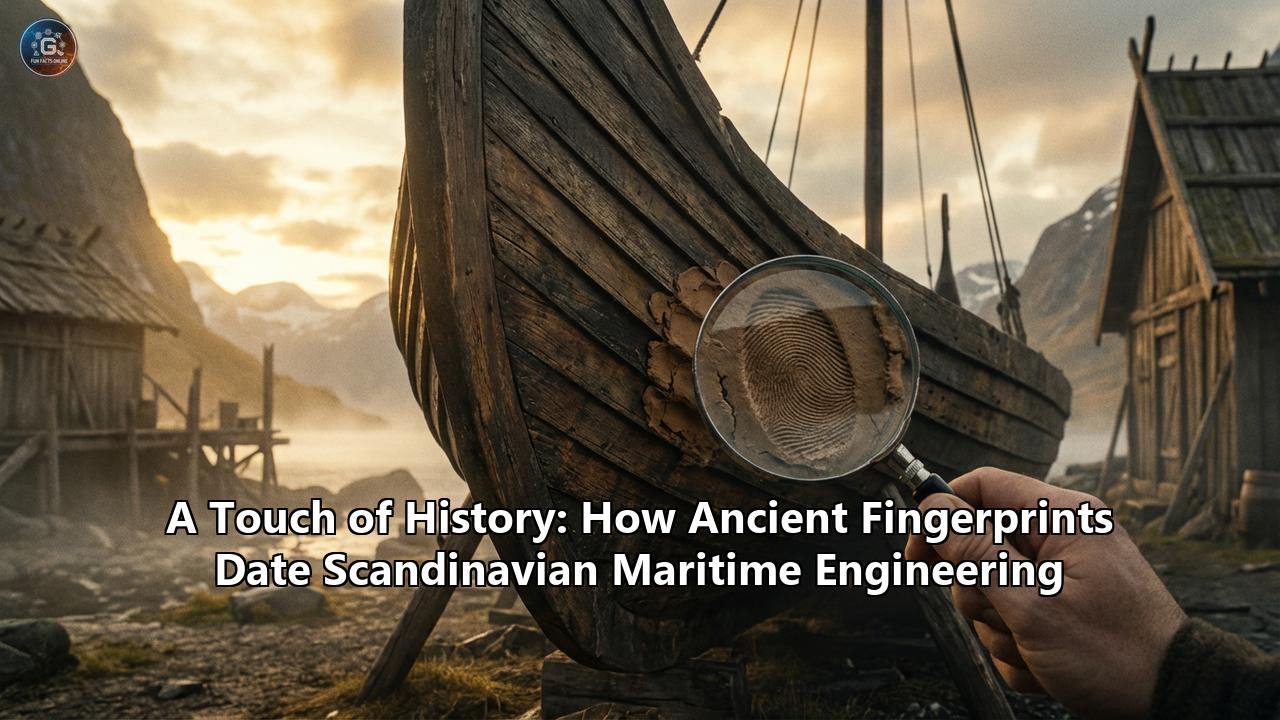
The silence of the laboratory at Lund University was broken not by the crash of thunder or the blast of a trumpet, but by a whisper of discovery that would echo across two and a half millennia. It was a discovery made not of gold or jewels, but of something far more humble, yet infinitely more intimate: a smudge. A ridge-lined imperfection trapped in a blackened lump of ancient tar.
It was a fingerprint.
This single, accidental impression, left by a craftsman during a mundane repair job in the 4th century BC, has become one of the most significant archaeological finds in recent Scandinavian history. It serves as a portal, a direct human connection to a time when the Nordic seas were the highways of warriors, and the mist-shrouded bogs were the gateways to the gods. This is the story of the Hjortspring boat, the oldest plank-built vessel in Scandinavia, and how a combination of modern forensic science, chemical analysis, and a touch of ancient humanity has rewritten the timeline of maritime engineering.
Part I: The Ghost in the Tar
To understand the magnitude of this discovery, one must first understand the artifact that housed it. The Hjortspring boat is a ghost of a vessel. Discovered in the 1880s by peat diggers in the Hjortspring Mose bog on the island of Als, Denmark, and fully excavated in the 1920s, it has long been the crown jewel of the Danish National Museum’s prehistoric collection.
For decades, it sat in quiet majesty, a slender, canoe-like warship measuring nearly twenty meters long. It was a vessel of war, designed to carry twenty-four paddlers and a steersman into battle. But for all its fame, the boat kept its secrets. Conservation treatments in the early 20th century, involving alum and later polyethylene glycol (PEG), had rendered the wood unsuitable for standard radiocarbon dating. The boat was effectively frozen in time, but untethered from a precise date.
Enter the researchers from Lund University and the National Museum of Denmark. In a recent re-examination of the boat’s fragments—specifically the boxes of "scrap" material left over from the original excavation—they sought to apply 21st-century science to 1920s leftovers. They were hunting for organic material that had escaped the chemical baths of early conservation.
They found boxes of cordage (rope) and lumps of caulking tar. The tar, a black, resinous substance used to waterproof the seams of the boat, was of particular interest for chemical analysis. But as Mikael Fauvelle, an archaeologist at Lund University, peered at a small, unassuming lump of this ancient sealant, he noticed a texture that didn't belong to the wood or the rope.
On the surface of the pitch, perfectly preserved by the anaerobic chemistry of the bog, was the friction ridge skin of a human finger.
It was a mistake. A slip of the hand. A moment of carelessness by a boatbuilder rushing to seal a leak or finish a seam before the pitch hardened. Yet, to the modern observer, it was a thunderclap. Fingerprints in archaeology are incredibly rare, usually found on ceramics where a potter’s thumb slipped on wet clay. To find one on a maritime vessel, preserved in organic pitch for 2,400 years, was unprecedented.
This print did not just belong to a generic "ancient person." It belonged to a specific individual—a member of the crew or a shipwright—who touched this vessel days or weeks before its final voyage. It transformed the boat from a sterile archaeological object into a tangible possession of a living, breathing human being.
Part II: The Alchemist’s Clue
While the fingerprint provided the emotional hook, the substance it was impressed into provided the forensic breakthrough. The tar was the key to unlocking the boat’s origins.
For over a century, the prevailing theory was that the Hjortspring boat was a local product, built perhaps in the very region of Southern Jutland where it was found, or possibly just south in what is now Northern Germany. The logic was sound: ancient people used local materials.
However, the team subjected the fingerprint-bearing tar to gas chromatography-mass spectrometry (GC-MS), a technique that separates and identifies the chemical signatures of complex mixtures. The results were startling. The waterproofing agent wasn't just mud or animal fat; it was a sophisticated distillated pine tar, or pitch.
This was a problem for the "local origin" theory. During the Pre-Roman Iron Age (circa 500 BC – 1 BC), the landscape of Denmark was dominated by deciduous forests—oak, lime, and hazel. Pine forests, the necessary source for producing pine tar in industrial quantities, were virtually nonexistent in the region. They had retreated north and east thousands of years prior as the climate warmed after the Ice Age.
If the boat was caulked with pine tar, the tar—or the boat itself—had to come from somewhere else.
The chemical fingerprint of the pitch pointed east. It matched the biomarkers found in the vast coniferous forests of the Baltic Sea region—likely present-day Sweden or the Baltic coasts of Poland and the Baltic states. This was a revelation. It suggested that the Hjortspring boat was not a local defense vessel, but a long-range raider.
The implications for Scandinavian maritime engineering were immense. It meant that as early as 350 BC, shipbuilders possessed the logistical networks to import strategic materials (pitch) over hundreds of kilometers, or that entire war fleets were being constructed in the Baltic and launched on trans-maritime raids across the open sea.
Part III: Dating the Undatable
The fingerprint and the tar changed the where, but the team still needed to fix the when. As mentioned, the main hull of the boat was chemically contaminated by conservation efforts. However, the forgotten boxes of cordage found in storage proved to be the "Rosetta Stone" for dating.
The cordage was made of lime bast—the inner bark of the lime tree—twisted into strong, flexible ropes used to sew the planks of the boat together. Unlike the hull, these fragments had never been treated with preservatives.
Using Accelerator Mass Spectrometry (AMS) radiocarbon dating, the team analyzed the bast fibers. The results were precise, narrowing the construction of the vessel to between 390 and 170 BC, with the highest probability centering on the mid-4th century BC.
This was the first direct, absolute dating of the Hjortspring boat. It confirmed that the vessel belonged to the Pre-Roman Iron Age, a mysterious period often overshadowed by the later, more glamorous Viking Age. It proved that sophisticated, plank-built vessels were plying the cold waters of the North Sea and Baltic centuries before the Romans set foot in Britain, and a thousand years before the first Viking longship would strike terror into the hearts of European monks.
Part IV: The Anatomy of a War Machine
To appreciate the fingerprint, one must appreciate the engineering it helped create. The Hjortspring boat is a marvel of "sewn plank" construction.
Unlike later Viking ships, which used iron rivets to hold overlapping planks (clinker building) together, the Hjortspring boat held itself together with tension and geometry. The hull was composed of five main parts: a bottom plank (the keel, though not a true keel in the sailing sense) and two wide planks on either side.
These planks were hewn from lime trees—huge, straight-trunked giants that were split and adzed down to thin, flexible boards. The builders did not use saws; they used axes and wedges, following the grain of the wood to ensure maximum strength.
The genius of the design lay in the fastening. The planks were overlapped, and holes were bored along the edges. Through these holes, the lime bast cords were threaded, stitching the boat together much like a shoemaker stitches leather. To make the hull watertight, the seams were packed with the pine tar caulking—the very substance that captured the ancient shipwright’s fingerprint.
This construction method gave the boat a unique property: flexibility. In the choppy, short waves of the Baltic and the Danish straits, a rigid boat might crack. The sewn Hjortspring boat could twist and flex, riding the waves like a sea serpent.
The vessel had no mast and no sails. It was powered solely by human muscle. Twenty paddlers (not oarsmen; the technology of the oarlock had not yet arrived) would kneel on benches, driving the narrow hull through the water with short, leaf-shaped paddles. The boat was double-ended, with distinctive, beak-like projections at the bow and stern. These "beaks" were likely not just aesthetic; they may have acted as handles for carrying the boat over land (portage) or as stabilizers in the water.
It was a stealth craft. Low to the water, fast, and silent, it was the perfect vehicle for a surprise attack. And that is exactly what it was used for.
Part V: The Raid and the Ritual
The context of the fingerprint is one of violence. The Hjortspring boat was not found in a harbor or a grave; it was found in a bog, surrounded by the carnage of war.
Archaeologists have reconstructed the event that led to the boat's deposition. Around 350 BC, the island of Als was a quiet, agricultural community. But the peace was shattered when a fleet of slender warships—likely three or four, judging by the number of weapons found—glided silently onto the shore.
The attackers were a warband, perhaps eighty strong. They were armed to the teeth. Excavations of the bog revealed not just the boat, but a vast arsenal: 169 spearheads, 50 shields, 10 swords, and coats of chainmail. The presence of chainmail is particularly significant; it is the oldest found in Denmark and suggests contact with the Celtic tribes of Central Europe, who were masters of ironwork.
We do not know the name of the battle, or the leaders involved. We only know the outcome. The invaders were defeated.
The local defenders, having repelled the raid, gathered the spoils of victory. In the Iron Age belief system, the bog was a liminal space—a boundary between the world of men and the Otherworld. To thank the gods for their victory, the defenders performed a massive votive offering.
They dragged the captured boat to the edge of the bog. They smashed the weapons, bending swords and breaking spears to "kill" them, ensuring they could never be used again in this world. They slaughtered a horse and perhaps other animals. And then, they sank the boat.
The fingerprint in the tar was sent to the bottom of the bog, intended as a gift to the gods, never to be seen again. The anaerobic peat enveloped the wood and the tar, stopping the clock of decay.
Part VI: The Meaning of the Touch
What does a single fingerprint tell us that a radiocarbon date cannot?
Science gives us data; the fingerprint gives us a narrative. It reminds us that "maritime engineering" is not an abstract concept of physics and displacement. It is a human endeavor.
The person who left that print was likely a specialist. In the tribal societies of the Iron Age, boatbuilding was a high-status craft. The knowledge of how to select the right lime tree, how to split it without cracking the wood, how to twist the bast fibers so they wouldn't rot, and how to distill the pine resin into sticky, waterproof pitch—this was wisdom passed down through generations.
The fingerprint was found on the caulking, likely applied during the final stages of construction or during a repair. Since the pitch was imported from the Baltic pine forests, the print might belong to a shipwright in Sweden or Poland, meaning the boat was imported. Or, perhaps the raw pitch was traded in a ceramic vessel to Denmark, and a local builder applied it, leaving his mark.
However, the "repair" hypothesis is compelling. Boats like the Hjortspring vessel required constant maintenance. The stitching could fray; the seams could leak. The crew would carry supplies of pitch and cordage with them. The fingerprint could belong to one of the raiders themselves—a warrior who put down his spear to patch a leak on the beach before the ill-fated attack on Als.
If that is the case, we are looking at the fingerprint of a man who likely died in the subsequent battle. It is a ghostly signature of the vanquished.
Part VII: The Evolution of the North
The dating of the Hjortspring boat to the 4th century BC fills a crucial gap in our understanding of Nordic maritime history. Before this discovery, there was a disconnect between the thousands of Bronze Age rock carvings (petroglyphs) found across Scandinavia—depicting fleets of "beaked" boats—and the much later, iron-riveted ships of the Nydam and Viking types.
The Hjortspring boat is the "missing link." It brings the rock carvings to life. The curious, bifurcated beaks seen in the stone etchings of Tanum and Alta are real, physical structures on the Hjortspring vessel.
This continuity shows that the Viking longship did not appear out of nowhere. It was the culmination of thousands of years of experimentation.
- The Log Boat (Dugout): The ancestor, a simple hollowed-out tree trunk. Stable but heavy and limited in size by the tree.
- The Expanded Log Boat: Builders learned to steam the hollowed log to widen it, increasing capacity.
- The Sewn Plank Boat (Hjortspring): The leap forward. By sewing planks, builders could go wider and longer than any tree. They created a light, flexible hull that could ride the waves rather than fight them. The use of paddles kept the freeboard low.
- The Rowed Boat (Nydam): Centuries later (c. 300 AD), the invention of the oarlock allowed for rowing, which is more efficient than paddling. This required a stronger hull, leading to the use of iron rivets instead of sewing.
- The Sailed Ship (Viking): The addition of the keel and the mast (c. 700 AD) allowed the Scandinavians to harness the wind, transforming them from coastal raiders to global explorers.
The Hjortspring boat sits at the pivotal transition from the dugout to the built hull. The fingerprint found in its seams is a testament to the era when wood, root, and resin were the ultimate high-tech materials.
Part VIII: Modern Science meets Ancient Mud
The story of the Hjortspring fingerprint is also a triumph of modern archaeological methodology. It highlights a shift in how we study the past.
In the 19th and early 20th centuries, archaeology was often about the "big find"—the gold, the statue, the complete hull. "Scrap" material like lumps of tar or frayed ropes were often discarded or ignored. The fact that the Lund University team went back to the storage boxes of the 1920s excavation shows the value of keeping everything.
The techniques used were non-destructive.
- X-Ray Tomography (CT Scanning): This allowed the researchers to look inside the lumps of tar without cutting them open. They could see the 3D structure of the fingerprint ridges and ensure it wasn't just a random scrape.
- Proteomics and DNA: While the current study focused on lipids and tars, the preservation of the fingerprint has raised hopes for DNA. If skin cells are trapped in the matrix of the tar, future technology might allow us to sequence the genome of the shipbuilder. We could know his eye color, his hair color, and his genetic relation to modern Scandinavians.
This is the new frontier of "Micro-Archaeology." It argues that the most important history isn't written in books, but is trapped in the microscopic debris of daily life.
Part IX: The Geopolitics of the Iron Age
The analysis of the tar has forced historians to redraw the maps of the Pre-Roman Iron Age.
The presence of a warship capable of open-sea crossings, waterproofed with imported materials, indicates a society that was far more interconnected and organized than previously thought. The "barbarians" of the north were not isolated tribes sitting in mud huts. They were part of a dynamic maritime sphere.
The Baltic Sea was a connector, not a barrier. Ideas, materials, and armies flowed across it. The raid on Als was likely not a random act of piracy but a calculated military operation, perhaps part of a larger conflict over trade routes or territory.
The abundance of weapons found with the boat—more shields than the boat could carry men—suggests the boat was part of a larger fleet, or that the invaders expected to arm a beachhead force. The organization required to build such a fleet, provision it, and navigate it to a specific island speaks of a centralized leadership, perhaps early petty kings or warlords who could command the labor of shipwrights and the loyalty of warriors.
Part X: A Fingerprint on Time
In the end, the science brings us back to the human.
Imagine the scene: It is a grey, blustery day on a Baltic beach, 2,350 years ago. The air smells of woodsmoke and heating pine pitch. A shipwright, his hands stained black with sticky resin, is working quickly to seal the final seam of a new warship. He presses a thumb against the warm, soft tar to smooth it down.
He doesn't know that this boat will carry young men to their deaths. He doesn't know it will be sunk in a bog as an offering to gods he fears. He certainly doesn't know that 24 centuries later, people in a world of steel and glass will use machines of unimaginable power to stare at the mark he just left.
He just wipes his hand and moves to the next seam.
That mundane action, preserved by the miracle of the bog and revealed by the brilliance of modern science, has given us a new date for the dawn of Scandinavian maritime dominance. It has proven that the age of the longship began not with the Vikings, but with the silent, sewn hunters of the Iron Age.
The Hjortspring boat is no longer just a wooden skeleton in a museum. It is a testament to the ingenuity of the ancients, and the fingerprint is their signature. It is a touch of history that reaches out from the dark waters of the past, demanding that we remember: they were here, they were skilled, and they were real.
Epilogue: The Future of the Past
As we move forward, the "Hjortspring approach"—combining archival re-examination with high-tech forensics—is being applied to other artifacts. What other fingerprints are hiding on the pottery sherds of the Bronze Age? What other chemical maps are locked inside the resins of Viking jewelry?
The dating of Scandinavian maritime engineering has become a collaboration between the archaeologist with a trowel and the chemist with a spectrometer. The sea has always kept its secrets well, but as we learn to look closer, to the molecular level and the microscopic ridge, we are finding that the past is more alive than we ever imagined.
The fingerprint on the Hjortspring boat is just the beginning. The history of the North is being rewritten, one touch at a time.
Reference:
- https://www.youtube.com/shorts/-zDVzB-ItPs
- https://whyrwe.com/news/2025/251217-1216.htm
- https://www.popsci.com/science/hjortspring-boat-builders-mystery-denmark/
- https://scitechdaily.com/a-2000-year-old-fingerprint-may-solve-mystery-of-scandinavias-oldest-wooden-boat/
- https://www.livescience.com/archaeology/lchashen-wagon-a-3-500-year-old-covered-wagon-that-transported-a-deceased-chief-to-the-next-world
- https://www.popularmechanics.com/science/archaeology/a69702119/single-fingerprint-2000-year-old-mystery/
- https://www.independent.co.uk/news/science/archaeology/hjortspring-boat-origin-mystery-denmark-b2882365.html
- https://www.livescience.com/archaeology/fingerprint-of-ancient-seaborne-raider-found-on-scandinavias-oldest-plank-boat
- http://www.thehistoryblog.com/archives/74883
- https://news.artnet.com/art-world/fingerprint-scandinavia-oldest-hjortspring-plank-boat-2730747
- https://www.lunduniversity.lu.se/article/fingerprint-ancient-seafarer-found-scandinavias-oldest-plank-boat
- https://www.eurekalert.org/news-releases/1109361
- https://www.forensicmag.com/3594-All-News/623300-Fingerprint-of-Ancient-Seafarer-Found-on-Scandinavia-s-Oldest-Plank-Boat/