
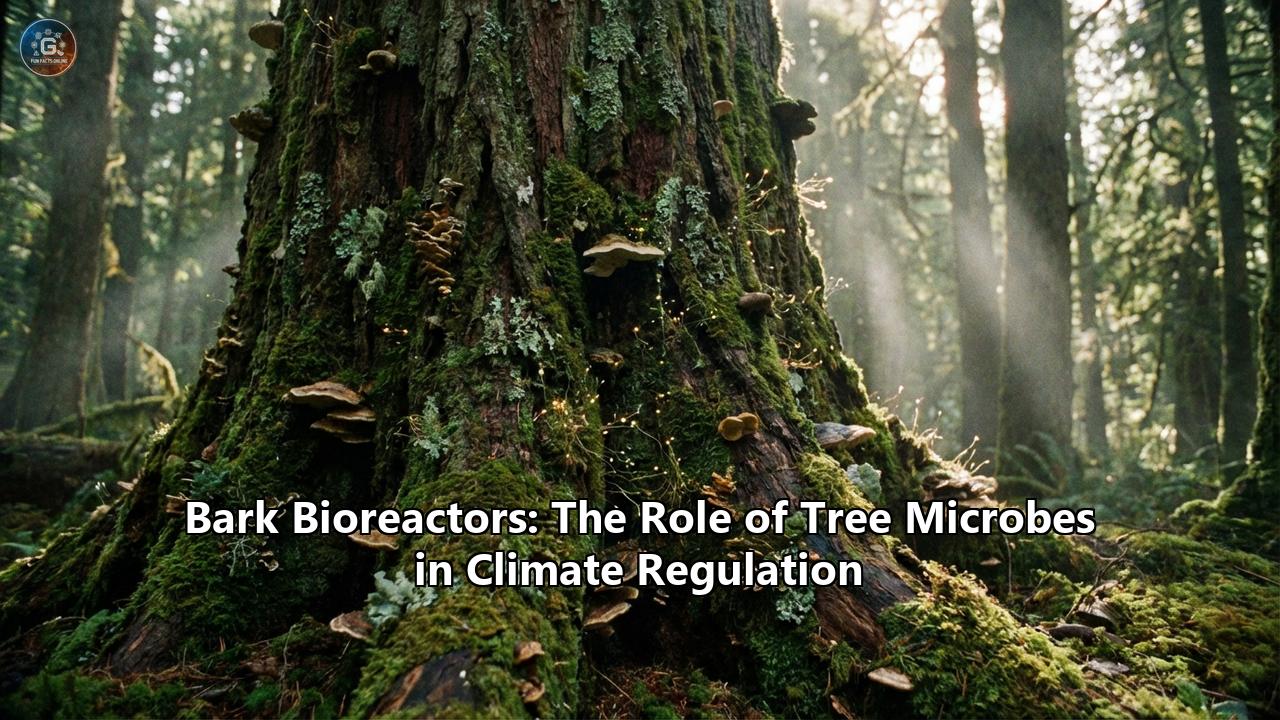
In the vast, verdant expanse of the world’s forests, a silent, invisible industrial revolution is taking place. For centuries, we have looked at trees and seen them primarily as carbon vaults—massive wooden pillars that suck carbon dioxide from the sky and lock it away in cellulose and lignin. This understanding has formed the bedrock of global climate policy: plant trees, save the planet. But this view, while correct, is incomplete. It ignores a bustling, microscopic metropolis teeming on the very skin of the forest.
Recent scientific breakthroughs, culminating in landmark studies published between 2024 and 2026, have upended our understanding of how forests interact with the atmosphere. We now know that tree bark is not merely a protective shield; it is a biologically active filter—a "Bark Bioreactor"—that hosts trillions of specialized bacteria capable of devouring methane, a greenhouse gas eighty times more potent than carbon dioxide in the short term. This discovery has rewritten the equations of the global carbon cycle, suggesting that trees are roughly 10% more beneficial to the climate than we previously dared to hope.
This article explores the science, the implications, and the future of this revolutionary finding. We will journey from the humid swamps of the Amazon to the cool woodlands of Oxford, zoom in to the molecular machinery of methanotrophic bacteria, and zoom out to the geopolitical stage where carbon credits are traded. We will uncover how the "wood wide web" extends far above the soil, turning every trunk into a chimney that doesn't just vent gases, but scrubs them clean.
Part I: The Paradigm Shift
From Chimneys to Scrubbers
To understand the magnitude of the "Bark Bioreactor" discovery, we must first appreciate the scientific dogma that preceded it. For decades, the relationship between trees and methane (CH₄) was viewed as somewhat problematic. Wetland trees, in particular, were often cast as the villains in the methane story.
In waterlogged soils, oxygen is scarce. Anaerobic archaea—ancient, single-celled organisms—thrive in these conditions, breaking down organic matter and releasing methane as a waste product. In a treeless swamp, this methane bubbles up through the water and enters the atmosphere. But trees growing in these environments act as straws. Their roots, seeking oxygen, create a pathway for gases. Methane dissolved in soil water enters the root system, travels up the xylem (the tissue that transports water), and diffuses out through the bark. This phenomenon, known as the "chimney effect," meant that trees were effectively bypassing the soil's natural methane filter (methanotrophic bacteria in the aerobic topsoil) and injecting greenhouse gases directly into the air.
For years, climate modelers debated the net impact of wetland forests. Did their carbon storage outweigh their methane emissions? The debate was fierce, and the "chimney" model reigned supreme.
Then came the anomaly.
In the late 2010s and early 2020s, researchers measuring methane fluxes in upland forests—forests with well-drained, oxygen-rich soils—began noticing something strange. Their instruments, strapped to tree trunks at varying heights, were detecting "negative fluxes." The trees weren't emitting methane; they were consuming it.
The initial assumption was that this was a measurement error or a localized curiosity. Perhaps the methane was simply diffusing into the wood and being stored? But as data trickled in from diverse ecosystems—from the Melaleuca forests of Australia to the oaks of the UK—a pattern emerged. The consumption was consistent, and it was happening on the bark, not just inside the tree.
The definitive pivot occurred with the publication of a massive global study in Nature in mid-2024, led by researchers from the University of Birmingham and an international consortium. They employed terrestrial laser scanning to map the exact surface area of tree bark globally. The result was staggering: if you were to peel every tree on Earth and lay the bark flat, it would cover an area equivalent to the entire land surface of the planet.
This wasn't just a surface; it was a continent. A "Bark Continent" inhabited by microbes.
The researchers found that while the base of the tree (the first meter or so) might still act as a chimney emitting soil methane, the dynamic flipped as you moved up the trunk. Above two meters, the bark became a hungry mouth, sucking methane out of the atmosphere. The "chimney" was actually a "scrubber." The trees were hosting their own emission-control systems.
The Global Methane Budget
Why does this matter? Methane is the second most important anthropogenic greenhouse gas. While it has a shorter atmospheric lifespan than CO₂ (about 12 years vs. centuries), it is far more efficient at trapping heat. Methane concentrations have been rising rapidly since 2007, threatening to push global warming past the 1.5°C and 2°C targets set by the Paris Agreement.
The global methane budget is a balance sheet of sources (wetlands, agriculture, fossil fuels, landfills) and sinks (processes that remove methane). The largest sink is atmospheric chemistry, where hydroxyl radicals (OH) break down methane in the sky. The second-largest known sink was soil. Bacteria in aerobic soils, known as upland soil methanotrophs, consume about 30-40 million tons (Tg) of methane per year.
The new "Bark Bioreactor" studies estimate that trees absorb between 25 and 50 Tg of methane annually. This is comparable to the entire soil sink. In one stroke, science identified a "missing sink" that effectively doubles the terrestrial capacity to scrub methane. This revelation resolves long-standing discrepancies in climate models, where the observed atmospheric methane levels didn't quite match the calculated sources and sinks. The missing methane was being eaten by the trees.
Part II: The Hidden World
The Biology of the Bark Microbiome
What exactly is living on the bark? To the naked eye, bark is a rugged landscape of ridges, fissures, and lenticels—pores that allow gas exchange. To a microbe, it is a canyon system as complex as the Grand Canyon, offering a diversity of microclimates.
The stars of the show are methanotrophs (literally "methane-eaters"). These are a specialized group of bacteria that use methane as their sole source of carbon and energy. They are not new to science; we have known about them in soils and aquatic sediments for over a century. However, finding them thriving on the dry, exposed, UV-blasted surface of a tree trunk was unexpected.
Recent metagenomic analyses—studies that sequence all the DNA in a sample to identify the community—have revealed a rich tapestry of life in the "caulosphere" (the scientific term for the stem/trunk ecosystem).
1. The Key Players:The dominant methanotrophs found on bark belong to the genera Methylomonas, Methylocystis, and Methylocapsa.
- Type I Methanotrophs (Gammaproteobacteria): These include Methylomonas. They typically thrive in environments where methane availability is sporadic or low. They use the Ribulose Monophosphate (RuMP) pathway to assimilate carbon, which is highly efficient.
- Type II Methanotrophs (Alphaproteobacteria): These include Methylocystis. They are stress-tolerant specialists, capable of fixing nitrogen and surviving in nutrient-poor acidic environments—exactly the conditions found on the bark of many tropical and boreal trees. They use the Serine pathway for carbon assimilation.
The magic happens via an enzyme called Methane Monooxygenase (MMO). This enzyme is the biological equivalent of a catalytic converter. It comes in two forms:
- Particulate MMO (pMMO): Embedded in the bacteria's internal membranes, this enzyme is copper-dependent and is the workhorse of methane consumption in most bark environments. It grabs a methane molecule (CH₄) and an oxygen molecule (O₂) and smashes them together to form methanol (CH₃OH).
- Soluble MMO (sMMO): Found in the cytoplasm, this iron-dependent enzyme is broader in its appetite but less common in the bark environment.
Once methane is converted to methanol, the bacterium doesn't stop. An enzyme called Methanol Dehydrogenase (MDH) converts the methanol into formaldehyde (CH₂O). Formaldehyde is a toxic crossroads. The bacterium must quickly decide:
- Anabolism (Building): Divert the formaldehyde into the RuMP or Serine pathway to build cell walls, DNA, and proteins.
- Catabolism (Burning): Oxidize the formaldehyde further into formate (HCOOH) and finally to Carbon Dioxide (CO₂), generating energy (ATP) in the process.
The result is that the potent greenhouse gas methane is converted into CO₂ (which is 80 times less potent) and bacterial biomass (which becomes food for other organisms).
3. The "Goldilocks" Zone:Bark is a harsh environment. It can be scorching hot at noon and freezing at night. It can be drenched by rain and then bone-dry hours later. How do methanotrophs survive?
The answer lies in the biofilm. Methanotrophs on bark don't live as isolated hermits; they form complex, slimy cities with other microbes—fungi, algae, and non-methanotrophic bacteria. This biofilm acts as a sponge, retaining moisture and protecting the community from UV radiation.
Furthermore, the bark structure itself provides niches. Deep fissures in the bark of an Oak or a Mahogany tree retain humidity and create "micro-anoxic" pockets where methane diffusing from the tree's interior can mix with oxygen diffusing from the air. This interface—where fuel meets the oxidizer—is the sweet spot for the bioreactor.
4. Symbiosis or Commensalism?Does the tree benefit from this? The relationship appears to be mutualistic.
- For the Bacteria: The tree provides a surface area, protection, and a steady stream of nutrients. Trees "leak" volatile organic compounds (VOCs) and even methane from their interior, providing a buffet for the microbes.
- For the Tree: The bacteria fix nitrogen (a critical nutrient often limiting forest growth) and may protect the tree from pathogens. Some methanotrophs produce localized antibiotics or outcompete fungal parasites. Moreover, by removing methane, they might reduce oxidative stress in the local micro-environment.
Part III: Global Case Studies
The Tale of Three Biomes
The magnitude of the Bark Bioreactor effect is not uniform across the globe. The 2024-2026 studies highlighted a clear gradient: the warmer and wetter the forest, the more methane it eats.
1. The Tropical Powerhouse (Amazon & Panama)In the lowland rainforests of the Amazon and Panama, the Bark Bioreactor is running at full capacity. High temperatures and constant humidity create a permanent incubator for microbes.
- The Phenomenon: Here, trees often act as net sinks even at lower heights. The sheer density of biomass means the "Bark Continent" is folded upon itself—vines (lianas), epiphytes, and mosses increase the surface area exponentially.
- The Species: Leguminous trees, common in the tropics, often host nitrogen-fixing bacteria. The interplay between nitrogen fixation and methane oxidation is complex (they often compete for the same enzymes), but in the nutrient-rich, rapid-cycling tropical ecosystem, methanotrophs thrive in the shadows of the canopy.
- Impact: Tropical forests account for the lion's share of the global bark methane sink, estimated at nearly 60-70% of the total absorption. This adds a new layer of urgency to saving the Amazon: deforestation doesn't just release carbon; it destroys a massive active methane filter.
In the temperate broadleaf forests, like the famous Wytham Woods in Oxford where key parts of the research were conducted, the effect is seasonal.
- The Phenomenon: During the active growing season (spring and summer), methane uptake is vigorous. The rough bark of English Oaks (Quercus robur) and Ash trees (Fraxinus excelsior) provides excellent habitat. However, in winter, as temperatures drop and metabolic rates slow, the "bioreactor" powers down.
- Vertical Stratification: It was here that the "2-meter rule" was most clearly defined. Researchers found that the base of the oak trees was emitting small amounts of methane (likely from the soil), but just a man's height up the trunk, the flux reversed. The canopy branches, with their immense surface area, were found to be particularly aggressive scrubbers.
In the cold coniferous forests of the north, the dynamic is subtler but still present.
- The Phenomenon: Scots Pine (Pinus sylvestris) and Norway Spruce (Picea abies) have different bark chemistries—often more acidic and resinous. While these chemical defenses are meant to repel beetles, they select for a specific, hardy community of acid-tolerant methanotrophs.
- Limitations: The cold restricts metabolic activity for much of the year. However, the sheer scale of the boreal forest (the largest biome on Earth) means that even a low rate of absorption sums up to a significant global number. Furthermore, boreal soils are often huge methane sources (peatlands); the trees acting as scrubbers for the methane bubbling up from the peat is a critical buffer system.
Part IV: The Physics of Flux
How the Bioreactor Works
To understand why this discovery was missed for so long, we have to look at the physics of gas exchange.
The Old Model: The Passive StrawIn the traditional view, a tree is a series of tubes (xylem vessels). Methane produced in the soil dissolves in groundwater. The tree drinks the water. As the water travels up the trunk, the pressure decreases, and the methane exsolves (turns into gas), much like opening a soda bottle. This gas then diffuses passively out through the lenticels in the bark.
- Implication: The tree is just a conduit. The amount of methane leaving the bark equals the amount entering the roots.
The new model introduces a biological "gatekeeper."
- Internal Diffusion: Methane still travels up from the roots. However, as it diffuses outward through the sapwood and cambium towards the bark, it encounters the endophytic microbiome—microbes living inside the plant tissues.
- The Radial Gradient: The concentration of methane is high in the center of the trunk and low in the atmosphere. This drives the gas outward.
- The Interception: As the methane reaches the phloem and the inner bark, it hits the methanotroph colonies. They consume a portion of this internal methane before it can escape.
- Atmospheric Drawdown: Simultaneously, the colony is hungry. If the internal supply isn't enough (which happens higher up the trunk where the soil methane has already dissipated), the bacteria start pulling methane in from the surrounding air.
- The Net Result: The tree trunk becomes a mixing valve. At the base, internal pressure wins, and there is a net emission (though reduced by the bacteria). Higher up, the internal pressure is gone, and the bacteria switch entirely to atmospheric consumption.
How did scientists prove this? They used a combination of low-tech and high-tech methods.
- The Flux Chamber: Imagine a plastic box strapped to a tree trunk, sealed with neoprene gaskets. Sensors inside measure the change in methane concentration over time. If the concentration drops, the tree is eating methane.
- Terrestrial Laser Scanning (TLS): Calculating the surface area of a tree is a nightmare. A tree is a fractal object. TLS uses LIDAR to create a millimeter-perfect 3D model of the forest. Scientists discovered that the "Bark Area Index" (bark surface area per square meter of ground) is much higher than the "Leaf Area Index" in some forests. A single hectare of forest might contain 10 hectares of bark surface—a massive folded landscape for microbes.
Part V: Climate Impact
The 10% Bonus
The headline statistic from the 2024 studies is that trees are "10% more beneficial" for the climate than previously thought. Let's unpack that number.
Global Warming Potential (GWP)Climate benefits are usually measured in "CO₂-equivalents" (CO₂e).
- A mature tree might sequester 25 kg of CO₂ per year through photosynthesis.
- However, if that same tree is also absorbing methane, we have to add that benefit. Since methane is ~28-84 times more potent than CO₂ (depending on the timeframe), absorbing even a small amount of methane has a huge multiplier effect.
- The research indicates that the "methane offset" provided by bark microbes adds an additional ~10% to the total CO₂e sequestration of the tree.
For years, atmospheric chemists have struggled to balance the global methane budget. Satellite data (like that from TROPOMI) often showed lower methane concentrations over tropical forests than bottom-up models (counting wetlands and termites) predicted. The forests looked like they were emitting less than they should.
We now know they weren't emitting less; they were re-absorbing their own emissions. This "internal recycling" means that tropical forests are tighter, more efficient systems than we realized. They clean up their own mess.
Implications for "Net Zero"This discovery complicates—and enhances—the math for Net Zero pledges.
- Corporate Offsets: A company planting a forest for carbon credits can now arguably claim a higher "climate value" for that forest.
- Avoided Deforestation: The value of existing old-growth forests just went up. An old tree has thick, deeply fissured bark with a mature, established microbiome. Cutting it down doesn't just release carbon; it destroys a high-efficiency methane scrubber that takes decades to rebuild. A sapling's smooth bark is far less effective than the rugged hide of an ancient mahogany.
Part VI: Future Forestry
Engineering the Bioreactor
If trees are bioreactors, can we upgrade them? This question is spawning a new field: Microbiome-Informed Forestry.
1. Species Selection for Methane UptakeNot all bark is created equal. The research shows that bark pH, texture, and porosity are critical.
- Texture: Rough, peeling bark (like that of the Paperbark tree, Melaleuca) creates stagnant air layers perfect for methanotrophs. Smooth-barked trees (like Beech) are less effective.
- Chemistry: Some trees produce terpenes or tannins that inhibit bacteria. Others exude sugars that feed them.
- The Strategy: Future reforestation projects might prioritize "high-affinity" tree species—those known to host aggressive methanotroph populations—especially in areas near methane sources like landfills, rice paddies, or sewage treatment plants. Imagine a "methane shield" of Paperbark trees planted around a landfill to scrub the fugitive emissions.
Agriculture has long used "seed inoculation"—coating seeds with beneficial bacteria before planting. Could we do the same for forestry?
- The Concept: Inoculate tree saplings with a "super-consortium" of high-efficiency methanotrophs before they leave the nursery.
- The Challenge: The microbiome is wild. Introduced species often fail to compete with native microbes. However, if we can identify the specific "keystone" species that allow methanotrophs to thrive (perhaps a fungus that structures the biofilm), we could engineer a stable, high-performance bark ecosystem.
Forest management practices affect the microbiome.
- Thinning: Opening the canopy lets in more UV light, which might kill sensitive methanotrophs. On the other hand, it warms the trunks, which could accelerate metabolism in cold climates.
- Fertilization: Nitrogen fertilizers inhibit methane oxidation in soils (the ammonium ion competes with methane for the methane monooxygenase enzyme). It is highly likely this applies to bark too. This suggests that aerial spraying of fertilizers could accidentally shut down the forest's methane scrubber. "Climate-smart" forestry must now consider the chemical impact on the bark surface.
Part VII: Policy & Economics
Monetizing the Invisible
The global economy is slowly moving towards valuing ecosystem services. The "Bark Bioreactor" discovery offers a tangible new asset class.
The Global Methane PledgeLaunched at COP26, this pledge aims to reduce global methane emissions by 30% by 2030. Most efforts focus on "stopping leaks" (plugging gas wells, covering landfills).
The "Bark Bioreactor" introduces a "negative emission" technology that is nature-based.
- Policy Recommendation: Nations with large tropical forests (Brazil, Indonesia, DRC) can now argue that their forests are contributing a service to the Global Methane Pledge, separate from and additional to their carbon contributions. This strengthens the argument for international climate finance transfers to these nations.
Carbon credits are currently priced based on tons of CO₂. A "Methane Removal Credit" would arguably be worth more, given methane's high potency.
- Verification: The challenge is measurement. You can't put a flux chamber on every tree. We need new remote sensing technologies. Scientists are working on "spectral signatures"—using hyperspectral cameras to detect the specific light reflectance changes caused by active methanotroph biofilms or the subtle physiological shifts in trees actively processing methane.
- The Risk: There is a danger of "double counting" or over-promising. If a forestry project claims it is absorbing methane, but a drought hits and the methanotrophs go dormant, the credit becomes worthless. Robust, conservative modeling is essential.
This research changes how we view city trees. In urban environments, methane leaks from natural gas pipelines under the streets are common. Urban trees might be acting as sentinels and scrubbers, cleaning up the fugitive emissions of our energy infrastructure. Planting rough-barked species along city streets could be a public health measure as well as a beautification one.
Part VIII: The Frontier
What We Don't Know Yet
As with all great scientific discoveries, the "Bark Bioreactor" has generated more questions than answers. The years 2026-2030 will likely be defined by the race to answer them.
1. The Virus QuestionWherever there are bacteria, there are bacteriophages—viruses that infect them. What role do viruses play in the bark biofilm? Do they kill off the methanotrophs effectively "crashing" the bioreactor? Or do they facilitate gene transfer, helping the bacteria evolve faster? Viral ecology on tree bark is a complete black box.
2. Other Gases: Hydrogen and COThe same 2026 studies that confirmed methane uptake also hinted that tree bark consumes other gases.
- Hydrogen (H₂): An indirect greenhouse gas. Bark appears to be a massive sink for molecular hydrogen.
- Carbon Monoxide (CO): A toxic pollutant. Methanotrophs often co-oxidize CO.
This suggests trees are "atmospheric purifiers" in a very broad sense.
3. The Canopy FrontierMost measurements have been taken on the trunk (up to 2-3 meters). But the vast majority of a tree's surface area is in the canopy—the branches and twigs.
- The Hypothesis: The canopy is exposed to more UV and drying winds, which might be bad for bacteria. However, it is also the site of immense gas exchange and photosynthesis. Some researchers believe the canopy might host "phototrophic" methanotrophs—bacteria that use light to boost their methane-eating efficiency. If the canopy is as active as the trunk, the current estimates of 50 Tg/year might be conservative. We might be looking at a sink double that size.
The terrifying question: Does climate change kill the bioreactor?
- Drought: Methanotrophs need moisture. As the Amazon dries out due to climate change, will the bark biofilms die? If they do, the forest stops scrubbing methane just as we need it most.
- Heat: Higher temperatures generally speed up bacterial metabolism—up to a point. Beyond a thermal optimum (around 30-35°C for many species), proteins denature. Are tropical forests nearing the thermal limit of their microbiome?
Conclusion: The Tree as a Holobiont
The discovery of Bark Bioreactors forces a philosophical shift. We can no longer see a tree as a solitary individual—a static sculpture of wood and leaf. A tree is a Holobiont: a super-organism consisting of the host (the tree) and its microbiome (roots, leaves, and now bark).
The bark is the interface between the living tree and the changing atmosphere. It is a frontier where biology meets atmospheric physics, where the microscopic metabolism of a single bacterium contributes to the cooling of the entire planet.
For humanity, the lesson is clear. The value of a forest is not just in its timber or even its carbon storage. Its value lies in its living complexity. Every rough patch of bark is a factory working 24/7 to clean our air. We are only just beginning to understand the machinery of this factory. Protecting it, understanding it, and potentially working with it, offers one of the most promising nature-based solutions to the climate crisis.
As we walk through the woods, we must look at the rough, gnarled trunks not as inert matter, but as breathing, living skins—the lungs of the earth, in more ways than one. The trees are not just standing there; they are working. And their work is helping to keep the world cool.
Reference:
- https://www.eci.ox.ac.uk/news/surprising-new-climate-benefit-found-tree-bark
- https://www.ceh.ac.uk/news-and-media/news/how-tree-bark-helping-fight-climate-change
- https://news.mongabay.com/short-article/2024/08/tree-bark-removes-atmospheric-methane-study-finds/
- https://www.psu.edu/news/research/story/researchers-predict-climate-change-driven-reduction-beneficial-plant-microbes
- https://www.popsci.com/environment/tree-bark-methane-absorption/
- https://pmc.ncbi.nlm.nih.gov/articles/PMC11269171/
- https://pmc.ncbi.nlm.nih.gov/articles/PMC8035153/
- https://www.mdpi.com/2223-7747/11/21/2834
- https://www.researchgate.net/figure/Metabolic-pathways-of-methanotrophs-type-I-II-and-X-Methane-CH4-is-oxidized-to_fig1_350384641
- https://www.frontiersin.org/journals/microbiology/articles/10.3389/fmicb.2021.678057/full
- https://pmc.ncbi.nlm.nih.gov/articles/PMC10715197/
- https://www.greeneconomy.co.uk/news-and-resources/news/tree-bark-is-removing-atmospheric-methane-study-finds
- https://www.researchgate.net/publication/43283202_Effects_of_symbiotic_bacteria_and_tree_chemistry_on_the_growth_and_reproduction_of_bark_beetle_fungal_symbionts
- http://climatesmartfarming.org/wp-content/uploads/2019/02/Forest-Management-and-GHG-Mitigation.pdf
- https://www.nsf.gov/news/new-research-microbiomes-could-help-understand
- https://www.biorxiv.org/content/10.1101/2021.04.26.441496v1.full-text
- https://www.researchgate.net/publication/261675480_Microbial_Communities_Associated_with_Tree_Bark_Foliose_Lichens_A_Perspective_on_their_Microecology
- https://www.researchgate.net/publication/371042167_Shifting_microbial_communities_can_enhance_tree_tolerance_to_changing_climates
- https://www.researchgate.net/publication/366377761_Managed_Forests_and_Methane_Recent_Research_and_Prospects_for_Best_Management_Practices
- https://pmc.ncbi.nlm.nih.gov/articles/PMC9239095/
- https://www.researchgate.net/publication/350755575_Bark-dwelling_methanotrophic_bacteria_decrease_methane_emissions_from_trees
- http://www.methanotroph.org/wiki/metabolic-pathways/
- https://harvardforest1.fas.harvard.edu/publications/pdfs/Castro_GlobalBiogeochemicalCycles_1995.pdf