
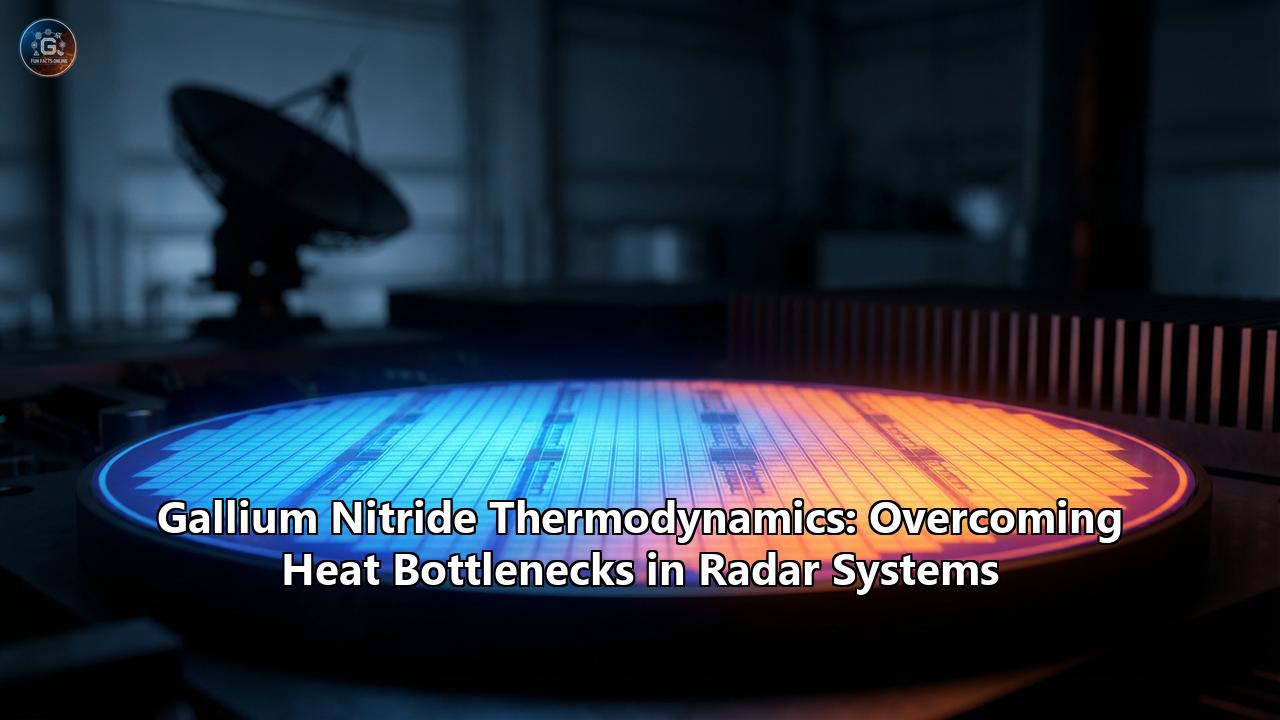
The modern electromagnetic spectrum is a silent, invisible battlespace where the ultimate currency is power, and the ultimate adversary is not a rival military, but the fundamental laws of thermodynamics. For decades, the evolution of radar and electronic warfare was defined by a steady march up the frequency spectrum and a relentless push for higher transmit power. At the heart of this evolution is Gallium Nitride (GaN), a wide-bandgap semiconductor material that has fundamentally rewritten the rules of high-frequency electronics. Capable of handling extreme voltages and operating at blistering frequencies, GaN has become the undisputed backbone of modern Active Electronically Scanned Array (AESA) radars, 5G networks, and satellite communications.
Yet, for all its miraculous electromagnetic properties, GaN harbors a severe vulnerability: it generates localized heat at a rate that traditional engineering struggles to comprehend, let alone manage. As radar designers push for greater power in the X and Ka bands—the critical frequencies used for long-range target tracking, fire control, and stealth aircraft detection—waste heat piles up inside the microscopic architecture of the chip faster than it can escape. When this happens, systems face a brutal choice: dial back the power, or risk thermal drift, signal distortion, and catastrophic hardware failure. In practice, modern radars rarely stop tracking a target because they have reached their electromagnetic limits; they stop because they have hit a thermal wall. Overcoming this thermal bottleneck is the single greatest engineering challenge in modern radio frequency (RF) design, sparking a revolution in materials science, microfluidic plumbing, and nanoscale manufacturing that is redefining the limits of human perception.
To understand why GaN runs so intensely hot, one must look deep inside the microscopic architecture of a High Electron Mobility Transistor (HEMT). Unlike older silicon or gallium arsenide (GaAs) components, a GaN HEMT operates by creating a two-dimensional electron gas (2DEG) at the junction of different semiconductor materials. When power is applied, electrons rip through this microscopic channel at incredible velocities. However, this high-speed electron traffic comes with a severe physical toll. As electrons collide with the atomic lattice of the semiconductor, their kinetic energy is converted into phonons—quantized vibrations of the crystal lattice that we experience as heat.
Because modern GaN devices are capable of handling power densities exceeding 40 watts per millimeter of gate periphery, the resulting thermal energy is not distributed evenly. Instead, it concentrates in microscopic "hotspots" near the gate-drain access region. At these specific junctions, the heat flux can reach tens of thousands of watts per square centimeter—a thermal density that rivals the surface of the sun. When localized temperatures spike, electron mobility degrades, creating a vicious positive feedback loop where the device generates even more heat to maintain its output.
The traditional approach to cooling electronics—bolting the chip to a metal heat spreader, applying thermal paste, and blowing air or pumping liquid coolant over a macroscopic heat sink—is woefully inadequate for GaN. By the time the thermal energy travels from the nanoscale hotspot, through the semiconductor substrate, across the thermal interface material (TIM), and into the heat sink, the temperature gradient is too steep. This massive "thermal path" acts like a congested highway, trapping heat at the source. Furthermore, under pulsed radar operation, the rapid extreme temperature fluctuations create severe mechanical stress. Because the different materials within the chip expand and contract at different rates—a phenomenon known as Coefficient of Thermal Expansion (CTE) mismatch—these thermal cycles accelerate fatigue, leading to microscopic cracks, delamination, and eventual device failure.
For years, the industry’s stopgap solution has been to grow GaN on top of Silicon Carbide (SiC) substrates. SiC is an excellent conductor of heat and provides a solid foundation for GaN HEMTs. However, even GaN-on-SiC has hit its ceiling. The primary choke point lies at the boundary between the GaN layer and the SiC substrate. This interface suffers from Thermal Boundary Resistance (TBR), also known as Kapitza resistance. Because the crystal lattices of the two materials do not align perfectly, phonons carrying heat energy scatter when they hit the boundary, bouncing back into the GaN layer rather than flowing smoothly into the SiC heat sink. In a standard GaN-on-SiC device, this invisible boundary alone can account for 30% to 40% of the chip's total thermal resistance.
Faced with the physical limits of traditional packaging, the defense and aerospace industries realized that cooling could no longer be an afterthought applied to the outside of a chip; it had to be engineered directly into the silicon. This paradigm shift was heavily driven by the Defense Advanced Research Projects Agency (DARPA) through its ICECool (Intra/Interchip Embedded Cooling) program. The philosophy behind ICECool was profoundly counter-intuitive: to improve cooling, engineers needed to stop adding material (like massive copper heat sinks) and start removing it.
Embedded microfluidic cooling reimagines the semiconductor substrate as a microscopic plumbing network. Using advanced lithography and etching techniques, engineers carve microchannels—sometimes no wider than a human hair—directly into the backside of the silicon or SiC substrate, directly beneath the active GaN transistor. By circulating dielectric fluids or energetic vanadium-based electrolytes through these embedded trenches, the coolant is brought within micrometers of the heat-generating junctions. This entirely eliminates the need for external thermal interface materials, bypassing the most restrictive thermal bottlenecks in the system.
The results of microfluidic co-design are staggering. Laboratory demonstrations have shown that embedded liquid cooling can effectively manage heat fluxes of up to 30,000 watts per square centimeter at the hotspot, while keeping the average surface temperature of the device below 45°C. In specific radar amplifier models, microchannel cooling increased output current by an average of 27% and allowed devices to dissipate upwards of 600 watts of total power while maintaining safe junction temperatures. By shifting to embedded cooling, defense contractors like BAE Systems, Lockheed Martin, and Raytheon have demonstrated the ability to boost the radio frequency output power of EW and radar amplifiers by three to four times, fundamentally altering the Size, Weight, Power, and Cost (SWaP-C) calculus of military hardware.
Yet, liquid cooling inherently requires pumps, manifolds, and fluid reservoirs, adding mechanical complexity to systems that must operate flawlessly under extreme G-forces and vibrations. For engineers seeking a solid-state solution, the holy grail of thermal management has always been diamond. Synthetically grown diamond possesses the highest thermal conductivity of any known material—up to five times greater than copper and substantially higher than silicon carbide.
The concept of GaN-on-Diamond is mathematically flawless but metallurgically nightmarish. To integrate the two, the GaN layer must be separated from its native growth substrate and bonded to a synthetic diamond wafer, or the diamond must be grown directly onto the back of the GaN using chemical vapor deposition (CVD). Because diamond growth requires temperatures exceeding 800°C, early attempts resulted in severe wafer warping; the extreme heat required for the diamond effectively baked and destroyed the fragile transistor structures on the other side of the wafer.
However, recent breakthroughs have conquered these manufacturing hurdles. Through DARPA’s THREADS (Technologies for Heat Removal in Electronics at the Device Scale) program, companies like Raytheon, partnering with Diamond Foundry, have unlocked proprietary methods to seamlessly integrate military-grade GaN with lab-grown diamond lattices. By placing the world's best thermal conductor in intimate contact with the GaN channel, engineers have achieved unsurpassed heat tolerance. The resulting GaN-on-Diamond transistors are capable of delivering 16 times the output power of traditional GaN devices without any increase in operating temperature. In the context of the battlefield, dialing up the amplifier by this magnitude translates directly to increasing a radar's detection range by a factor of two to three.
While Western defense consortiums focused heavily on exotic substrates and microfluidics, a parallel breakthrough emerged from China in early 2026, proving that massive gains could still be found at the atomic level. Researchers at Xidian University announced a leap forward that didn't require micro-pumps or synthetic diamonds, but rather a fundamental redesign of the microscopic bonding layer buried inside the chip.
In standard GaN architectures, Aluminum Nitride (AlN) is often used as the intermediate bonding layer between the GaN and its substrate. While electrically highly suitable, the traditional growth process of this AlN layer naturally forms irregular, microscopic "islands" rather than a perfectly uniform sheet. These disordered micro-structures act like speed bumps for phonons, trapping thermal energy and causing it to scatter rather than flow into the substrate. The Chinese research team devised a highly guarded nanoscale fabrication technique to control the crystalline growth of this layer, forcing it to form an impeccably smooth, uniform film.
By eliminating the microscopic irregularities, they converted a thermal barrier into a thermal highway. Measurements indicated that this single atomic-level smoothing reduced the chip's overall thermal resistance by roughly 33%. Because the chip could now breathe thermally, it could sustain continuous high-load operations without throttling. In practical terms, this supercooling technique yields up to a 40% improvement in the detection of low-observability stealth aircraft. For stealth platforms like the J-20 or J-35, a thermally unconstrained GaN module means the aircraft can "see" an adversary from much further away, maintaining a high-resolution track without having to rely on larger, heavier radar dishes or power-hungry cooling units.
The operational implications of these combined thermal breakthroughs—whether achieved through microfluidics, diamond integration, or atomic-layer smoothing—are radically reshaping the global balance of electromagnetic power. In the realm of ground-based air defense, systems like the Patriot LTAMDS (Lower Tier Air and Missile Defense Sensor) are required to track hypersonic glide vehicles that move at unpredictable trajectories and blistering speeds. Tracking these targets requires the radar to operate with massive duty cycles, emitting continuous, high-power pulses. Previously, sustained tracking of a hypersonic threat could literally melt the radar's internal components, forcing the system to blink and potentially lose the track. With next-generation thermal management, these systems can stare continuously into the sky, processing massive amounts of data without thermal degradation.
In the domain of Electronic Warfare (EW), the goal is to blast the enemy's receivers with overwhelming amounts of broadband RF energy, blinding their sensors. The limiting factor for an EW pod mounted on a fighter jet has always been the pod's ability to shed the immense heat generated by this electronic barrage. Thermally liberated GaN amplifiers allow electronic attack aircraft to jam enemy communications and radar from safer standoff distances, utilizing pods that are smaller, lighter, and vastly more powerful than legacy systems.
Beyond the theater of war, the thermodynamics of Gallium Nitride are dictating the pace of global civilian infrastructure. The commercial telecommunications sector is currently navigating the extreme demands of dense 5G rollouts and the impending leap to 6G networks. 6G relies on ultra-high frequencies and massive MIMO (Multiple Input, Multiple Output) antenna arrays to deliver unprecedented data rates. However, if traditional GaN thermal limitations were applied to 6G base stations, the cellular towers would consume unsustainable amounts of electricity and require industrial-grade air conditioning to prevent catastrophic failure. The integration of advanced thermal interfaces and embedded micro-cooling allows network operators to increase the output power at each small cell, extending signal coverage and lowering electricity consumption in dense urban environments.
Similarly, the new space race relies heavily on GaN thermodynamics. Satellites operating in Low Earth Orbit (LEO) provide global broadband coverage using Ka-band microwave signals. Space, however, is a thermal nightmare. Without air to facilitate convection cooling, satellites must rely entirely on conduction and massive radiative panels to shed heat. Every ounce of thermal management hardware launched into orbit costs tens of thousands of dollars. By utilizing GaN-on-Diamond or smoothly bonded GaN architectures, satellites can achieve stronger, cleaner data transmissions with significantly smaller cooling arrays, directly impacting the economic viability of global satellite internet constellations.
As we look toward the future, the boundary between electronic engineering and thermodynamic engineering is disappearing entirely. The next frontier involves the co-design of RF and thermal networks using predictive artificial intelligence. Engineers are now developing 3D heterogeneously integrated circuits, where microfluidic channels are dynamically routed through multi-layer chip stacks based on AI-predicted thermal loads. In these advanced architectures, logic processors, field-programmable gate arrays (FPGAs), and high-power GaN amplifiers are stacked like a skyscraper, with microscopic cooling rivers flowing between the floors to extract heat exactly where and when it is generated.
The story of Gallium Nitride is a profound reminder of the physical limits of our digital world. The ability to detect a stealth fighter over the horizon, to jam a hypersonic missile in mid-flight, or to beam gigabits of data from a satellite to a smartphone, no longer depends merely on writing better software or designing larger antennas. It depends on the mastery of phonons, the alignment of crystal lattices, and the precise control of microscopic heat. By unlocking the thermal bottlenecks of GaN, science has not just cooled down a piece of silicon; it has permanently expanded the horizons of human technology, proving that the ultimate power lies not just in generating energy, but in mastering the fire it leaves behind.
Reference:
- https://www.charlesyoungcentre.org.uk/25-169526-china-set-to-master-super-radar-tech-first-thanks-to-breakthrough-that-fixes-their-biggest-flaw-waste-heat/
- https://csmantech.org/wp-content/acfrcwduploads/field_5e8cddf5ddd10/post_4891/07a.1.pdf
- https://militaryembedded.com/radar-ew/thermal-management/gan-applications-gets-hot
- https://eureka.patsnap.com/report-thermal-management-challenges-for-gan-hemt-devices
- https://www.mdpi.com/2072-666X/15/1/33
- https://interactive.aviationtoday.com/avionicsmagazine/april-may-2018/beating-the-heat-for-emerging-electronics/
- https://ieeexplore.ieee.org/document/9867939/
- https://www.electronics-cooling.com/2022/08/better-cooling-by-removing-material-instead-of-adding-material-to-unlock-the-full-power-of-gan-electronics/
- https://ieeexplore.ieee.org/document/10732837/
- https://pubs.acs.org/doi/abs/10.1021/acsaelm.4c01424
- https://seapowermagazine.org/rtx-and-darpa-to-revolutionize-gallium-nitride-technology-for-improved-radio-frequency-sensors/?print=pdf
- https://www.c4isrnet.com/electronic-warfare/radar/2023/11/27/ice-ice-baby-raytheon-uses-diamonds-to-keep-radars-cool/
- https://www.army-technology.com/news/newsdarpa-demonstrates-gan-diamond-transistor-military-rf-applications/
- https://hometownjournal.biz/2026/01/31/chinas-radar-breakthrough-solves-overheating-40-power-boost/
- https://www.youtube.com/watch?v=KxJYN_dl8Ak
- https://electronics360.globalspec.com/article/23287/supercooled-radar-chips-promise-to-increase-stealth-jet-detection-by-40