
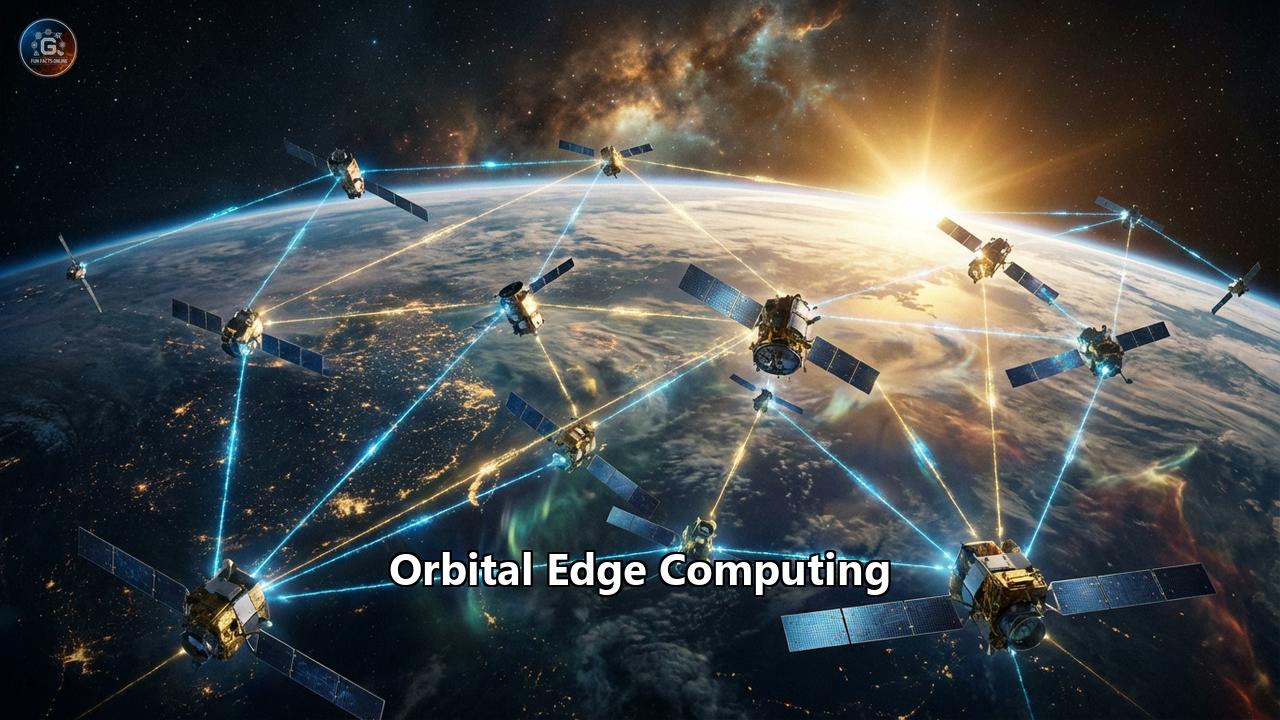
The popular imagination of space exploration is often dominated by the visceral roar of rocket engines, the blinding flare of launch, and the iconic imagery of astronauts floating in tin cans far above the world. Yet, a quieter, invisible revolution is currently unfolding in the vacuum of Low Earth Orbit (LEO)—one that promises to be as transformative as the reusable rocket. It is a shift not in how we get to space, but in what we do once we are there. We are witnessing the death of the "bent pipe" era and the birth of the Orbital Edge Computing (OEC) age.
For decades, satellites were essentially dumb mirrors. They captured data—images, radio signals, weather patterns—and blindly reflected it back to ground stations on Earth for processing. This architecture, known as "bent pipe," was born of necessity. Space is a harsh, unforgiving environment for delicate electronics. Radiation shreds silicon; extreme thermal cycles crack solder joints; and the tyranny of the launch equation meant that every gram of onboard computing power was a gram of fuel or payload left behind. As a result, the "brains" of the operation remained safely terrestrial, while the "eyes" and "ears" floated in orbit.
Today, that paradigm is collapsing. Driven by the explosive growth of the NewSpace economy, the plummeting cost of launch, and radical advancements in radiation-tolerant hardware, we are moving the datacenter to the stars. Orbital Edge Computing is the practice of processing data in situ—directly on the satellite itself—using onboard Artificial Intelligence (AI) and Machine Learning (ML). It is the difference between a security camera recording 24 hours of empty hallway to be reviewed later, and a smart camera that only alerts you when it sees a person. In space, this shift changes everything: from the economics of Earth observation to the speed of hypersonic missile defense.
This comprehensive guide explores the technical architecture, economic drivers, security implications, and future potential of Orbital Edge Computing. We will dismantle the hardware stacks flying on today’s most advanced CubeSats, examine the software defining the next generation of "app store" satellites, and look ahead to the science-fiction-turned-reality of server farms orbiting the moon.
Part I: The Physics of the Problem – Why Process in Orbit?
To understand why OEC is inevitable, one must first understand the bottlenecks of the legacy model. The traditional "downlink-then-process" architecture is hitting three hard physical limits: Latency, Bandwidth, and Autonomy.
The Latency Trap
In a bent-pipe architecture, a satellite snaps a picture of a forest fire in California. It then stores that massive raw file until it passes over a ground station—perhaps in Svalbard, Norway, or a leased dish in Chile. This "store-and-forward" delay can range from minutes to hours. Once downlinked, the data must be transferred via fiber optics to a cloud data center (like AWS or Azure), processed to identify the fire, and then alerted to emergency services. In a best-case scenario, the "insight" arrives 20 to 60 minutes after the photon hit the sensor. For a spreading wildfire, a moving military target, or a tsunami wavefront, 20 minutes is an eternity.
Orbital Edge Computing short-circuits this loop. An AI-enabled satellite spots the fire, processes the image onboard using a thermal detection algorithm, and sends a tiny data packet—containing just the coordinates and fire intensity—directly to a handheld receiver on the ground via an Iridium link or a direct L-band broadcast. The latency drops from hours to seconds.
The Bandwidth Bottleneck
We are launching sensors that are too good for our radios. Modern hyperspectral imagers and Synthetic Aperture Radar (SAR) collect terabytes of data per day. A single high-resolution optical satellite can generate more data in a single pass than it can transmit to the ground. The radio spectrum is a finite resource, and downlink bandwidth is expensive and congested.
Transmitting a 50GB raw image file when 90% of the image is just cloud cover or open ocean is an immense waste of resources. OEC allows the satellite to act as a gatekeeper. A "cloud detection" neural network can discard useless cloudy images instantly. A maritime tracking algorithm can crop the image to just the ship, discarding the miles of empty water around it. By sending only the insight (the ship is here) rather than the raw data (pixels of water), OEC reduces downlink requirements by factors of 100x to 1000x.
The Autonomy Imperative
As humanity pushes deeper into space, the speed of light becomes a laggy nuisance. On Mars, the round-trip communication delay to Earth is between 8 and 40 minutes. You cannot joystick a rover in real-time with a 20-minute lag. If a rover is about to drive off a cliff, it must recognize the cliff and stop itself.
While LEO satellites don't face light-speed delays, they face "comms blackouts." A defense satellite tracking a hypersonic glide vehicle cannot wait for a ground operator to confirm the track; the target will be gone. OEC grants the asset agency—the ability to make decisions (to slew the camera, to switch modes, to fire a thruster) without checking with "mother" first.
Part II: The Hardware – Silicon Survival in the Void
The holy grail of OEC is running terrestrial-grade AI on space-grade hardware. This has historically been impossible because the heavy shielding and redundant circuitry required for "Radiation Hardened" (Rad-Hard) chips made them slow, expensive, and generations behind the curve. A standard Rad-Hard processor from BAE Systems or Honeywell might cost $200,000 and offer the computing power of a 1990s Pentium.
The OEC revolution is fueled by a new approach: Radiation Tolerant (Rad-Tolerant) and COTS (Commercial Off-The-Shelf) architectures.
The Rise of COTS and "Space-Hardened" AI
Instead of designing a chip from scratch for space, engineers are taking powerful consumer chips—like those found in self-driving cars or video game consoles—and wrapping them in software and hardware protection.
- NVIDIA in Orbit: The gold standard for terrestrial AI, NVIDIA's Jetson series (TX2, Xavier, Orin), is now flying in space. Companies like Cosmic Shielding Corporation have developed nanocomposite polymers that shield these consumer GPUs from protons and heavy ions. This allows a satellite to run a standard PyTorch or TensorFlow model on a GPU that costs a few hundred dollars, rather than a bespoke processor costing millions.
- FPGAs (Field Programmable Gate Arrays): Chips like the Xilinx (now AMD) Versal ACAP and Microchip RT PolarFire are the workhorses of OEC. Unlike a CPU that has a fixed architecture, an FPGA can be rewired in software. If a new compression algorithm is invented after launch, you can literally reconfigure the hardware logic of the chip to run it efficiently. The Xilinx XQR Versal is the first "adaptive compute" chip qualified for space, capable of massive parallel processing for AI inference while monitoring itself for radiation errors.
- Neuromorphic Computing: The ultimate frontier is mimicking the human brain. Spacecraft are power-starved; a typical CubeSat might have a power budget of 20 watts—less than a dim lightbulb. Neuromorphic chips, like BrainChip’s Akida or Intel’s Loihi, process information using "spiking neural networks" that only consume power when data changes (an "event"). If the camera sees empty space, the chip sleeps. This event-based processing matches the extreme power constraints of orbit perfectly.
Dealing with the SEU (Single Event Upset)
The invisible enemy of OEC is the Single Event Upset. A high-energy particle strikes a transistor and flips a 0 to a 1. On Earth, the atmosphere protects us. In space, this bit-flip can crash a system or cause a neural network to hallucinate a tank where there is a tree.
Modern OEC hardware uses voting logic to fight this. Three identical processor cores run the same calculation simultaneously. If one core says "0" and the other two say "1," the system assumes the "0" was a radiation error, corrects it, and reboots the corrupted core—all in milliseconds. This "Triple Modular Redundancy" (TMR) allows us to use faster, non-hardened silicon safely.
Part III: The Software – Kubernetes in the Sky
If hardware is the engine, software is the fuel. The old way of coding for space was rigid: monolithic firmware written in C or Assembly, tested for years, and rarely touched after launch. The OEC era is bringing modern DevOps to orbit. We are seeing the "containerization" of space.
Software-Defined Satellites
The concept of the Software-Defined Satellite (SDS) is analogous to the smartphone. When you buy an iPhone, its hardware is fixed, but its utility changes depending on what apps you install. An SDS is a generic orbital platform—a box with power, comms, and compute.
Imagine a satellite launched by a company like SmartSat or using Lockheed Martin’s SmartSat software.
- Day 1: It is rented by a forestry startup to count trees. They upload a "Tree Counter" Docker container to the satellite.
- Day 30: A hurricane strikes. The forestry app is killed, and a "Flood Detection" container is deployed to the same satellite in minutes.
- Day 60: The satellite is leased by a maritime company to track illegal fishing vessels.
Kubernetes (K3s) on Orbit
To manage these containers, the industry is adopting Kubernetes—the same orchestration system used by Google and Netflix. Specifically, lightweight distributions like K3s (from SUSE/Rancher) are being flown.
In 2022, Hypergiant and the US Department of Defense proved this with "Satellite One," updating a satellite's operating system and deploying new AI models using K3s in orbit. This means developers can write code on their laptops, push it to a CI/CD pipeline, and have it deploy to a constellation of 100 satellites as easily as deploying to a cloud server. It democratizes access; you no longer need to be an aerospace engineer to write code for space. You just need to know Python and Docker.
App Stores for Space
This architecture enables an "App Store" economy. A satellite operator (like Sidus Space or Loft Orbital) provides the infrastructure. Third-party developers upload algorithms.
- Example: An AI researcher develops a superior cloud-removal algorithm. They upload it to the "Orbit Store." Satellite operators pay a micro-license fee every time their satellite uses that algorithm to clear an image.
- Example: A security firm uploads a "Jamming Detector" app that listens to the radio background noise and alerts the operator if someone is trying to jam the GPS signal.
Part IV: Case Studies – OEC in Action
The theory is sound, but who is actually doing it? The past three years have seen a flurry of pathfinder missions.
1. ESA’s Phi-Sat-1: The Icebreaker
Launched in 2020, the European Space Agency’s Phi-Sat-1 was a watershed moment. It carried an Intel Movidius Myriad 2 VPU (Vision Processing Unit)—a chip originally designed for security cameras and drones. Its mission: cloud detection.
Hyperspectral cameras are notorious data hogs. Phi-Sat-1 used a Convolutional Neural Network (CNN) to look at images as they were taken. If an image was too cloudy to be useful, the satellite deleted it immediately. This simple logic saved 30% of the downlink bandwidth, proving that even a low-power ($20) AI chip could survive space and deliver immediate ROI.
2. HPE Spaceborne Computer-2: The Supercomputer on the ISS
While Phi-Sat was a tiny experiment, Hewlett Packard Enterprise (HPE) went big. They bolted a rack of commercial servers (ProLiant DL360) to the International Space Station. This wasn't a stripped-down chip; it was a beast with TFLOPs of compute and 130TB of Kioxia flash storage.
HPE Spaceborne-2 is testing the limits of "edge-to-cloud" logic. In one experiment, they processed DNA sequencing data from astronauts directly on the ISS to check for mutations caused by radiation. Sending the raw DNA data to Earth would have taken weeks over the ISS’s constrained slow-link. Processing it onboard took hours, and only the results (the anomalies) were sent down. This proved that high-performance computing (HPC) is viable in zero-g.
3. Starfish Space & "Otter": The Autonomous Mechanic
Starfish Space is building the "Otter," a small servicing satellite designed to dock with dead satellites and extend their life or de-orbit them. Docking with a tumbling, non-cooperative object is incredibly difficult. You cannot do it with remote control from Earth; the latency would cause a crash.Otter uses OEC to run complex "Computer Vision" and "Guidance, Navigation, and Control" (GNC) algorithms in real-time. It creates a 3D map of the target satellite on the fly, calculating its spin and trajectory to execute a soft docking. Starfish uses Google Kubernetes Engine (GKE) to simulate these dockings millions of times on Earth before uploading the "brains" to the satellite—a perfect example of the cloud-native space workflow.
Part V: The Connectivity Mesh – The Internet of Space
OEC does not exist in a vacuum (pun intended). A smart satellite is powerful; a network of smart satellites is revolutionary. We are moving from isolated assets to a Space Mesh Network.
Optical Inter-Satellite Links (OISL)
Starlink has popularized the "laser link"—using lasers to beam data between satellites at the speed of light in a vacuum (which is faster than light in fiber optic glass). For OEC, this is the backbone.
Imagine a "Federated Learning" scenario:
- Satellite A over Australia spots a new type of wildfire signature.
- It updates its internal AI model.
- Instead of waiting to tell Earth, it beams the model update via laser to Satellite B, C, and D.
- Within seconds, the entire constellation is smarter, without a single byte touching the ground.
This creates a "Space Edge Cloud." If one satellite is overwhelmed with processing tasks, it can offload the computation to a neighbor that is currently idle (flying over the ocean at night), balancing the load across the constellation.
DTN: The Protocol of the Interplanetary Internet
The TCP/IP protocol that runs the internet breaks down in space. It relies on "handshakes"—constant confirmations that data arrived. In space, with high error rates and long delays, TCP/IP stalls.
The solution is Delay/Disruption Tolerant Networking (DTN), specifically the Bundle Protocol (BP). DTN is like a super-resilient postal service. If a node (satellite) has a packet but no link to the next hop, it stores the data. It holds it for minutes or hours until a link opens, then forwards it. OEC relies on DTN to ensure that the "insights" generated onboard eventually reach the user, even if the satellite is tumbling or jamming is present.
Part VI: Security, Sovereignty, and the "Data Heaven"
As we put supercomputers in space, we introduce new risks. A hacked "bent pipe" satellite might stop transmitting. A hacked OEC satellite could be reprogrammed to de-orbit itself, crash into another satellite, or manipulate the data it processes—telling a General that a tank battalion is a herd of cows.
The NIST Framework & CCSDS
Security in space has historically been "security by obscurity." That is over. The NIST (National Institute of Standards and Technology) has released cybersecurity frameworks specifically for satellite ground segments and command links. Meanwhile, the CCSDS (Consultative Committee for Space Data Systems)—the body that sets the USB-like standards for space—is rolling out the SDLS (Space Data Link Security) protocol.
SDLS adds authentication and encryption at the data link layer. This prevents "replay attacks" (where a hacker records a valid command and plays it back later) and "spoofing."
Data Sovereignty in the Void
Here lies a fascinating legal grey area. The GDPR (General Data Protection Regulation) governs data privacy for EU citizens. But does GDPR apply to a server orbiting 500km above Paris? What about 500km above international waters?
The ASCEND project (led by Thales Alenia Space) explores the concept of "Space Data Centers" partly to address Data Sovereignty. European nations are uncomfortable with their data residing in US-controlled clouds (AWS/Azure/Google). A data center in orbit, flagged to an EU nation, offers a "neutral" territory. It is physically impossible for a foreign government to seize the servers with a warrant. This "Data Heaven" concept suggests that highly sensitive banking, diplomatic, or genomic data might one day be stored in orbit not just for performance, but for jurisdictional immunity and physical security.
Part VII: The Economics of Orbital Edge
Technology is cool, but economics drives adoption. The business case for OEC is becoming undeniable.
Cost Savings: The $100/GB Downlink Problem
While costs are dropping, downlinking data remains a significant OpEx (Operational Expenditure). Ground station time is rented by the minute. By reducing data volume by 90% through onboard filtering, OEC pays for itself. The added cost of a $50,000 edge computer is recouped in months of saved bandwidth fees.
New Business Models: Space-as-a-Service
OEC enables "Space-as-a-Service" (SPaaS).
- Old Model: You buy a satellite, launch it, and hire a team to run it. (Cost: $100M+)
- OEC Model: You write a Python script. You pay Loft Orbital or Sidus Space to upload that script to their satellite for 10 minutes a day. You pay for the compute time and the insight, not the hardware.
This lowers the barrier to entry from millions to thousands of dollars. A university student can now "run a space mission" for the cost of a cloud subscription.
The "Green" Data Center
The ASCEND feasibility study also points to an environmental driver. Terrestrial data centers consume 2-3% of the world's electricity and vast amounts of water for cooling. In space, solar energy is limitless and 24/7 (in certain orbits). The "cooling" is free (radiation into deep space). If we can solve the launch emissions problem (via green hydrogen rockets), moving the world’s heaviest computational workloads (training massive AI models) to orbit could significantly reduce Earth's carbon footprint.
Part VIII: The Future – 2030 and Beyond
Where does this road lead?
1. The Autonomous Swarm
We will see swarms of hundreds of small satellites flying in formation, acting as a single "synthetic aperture" instrument. They will use OEC to coordinate their movements without human input, reshaping themselves to focus on specific targets—like a giant telescope lens that can break apart and reform.
2. In-Orbit Manufacturing & Assembly
Robots building stations in space will need real-time feedback. You cannot 3D print a truss structure with a 2-second control lag. OEC will be the "brain" of the robotic arms that build the post-ISS space stations.
3. 6G and the Non-Terrestrial Network (NTN)
The upcoming 6G standard natively integrates "Non-Terrestrial Networks." Your smartphone will seamlessly switch between a cell tower and a LEO satellite without you knowing. OEC on these satellites will handle the traffic management, caching Netflix content in orbit to beam directly to your device, effectively turning satellites into "Content Delivery Networks" (CDNs) in the sky.
Conclusion
Orbital Edge Computing is more than just a technical upgrade; it is the maturation of the space age. We are transitioning from the age of visiting space to the age of inhabiting the digital infrastructure of space. By endowing satellites with the power to think, filter, and decide, we are weaving a nervous system around our planet—one that is faster, smarter, and more autonomous than anything that has come before.
The next time you look up at the night sky, know that the points of light moving above you are no longer just mirrors reflecting the sun. They are thinking. And they are watching out for us.
Reference:
- https://www.kplabs.space/news/how-on-board-data-processing-is-reshaping-space-missions
- https://www.qodequay.com/satellite-edge-computing-guide
- https://www.cyberhive.com/insights/what-cyber-risks-are-present-in-the-satellite-communication-infrastructure/
- https://www.researchgate.net/figure/The-comparison-between-ground-processing-and-on-board-processing-The-black-line-is-the_fig1_332084584
- https://industrialcyber.co/nist/nist-rolls-out-cybersecurity-profile-that-focuses-on-command-and-control-of-satellite-buses-payloads/
- https://www.securityweek.com/nist-finalizes-cybersecurity-guidance-ground-segment-space-operations/
- https://industrialcyber.co/threats-attacks/nist-works-on-applying-cybersecurity-framework-for-satellite-command-and-control-seeks-feedback/
- https://www.nccoe.nist.gov/cybersecurity-space-domain
- https://scispace.com/pdf/towards-completion-of-the-ccsds-space-data-link-security-599rrdwafy.pdf
- https://ccsds.org/Pubs/350x11g1e1.pdf
- https://secureprivacy.ai/blog/gdpr-ccpa-cpra-compliance-in-space-tourism-operations
- https://www.rothwellfigg.com/assets/htmldocuments/ICLG__Data_Protection_2019_RothwellFigg_Outer_Space.pdf
- https://www.thalesaleniaspace.com/en/news/ascend-new-alternative-terrestrial-datacenters
- https://hellofuture.orange.com/en/lower-emissions-and-reinforced-digital-sovereignty-the-plan-for-datacentres-in-space/
- https://ascend-horizon.eu/
- https://www.thalesgroup.com/en/news-centre/press-releases/ascend-thales-alenia-space-lead-european-feasibility-study-data-centers
- https://www.michalsons.com/blog/spacetech-do-data-privacy-laws-apply-to-outer-space/45577