
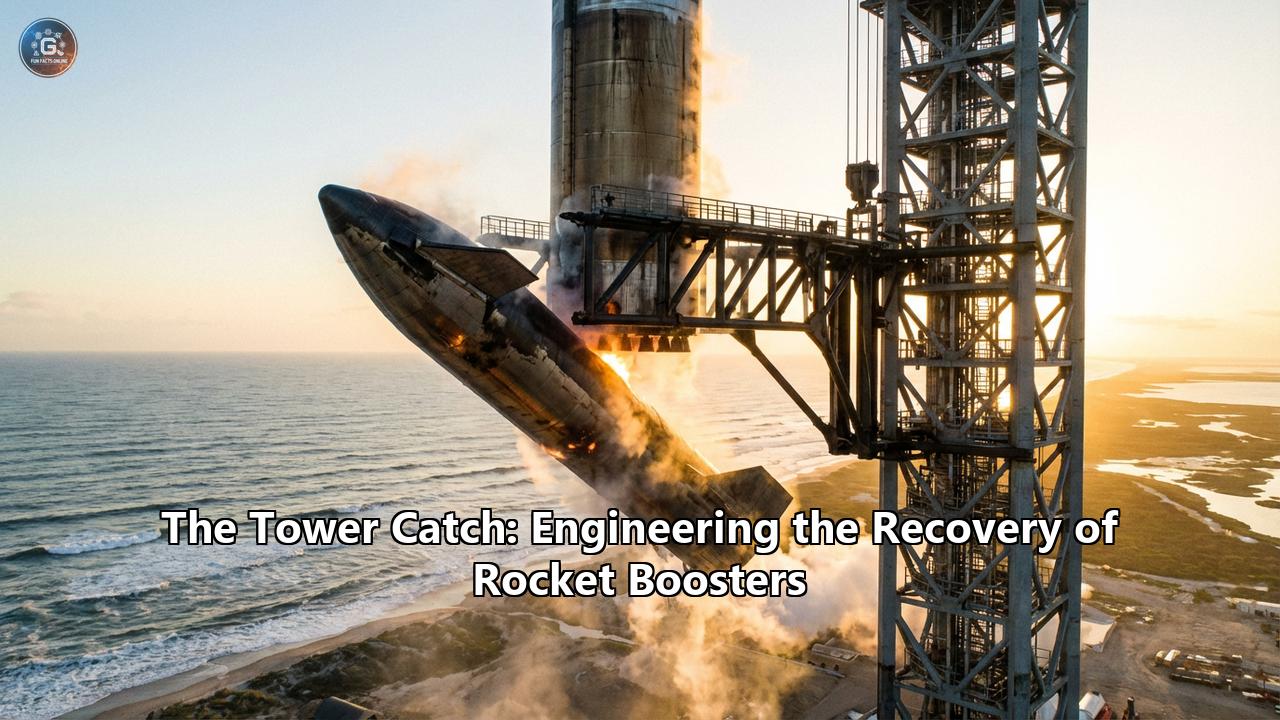
In the history of aerospace engineering, few moments have bifurcated the timeline of progress as sharply as October 13, 2024. On that morning, a 232-foot-tall stainless steel cylinder, descending from the edge of space at supersonic speeds, did not crash into the ocean or land on concrete legs. Instead, it slowed to a hovering roar and gently slid between two massive mechanical arms protruding from a launch tower. The arms closed. The engines cut. The rocket hung there, suspended in the air, captured by the very structure that had launched it minutes earlier.
This feat, known as the "Tower Catch," represents a fundamental shift in how humanity accesses space. It is not merely a different way to land; it is a total reimagining of rocketry that trades flight hardware for ground infrastructure, moving the complexity of recovery from the vehicle to the launchpad. This article delves deep into the engineering, physics, and economics of this audacious maneuver, dissecting the "Mechazilla" system, the control algorithms that make it possible, and the global race to replicate it.
Part I: The Evolution of Recovery – From Splashdowns to Chopsticks
To truly appreciate the engineering insanity of catching a rocket mid-air, one must understand the tyranny of the rocket equation and the history of fighting gravity.
The Weight of Reusability
For decades, rockets were expendable ammunition. The Saturn V, the Space Shuttle’s external tank, and the Soyuz boosters were all discarded after a single use. The logic was simple: gravity is expensive. Every kilogram of hardware you add to a rocket to help it survive the return trip—parachutes, heat shields, landing legs—is a kilogram of payload you cannot take to orbit.
When SpaceX began its quest for reusability with the Falcon 9, they accepted this "payload penalty." A Falcon 9 booster carries four carbon-fiber landing legs, hydraulic pistons to deploy them, and grid fins for steering. This hardware weighs tonnes. Furthermore, the rocket must reserve fuel to slow down, reducing its cargo capacity by 30-40% compared to an expendable flight.
The Limits of Legs
Landing legs are a brilliant interim solution, but they are imperfect for a vehicle designed for rapid, airline-like turnover.
- Dead Weight: Legs are useless for 99% of the flight. They are dead mass during ascent, fighting gravity all the way to space, only to be used for the final 10 seconds of the mission.
- Structural Penalty: To support the shock of landing, the rocket’s fuselage must be reinforced at the base, adding even more weight.
- Turnaround Time: Once a Falcon 9 lands, a recovery crew must secure it, safe the systems, crane it onto a transporter, retract the legs (a manual and time-consuming process), and truck it back to the hangar. This takes days.
Elon Musk’s vision for Starship—a vehicle to colonize Mars—required a launch cadence of multiple flights per day. The "legs" approach was a bottleneck. The solution was a radical philosophy: "The best part is no part."
If you remove the legs, you save mass. If you remove the shock absorbers, you save mass. But the rocket still needs to stop. The engineering answer was to offload all that complexity to the only part of the system that doesn't need to fly: the ground.
Part II: Anatomy of Mechazilla
The launch tower at Starbase, Texas, affectionately named "Mechazilla," is more than just a scaffold. It is a 469-foot robotic organism designed to act as a stage-zero component of the flight vehicle.
The Tower Structure
The tower is a square-truss structure made of structural steel, filled with concrete in its lower sections for immense stability. Unlike traditional launch towers (like the Apollo service structures), Mechazilla is designed to withstand the direct impingement of 33 Raptor engines blasting it with 16 million pounds of thrust, and then, seven minutes later, withstand the heat and acoustic energy of the returning booster.
The "Chopsticks"
The heart of the catch system is a pair of articulating arms, often called "chopsticks."
- Dimensions: These arms are roughly the length of a Boeing 747 wing, massive steel box girders capable of supporting the empty weight of a Super Heavy booster (approx. 250 tonnes) and the dynamic loads of a catch.
- Actuation: The arms ride on a carriage that travels vertically up and down the tower on rails, driven by a massive drawworks system similar to those used on oil rigs. The arms themselves can slide open and closed horizontally.
- The Catch Points: Crucially, the arms do not "grab" the rocket by squeezing it like a pair of pliers. That would crush the thin stainless steel tanks. Instead, the Super Heavy booster has two load-bearing pins (lift points) protruding from its side, just below the grid fins. The chopsticks have a track or "cushion" on their upper surface. The booster hovers, positions itself so the pins are above the arms, and then cuts its engines. The booster drops, and the pins land on the arms, suspending the rocket.
The Crash Absorbers
A catch is a controlled collision. To prevent the arms from destroying the rocket (or the rocket destroying the arms), the landing rails on the chopsticks are equipped with shock-absorbing materials. While specifics are proprietary, visual analysis suggests a combination of crushable sacrificial buffers and hydraulic dampeners designed to dissipate the residual vertical velocity and the kinetic energy of a slight lateral misalignment.
Part III: The Physics of the Catch
Catching a building-sized object falling from space requires a symphony of physics, control theory, and raw power. The margin for error is measured in centimeters.
The Approach: Transonic to Supersonic
The return profile of the Super Heavy is distinct from the Falcon 9.
- Boostback Burn: After separating from the ship, the booster flips and fires engines to cancel its forward velocity and fly back toward the launch site.
- The Glide: As it hits the atmosphere, it uses its four independent grid fins to steer. Unlike Falcon 9, which falls ballistically, Super Heavy generates significant body lift. It "flies" through the air at an angle of attack, bleeding off speed and adjusting its cross-range distance to target the tower.
The Hover vs. The Suicide Burn
This is the most critical aerodynamic distinction.
- Falcon 9: Uses a "suicide burn" (or hover-slam). Its Merlin engines are so powerful that even one engine at minimum throttle produces more thrust than the empty booster weighs. It cannot hover. It must time its deceleration perfectly to reach zero velocity exactly as it touches the ground.
- Super Heavy: The booster uses 33 Raptor 2 engines. For the landing burn, it ignites the inner ring of 13 engines, then shuts down to just the center 3. These engines can throttle deep enough that their combined thrust is less than the weight of the empty booster. This allows Super Heavy to hover.
The ability to hover is the game-changer for the tower catch. It allows the booster to come to a halt alongside the tower, translate sideways (slide) into the opening between the arms, and stabilize before the catch is attempted. It buys the flight computer time—seconds of grace that the Falcon 9 never had.
Guidance, Navigation, and Control (GNC)
The control logic required for this is staggering.
- Sensors: The booster uses a fusion of GPS, inertial measurement units (IMUs), and radar altimeters. As it nears the tower, it likely switches to relative navigation, using LIDAR or optical cameras on the tower and booster to measure the relative distance between the pins and the arm tracks.
- The "Kick": In the final seconds, the exhaust from the engines hits the concrete pad and the base of the tower, creating complex recirculation patterns and acoustic shockwaves that can buffet the vehicle. The flight computer must use the gimballing engines (thrust vector control) to fight these chaotic ground effects.
- Latency: The decision to "commit" to the catch is automated. If the booster detects it is off-nominal (too fast, wrong angle, engine issue) below a certain altitude, it is programmed to divert away from the tower and crash into the ocean to protect the billion-dollar ground infrastructure.
Part IV: The Ship Catch – The Next Frontier
While catching the booster is a historic achievement, catching the Starship upper stage (the "Ship") is an order of magnitude more difficult. This has not yet been attempted, but it is the ultimate goal.
The Thermal Protection Challenge
The booster stays within the atmosphere (mostly) and doesn't experience orbital re-entry heat. The Ship, however, returns from orbit at Mach 25. One side of it is covered in 18,000 fragile ceramic hexagonal tiles.
- The Dilemma: You cannot put lifting pins on the heat shield side, or they will melt. You cannot put them on the leeward (steel) side easily because the ship lands "belly flop" style and then flips.
- The Maneuver: The Ship performs a "belly flop" descent to bleed speed. At the last second, it ignites engines to flip vertical. During this flip, it must align perfectly with the tower.
- The Mechanism: Engineers speculate that the lifting pins on the Ship might be retractable, popping out from behind the tiles only seconds before landing. Alternatively, they may be located in a "shadowed" region of the hull that experiences less heating. The risk is high: if the arms scrape the side of the ship during a catch, they could shatter the heat shield tiles, rendering the ship unsafe for rapid relaunch.
Part V: The Economics of the Catch
Why take these risks? The answer lies in the spreadsheets.
Mass Fraction and Payload
The removal of landing legs from the Super Heavy booster saves an estimated 10 to 15 tonnes of dry mass. In the tyranny of the rocket equation, mass saved on the first stage translates directly to performance. This weight savings allows Starship to carry more fuel or more payload to orbit. When extrapolated to a Mars mission, where every kilogram of supply matters, those 15 tonnes could mean the difference between a viable colony mission and a failure.
The Factory Model
The true economic unlock is "Rapid Turnaround."
- Old Way: Land on a barge -> Tow to port (3 days) -> Crane off barge (1 day) -> Transport to hangar -> Inspect -> Transport to pad -> Stack. Total: Weeks.
- Tower Catch Way: Catch -> Rotate -> Place on Launch Mount -> Refuel -> Launch. Total: Hours.
By combining the launch tower and the landing tower into one, SpaceX turns the launchpad into a factory line. The booster never leaves the pad. It is caught, set down, refueled, and flown again. This eliminates the need for a fleet of recovery ships, massive crawler-transporters, and separate refurbishment facilities. It is the infrastructure of an airport applied to spaceflight.
Part VI: The Global Space Race
SpaceX’s success has sent shockwaves through the global aerospace industry, prompting competitors to either adapt or risk obsolescence.
China: The "Cosmoleap" and State Competitors
China’s aerospace sector is the most aggressive in following SpaceX’s lead.
- Cosmoleap: A Chinese startup, Cosmoleap, has officially announced plans for a "chopstick" recovery system for their "Leap" rocket. Their renders show a tower catch mechanism strikingly similar to Mechazilla.
- CASC: The state-owned main contractor is developing the Long March 10 for lunar missions. While they are initially looking at leg-based recovery, they have also showcased concepts for "tether catches," where wires tighten around a rocket to catch it—a variation on the tower catch theme.
Blue Origin: The Ocean Landing
Jeff Bezos’s Blue Origin is taking a different path with its New Glenn rocket.
- The Strategy: New Glenn lands on a moving ship at sea, using landing legs. The ship is underway (moving) during the landing to help stabilize the aerodynamics.
- The Trade-off: Blue Origin argues that sea landings are safer (no risk of crashing into the launch tower) and require less fuel for the boostback burn (the rocket doesn't have to fly all the way back to launch site). However, they incur the cost of the recovery ship and the time penalty of transport. They have not yet announced plans for a tower catch.
Rocket Lab: The Helicopter Experiment
Rocket Lab, a smaller competitor, briefly experimented with mid-air capture for their Electron rocket.
- The Method: They used a helicopter to snag the parachute of the falling booster.
- The Result: They successfully caught a booster once but dropped it shortly after due to load handling issues. They eventually abandoned the method in favor of ocean splashdowns, proving that mid-air capture is incredibly difficult to scale.
Part VII: Risks and Future Implications
The Tower Catch is not without peril. A failure during the landing burn doesn't just mean the loss of a rocket; it could mean the destruction of "Stage Zero"—the tower, the tank farm, and the ground support equipment. Rebuilding a tower takes months and costs hundreds of millions of dollars.
To mitigate this, SpaceX has developed ultra-precise abort modes. If the system detects a failure probability above a certain threshold (e.g., 0.1%), the booster is commanded to ditch into the Gulf of Mexico.
The Mars Connection
Ultimately, this technology is about Mars. On Mars, there are no runways and no cranes. While the first Mars landings will likely use legs (since there is no tower there yet), the long-term vision involves building launch infrastructure on the Red Planet. The "Tower Catch" philosophy—minimizing vehicle mass by maximizing ground infrastructure—is the blueprint for building a bridge between worlds.
In conclusion, the Tower Catch is more than a spectacle; it is a declaration of intent. It signifies a move away from the "expedition" mindset of spaceflight, where every mission is a unique, bespoke event, toward an "operational" mindset, where rockets are just heavy machinery that pick up and drop off loads, never leaving their place of work. When the chopstick arms closed around Booster 12, the door to the sci-fi future of space travel didn't just open; it was kicked off its hinges.
Reference:
- https://www.youtube.com/watch?v=qvXgb4iBZQ8
- https://www.youtube.com/watch?v=7Ig2IgbwqkU
- https://timesofindia.indiatimes.com/world/us/watch-elon-musk-explains-how-spacexs-mechazilla-can-catch-super-heavy-booster/articleshow/114195454.cms
- https://www.reddit.com/r/StarshipDevelopment/comments/1g3ln6k/what_advantages_does_catching_provide_that_a/
- https://www.reddit.com/r/SpaceXLounge/comments/kntjrv/super_heavy_with_no_legs_saves_est_14000kg/
- https://en.wikipedia.org/wiki/New_Glenn
- https://www.quora.com/What-is-the-reason-for-the-lack-of-landing-gear-on-the-super-heavy-booster-of-SpaceXs-Starship
- https://www.reddit.com/r/SpaceXLounge/comments/12ai281/starship_economics_question/
- https://thespacebucket.com/how-exactly-does-starships-catching-mechanism-work/
- https://www.youtube.com/watch?v=BzxQgTE8mjs
- https://www.youtube.com/watch?v=jDoJlmnr-Cc
- https://www.trefis.com/stock/spacex/articles/585758/the-bet-that-could-turbocharge-spacexs-800-billion-valuation/2025-12-19
- https://www.ctol.digital/news/spacex-starship-rapid-reusability-space-economics/
- https://www.space.com/china-catch-reusable-rockets-wires-video
- https://www.teslarati.com/spacex-reusability-good-company-rocket-lab-helicopter-catch/
- https://www.foxweather.com/earth-space/rocket-lab-is-ready-to-catch-a-rocket-booster-with-a-helicopter-yes-you-read-that-right