
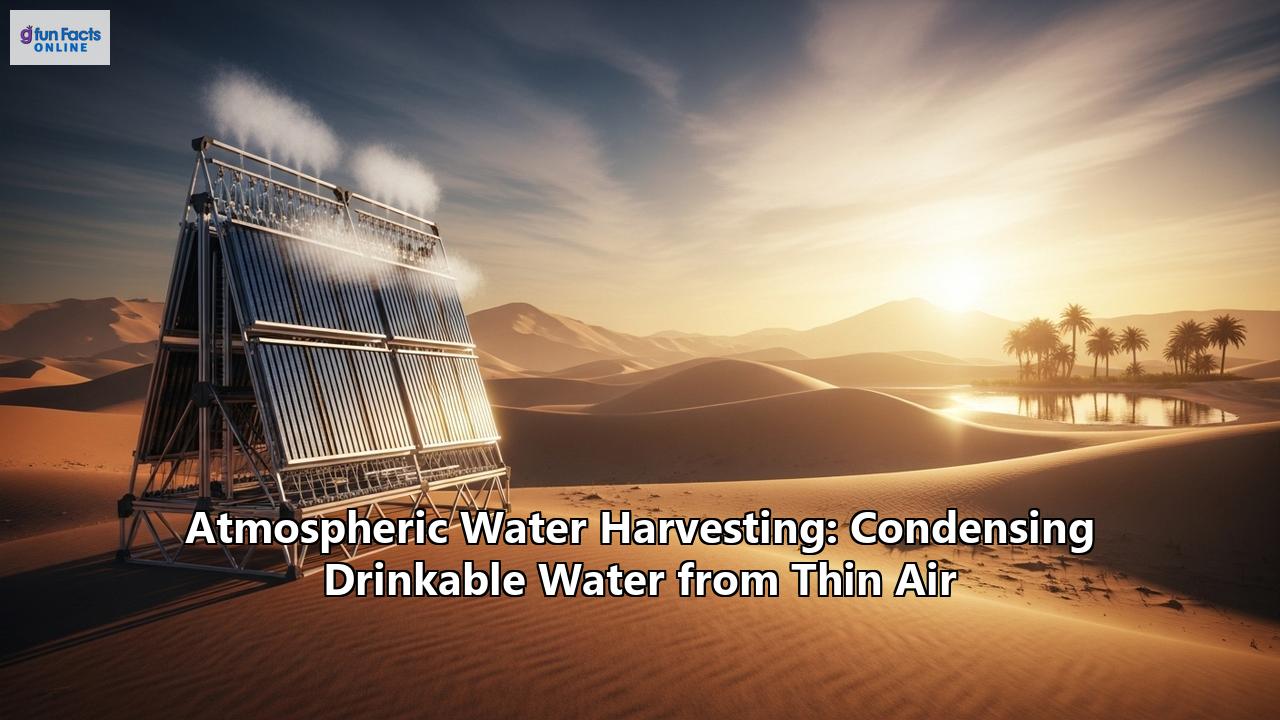
An invisible river flows above our heads, a vast and perpetually renewing resource of freshwater suspended in the very air we breathe. This atmospheric moisture, estimated to be around 12,900 billion tons, is a tantalizing prospect in a world grappling with increasing water scarcity. The United Nations Children's Emergency Fund (UNICEF) paints a stark picture, with approximately four billion people facing severe water shortages for at least one month each year. As traditional water sources like rivers, lakes, and groundwater are stretched to their limits and contaminated by pollution, a revolutionary technology is gaining traction: Atmospheric Water Harvesting (AWH). This innovative approach promises to condense drinkable water from thin air, offering a decentralized, sustainable, and potentially life-changing solution to one of humanity's most pressing challenges.
The concept of harvesting water from the atmosphere is not new; it is a process that nature itself has perfected over millennia, from the formation of dew on leaves to the way a desert beetle collects fog on its back. AWH technologies are, in essence, an attempt to mimic and optimize these natural processes. The fundamental principle is simple: condensation. By cooling air below its dew point, the invisible water vapor transforms into liquid, ready to be collected.
This article will delve into the fascinating world of atmospheric water harvesting, exploring its scientific underpinnings, the diverse technologies it employs, its ancient roots, and its modern applications. We will also examine the environmental and economic landscapes of AWH, and look towards a future where this technology could play a pivotal role in ensuring water security for all.
The Science of Plucking Water from the Air
To comprehend how AWH works, one must first understand the properties of the air around us. The atmosphere is a mixture of gases, including a significant amount of water in its gaseous state, known as water vapor. The capacity of air to hold this vapor is directly linked to its temperature; warmer air can retain substantially more moisture than cooler air.
Two key concepts are central to atmospheric water harvesting:
- Relative Humidity (RH): This is a measure, expressed as a percentage, of the amount of water vapor present in the air compared to the maximum amount it could hold at that specific temperature. For instance, a relative humidity of 50% means the air is holding half the water vapor it is capable of holding at that temperature. AWH systems generally perform better in regions with higher relative humidity due to the greater availability of moisture.
- Dew Point: This is the temperature to which air must be cooled for the water vapor within it to condense into liquid water. Reaching this critical temperature is the primary goal of most AWH technologies. The lower the dew point, the less energy is required to initiate condensation.
The potential for atmospheric water harvesting varies globally, dependent on local climatic conditions like temperature and humidity. However, even in arid regions where daytime relative humidity is low, the significant drop in nighttime temperatures can increase relative humidity, creating favorable conditions for dew condensation. This diurnal cycle is a crucial consideration in the design and operation of effective AWH systems.
A Spectrum of Technologies: From Passive Nets to Active Sorbents
Atmospheric water harvesting technologies can be broadly classified into two main categories: passive and active systems. The distinction lies in their reliance on external energy sources.
Passive Atmospheric Water Harvesting
Passive systems leverage natural processes and require minimal or no energy input. They are often characterized by their simplicity and low operational cost.
- Fog Harvesting: This ancient technique utilizes large, vertical mesh nets, often erected on hillsides in coastal or mountainous areas where fog is prevalent. As the wind drives fog through the nets, tiny water droplets are captured by the mesh, coalesce into larger drops, and trickle down into a collection system. This method has been used for centuries, with historical records indicating their use by the Incas. Modern iterations of this technology are being integrated into building facades, creating "building-integrated fog collectors."
- Dew Harvesting: This method collects water that naturally condenses on surfaces when their temperature drops below the dew point, a common phenomenon observed on clear nights. Historically, alchemists used horizontal cloths to collect dew. Modern advancements focus on creating surfaces with specific properties to enhance condensation and water collection.
- Radiative Cooling: This passive cooling technique is key to dew harvesting. Surfaces can be engineered to have high emissivity in the atmospheric window (a range of infrared wavelengths where the atmosphere is transparent), allowing them to radiate heat to the cold outer space and cool down below the ambient air temperature, even during the day. This sub-ambient cooling promotes condensation without the need for external energy.
While passive systems are energy-efficient and environmentally benign, their water production is heavily dependent on specific climatic conditions, such as the presence of fog or significant temperature fluctuations.
Active Atmospheric Water Harvesting
Active AWH systems employ external energy to enhance water extraction, making them more versatile and capable of operating in a wider range of conditions, including lower humidity environments.
- Cooling Condensation Systems: This is the most common form of active AWH and functions similarly to a dehumidifier. A fan draws ambient air through a filter and over a cooled coil. The coil is chilled by a refrigeration cycle, causing its surface temperature to drop below the dew point of the incoming air. This temperature difference forces the water vapor to condense into liquid water, which is then collected. The collected water is typically passed through a purification and filtration system to ensure its potability. The efficiency of these systems increases with higher relative humidity and air temperature. As a general rule, cooling condensation AWGs are not efficient when the ambient temperature is below 18.3°C (65°F) or the relative humidity is below 30%.
- Sorbent-Based Systems (Hygroscopy): These systems utilize materials with a high affinity for water, known as desiccants or sorbents, to capture water vapor from the air. The process typically involves two stages: adsorption (capturing water) and desorption (releasing water).
Solid Desiccants: These include materials like silica gel and zeolites, which have a porous structure that adsorbs water molecules. More advanced materials like metal-organic frameworks (MOFs) and hydrophilic polymers are being developed for their high water uptake capacity, even in low-humidity conditions. MOFs are crystalline materials with a very high surface area, allowing them to capture significant amounts of water. Researchers have developed MOF-based devices that can produce water from air with as low as 20% relative humidity using solar heat for the desorption process.
Wet Desiccants: These systems use a liquid desiccant, typically a brine solution (salt water), to absorb moisture from the air. The diluted brine is then heated in a separate chamber, often under a partial vacuum, to release the captured water vapor, which is then condensed and collected. Some of these systems can be powered by solar energy. Hydrogels, which are polymer networks that can absorb large amounts of water, are also being explored. Some hydrogels incorporate hygroscopic salts, which enhance their ability to extract moisture from the air.
Sorbent-based systems hold great promise for arid regions as they can operate at lower humidity levels than cooling condensation systems. Many are being designed to utilize low-grade heat, such as solar energy or waste heat, for the water release phase, making them more energy-efficient.
A Journey Through Time: The History of AWH
The practice of harvesting water from the atmosphere dates back to ancient civilizations.
- Ancient Practices: The Incas are known to have used fog nets, or "atrapanieblas," to collect water in the high-altitude Atacama Desert. Historical accounts also suggest the Persians employed terracotta towers designed to create natural air convection, forcing warm air to cool and release its moisture. These early methods were entirely passive, relying on natural temperature and pressure differences.
- 20th Century Developments: The advent of refrigeration technology in the 20th century paved the way for modern active AWH systems. The development of cooling condensation techniques, first emerging in the 1930s and gaining more traction in the 1980s, allowed for the extraction of water vapor from air with less than 100% relative humidity. An early example of a personal AWH device was the Armbrust cup, designed as an emergency survival tool to condense water from exhaled breath for downed pilots at sea.
- Modern Innovations: The turn of the 21st century has seen a surge in research and development in the AWH field, driven by growing concerns over water scarcity. Scientists and engineers are now focused on developing novel materials and more efficient systems. This includes the creation of advanced sorbents like MOFs and hydrogels, which are pushing the boundaries of what is possible, particularly in arid climates.
A Myriad of Applications: From Drinking Water to Agriculture
The potential applications for atmospheric water harvesting are vast and varied, ranging from small-scale domestic use to large-scale industrial and agricultural support.
- Decentralized Drinking Water: AWH provides a decentralized source of clean drinking water, independent of traditional water grids. This is particularly valuable in remote, arid, or disaster-stricken areas where infrastructure is lacking or has been compromised. Household-sized units can provide a continuous supply of safe drinking water for families and communities.
- Agriculture and Irrigation: Agriculture accounts for approximately 70% of global freshwater consumption. AWH offers a supplementary water source for irrigation, reducing the strain on conventional water supplies. Strategically placed AWH systems can provide localized water for crops, promoting water conservation and enhancing food security in water-scarce regions.
- Industrial and Commercial Use: Many industries require high-purity water for their processes. AWH can provide this, with potential applications in cooling data centers, which rely on pure water for their operation.
- Emergency Relief: In the aftermath of natural disasters, access to clean drinking water is often a critical challenge. Mobile AWH units, potentially powered by solar panels or generators, can be rapidly deployed to provide a reliable source of potable water for affected populations and relief workers.
- Military Applications: The U.S. Defense Advanced Research Projects Agency (DARPA) is actively funding the development of portable AWH devices that can supply water for soldiers in the field, reducing the logistical burden of transporting water.
The Environmental and Economic Equation
As with any technology, it is crucial to consider the environmental and economic implications of widespread AWH adoption.
Environmental Considerations
- Benefits: AWH offers significant environmental advantages. It provides a new source of freshwater without depleting groundwater or surface water resources. This helps to protect and restore natural ecosystems. By providing a localized water source, it can reduce the energy and carbon footprint associated with pumping water over long distances. Passive AWH systems, in particular, have a minimal environmental impact due to their low energy consumption.
- Challenges: The primary environmental concern associated with active AWH systems is their energy consumption. Many cooling condensation units require a significant amount of electricity, which, if generated from fossil fuels, would contribute to greenhouse gas emissions. However, the integration of renewable energy sources like solar and wind power can mitigate this issue, making the process more sustainable. For sorbent-based systems, the environmental impact of producing and disposing of the sorbent materials needs to be carefully assessed.
Economic Viability
- Cost: The cost of water produced by AWH is a key factor in its economic viability. Currently, the levelized cost can range from $0.50 to $2.00 per liter, which is still relatively high compared to conventional water sources in many regions. However, costs are expected to decrease significantly with mass production, technological advancements, and improvements in material science. When compared to desalination, another technology for producing freshwater, AWH avoids the issue of brine disposal, which can have negative environmental and economic consequences.
- Market Growth: The AWH market is experiencing rapid growth. It is currently valued at around $800 million annually and is projected to grow at a rate of 8-12% per year. The United States is a leader in AWH technology development, with numerous startups attracting significant venture capital investment. This growing market is fostering innovation and driving down costs, making AWH an increasingly attractive economic proposition.
Challenges on the Horizon
Despite its immense potential, several challenges need to be addressed for atmospheric water harvesting to become a mainstream solution.
- Energy Efficiency: Reducing the energy consumption of active AWH systems is paramount, especially for their deployment in off-grid or energy-poor regions. The development of more efficient refrigeration cycles and sorbent materials that can be regenerated with low-grade heat are key areas of research.
- Water Production Rates: The amount of water that can be produced by AWH systems is still relatively low compared to large-scale water supply methods. Improving the water yield, particularly in low-humidity conditions, is a major focus of ongoing research.
- Scalability: Scaling up AWH technology to meet the needs of large urban populations or extensive agricultural operations remains a challenge. This will require further innovation in system design and manufacturing.
- Water Quality: While the condensation process itself produces pure water, the collected water can be contaminated by airborne pollutants or microorganisms. Therefore, effective filtration and purification systems are essential components of any AWH device to ensure the water is safe for consumption.
The Future is in the Air
The future of atmospheric water harvesting is bright, with continuous advancements in technology and a growing recognition of its potential.
- Emerging Technologies: The next generation of AWH systems is likely to be "smarter" and more efficient. We can expect to see the integration of artificial intelligence and the Internet of Things (IoT) to optimize water harvesting based on real-time weather data and humidity forecasts. Research into novel materials, such as cellulose-based desiccants and nanocoatings that repel dust and pollutants, will further enhance efficiency and reduce maintenance.
- A Roadmap for the Future: The global AWH community is actively collaborating to create a roadmap for the future development and deployment of this technology. International summits and research collaborations are fostering the exchange of ideas and accelerating innovation. With continued investment and interdisciplinary collaboration, it is projected that AWH could supply 10-20% of urban freshwater demand in arid regions by 2040.
In conclusion, atmospheric water harvesting represents more than just a clever technological trick; it is a paradigm shift in how we think about and source fresh water. By tapping into the vast, renewable reservoir of moisture in our atmosphere, we can create a more resilient and sustainable water future. While challenges remain, the pace of innovation is rapid, and the promise of condensing drinkable water from thin air is becoming a tangible reality. As we continue to navigate the complexities of a changing climate and growing population, the ability to harvest this ethereal resource may prove to be one of our most vital tools in quenching the world's thirst.
Reference:
- https://www.theearthandi.org/post/atmospheric-water-harvesting-hope-from-extracting-water-from-air
- https://atomfair.com/scibase2/article.php?id=6
- https://www.greencitytimes.com/atmospheric-water-harvesting/
- https://pmc.ncbi.nlm.nih.gov/articles/PMC10073925/
- https://prism.sustainability-directory.com/term/atmospheric-water-harvesting/
- https://sciencereader.com/glossary/atmospheric-water-harvesting/
- https://azwaterinnovation.asu.edu/future-atmospheric-water-harvesting
- https://medium.com/@anushkapun/water-from-thin-air-the-science-behind-atmospheric-water-harvesting-265bdb75612c
- https://oxfordre.com/environmentalscience/display/10.1093/acrefore/9780199389414.001.0001/acrefore-9780199389414-e-613?d=%2F10.1093%2Facrefore%2F9780199389414.001.0001%2Facrefore-9780199389414-e-613&p=emailAM1NUkONavYOg
- https://en.wikipedia.org/wiki/Atmospheric_water_generator
- https://www.awegsystems.com/en/aweg/a-brief-history-of-atmospheric-water-production/
- https://pubs.acs.org/doi/10.1021/acsmaterialslett.1c00850
- https://oxfordre.com/environmentalscience/display/10.1093/acrefore/9780199389414.001.0001/acrefore-9780199389414-e-613
- https://russkapwater.com/blogs/insights/atmospheric-water-generation-an-introduction
- https://pubs.acs.org/doi/10.1021/acsmaterialslett.0c00130
- https://www.airwaterawg.com/blog/atmospheric-water-revolution-the-future-prospects-of-atmospheric-water-generators_b78
- https://www.researchgate.net/figure/AWH-technology-and-design-principle-of-SHPFs-a-Key-steps-of-AWH-technology-b-Geographic_fig1_360723891