
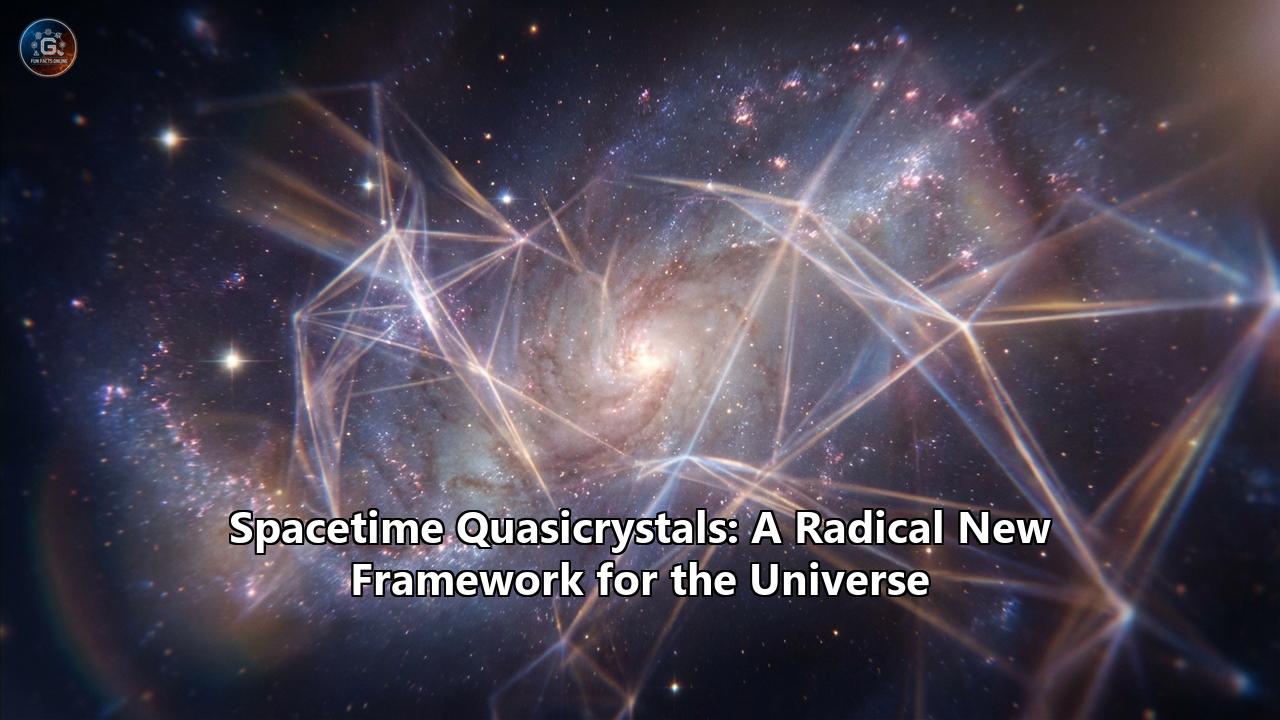
Imagine looking closely at a high-definition photograph. From a distance, it appears as a smooth, continuous image, an unbroken tapestry of light, shadow, and color. But zoom in close enough, and the illusion shatters into millions of discrete, blocky pixels. For over a century, theoretical physicists have been haunted by a similar possibility regarding the fabric of reality itself. If we were to zoom in on the universe—past the cellular level, past the atoms, past the subatomic quarks, all the way down to the Planck scale—would we find that space and time are fundamentally smooth and continuous? Or would we discover that reality shatters into geometric, indivisible pixels?
For decades, the standard models of physics have treated spacetime as a smooth, continuous backdrop—a trampoline-like fabric that bends and warps under the weight of gravity. This continuous framework is the bedrock of Albert Einstein’s General Relativity. Yet, when we try to marry this smooth fabric with the chunky, discrete, quantized realm of Quantum Mechanics, our mathematical models collapse into catastrophic infinities. The two greatest triumphs of 20th-century science refuse to seamlessly coexist.
But a profound paradigm shift is sweeping through the theoretical physics community, offering a unified, radically different blueprint for reality. What if spacetime is not a smooth, empty vacuum, but an emergent, highly structured, non-repeating geometric code? Welcome to the mind-bending frontier of Spacetime Quasicrystals and Emergence Theory—a framework that suggests the universe is a self-actualizing, geometric language cast as a shadow from higher dimensions.
The Impossible Geometry of Quasicrystals
To understand a spacetime quasicrystal, we must first understand the mathematical anomaly of the quasicrystal itself.
In classical crystallography, a crystal is defined by its periodicity. If you take the fundamental building block of a salt or diamond crystal, you can perfectly tile it across three-dimensional space without leaving any gaps. The pattern repeats endlessly, like the square tiles on a bathroom floor. Because of the strict rules of periodic tiling, scientists believed that only certain rotational symmetries were possible in nature: 2-fold, 3-fold, 4-fold, and 6-fold. A 5-fold symmetry (like a pentagon) was deemed mathematically and physically impossible because pentagons cannot tile a flat plane without leaving empty, jagged gaps.
But in 1982, materials scientist Dan Shechtman peered through an electron microscope at a rapidly cooled alloy of aluminum and manganese and saw the impossible: a diffraction pattern displaying perfect 10-fold symmetry. The atoms were highly ordered, yet the overarching pattern never repeated itself. For this discovery, Shechtman was initially ridiculed by his peers—chemist Linus Pauling famously quipped, "There is no such thing as quasicrystals, only quasi-scientists." Yet, the math held up, and Shechtman was ultimately awarded the Nobel Prize.
These structures are physical manifestations of "Penrose tilings," conceived by mathematician Roger Penrose. By using just two geometric shapes (often called kites and darts), you can tile an infinite plane in a way that creates intricate, mesmerizing order, but never falls into a repeating loop. What makes quasicrystals so fascinating is their local isomorphism: any finite patch of a quasicrystal will appear infinitely many times throughout the entire structure, but never at regular intervals. An ant sitting on a geometric node in one region of a quasicrystal would see an environment structurally similar to what an ant on the opposite side of the quasicrystal observes, yet the exact overarching configuration remains uniquely aperiodic.
For decades, quasicrystals were relegated to spatial dimensions—found in exotic meteorites, the debris of early atomic bomb tests, and synthetic laboratory alloys. But could this "impossible" math be the fundamental architecture of time and space?
The 2026 Breakthrough: Lorentzian Spacetime Quasicrystals
Until recently, it was widely believed that building a quasicrystal out of spacetime itself was impossible. Theoretical physicist Felix Flicker noted the prevalent assumption in the community: "My feeling was probably it wouldn't be possible to make a proper spacetime quasicrystal".
The hurdle was Special Relativity. Standard crystals and spatial quasicrystals possess preferred rest frames. If you accelerate through a spatial lattice at near-light speeds, the distances between the atoms will appear to distort and compress due to relativistic length contraction. This violates Lorentz invariance—the ironclad principle of physics which states that the laws of the universe must appear exactly the same to all observers, regardless of their relative speed.
However, in January 2026, researchers Latham Boyle and Sotirios Mygdalas published a groundbreaking paper demonstrating the theoretical existence of Lorentzian Spacetime Quasicrystals. They successfully generalized self-similar quasicrystals from standard Euclidean space into Minkowski spacetime (the four-dimensional arena of special relativity).
How do you build a structure that bridges space and time without violating relativity? The answer lies in higher dimensions. The researchers mathematically formulated these spacetime quasicrystals by taking a four-dimensional "slice" through a much higher-dimensional grid of points. They angled this slice using an irrational number (a number that cannot be expressed as a simple fraction, much like pi or the golden ratio). Because the slope of the slice is mathematically irrational, the plane never directly intersects the periodic grid points of the higher dimension perfectly, thereby generating an infinite, deeply ordered, but entirely non-repeating structure in four dimensions.
Crucially, because of the mathematical nature of this projection, these new Lorentzian quasicrystals inherently respect Lorentz symmetry. An observer hovering perfectly still and an observer rocketing past at 99% the speed of light would perceive the exact same overarching geometric order. The structures exhibit non-crystallographic orientational symmetry that is infinitely large, yielding a continuous scale of discrete invariance—essentially allowing self-similarity at varying magnifications of reality.
Boyle and Mygdalas’s work even offers tantalizing bridges to String Theory. They proposed an elegant, highly speculative scenario wherein our infinite (3+1)-dimensional universe is embedded as a spacetime quasicrystal slice within a profoundly symmetric (9+1)-dimensional torus. This specific 10-dimensional geometry could provide a natural mathematical explanation for one of physics' greatest mysteries: the "seesaw" relationship between the Planck scale, the vacuum energy of the universe, and the electroweak scale.
The 8-Dimensional Shadow and Emergence Theory
While traditional academia wrestles with the mathematics of Lorentzian spacetime quasicrystals, an independent physics institute in Los Angeles known as Quantum Gravity Research (QGR), led by theorist Klee Irwin, has spent years developing a holistic framework known as Emergence Theory. Emergence Theory weaves together quantum mechanics, relativity, and information theory into a unified, discretized picture of a self-actualizing universe.
At the heart of Emergence Theory is the E8 Lattice. In mathematics, the E8 lattice is an incredibly beautiful and complex 8-dimensional point set that represents the densest possible packing of spheres in eight dimensions. The fundamental cellular building block of the E8 lattice is known as the Gosset polytope, an 8D geometric marvel boasting 240 vertices.
Why does an 8-dimensional shape matter to us in a 3D world? Over 80 years of smashing subatomic particles in colliders has revealed that fundamental particles and forces can dynamically transform into one another—a process known as gauge symmetry transformation. Remarkably, when physicists map out the mathematics of how all known fundamental elementary particles interact, their transformations perfectly correspond to the 240 vertices of the Gosset polytope of the E8 lattice.
Emergence Theory suggests that the 3D reality we inhabit is quite literally a geometric "shadow" cast by this 8-dimensional crystal. Think of it this way: if you hold your 3-dimensional hand up to a light, it casts a 2-dimensional shadow on the wall. The shadow is a lower-dimensional projection of a higher-dimensional object.
According to QGR, reality works via a process of geometric projection known as a "cut-and-project" algorithm. When the 8D E8 lattice is sliced and projected down into four dimensions, it creates a 4D quasicrystal known as the Elser-Sloane quasicrystal. The 4D Gosset polytope projects into two identical 4D shapes of different sizes—specifically, 600-cells made entirely of 3-dimensional tetrahedra. Slicing this 4D structure down one more time yields a 3D Quasicrystalline Spin Network (QSN).
This QSN is the proposed bedrock of reality. It is an ocean of pixelated, tetrahedral geometry operating at the Planck length (the smallest measurable distance in physics). But flat 3D space cannot be perfectly tiled by regular tetrahedra without leaving gaps—a phenomenon known as "geometric frustration". To resolve this, the network must twist, distort, and weave its way through space, generating the aperiodic, infinitely complex patterns of a quasicrystal. The particles, forces, and very fabric of the cosmos are not things existing inside this space; they are localized geometric deformations of this quasicrystalline network.
The Golden Ratio: The Source Code of the Matrix
If the universe is a quasicrystal cast from higher dimensions, what determines the exact angle of the projection? The answer is a number that has captivated artists, architects, and mathematicians since antiquity: the Golden Ratio ($\Phi \approx 0.618$).
The Golden Ratio isn't just a pleasing aesthetic proportion found in sunflower seeds and nautilus shells. In Emergence Theory and quasicrystal mathematics, it is the fundamental constant of nature. When the 8D Gosset polytope is projected into 4D, the ratio of the sizes of the resulting two 600-cells is exactly the Golden Ratio. The intersecting angles that define the tetrahedra of the 3D Quasicrystalline Spin Network are governed by Golden Ratio mathematics.
Furthermore, researchers have found that the Golden Ratio scales seamlessly into the deepest equations of quantum gravity. It appears in the equations bridging loop quantum gravity parameters with the lower bounds of black hole entropy. A true Theory of Everything must unify relativity (the physics of the macro-universe) and quantum mechanics (the physics of the micro-universe). The singularity of a black hole is exactly where these two extremes meet, and right there in the math, regulating the entropy of the cosmic abyss, is the Golden Ratio.
The Teleporting Electron and the Blinking Universe
If we accept that spacetime is a discrete, pixelated quasicrystal, we are forced to entirely rethink the concept of motion.
In our everyday macroscopic experience, if you walk from Point A to Point B, you traverse every infinitely small fraction of distance between the two points. But in a quantized, pixelated universe, smooth, continuous motion is an illusion—much like the movement on a television screen, which is just individual static pixels turning on and off in sequence.
When quantum physicists observe electrons moving within an atom, the electrons do not traverse the space between their orbits. Instead, they vanish from one location and instantaneously actualize in another—a phenomenon known as quantum jumping. In a quasicrystalline spacetime model, the electron is not a little billiard ball flying through an empty void; it is a specific geometric pattern illuminated upon the Quasicrystalline Spin Network.
When the electron "moves," the geometric pattern dissolves at one node and instantaneously reconfigures at the adjacent node. As one analyst eloquently put it, "The electron seems to manipulate space to instantly appear somewhere else entirely, like beaming onto the transporter platform of the Enterprise".
To facilitate this illusion of continuity, Emergence Theory posits that the universe updates itself at the speed of the Planck time. In this model, one single second contains approximately $10^{44}$ "frozen frames" of reality. The universe is continuously computing its next geometric arrangement, blinking in and out of existence $10^{44}$ times per second. Over many of these frames, the complex aperiodic patterns shift and evolve, creating the illusion of smooth motion, fluid time, and physical particles.
The Growing Quasicrystal: A New Model for the Cosmos
This discrete framework also revolutionizes our understanding of the origin and evolution of the entire cosmos. For nearly a century, the Big Bang theory has posited that the universe exploded from an infinitely dense singularity and has been stretching the continuous fabric of spacetime outward ever since.
However, recent papers, including a 2025 hypothesis framing the universe as a "Growing Quasicrystal," suggest an alternative, algorithmic origin. In this heuristic model, the universe did not begin with a chaotic explosion. Instead, it began with the projection of a single point from a higher-dimensional lattice (like the E8 root lattice).
This initial point initiated a sequence of geometric projections, building the structure of the universe shell by shell. As the cut-and-project algorithm continuous to process, the 4D quasicrystal intrinsically grows larger externally while simultaneously subdividing internally. The observed cosmic expansion of the universe isn't spacetime arbitrarily stretching; it is the natural, mathematical result of new geometric "pixels" being continuously calculated and appended to the outer boundaries of the quasicrystalline lattice.
This structural model also offers profound insights into Dark Matter. In standard physics, dark matter is a ghostly, undetected particle that accounts for 85% of the universe's mass. In the growing quasicrystal model, however, dark matter could simply be "phonons"—fundamental vibrations or acoustic oscillations within the quasicrystal field itself. Just as hypothetical particles like axions are thought to arise as classical oscillations of an underlying field, these quasicrystal phonons follow conventional dispersion relations, surviving as weakly interacting relics that exert gravitational pull on galaxies without interacting with light.
Information, Consciousness, and Causality Loops
Perhaps the most radical, yet inescapable, conclusion of a pixelated, quasicrystalline universe is its requirement for consciousness.
At the root of Emergence Theory is the postulate that all of reality is essentially made of information. But what is information? In strict terms, information is "meaning conveyed by symbols". A language, like English or binary computer code, is a set of symbols and rules (syntax). However, for a language to express something, there must be syntactical freedom—the ability to choose how to arrange those symbols to create meaning.
If the universe operates as a geometric language using 3D tetrahedra as its alphabet, it possesses rules (the E8 gauge symmetries) but also non-deterministic flexibility. Fundamentally, the existence of information implies the existence of a "chooser"—a conscious agent that collapses probability waves into actualized reality.
Therefore, Emergence Theory views consciousness not as a biological accident that arose purely from wet brain chemistry, but as both an emergent and fundamental property of the universe itself.
Because quasicrystals are inherently non-local—meaning the geometry of one side of the universe is mathematically entangled with the geometry on the other side—spacetime functions much like an immense, self-optimizing neural network. Furthermore, the model treats the past, present, and future as existing simultaneously within one unified geometric object. In this framework, spacetime is governed by causality loops: the past dictates the trajectory of the future, but the higher structural order of the future retrocausally influences the past.
As this cosmic neural network processes its $10^{44}$ frames per second, the primitive, fundamental consciousness of the system steers the quasicrystalline patterns toward greater and greater complexity and meaning. Eventually, this self-simulation gives rise to biological life, which continues to evolve, expand, and connect, perhaps one day forming a universal-scale collective consciousness.
The Technological Horizon: Hacking the Cosmic Code
What happens if physics successfully decodes the complete syntax of the Spacetime Quasicrystal?
If reality is an information-theoretic shadow cast by 8-dimensional geometry, it is, for all practical purposes, a highly sophisticated code. Understanding the specific algorithms that project E8 geometry into 3D spacetime could lead to the next monumental leap in human technological evolution.
If we learn the mathematical rules that allow an electron to instantaneously "blip" from one node of the quasicrystal to another, humanity could theoretically transcend the boundaries of linear travel. The science fiction concept of teleportation—manipulating the local geometric code of an object to instantaneously actualize it at a distant set of spacetime coordinates—would transform from fantasy to applied physics. We could bypass the speed of light entirely, as we wouldn't be traveling through spacetime, but rather updating the localized code of spacetime.
The Ultimate Synthesis
The exploration of Spacetime Quasicrystals represents a breathtaking convergence of disciplines. It takes the elegant, irrational-number mathematics of Penrose tilings, scales them up through the Lorentz-invariant symmetries of special relativity, and merges them with the 8-dimensional perfection of the E8 Lie group. It bridges the quantum leaping of elementary particles with the massive cosmic expansion of the universe, and ultimately dares to place human consciousness at the very center of the cosmological equation.
We are moving away from a physics of cold, dead, empty continuous space. In its place, scientists are uncovering a universe that is vibrantly alive—a shimmering, 10-dimensional crystal casting a shadow into the third dimension, processing meaning, structure, and existence trillions of times a second. We are not just wandering blindly through a random, mechanical void; we are active, conscious participants in the magnificent, self-actualizing geometry of the cosmos.
Reference:
- https://www.sciencenews.org/article/spacetime-quasicrystals-universe
- https://climatecosmos.com/climate-news/spacetime-quasicrystals-theorists-unveil-non-repeating-order-that-might-define-reality/
- https://www.ekhbary.com/news/physicists-envision-spacetime-quasicrystals-that-could-underpin-the-universe-135-2.html
- https://arxiv.org/html/2601.07769v1
- https://arxiv.org/abs/2601.07769
- https://quantumgravityresearch.org/lay-person-overview/
- https://kleeirwinresearch.wordpress.com/about/
- https://quantumgravityresearch.org/portfolio/a-deep-link-between-3d-and-8d/
- https://www.youtube.com/watch?v=1DHMMLs7BEs
- https://www.elephantjournal.com/2016/08/e8-quasicrystals-the-theory-of-everything-its-way-cooler-than-it-sounds/
- https://www.researchgate.net/publication/243298250_The_E8_lattice_and_quasicrystals
- https://www.researchgate.net/publication/330204648_Emergence_Theory_Overview
- https://www.youtube.com/watch?v=e7gfnrTS538
- https://arxiv.org/html/2407.14520v2