
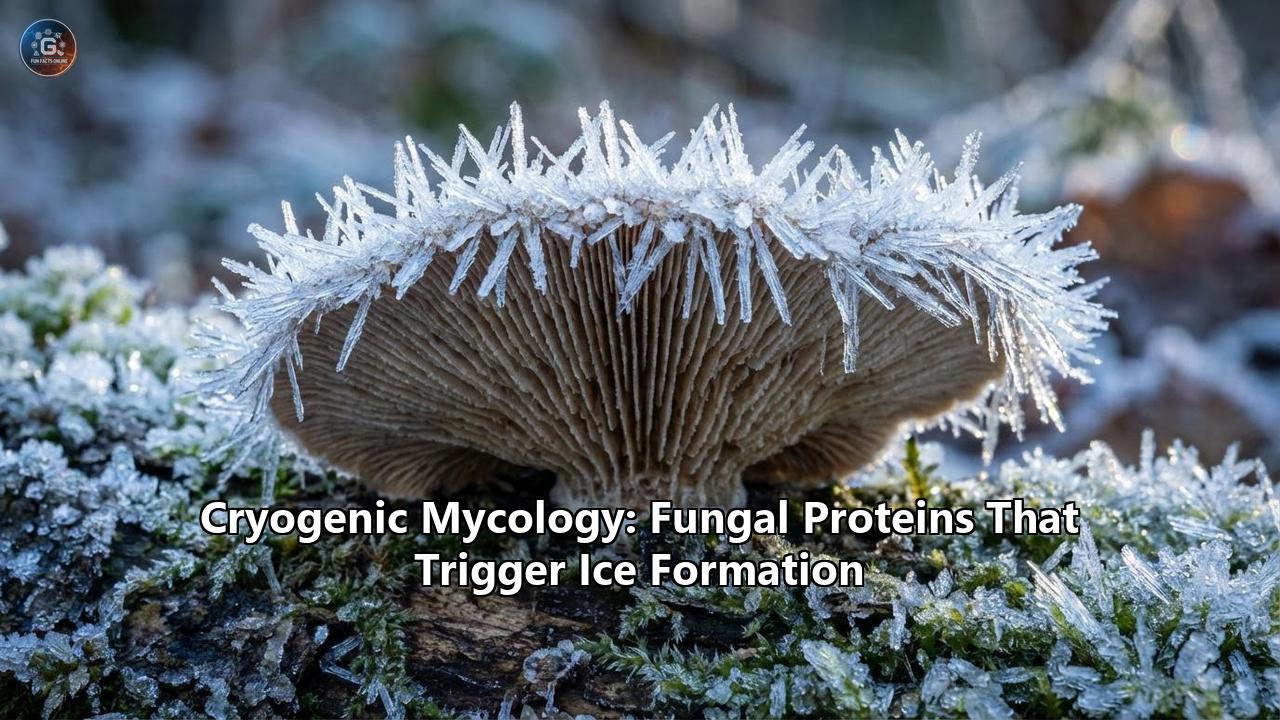
Water freezing into ice is one of the most common physical phenomena on Earth, yet it harbors a secret that defies common intuition. We are taught that water freezes at 0°C (32°F). However, strictly speaking, this is only true for water containing impurities. Completely pure water, devoid of any particles to act as a scaffold, can be supercooled to temperatures as low as -46°C before the kinetic energy drops enough for water molecules to spontaneously arrange themselves into an ice crystal lattice. For ice to form at warmer, everyday subzero temperatures, it requires a catalyst—a process known as heterogeneous ice nucleation.
While dust, soot, and minerals like feldspar can trigger freezing, the most efficient ice-nucleating particles on our planet are not geological, but biological. Among the myriad of organisms capable of freezing water, a highly specialized group of fungi has emerged as the undisputed master of this cryogenic domain. The study of these organisms and their astonishing molecular machinery forms the bleeding edge of a field known as cryogenic mycology.
Through the secretion of highly specialized Ice Nucleating Proteins (INPs), these fungi can force water to freeze at remarkably warm subzero temperatures—sometimes as high as -1°C to -2°C. For decades, the exact mechanisms behind this fungal superpower remained shrouded in mystery. However, recent breakthroughs in 2025 and 2026 have illuminated the molecular architecture of these proteins, revealing a complex evolutionary history and unlocking revolutionary applications in weather modification, medicine, and food preservation.
The Physics of the Freeze: How Biology Commands Water
To understand the marvel of fungal ice nucleation, one must first understand the physics of freezing. Water molecules in a liquid state are in constant, chaotic motion, forming and breaking hydrogen bonds billions of times per second. For liquid water to become solid ice, these molecules must slow down and align into a rigid, hexagonal crystalline structure. The initial formation of this microscopic crystal embryo requires a significant amount of energy to overcome the thermodynamic barrier of the phase transition.
Abiotic particles, such as mineral dust, provide a rough surface that lowers this energy barrier, but they typically only initiate freezing at temperatures between -15°C and -30°C. Biological Ice Nucleators (BioINs), however, take a vastly more sophisticated approach. They produce proteins that act as perfect molecular templates. The surface of an ice nucleating protein mimics the exact spacing and lattice structure of an ice crystal. When roaming water molecules encounter this protein, they are physically guided into a hexagonal arrangement. By removing the energetic guesswork, the protein effectively tricks the water into freezing at temperatures just barely below the freezing point.
The Evolutionary Weaponry of Frost
Why would a fungus expend precious metabolic energy to manufacture proteins whose sole purpose is to freeze water? In the microscopic battles of the natural world, ice is a devastating weapon.
Many ice-nucleating fungi, such as those in the ubiquitous genus Fusarium (including Fusarium acuminatum and Fusarium avenaceum), are opportunistic plant pathogens. Plants have evolved robust, rigid cell walls to protect their nutrient-rich interiors. When ambient temperatures drop below freezing, these fungi secrete their ice-nucleating proteins onto the surface of the plant. The localized, premature freezing causes ice crystals to form rapidly in and around the plant tissues. As water expands upon freezing, these microscopic ice spears physically puncture and rupture the plant cell walls. Once the frost damages the plant, the fungus easily accesses the extracellular nutrients spilling out, establishing a foothold for infection.
It is an ingenious evolutionary adaptation—weaponizing the weather to secure a meal. However, this localized biological warfare has profound consequences that extend far beyond the soil, reaching all the way into the stratosphere.
Bioprecipitation: Fungi in the Sky
The reach of fungal ice nucleators does not end at the forest floor. Fungi reproduce by releasing billions of microscopic spores into the air. These spores, carrying their payload of ice-nucleating proteins, are caught in updrafts and swept high into the Earth's atmosphere.
Once in the upper atmosphere, these fungal particles act as Cloud Condensation Nuclei (CCN) and ice nucleating particles. Inside supercooled clouds, where temperatures hover around -10°C, the fungal proteins initiate the formation of ice crystals. As more water vapor condenses and freezes around these fungal templates, the ice crystals grow heavier and heavier. Eventually, gravity takes hold, and the ice falls toward the Earth. Depending on the temperature of the lower atmosphere, this precipitation reaches the ground as snow, hail, or rain.
This phenomenon, known as "bioprecipitation," suggests a beautiful, self-sustaining ecological feedback loop. Fungi trigger rainfall; the rain nourishes the earth and stimulates plant growth; the plants provide a host for the fungi to grow and release more spores into the sky. Recent studies mapping the abundance of airborne biological particles suggest that fungi are a dominant force in cloud glaciation, meaning that a significant portion of the rain and snow that falls on Earth is directly triggered by microscopic organisms seeking to propagate their species.
The Structural Marvel of Fungal Proteins
For many years, bacteria—specifically the plant pathogen Pseudomonas syringae—were the most studied biological ice nucleators. Bacterial ice nucleating proteins are highly effective, but they come with a significant biological limitation: they are anchored to the outer membrane of the bacterial cell. A bacterial INP requires the physical structure of the cell membrane to align correctly and function optimally; if the protein is separated from the cell, its ice-nucleating efficiency drops drastically.
Fungal ice nucleators, however, are a completely different structural marvel. Advanced research published between 2024 and 2026, spearheaded by international teams of chemists and microbiologists, revealed that fungal INPs are cell-free and water-soluble. Unlike their bacterial counterparts, fungi excrete ultra-minute protein subunits directly into their environment.
On their own, these individual subunits are incredibly small—often less than 100 kilodaltons in weight and barely 5 to 6 nanometers in diameter. However, once released, these fungal proteins possess a remarkable ability to self-assemble. Utilizing artificial intelligence tools for protein structural prediction, researchers discovered that these small subunits aggregate, aligning side-by-side in parallel rows. A cluster of just three to five of these proteins creates a surface area wide enough to successfully template an ice crystal.
This ability to aggregate functionally without needing the physical presence of the fungal cell membrane is a revolutionary discovery. It means that the biological machinery of ice nucleation can be isolated, purified, and utilized entirely independent of the living organism.
A Stolen Blueprint: The Secret of Horizontal Gene Transfer
One of the most astonishing discoveries in cryogenic mycology occurred in early 2026, when researchers mapped the genetic origins of these ice-nucleating abilities in newly discovered IN-active fungi like Mortierella alpina, Entomortierella parvispora, and Podila clonocystis.
Evolutionary biologists noticed striking similarities between the functional domains of fungal INPs and bacterial INPs, despite their different structural implementations. Through rigorous genome sequencing, scientists uncovered evidence of horizontal gene transfer. Hundreds of thousands, if not millions, of years ago, an ancient fungal ancestor essentially "stole" the genetic blueprint for ice nucleation from a bacterium.
While fungi routinely exchange genetic material with other fungi, acquiring functional genes directly from bacteria across biological kingdoms is a rare evolutionary event. Once the fungi acquired the bacterial gene, they optimized it. They stripped away the requirement for a cell membrane anchor, evolving a sequence—complete with unique cysteine residues absent in bacteria—that allowed the proteins to be excreted and self-assemble. This evolutionary upgrade resulted in a highly stable, highly efficient, and easily dispersible ice-making molecule.
Engineering the Weather: The Future of Cloud Seeding
The discovery that fungal ice-nucleating proteins are stable, cell-free, and highly active at warm subzero temperatures has ignited a wave of interest across the biotechnology and atmospheric science sectors. Perhaps the most immediate and profound application lies in the controversial realm of weather modification.
For decades, governments and agricultural sectors have utilized "cloud seeding" to combat drought, enhance snowfall for ski resorts, and suppress devastating hail storms. The traditional method involves spraying clouds with silver iodide, an inorganic compound that can nucleate ice at around -5°C. However, silver iodide is a heavy metal compound. Repeated use in drought-stricken areas leads to the accumulation of toxic silver in the soil and local water systems, posing a severe ecological risk.
Fungal INPs offer a vastly superior, biologically derived alternative. Because they are water-soluble molecules rather than entire cells, they can be easily and cheaply manufactured, purified, and dispersed into the atmosphere. Furthermore, fungal proteins are completely biodegradable and environmentally benign. They trigger freezing at temperatures as high as -2°C—outperforming silver iodide—making them far more efficient at coaxing precipitation out of warmer, lower-altitude clouds. By harnessing the power of cryogenic mycology, humanity could engineer weather patterns and mitigate the impacts of climate-change-induced droughts without poisoning the earth in the process.
Revolutionizing Cryopreservation and Food Security
The applications of fungal ice proteins extend far below the clouds, directly into the medical laboratory. Cryopreservation—the process of freezing biological material such as human tissues, sperm, eggs, and embryos for future use—is a delicate and often damaging process. When cells are subjected to deep freezing, the water inside them can form sharp, chaotic ice crystals that puncture the cell membrane from the inside out, causing cell death.
Currently, scientists use chemical cryoprotectants to prevent this, but these chemicals can be toxic to the cells at high concentrations. Enter the fungal ice nucleator. Because fungal INPs are microscopic, cell-free molecules, they can be introduced into the water surrounding delicate biological tissues. By adding these proteins to the extracellular fluid, scientists can force the surrounding water to freeze very early, at a much higher temperature. This early, controlled freezing outside the cell draws water out of the cell via osmosis, safely dehydrating the delicate interior and preventing lethal intracellular ice from forming when the temperature is subsequently dropped to cryogenic levels. This targeted manipulation of ice formation could vastly improve the viability rates of organ transplants and reproductive technologies.
Similarly, the food preservation industry stands to benefit massively. Freezing food rapidly and efficiently is critical for maintaining cellular integrity, texture, and nutritional value. Slower freezing processes create large, jagged ice crystals that turn frozen vegetables to mush upon thawing. By utilizing purified fungal INPs in the freezing process, the food industry can trigger immediate, uniform, and micro-crystalline freezing at warmer temperatures, saving immense amounts of energy while drastically improving the quality of frozen foods.
The Unseen Architects of Our Climate
As we peel back the layers of cryogenic mycology, it becomes abundantly clear that our planet's climate is intimately tethered to the microscopic world. Fungi are not just passive inhabitants of the soil; they are active architects of the atmosphere.
The ice-nucleating proteins produced by fungi like Fusarium, Mortierella, and Podila represent billions of years of evolutionary engineering. From stealing genetic codes from bacteria to refining water-soluble, self-assembling protein arrays, these organisms have mastered the manipulation of water's phase transitions.
As global temperatures continue to shift, understanding the role of biological ice nucleators is no longer just a matter of academic curiosity—it is a critical necessity for accurate climate modeling. The amount of radiation reflected by clouds into space is directly dictated by the ratio of liquid water droplets to solid ice crystals. By mapping the global distribution of airborne fungal spores, climate scientists can better predict how clouds will form, how much sunlight they will reflect, and where the rain will fall.
The synthesis of biology, chemistry, and meteorology has revealed a world where the tiniest proteins cast the longest shadows. Through cryogenic mycology, we are finally learning to read the symphony of frost, written by fungi, echoing through the clouds, and falling as snow upon the Earth.
Reference:
- https://www.nsf.gov/news/forming-ice-theres-fungal-protein
- https://attheu.utah.edu/research/forming-ice-theres-a-fungal-protein-for-that/
- https://pmc.ncbi.nlm.nih.gov/articles/PMC9501429/
- https://www.rdworldonline.com/fungal-ice-nucleation-proteins-open-new-pathways-for-weather-modification-and-biopreservation/
- https://www.sci.news/biology/fungi-ice-formation-14633.html
- https://www.biorxiv.org/content/10.64898/2025.12.15.694473v1.full-text
- https://micro-bites.org/2024/01/15/fungus-natures-ice-machines/
- https://www.thebrighterside.news/post/fungi-proteins-can-make-water-freeze-faster-and-easier/
- https://www.boisestate.edu/news/2023/11/13/meister-publishes-novel-research-revealing-how-fungal-proteins-efficiently-make-ice/
- https://bg.copernicus.org/articles/16/4647/2019/
- https://www.igminresearch.com/articles/html/igmin248
- https://nationaltoday.com/us/va/blacksburg/news/2026/03/18/fungi-discovered-with-water-freezing-ability/