
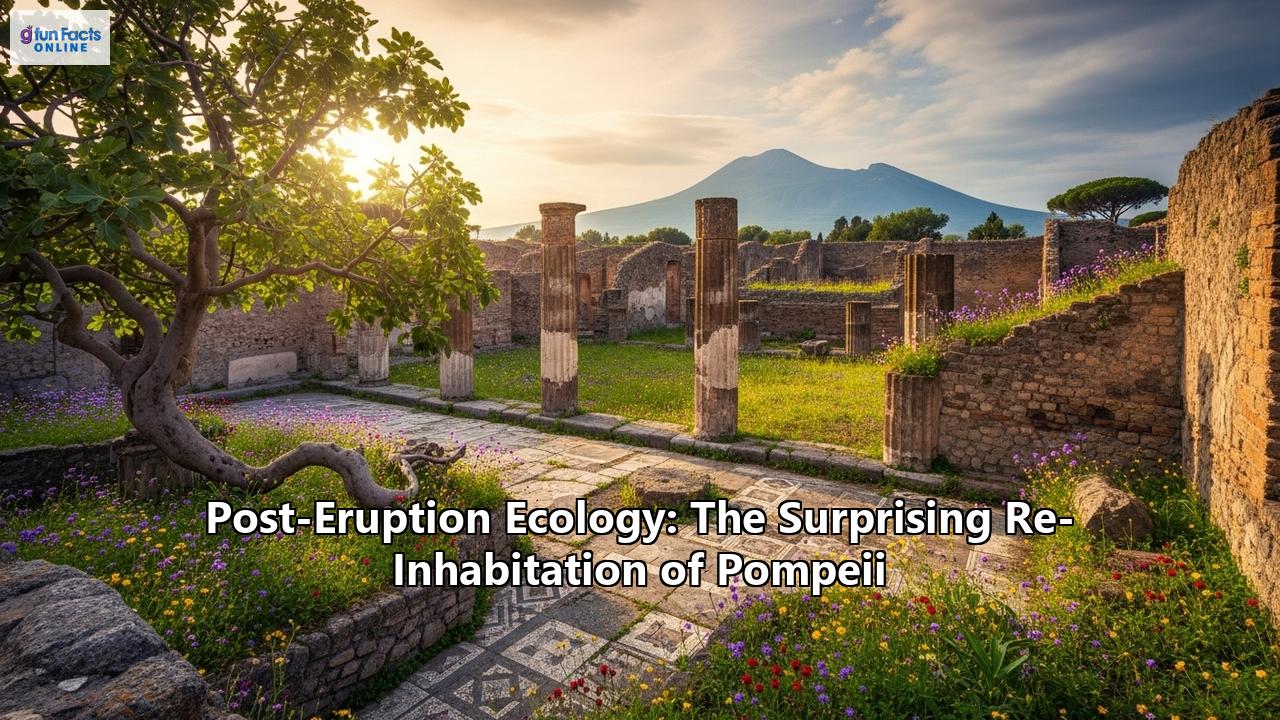
The Phoenix City: How Life Clawed Its Way Back to Pompeii
The story of Pompeii is etched in the world's collective memory as a city frozen in time, a tragic tableau of Roman life extinguished in an instant by the cataclysmic eruption of Mount Vesuvius in 79 AD. For centuries, the narrative has been one of sudden death and silent, ash-shrouded ruins. However, beneath the layers of pumice and hardened pyroclastic flow, a different, more resilient story has been waiting to be told. Recent archaeological discoveries are revolutionizing our understanding, revealing that Pompeii was not entirely abandoned to the ghosts of its past. In a surprising twist of history, life, both wild and human, began a slow, tenacious return to the devastated landscape, creating a unique and complex post-eruption ecosystem. This is the story of Pompeii's second life, a narrative of ecological succession on a sterile canvas and the surprising reinhabitation of a city synonymous with destruction.
The Day the World Ended: The Immediate Aftermath
To comprehend the sheer scale of the rebirth, one must first grasp the totality of the annihilation. The eruption of Vesuvius in 79 AD was an event of unimaginable fury. A colossal column of gas, ash, and rock rocketed miles into the stratosphere, plunging the bustling city of Pompeii and its surroundings into darkness. For eighteen to twenty hours, a relentless rain of pumice and ash buried the city, the weight of the debris causing roofs to collapse. This was followed by a series of pyroclastic surges—superheated, fast-moving avalanches of gas and volcanic matter that incinerated and suffocated everything in their path.
The immediate aftermath was a scene of utter desolation. The once-thriving agricultural heartland of Campania, renowned for its fertile soils, was transformed into a sterile, grey desert. The eruption obliterated all vegetation and wildlife, burying the land under a thick blanket of volcanic material that drastically altered the physical landscape. The course of the Sarno River was changed, and the coastline itself was reshaped. The air was thick with toxic gases, and any sources of fresh water were contaminated. For all intents and purposes, the region around Pompeii was a lifeless moonscape.
The First Stirrings of Life: Ecological Succession on a Volcanic Canvas
In the face of such complete devastation, the return of life might seem impossible. Yet, nature's resilience is a powerful force, and the process of ecological succession began almost as soon as the volcanic deposits cooled. This process, known as primary succession, is the colonization of a barren landscape devoid of life and soil.
The very first pioneers to venture into this hostile new world were likely hardy microorganisms and lichens. Lichens are remarkable composite organisms, a symbiotic partnership between a fungus and an alga or cyanobacteria. They are uniquely adapted to colonize bare rock, and the lava flows from Vesuvius would have provided an ideal, albeit harsh, substrate. One of the key pioneer species on the lava flows of Vesuvius is the lichen Stereocaulon vesuvianum. This lichen, with its characteristic stringy, grey appearance, is a master of survival. It secretes acids that slowly break down the rock, beginning the millennia-long process of soil formation.
Following the lichens and mosses, the first simple plants began to take root in the cracks and crevices where a rudimentary organic substrate had started to form. These included ferns and various grasses. As these pioneer plants lived and died, their decomposing organic matter further enriched the nascent soil, paving the way for more complex vegetation. Soon, hardy shrubs and wildflowers, such as Red Valerian (Centranthus ruber), Helichrysum litoreum, and species of Cistus and Artemisia, would have added splashes of color to the grey landscape.
The timeline for this ecological recovery can be partly understood by looking at more recent volcanic eruptions, such as that of Mount St. Helens in 1980. There, ecologists observed the emergence of "fireweed" just a few weeks after the eruption. While a direct comparison is complex due to differences in climate and the specific nature of the volcanic deposits, the recovery at Mount St. Helens suggests that a significant degree of natural regeneration could have occurred in the Vesuvian region within a few decades. By approximately 120 AD, it is conceivable that the landscape around Pompeii was no longer a barren wasteland but was instead covered in a mosaic of hardy grasses, shrubs, and young trees, a testament to the inexorable march of nature.
The Return of Humanity: A "Favela Among the Ruins"
Perhaps even more surprising than the return of plant and animal life is the new evidence that humans also came back to the buried city of Pompeii. For a long time, it was believed that the survivors fled and never returned, the site being too dangerous and devastated. However, recent excavations, particularly in the southern quarter of the city known as the Insula Meridionalis, have unearthed compelling evidence of a post-eruption settlement that persisted for centuries.
This was not a grand rebuilding of Pompeii to its former glory. Instead, what emerged was a "precarious and grey agglomeration, a kind of camp, a favela among the still recognisable ruins of the Pompeii that once was," as described by Gabriel Zuchtriegel, the director of the Pompeii Archaeological Park. The inhabitants of this makeshift settlement were likely a mix of original survivors who were too poor to relocate elsewhere and newcomers drawn to the site by the opportunity to salvage valuables from the ruins.
These post-disaster Pompeians lived a precarious existence. Archaeological evidence shows that they occupied the upper floors of buildings that protruded from the layers of ash. The buried ground floors of the once-grand Roman villas were repurposed as cellars and storage areas. Ovens for baking bread and millstones for grinding grain have been discovered, indicating a subsistence economy focused on basic survival. Large vaulted warehouses were subdivided into smaller living quarters, and staircases were constructed to access the upper levels. Life in this squatter settlement was a far cry from the organized, amenity-rich urban environment of pre-eruption Pompeii. There was no running water, no sewage system, and none of the infrastructure of a typical Roman city.
The discovery of ceramics, coins from successive emperors, and even fifth-century oil lamps bearing Christian symbols indicates that this settlement was occupied for a considerable period, with two main phases of reoccupation: one from the late first to the early third centuries AD, and another from the fourth to the mid-fifth century. The poignant discovery of a newborn's burial from between 100 and 200 AD offers a glimpse into the cycle of life that continued amidst the ruins. This "second Pompeii" was a testament to human resilience and the desperate will to survive in the most challenging of circumstances.
The final abandonment of this settlement is thought to have been triggered by another major eruption of Vesuvius in 472 AD. This eruption, while not as catastrophic as the one in 79 AD, caused widespread damage in Campania through pyroclastic flows and lahars (volcanic mudflows). The ash from this eruption was reportedly carried as far as Constantinople. It is likely that this event made continued habitation in the already precarious settlement at Pompeii untenable.
The Fate of the Survivors: A New Life Elsewhere
While a small community clung to life within the ruins of Pompeii, the majority of the survivors sought refuge in neighboring towns and cities. The Roman government, under the Emperor Titus, responded to the disaster with a significant relief effort. Titus appointed officials to oversee the recovery of Campania and allocated funds, including from his own private wealth, to aid the survivors and reconstruct damaged areas. Land from those who perished without heirs was also assigned to the rebuilding of the afflicted towns.
Historical records and archaeological evidence, such as inscriptions with Pompeian family names, have allowed researchers to trace the resettlement of these refugees. The coastal communities of Cumae, Neapolis (modern Naples), and Puteoli (modern Pozzuoli) were major destinations for the displaced Pompeians. In Neapolis, a new neighborhood called the Regio Herculanensis was even constructed to house survivors from Herculaneum.
These survivors were not simply passive recipients of aid. They brought their skills, economic networks, and cultural practices with them, contributing to the social and economic fabric of their new homes. A notable example is the Umbricii Scauri family, who were prominent producers of garum (a fermented fish sauce that was a staple of Roman cuisine) in Pompeii. After the eruption, they relocated to Puteoli and appear to have continued their lucrative trade, as evidenced by the emergence of fish-sauce manufacturing in that city. Other families, like the Caltilius and Munacians, resettled in the port city of Ostia, near Rome, where they prospered and intermarried. These stories of successful integration highlight the resilience and adaptability of the Pompeian survivors.
The Long-Term Environmental Legacy
The eruption of 79 AD left an indelible mark on the environment of the Bay of Naples that extended far beyond the immediate destruction. The massive quantities of volcanic material that blanketed the landscape had long-term consequences for the region's hydrology and marine ecosystems.
The Sarno River, which flowed through the fertile plain south of Vesuvius, was profoundly affected. The eruption altered its course and choked it with volcanic debris. Subsequent eruptions, like the one in 472 AD, would continue to deposit vast amounts of sediment into the river system, leading to further changes in the floodplain and the progradation of the coastline.
The Bay of Naples itself was also significantly impacted. The pyroclastic flows that surged into the sea created a submarine volcaniclastic fan off the coast of Herculaneum. Analysis of sediment cores from the bay has revealed the distinct layers of tephra from the 79 AD eruption, providing a valuable record of the event. These studies show that the eruption triggered tsunamis and subaqueous density flows that reshaped the seabed. The influx of volcanic material and the associated chemical changes would have had a major, albeit not fully understood, impact on the marine life in the bay. Lead isotope analysis from the harbor of Naples has also shown that the eruption damaged the aqueduct system that supplied the city with water, and it took several decades for the Roman authorities to fully repair and replace it.
However, in the long run, the volcanic deposits that had caused so much destruction would once again become a source of immense fertility. The weathering of volcanic ash releases a rich cocktail of minerals, creating incredibly fertile soils. This is why, despite the ever-present danger, people have been drawn back to the slopes of Vesuvius time and again. In the centuries following the 79 AD eruption, agriculture did return to the region, and the land once buried under a sterile blanket of ash would again be cultivated with vineyards and olive groves.
A Tale of Two Recoveries: Vesuvius and Krakatoa
The story of Pompeii's surprising reinhabitation finds a fascinating parallel in the aftermath of another great volcanic cataclysm: the eruption of Krakatoa in 1883. Krakatoa, a volcanic island in Indonesia, was obliterated in an explosion that was heard thousands of miles away and generated devastating tsunamis. The eruption, with a Volcanic Explosivity Index (VEI) of 6, was significantly larger than the Vesuvius eruption of 79 AD (VEI 5).
Like the area around Vesuvius, the remnants of Krakatoa were initially sterile. However, the process of ecological succession began with remarkable speed. Within a few years, ferns and flowering plants had established themselves, and within a few decades, a nascent forest was taking shape. This rapid recovery, in a much more isolated island environment, underscores the incredible power of nature to reclaim even the most devastated landscapes. The story of Krakatoa's rebirth provides a powerful lens through which to view the ecological recovery of Pompeii, suggesting that the return of life to the Vesuvian slopes was not an anomaly but a testament to a fundamental ecological principle.
Conclusion: A City of Endings and Beginnings
The narrative of Pompeii is no longer a simple story of a city that died. It is a far more complex and compelling tale of destruction and surprising resilience, of endings and unexpected new beginnings. The image of the "favela among the ruins" forces us to reconsider our understanding of life in the aftermath of ancient disasters. It reveals a community of survivors and salvagers who carved out a new existence in the shadow of the volcano that had taken so much from them. Their story is one of tenacity, adaptation, and the enduring human will to persist.
Simultaneously, the slow greening of the sterile volcanic landscape tells a parallel story of nature's own resilience. From the first intrepid lichens to the eventual return of forests and farms, the ecological recovery of the Vesuvian region is a powerful reminder of the cyclical nature of destruction and creation. The ash that buried Pompeii also contained the seeds of its future fertility.
Thus, the story of post-eruption Pompeii is a rich tapestry woven from the threads of human and ecological resilience. It is a narrative that challenges our preconceptions and deepens our appreciation for the intricate dance between humanity and the formidable power of the natural world. The silent ruins of Pompeii, it turns out, have been whispering a story not just of death, but of a tenacious and surprising second life.
Reference:
- https://en.wikipedia.org/wiki/Eruption_of_Mount_Vesuvius_in_79_AD
- https://www.forbes.com/sites/drsarahbond/2016/08/24/august-24-79-an-hour-by-hour-account-of-vesuvius-eruption-on-the-1937th-anniversary/
- http://mandalaprojects.com/ice/ice-cases/pompeii.htm
- https://pompeiiarchaeologicalpark.com/the-ecological-recovery-of-the-vesuvian-region/
- https://www.sciencealert.com/archaeologists-find-evidence-of-life-in-post-eruption-pompeii
- https://www.parconazionaledelvesuvio.it/en/biodiversity/the-pioneer-species/
- https://vesuviustheveryangrypimple.weebly.com/social-structure-i-politics-i-economy.html
- https://archaeology.org/news/2025/08/08/some-of-pompeiis-residents-returned-home/
- https://archaeologymag.com/2025/08/pompeii-after-vesuvius-reoccupation/
- https://pompeiiarchaeologicalpark.com/survivors-of-pompeii/
- https://www.jpost.com/archaeology/article-863511
- https://earth.sas.upenn.edu/events/title-be-announced-4
- https://origins.osu.edu/connecting-history/roman-government-disaster-response
- https://www.researchgate.net/publication/235934306_The_eruption_of_Vesuvius_of_79_AD_and_its_impact_on_human_environment_in_Pompei
- https://direct.mit.edu/jinh/article-abstract/51/1/1/96234
- https://www.google.com/search?q=time+in+Naples,+IT
- https://www.taylorfrancis.com/chapters/edit/10.4324/9780203131626-2/roman-emperors-natural-disasters-first-century-mischa-meier
- https://en.wikipedia.org/wiki/Mount_Vesuvius
- https://pompeiiarchaeologicalpark.com/family-social-structures-pompeii/
- https://origins.osu.edu/watch/ancient-roman-origins-government-disaster-response
- https://www.lapl.org/collections-resources/blogs/lapl/mountains-august-doom-vesuvius-and-krakatoa
- https://www.quora.com/Which-volcanic-eruption-was-larger-Krakatoa-or-Pompeii-Which-volcanic-eruption-is-the-largest-ever