
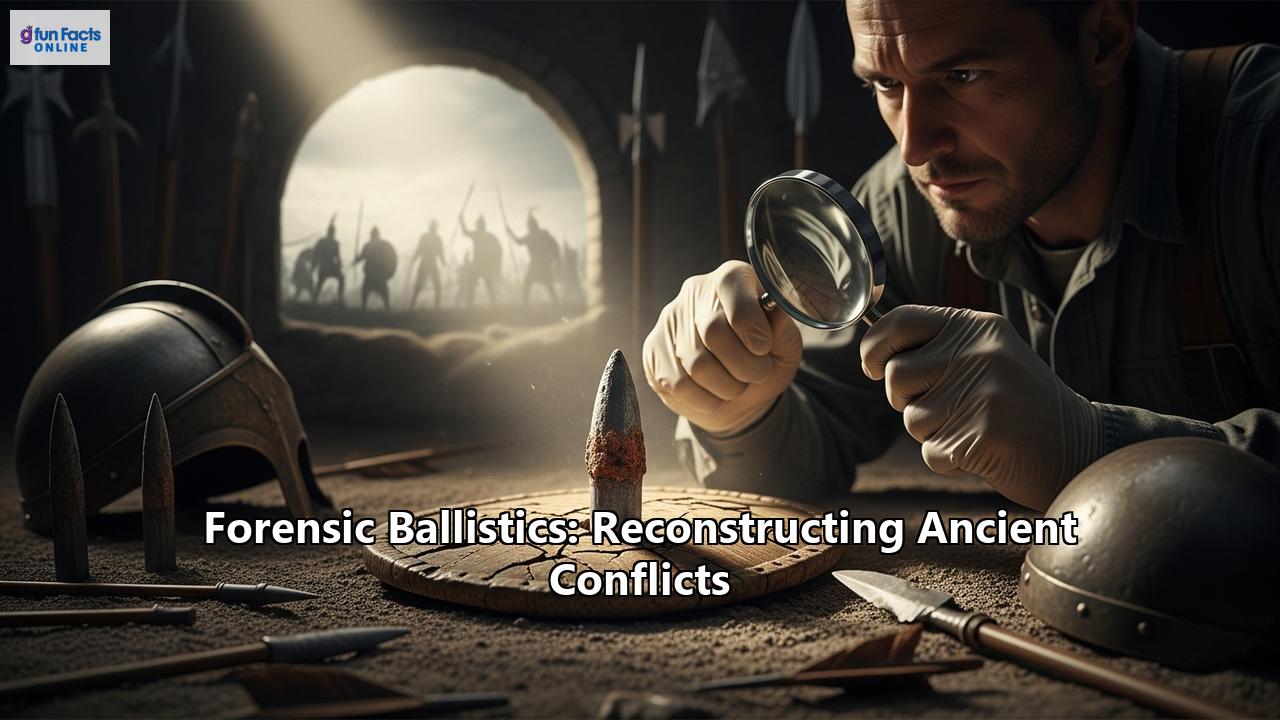
Forensic Ballistics: Unearthing the Realities of Ancient Conflicts
The silent, grassy fields of battlegrounds and the solemn stillness of ancient burial sites hold explosive secrets. For centuries, our understanding of past conflicts was shaped by the epic poems of Homer, the terse accounts of caesars, and the heroic sagas of medieval chroniclers. These narratives, while rich in cultural value, are often colored by the biases and artistic license of their authors. But what if we could let the dead and the discarded remnants of warfare tell their own, unvarnished stories? This is the promise of a fascinating and relatively new discipline: forensic ballistics in archaeology. By applying the rigorous scientific principles of modern crime scene investigation to ancient remains and artifacts, archaeologists are piecing together a much more visceral and accurate picture of what it was truly like to face the fury of ancient and medieval warfare.
This burgeoning field is not merely about identifying a weapon and its victim. It is a multidisciplinary endeavor that combines archaeology, anthropology, physics, and materials science to reconstruct the intricate details of past conflicts. From the microscopic striations on a flint arrowhead to the devastating crush injuries inflicted by a musket ball, every piece of evidence offers a clue. By meticulously analyzing these clues, researchers can determine the types of weapons used, the trajectories from which they were launched, the skill of the combatants, and even the tactical formations of armies. This journey into the past, guided by the principles of forensic ballistics, is rewriting the history of human conflict, one meticulously examined artifact at a time.
The Armory of the Ancients: A Lethal Legacy in Stone, Bone, and Metal
Before the age of gunpowder, the battlefields of the ancient world were dominated by a formidable array of projectile weapons, each with its own deadly calculus of design and function. The fundamental goal of these weapons was to inflict trauma from a distance, and their evolution reflects a sophisticated understanding of physics and materials science, honed over millennia of conflict and hunting.
The Humble Sling and the Deadly Dart: Often underestimated, the sling was a devastatingly effective weapon in the hands of a skilled user. Simple in construction, typically consisting of a leather or fabric pouch with two cords, it could launch a carefully chosen stone or a purpose-made lead or clay projectile with astonishing force and accuracy. The mathematics of a sling's power are a testament to ancient ingenuity, transforming the circular motion of the slinger's arm into a powerful linear projection.The atlatl, or spear-thrower, represents another significant leap in projectile technology. This device, essentially a wooden or bone shaft with a hook or spur at one end, acted as a lever to dramatically increase the velocity and range of a thrown dart. Experimental archaeology has shown that atlatls could propel darts with enough force to penetrate the thick hides of large game, making them formidable weapons in both hunting and warfare. The increased kinetic energy imparted by the atlatl meant that even simple, sharpened wooden or bone points could be lethal.
The Reign of the Arrow: The invention of the bow and arrow marked a pivotal moment in the history of projectile warfare. A well-crafted bow stores and releases a tremendous amount of energy, and when paired with a skillfully designed arrowhead, it becomes a weapon of remarkable precision and lethality. Archaeological evidence reveals a wide variety of arrowhead designs, each tailored for a specific purpose. Broadheads with wide, cutting edges were designed to cause massive bleeding, while narrow, armor-piercing bodkins were engineered to punch through mail and leather defenses.The materials used for these early projectiles were as varied as their designs. Flint, with its sharp, predictable fracture patterns, was a favored material for arrowheads and spear points. Bone and antler were also widely used, valued for their strength and resilience upon impact. Experimental studies have demonstrated that these organic points were just as effective as their stone and metal counterparts, and in some cases, more durable. The choice of wood for the shaft was also critical, with species like dogwood, viburnum, and hazel being selected for their combination of strength and flexibility.
The Science of Impact: Reading the Scars of Battle
The core of forensic ballistics in archaeology lies in the meticulous analysis of the evidence left behind by these ancient projectiles. This analysis can be broadly divided into two categories: the examination of the projectiles themselves and the study of the trauma they inflicted on human and animal remains.
Wound Ballistics in Bone: When a projectile strikes bone, it leaves behind a signature that can reveal a wealth of information about the weapon, the angle of impact, and the amount of force involved. Bioarchaeologists and forensic anthropologists have developed a sophisticated understanding of how to interpret these "tool marks" on bone.Sharp-force trauma, caused by edged weapons like swords or arrowheads, typically leaves linear incisions. Microscopic analysis of these cuts can reveal the type of material used to make the weapon, with stone tools leaving characteristic parallel striations that are absent in marks made by metal blades. Projectile trauma, on the other hand, is characterized by high-velocity impacts that can cause penetrating defects, fractures, and embedded material.
The study of wound morphology allows researchers to differentiate between various types of projectiles. For instance, full-thickness punctures caused by flint arrowheads often have a lozenge-shaped or elliptical appearance with internal beveling, a feature that distinguishes them from the circular defects left by bullets. Experimental archaeology has been crucial in developing a reference collection of wound patterns. By firing replica ancient weapons into animal carcasses or synthetic bone analogues, researchers can observe and categorize the resulting trauma, providing a vital baseline for interpreting archaeological finds.
Advanced Imaging and 3D Modeling: The advent of advanced imaging technologies has revolutionized the field of archaeological ballistics. Computed tomography (CT) and micro-CT scanning allow for non-invasive analysis of artifacts and skeletal remains, revealing internal structures and hidden details without causing damage. For example, a CT scan can reveal a projectile fragment embedded deep within a bone or provide a three-dimensional view of a complex fracture pattern.3D modeling has also become an invaluable tool. By creating digital replicas of projectiles and the wounds they caused, researchers can perform detailed analyses that would be impossible with the naked eye. For example, a 3D model can be used to create a negative imprint of a wound, allowing for the precise identification of the weapon that caused it, even when the projectile itself is missing. This technology has been used to identify arrowhead injuries in the pelvis of an elite Celtic warrior and to reconstruct the face of a medieval soldier from the Battle of Visby who suffered horrific axe wounds.
Case Studies in Carnage: Reconstructing Ancient Conflicts
The application of forensic ballistics to specific archaeological sites has yielded remarkable insights into the brutal realities of past conflicts. These case studies provide a window into the chaos and violence of the battlefield, offering a powerful counterpoint to often sanitized historical accounts.
The Battle of Towton (1461): A Medieval Bloodbath: The Battle of Towton, fought in 1461 during the English Wars of the Roses, is considered one of the bloodiest battles ever fought on English soil. The discovery of a mass grave at Towton Hall in 1996 provided a unique and harrowing opportunity for archaeologists to study the casualties of this brutal conflict.The skeletal remains from Towton revealed a shocking level of violence. Many of the skulls showed evidence of multiple, devastating blows, suggesting that the victims were killed in a frenzy of close-quarters combat. The analysis of the wounds, which included sharp-force trauma from swords and bills and puncture wounds from arrows, allowed researchers to reconstruct the final, terrifying moments of these men's lives. The presence of early lead-composite shot at the site also indicates the use of early handguns in the battle, a testament to the changing nature of warfare in the 15th century.
The Battle of Visby (1361): Armor and Annihilation: The Battle of Visby, fought on the Swedish island of Gotland in 1361, is another medieval conflict that has been brought to life through archaeological investigation. The discovery of mass graves outside the walls of Visby, containing the remains of soldiers still clad in their armor, provided an unprecedented snapshot of medieval warfare.The analysis of the skeletal remains from Visby has revealed a grim catalog of injuries, with a particular focus on wounds to the lower legs, suggesting a specific combat tactic. The armor itself has also been a subject of intense study, providing invaluable information about the types of protection worn by medieval soldiers and its effectiveness against the weapons of the day. The use of 3D facial reconstruction on one of the Visby skulls has created a powerful and poignant connection to an individual who perished in this brutal battle over 600 years ago.
The Battle of the Little Bighorn (1876): A New Perspective on a Famous Defeat: The application of modern forensic techniques to the battlefield of the Little Bighorn has fundamentally changed our understanding of this iconic conflict. By meticulously mapping the locations of spent cartridge cases and bullets, archaeologists have been able to reconstruct the movements of individual soldiers and warriors across the battlefield.The analysis of the ballistic evidence, including the identification of cartridge case signatures unique to individual firearms, has allowed researchers to trace the ebb and flow of the battle with remarkable precision. This archaeological evidence has challenged many of the long-held historical narratives about the battle, providing a more nuanced and accurate picture of the tactics employed by both the U.S. Army and the Lakota and Cheyenne warriors.
The Dawn of Firearms: The Ballistics of Black Powder
The introduction of gunpowder and firearms in the late medieval period ushered in a new era of warfare, one defined by the thunderous roar of cannons and the deadly efficiency of the musket. The study of early firearms and their impact on human conflict is a crucial subfield of archaeological ballistics.
From Hand Cannons to Muskets: The earliest firearms were simple, hand-held cannons that were little more than a metal tube on a stick. Over time, these crude weapons evolved into more sophisticated firearms, such as the matchlock, wheellock, and flintlock muskets. These weapons, which dominated the battlefields of the 16th to the mid-19th centuries, fired large, soft-lead musket balls with devastating effect.The ballistic properties of these early firearms were significantly different from modern weapons. The use of black powder as a propellant produced lower muzzle velocities, and the spherical lead balls were less aerodynamically stable than modern bullets. However, the large size and soft nature of the musket ball meant that it could inflict horrific injuries, shattering bone and causing massive tissue damage.
Reading the Wounds of Gunpowder: The analysis of gunshot wounds in historical archaeological contexts provides a unique opportunity to study the impact of these early firearms. The skeletal remains of soldiers from conflicts like the American Civil War and the Napoleonic Wars often bear the unmistakable signs of musket ball trauma.Experimental studies using modern research methods, such as ballistic skull phantoms and CT imaging, have helped to elucidate the wounding patterns of musket balls. These studies have shown that even at low velocities, a musket ball could easily perforate the skull, and that the velocity of the projectile influenced the size and appearance of the entrance and exit wounds. This information is invaluable for interpreting archaeological remains and understanding the lethality of these early firearms.
The Archaeologist's Arsenal: Experimental and Computational Approaches
To truly understand the dynamics of ancient conflicts, archaeologists cannot rely solely on the analysis of static artifacts and remains. They must also find ways to bring the past to life, to recreate the conditions of ancient warfare and test the effectiveness of its weapons. This is where experimental and computational archaeology come into play.
Bringing the Past to Life through Experimental Archaeology: Experimental archaeology involves the creation and use of replica ancient weapons to test their performance and understand their function. This hands-on approach allows researchers to explore questions that cannot be answered by studying archaeological finds alone. For example, by firing replica arrows into animal carcasses, researchers can measure penetration depth, analyze wound channels, and observe how different types of arrowheads perform against different targets.These experiments are often conducted with a high degree of scientific rigor, using high-speed cameras, Doppler radar, and other modern observational equipment to capture detailed data on projectile ballistics. The results of these experiments provide a vital interpretive framework for understanding archaeological evidence and for appreciating the sophistication of ancient weapon technology.
Modeling Conflict with Computers: In recent years, computational modeling has emerged as a powerful tool for reconstructing and analyzing ancient conflicts. By creating computer simulations of battles, researchers can test different hypotheses about tactics, formations, and weapon effectiveness.These models can incorporate a wide range of data, including the topography of the battlefield, the types of weapons used, and the known ballistic properties of those weapons. For example, a computational model could be used to simulate the trajectory of arrows fired from a particular location on a battlefield, helping to identify the likely positions of archers during a conflict. While these models are still in their early stages of development, they hold immense promise for the future of battlefield archaeology.
The Weight of the Past: Ethical Considerations and Future Directions
The study of human conflict, particularly when it involves the analysis of human remains, carries with it a profound ethical responsibility. Archaeologists and anthropologists who work in this field must be mindful of the sensitive nature of their research and the importance of treating the dead with dignity and respect.
The Ethics of Studying the Dead: The excavation and analysis of human remains from conflict sites raises a number of complex ethical questions. In many cultures, the disturbance of the dead is considered a taboo, and researchers must be sensitive to the beliefs and wishes of descendant communities. Professional organizations like the World Archaeological Congress have established codes of ethics that provide guidance on the responsible treatment of human remains, emphasizing the importance of consultation and informed consent. The Future of Forensic Ballistics in Archaeology: The field of forensic ballistics in archaeology is constantly evolving, driven by new technologies and new research questions. The increasing use of non-invasive analytical techniques, such as CT scanning and 3D modeling, will continue to provide new insights into ancient conflicts without causing damage to irreplaceable artifacts. The development of more sophisticated computational models will allow for more detailed and accurate reconstructions of past battles.But perhaps the most important future direction for this field is the continued integration of scientific analysis with a deep respect for the human stories behind the artifacts. By combining the rigor of forensic science with the empathy of the humanities, we can ensure that the voices of those who lived and died in ancient conflicts are heard with clarity and compassion. In doing so, we not only gain a better understanding of the past, but also a more profound appreciation for the enduring human cost of war.
Reference:
- http://wwwhomes.uni-bielefeld.de/tkohers/Pal%E4opathologie_Knochen,%20Wundballistik/Verletzungen%20durch%20Projektile_Pfeil,%20Wurfspeer,%20etc/Smith,%20Experimental%20evidence%20for%20lithic%20projectile%20injuries,%20improving%20identification%20of%20an%20under-recognised%20phenomenon.pdf
- https://experimentalarchaeology.wordpress.com/wp-content/uploads/2011/06/barton-experimental-approaches-to-near-eastern-archery.pdf
- https://eprints.bournemouth.ac.uk/26336/1/Forsom%20and%20Smith_Green%20version.pdf
- https://www.researchgate.net/publication/248913970_Wretchedly_poor_but_amazingly_practical_Archaeological_and_experimental_evidence_on_the_bone_arrowheads_of_the_Fenni
- https://www.researchgate.net/figure/A-puncture-wound-related-to-pointed-weapon-on-the-right-parietal-bone-from_fig5_257731253
- https://americansocietyofarmscollectors.org/wp-content/uploads/2024/07/I-Roundball-Shooting-Phase-1-Report-Revised-3-20-24.pdf
- https://digital.csic.es/bitstream/10261/234258/1/The%20Dignity%20of%20the%20Dead.pdf
- https://pmc.ncbi.nlm.nih.gov/articles/PMC11844905/
- https://consensus.app/questions/what-ethical-considerations-archaeological-research/
- https://www.researchgate.net/publication/378437637_Identification_and_quantification_of_projectile_impact_marks_on_bone_new_experimental_insights_using_osseous_points
- https://www.mdpi.com/2227-9059/13/7/1742
- https://www.uu.se/en/events/archive/2025-05-21-the-archaeology-of-medieval-warfare-skeleton-stories-from-stirling-castle-towton-and-visby
- https://www.livescience.com/archaeology/elite-celtic-warrior-had-healed-arrowhead-injury-in-his-pelvis-3d-bone-analysis-reveals
- https://www.ancient-origins.net/news-history-archaeology/visby-warrior-0017482
- https://uu.diva-portal.org/smash/get/diva2:1921533/FULLTEXT01.pdf
- https://snu.elsevierpure.com/en/publications/bioarchaeological-investigation-of-possible-gunshot-wounds-in-18t
- https://en.wikipedia.org/wiki/Battle_of_Visby
- https://www.youtube.com/watch?v=elg_oLiPZ80
- https://www.researchgate.net/publication/263093292_Experimental_projectile_impact_marks_on_bone_Implications_for_identifying_the_origins_of_projectile_technology
- http://towtonbattle.free.fr/index.php/brief-history/
- https://orca.cardiff.ac.uk/id/eprint/138081/1/thebsdj_4_3_2020_bsdj.201.pdf
- https://archaeologycolorado.org/sites/default/files/Gleichman%20and%20Teegarden%202005%20Cartridges%20Caps%20and%20Flints%20with%20errata.pdf
- https://dspace.lib.cranfield.ac.uk/server/api/core/bitstreams/8d48da01-b4dd-4be7-880b-aeea06d9640c/content
- https://summit.sfu.ca/_flysystem/fedora/sfu_migrate/6549/b16962941.pdf
- https://digitalcommons.unl.edu/cgi/viewcontent.cgi?article=1101&context=anthrotheses
- https://wbmf.online/wp-content/uploads/2021/01/From-Battlefield-Archaeology-to-Conflict-Archaeology.pdf
- https://www.cambridgescholars.com/product/978-1-0364-0291-4
- https://oxfordre.com/politics/display/10.1093/acrefore/9780190228637.001.0001/acrefore-9780190228637-e-535?p=emailAi.W2aRmUz95Y&d=/10.1093/acrefore/9780190228637.001.0001/acrefore-9780190228637-e-535
- https://www.comses.net/codebases/?query=James+Wilson&page=3
- https://content.e-bookshelf.de/media/reading/L-13121227-1c584f7675.pdf
- https://worldarchaeologicalcongress.com/code-of-ethics/
- http://wwwhomes.uni-bielefeld.de/~tkohers/Pal%E4opathologie_Knochen,%20Wundballistik/Verletzungen%20durch%20Projektile_Pfeil,%20Wurfspeer,%20etc/O%20Driscoll,%20Experimental%20projectile%20impact%20marks%20on%20bone.pdf