
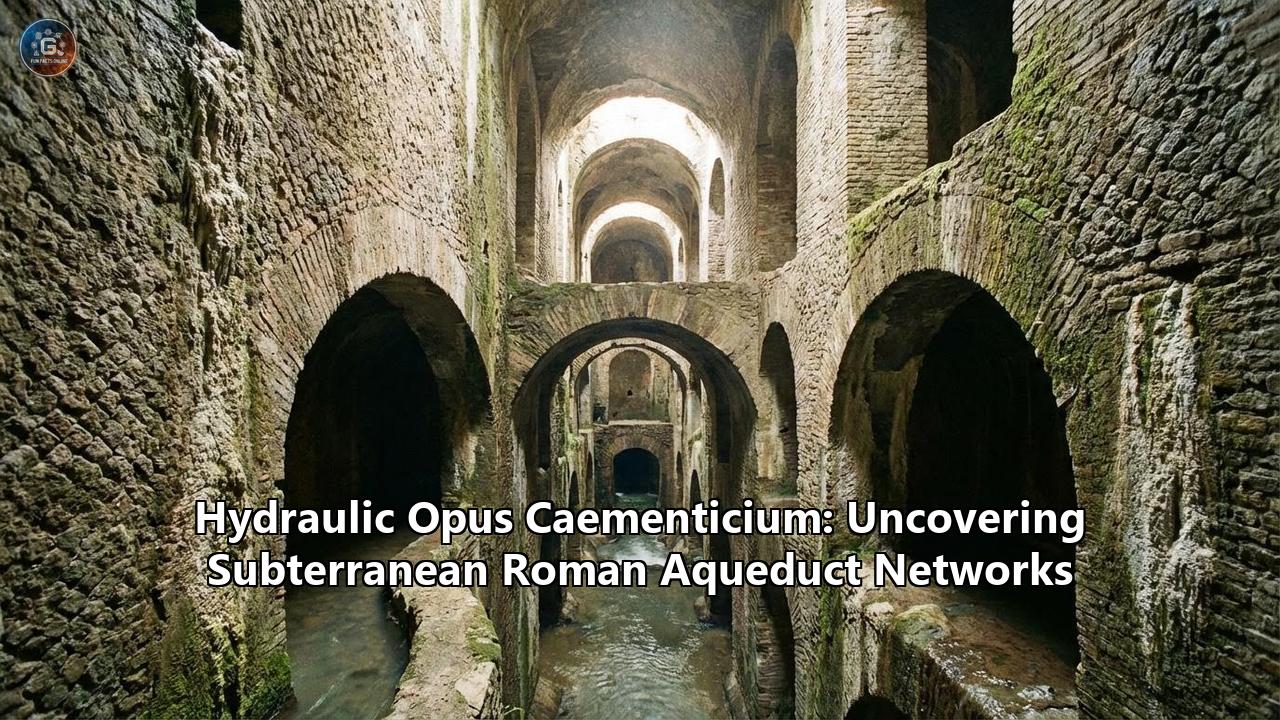
When we envision the majesty of the ancient Roman Empire, our minds almost instinctively conjure images of colossal stone arches striding proudly across sun-drenched European valleys. The Pont du Gard in France or the towering arcades of the Aqua Claudia outside Rome stand as the ultimate symbols of classical engineering. Yet, this iconic imagery represents a profound historical illusion. The truth of Roman water management is far more secretive, largely hidden beneath the earth. Between 80 and 90 percent of the Roman aqueduct systems were entirely subterranean.
To quench the thirst of an empire, Roman engineers had to conquer the underworld. They carved thousands of miles of tunnels through solid rock, sank deep vertical shafts into unstable soil, and navigated the complex geomorphology of the Mediterranean. But digging a hole is only half the battle; ensuring that millions of gallons of water can flow through it continuously for centuries without collapsing the tunnel or seeping into the surrounding bedrock requires an absolute mastery of materials science.
Enter Hydraulic Opus Caementicium (Roman concrete) and Opus Signinum (waterproof mortar).
Through a combination of geological luck and relentless empirical experimentation, the Romans developed a chemical formulation for concrete and mortar that not only set underwater but actually grew stronger as it interacted with moisture. This article delves deep into the subterranean darkness of the Roman aqueduct networks, exploring how ancient engineers utilized hydraulic opus caementicium to build an invisible, indestructible circulatory system that breathed life into the greatest cities of the ancient world.
The Illusion of the Arches: Why Rome Built Underground
To the practical and militaristic minds of the Romans, the aqueducts were not initially designed to be decorative monuments; they were critical infrastructure, and as such, they needed to be protected. When Appius Claudius Caecus commissioned Rome’s first aqueduct, the Aqua Appia, in 312 BC, it stretched for approximately 16 kilometers (10 miles). Of that total length, nearly all of it was buried underground.
The preference for subterranean networks over elevated arcades was driven by four vital factors:
- Security against Sabotage: An elevated aqueduct is a glaring target for a besieging army. By keeping the water channels hidden below ground, the Romans ensured that enemy forces could not easily locate, poison, or destroy the city’s water supply.
- Structural and Financial Economy: Building massive, multi-tiered stone arches required an astronomical budget, immense labor, and staggering amounts of quarried stone. Tunneling through the earth or using cut-and-cover trenching was generally more cost-effective and structurally stable.
- Protection from the Elements: Water flowing underground was shielded from the blistering Mediterranean sun, minimizing evaporation and preventing the aggressive growth of algae. The earth acted as a natural insulator, delivering water to the city at a cool, refreshing temperature year-round.
- Maintaining the Gradient: Roman aqueducts relied entirely on gravity. They required a continuous, incredibly precise downward slope—often dropping just a few centimeters every kilometer. To maintain this exacting trajectory across undulating topography, it was far easier to dig a tunnel through a hill than to build a bridge over it. Engineers only resorted to the famous monumental arches when they had no other choice, such as when traversing a deep valley.
Sextus Julius Frontinus, the highly esteemed curator aquarum (water commissioner) of Rome in the late 1st century AD, understood the superiority of these structures perfectly. Surveying the vast network under his command, Frontinus noted that of the 269 miles of aqueducts supplying Rome at the time, a staggering 269 miles ran underground, while only about 36 miles were carried on arches. He proudly compared these highly functional, life-sustaining hidden veins to the "idle Pyramids or the useless, though famous, works of the Greeks".
The Miracle Material: Deciphering Hydraulic Opus Caementicium
The construction of miles of subterranean tunnels through varying types of geology—from hard limestone to loose, saturated sand—posed a severe risk of cave-ins and groundwater infiltration. To line, support, and seal these tunnels, the Romans turned to a material that would forever change the history of architecture: Opus Caementicium.
However, standard lime mortar—used by civilizations for thousands of years—was not sufficient for the aqueducts. Standard mortar requires exposure to air (specifically carbon dioxide) to cure and harden. In the damp, oxygen-deprived environment of an underground water channel, standard mortar would remain soft and eventually wash away. The Romans needed a hydraulic binder—a cement that could cure in the presence of water, or even entirely submerged.
The Secret Ingredient: Pulvis Puteolanus
The ancient Greeks and Macedonians had experimented with early forms of hydraulic cement, but it was the Romans who perfected it on an industrial scale. Their secret weapon was a specific type of volcanic ash known as pulvis Puteolanus, named after the city of Puteoli (modern-day Pozzuoli) near Mount Vesuvius. Today, this remarkable substance is known generically as pozzolana.
Pozzolana is an aluminosilicate material—rich in silica and alumina. When this finely ground volcanic ash was mixed with slaked lime (calcium hydroxide) and water, a complex and highly reactive chemical process occurred. The silica and alumina in the ash reacted with the calcium hydroxide to form incredibly stable, water-insoluble compounds (calcium silicate hydrates and calcium aluminate hydrates).
Vitruvius and the Ancient Formula
The great Roman architect and engineer Vitruvius meticulously documented this process in his seminal treatise De Architectura. He observed that when this specific volcanic ash was mixed with lime and rubble, it hardened into a stone-like mass that "neither the waves can break, nor the water dissolve".
Vitruvius prescribed highly specific ratios for this hydraulic opus caementicium depending on its intended environment:
- For general terrestrial walls, he recommended a mix of one part lime to three parts pozzolana.
- For underwater structures, bridge piers, or deep, water-logged subterranean aqueduct shafts, he instructed a mix of one part lime to two parts pozzolana.
The result was a structural material of unparalleled resilience. When aqueduct engineers tunneled through unstable, friable soil, they could pour this pozzolanic concrete into wooden forms along the tunnel walls and ceilings. Within days, it would cure into a monolithic, unyielding vault that could support the crushing weight of the earth above, totally immune to the continuous flow of water within.
Sealing the Veins: The Crucial Role of Opus Signinum
While hydraulic opus caementicium provided the structural backbone of the subterranean network, the internal conduit that actually carried the water—known as the specus—required an even more specialized treatment.
The specus was typically a rectangular channel, roughly 0.7 to 1 meters wide and 1.5 to 1.8 meters high, large enough for maintenance workers to walk through. It was usually vaulted at the top to withstand pressure. However, concrete and masonry, even when robust, are naturally porous. If water were allowed to flow directly against raw concrete or stone blocks, a vast percentage of the precious resource would simply seep out into the surrounding earth before ever reaching the city. Furthermore, rough stone surfaces would create hydraulic friction, slowing the water's flow and allowing sediment to settle and choke the channel.
To solve this, the Romans lined the entire interior of the specus with a highly specialized, waterproof plaster called Opus Signinum.
The Composition of Ancient Waterproofing
Opus Signinum (named after the town of Signia, where it was heavily produced) was an ingenious variation of hydraulic mortar. Instead of relying solely on volcanic ash, Roman engineers mixed slaked lime with finely crushed terracotta, broken roof tiles (tegulae), and shattered clay amphorae.The addition of this crushed ceramic dust served two critical purposes:
- Chemical Binding: Like pozzolana, the fired clay contained active silicates that reacted chemically with the lime, giving the mortar excellent hydraulic properties and allowing it to set incredibly hard in wet conditions.
- Impermeability: The dense, fine matrix created by the brick dust formed an impenetrable barrier, tightly sealing the pores of the underlying stone or concrete.
Application and Hydraulic Efficiency
Applying opus signinum was a labor-intensive art. The mortar was layered thickly onto the floor and walls of the specus and then painstakingly polished by hand or with specialized tools until it achieved a smooth, glass-like finish. This smooth surface drastically reduced hydraulic friction, allowing the water to glide effortlessly along its gentle gradient.
To prevent leaks in the most vulnerable areas—the sharp 90-degree internal corners where the walls met the floor—engineers applied the opus signinum in thick, curved fillets, creating characteristic "quarter-round" moldings. This clever geometric trick eliminated sharp angles where water pressure could exploit structural seams, effectively creating a continuous, seamless, waterproof pipe.
Engineering the Deep: Surveying and Tunneling
Building a subterranean aqueduct was an astonishing feat of spatial reasoning and manual labor. Because the water was driven entirely by gravity, the engineers (libratores) had to maintain a precise, agonizingly shallow slope over dozens of miles of invisible underground terrain.
The Instruments of the Libratores
To plot the route before a single shovel struck the earth, the Romans used basic yet highly effective optical instruments:
- The Chorobates: Described by Vitruvius, this was a long wooden table, approximately 20 feet in length, fitted with plumb bobs at the legs. A water-filled trough carved into the top allowed engineers to establish a perfectly level horizontal plane across long distances.
- The Dioptra: A more complex surveying instrument akin to a modern theodolite, used for calculating angles and gradients.
- The Groma: A cross-shaped instrument used to trace straight lines and exact right angles, crucial for ensuring that tunneling teams working from opposite directions would eventually meet in the middle.
The Qanat Technique
Once the route was surveyed, the actual excavation of the subterranean aqueduct relied heavily on an ancient Persian technique known as the qanat system.
Instead of digging horizontally from one end of a hill to the other—a process that would take decades and suffer from zero ventilation—the Romans sank a series of vertical shafts, known as putei, directly down into the earth at regular intervals of approximately 230 feet (70 meters).
These shafts served multiple indispensable functions:
- Accelerated Construction: By sinking multiple shafts along the planned route, dozens of separate teams of laborers could simultaneously dig horizontally toward one another. This exponentially reduced construction time.
- Spoil Removal: Workers at the bottom of the shafts filled baskets with excavated rock and dirt, which were then hoisted to the surface via hand-cranked wooden cranes.
- Materials Delivery: The same cranes lowered heavy ashlar stone blocks, bricks, and buckets of wet opus caementicium down to the tunneling teams.
- Alignment Checks: Engineers frequently dropped plumb lines down adjacent shafts to ensure the horizontal tunnel was adhering strictly to the surveyed route.
- Ventilation: The shafts provided life-saving oxygen to the laborers hacking away at solid rock in the suffocating darkness below.
When tunneling through solid bedrock, the rock itself formed the walls of the specus, which was then simply smoothed and lined with opus signinum. However, when tunneling through earth or loose gravel, the laborers had to quickly build the floor, walls, and vaulted ceiling out of brick and hydraulic concrete to prevent deadly cave-ins, effectively building a concrete tube deep underground.
Conquering Valleys: Subterranean Siphons
While the Romans preferred to maintain their subterranean gradients by following the natural contours of the land, they occasionally encountered geographic obstacles that could not simply be tunneled through or skirted around—such as massive, plunging river valleys.
If the valley was relatively shallow, they would construct the famous arched bridges (like the Pont du Gard) to carry the specus across at the required height. But if the valley was too deep—sometimes plunging hundreds of feet—a stone bridge was structurally impossible. The arches would collapse under their own massive weight.
To solve this, Roman engineers utilized one of the most brilliant applications of subterranean hydraulics: the Inverted Siphon.
Relying on the principle of communicating vessels, the aqueduct channel would reach the edge of the deep valley and empty its water into a high-level collection tank (a header tank). From this tank, the water was forced down into a series of tightly sealed, pressurized pipes made of soldered lead or hollowed stone.
These pipes were routed steeply down the side of the valley, buried underground or laid across a low foundational bridge at the valley floor, and then directed back up the opposite slope. Because water naturally seeks its own level, the immense kinetic pressure generated by the steep drop drove the water back up the other side to a receiving tank, placed just slightly lower than the header tank to account for friction loss.
The pressure at the bottom of these siphons, or the "belly" (venter), was catastrophic. A single structural failure would result in a geyser capable of obliterating the surrounding earth. To prevent the lead pipes from rupturing under hundreds of pounds of pressure, Roman engineers encased the pipes in massive sleeves of high-strength hydraulic opus caementicium and stone blocks, effectively locking the volatile pressurized system inside a subterranean concrete bunker.
The Anatomy of an Aqueduct: Cisterns and Settling Tanks
The subterranean aqueduct was not just a pipe; it was a complex machine with moving parts designed to purify and manage the water flow.
Piscina Limaria (Settling Tanks)
Before water entered the main city network, and often at various intervals along the subterranean route, the water was diverted into large underground chambers known as piscina limaria, or settling tanks.
These pools were designed to radically slow the velocity of the water. As the water stilled, gravity pulled heavy impurities—sand, dirt, pebbles, and debris—down to the floor of the basin. The purified water then spilled over a weir at the opposite end and continued its journey. Without these subterranean filtration stations, the city's fountains and lead distribution pipes would have quickly choked on sediment.
The Castellum Aquae and Underground Cisterns
Upon reaching the city, the subterranean tunnel terminated at a massive distribution hub known as the castellum aquae. From here, the water was divided into different lead pipes (fistulae) serving three distinct destinations: the emperor and wealthy private households, the public baths, and the public fountains.
Because aqueduct flow was continuous and could not simply be "turned off" at the source, excess water had to be managed. This led to the construction of colossal underground storage cisterns. The most awe-inspiring surviving example of this technology is the Basilica Cistern in Istanbul (ancient Constantinople), built in the 6th century AD using the exact hydraulic engineering principles pioneered by Rome.
Capable of holding 80,000 cubic meters of water, the Basilica Cistern was designed as a strategic reservoir to sustain the city during droughts or sieges. Its vaulted brick ceilings were heavily reliant on opus signinum and hydraulic cement to prevent leakage into the surrounding earth. The environment of a cistern—permanently dark and endlessly submerged—was the ultimate proving ground for Roman pozzolanic concrete, a test it passed with flying colors as it still holds water today.
Life in the Dark: Maintenance and the Sinter Threat
The completion of a subterranean aqueduct was only the beginning of its lifespan. To maintain the continuous flow of millions of gallons of water, a dedicated army of specialized laborers, known as the aquarii, lived their lives in the dark, maintaining the tunnels.
The greatest threat to a Roman aqueduct was not enemy armies or earthquakes; it was geology. The water sources the Romans favored—deep mountain springs—were heavily mineralized, rich in dissolved calcium carbonate. As the water flowed down the specus, the slight agitation and changes in temperature caused the calcium carbonate to precipitate out of the water, crystallizing onto the walls and floor of the tunnel.
Over decades, this limestone crust—known as sinter or travertine—would grow thicker and thicker, eventually shrinking the internal volume of the specus and restricting the water flow. In highly mineralized aqueducts, like the one feeding the Pont du Gard, these calcium deposits could grow up to 30 centimeters thick.
The Endless Battle
The vertical putei (shafts) originally used for excavation were repurposed as permanent maintenance access hatches. Teams of aquarii would descend into the dark, wet tunnels by torchlight. Sluice gates would be utilized to temporarily divert the water into bypass channels, draining the main specus.
Working in claustrophobic conditions, the laborers used iron picks and chisels to painstakingly hack away the rock-hard sinter crust without damaging the fragile opus signinum waterproofing beneath. To this day, modern archaeologists exploring these subterranean networks can clearly see the ancient pickaxe marks left behind in the sinter by the aquarii thousands of years ago.
When the underlying opus signinum eventually degraded from centuries of friction or overzealous cleaning, teams would haul fresh buckets of crushed terracotta mortar down the shafts to patch the concrete walls, ensuring the veins of the empire never bled out into the surrounding soil.
The Eternal Concrete: A Legacy Carved in Stone
The brilliance of the Roman subterranean aqueduct network lies not just in its scale, but in its permanence. When the Western Roman Empire collapsed in the 5th century AD, the visible arches were frequently dismantled by locals who repurposed the perfectly cut stone blocks to build medieval walls and churches. But the subterranean networks, hidden far below the plow line, survived in the dark.
In modern times, the study of these underground labyrinths is yielding profound scientific discoveries. Today's standard construction material, Portland cement, is designed to be largely inert once cured. However, it is highly susceptible to cracking, and when water inevitably infiltrates those cracks, the internal steel rebar rusts, expands, and destroys the concrete from the inside out—a process that gives modern concrete an average lifespan of just 50 to 100 years.
In stark contrast, Roman hydraulic opus caementicium used in subterranean and marine environments continues to outlast our modern materials. Modern chemists and materials scientists studying core samples from Roman aqueducts and harbor breakwaters have discovered that pozzolanic concrete is not chemically inert; it is a continuously reactive, living material.
When microscopic cracks form in Roman concrete—either from seismic shifting or ground settling—and water flows into those fissures, the water reacts with unhydrated lime particles trapped within the ancient mixture. This secondary chemical reaction creates new calcium carbonate crystals that physically grow into the void, automatically sealing the crack. The Romans essentially invented self-healing concrete. The more water the aqueduct concrete was exposed to, the harder and more resilient it became.
The Silent Flow of History
It is a profound irony that the most impressive achievements of Roman engineering were designed to never be seen. While the colossal Colosseum and the Pantheon commanded the awe of the ancient public, it was the silent, pitch-black tunnels buried deep beneath the earth that truly made the metropolis possible.
By fusing the aggressive volcanic ash of Mount Vesuvius with shattered ceramics and burnt limestone, the Romans unlocked a chemical alchemy that defied nature. The marriage of hydraulic opus caementicium with the flawless waterproofing of opus signinum allowed them to mold the subterranean world to their will.
Today, beneath the bustling streets of Rome, Lyon, and Istanbul, remnants of these ancient tunnels still exist. Some have run completely dry, their pristine quarter-round moldings gathering dust in the quiet dark. But in some miraculous stretches, fed by the same eternal mountain springs mapped by ancient surveyors, cold, crystal-clear water still glides silently over the smooth, red terracotta floors. They remain as a hidden, enduring testament to a civilization that understood that to conquer the world above, they first had to master the deep.
Reference:
- https://europe.factsanddetails.com/article/entry-1211.html
- https://fiveable.me/history-of-architecture/unit-2/roman-aqueducts-bridges/study-guide/9ouFim2a3nzliNZK
- https://www.historyskills.com/classroom/year-7/roman-aqueducts/
- https://www.nationalgeographic.com/history/history-magazine/article/roman-aqueducts-engineering-innovation
- https://pristinegraphene.com/roman-concrete-aqueducts/
- https://thequantumrecord.com/technology-over-time/ancient-roman-concrete-a-technology-ahead-of-its-time/
- https://circularwaterstories.org/wp-content/uploads/2020/10/The-Roman-Aqueducts_Camilla-Di-Nicola-1.pdf
- https://development.asia/explainer/basilica-cistern-timeless-water-marvel-beneath-istanbul
- https://www.machupicchu.org/pont-du-gard-provence-roman-aqueduct-unesco-complete-guide.htm
- http://www.romanaqueducts.info/picturedictionary/pd_onderwerpen/constructionmaterials.htm
- https://www.mdpi.com/2073-4441/13/8/1069
- https://www.traianvs.net/pdfs/2015_roman_water_supply_systems_big.pdf
- https://www.napolisotterranea.org/en/roman-aqueducts/
- https://www.researchgate.net/figure/Typical-cross-section-of-a-Roman-aqueduct-channel-The-channel-is-built-of-masonry-and_fig9_285626906