
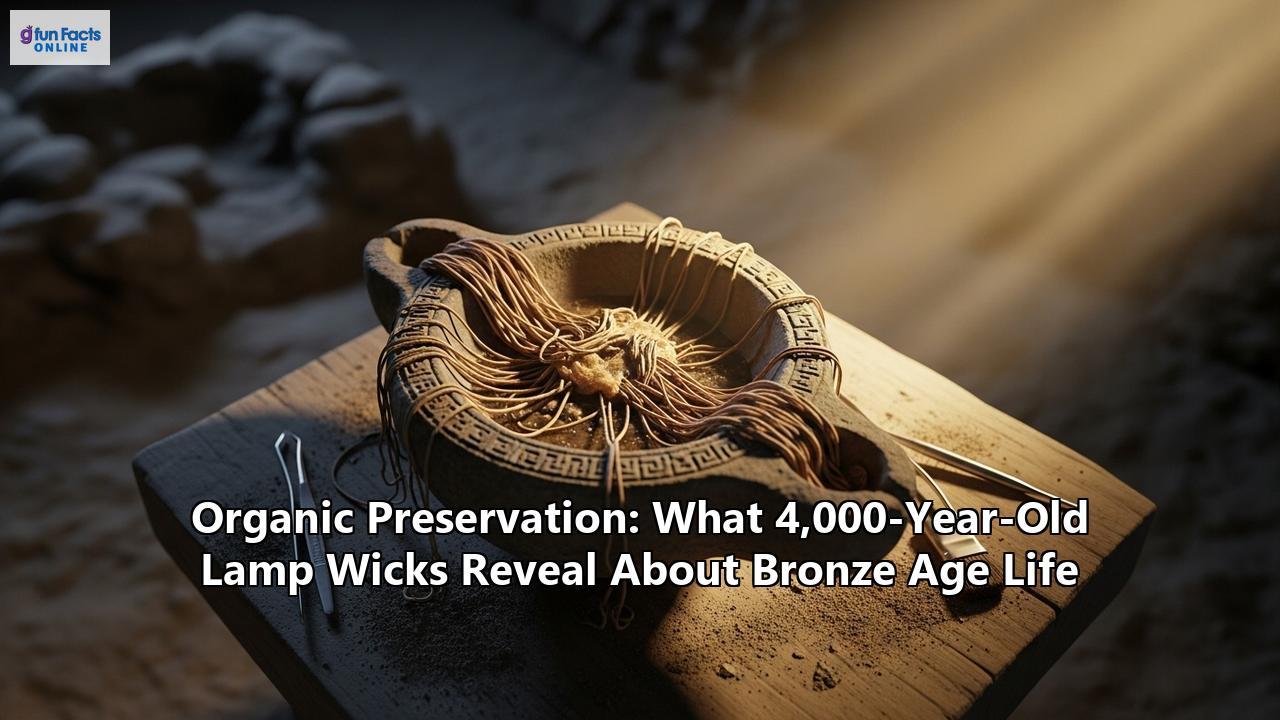
An unassuming fragment of twisted fiber, nestled within a simple clay bowl for four millennia, has cast a brilliant new light on the ancient world. In the quiet of an archaeological laboratory, a discovery of immense significance was made: 4,000-year-old lamp wicks, among the oldest ever found, unearthed from a Bronze Age cemetery near modern-day Yehud in central Israel. These are not merely scraps of old cloth; they are time capsules, whispering intimate secrets of life, death, and belief in an era of profound transformation. The survival of these delicate organic objects is a near miracle, a fluke of chemistry that has preserved a tangible link to the people who lit them during sacred, final farewells.
What these fragile threads reveal is a story far grander than their humble appearance suggests. They speak of a world where resources were precious and nothing was wasted, where the cloth that once warmed a living body found a final, sacred purpose in illuminating the path to the afterlife. They pull back the curtain on the technological innovations of the Bronze Age, showing us how our ancestors first learned to conquer the darkness with controlled, portable light. And most profoundly, they connect us to the timeless human search for meaning in the face of mortality, demonstrating that the association of flame with the soul is a concept that reaches back into the mists of deep time. This is the story of those wicks—a journey into the heart of Bronze Age life, illuminated by the very objects designed to burn away and be forgotten.
A Discovery Against All Odds: The Newe Efrayim Wicks
Archaeology is often a discipline of fragments, of piecing together the past from the durable remnants of human existence—stone, pottery, and metal. Organic materials like textiles, wood, and fiber rarely survive the long centuries, especially in the damp Mediterranean climate of Israel, where microorganisms and decay typically erase all traces. This makes the discovery at the Newe Efrayim cemetery nothing short of extraordinary.
During a large-scale rescue excavation conducted by the Israel Antiquities Authority (IAA) ahead of urban development, archaeologists uncovered a vast burial ground from the Intermediate Bronze Age (c. 2500–2000 BCE). The site yielded over 1,200 tombs, each a small window into the past, containing offerings left for the dead: pottery vessels, animal bones, metal weapons, and jewelry. Among these common funerary items were simple, open-style clay oil lamps, found in the graves of men, women, and children alike.
It was during the careful cleaning and conservation of these lamps in the IAA laboratories that the true treasure revealed itself. Tucked inside three of the lamps were the preserved remains of wicks. Two were partial, but one was found complete, a twisted piece of textile that had last seen the light of day 4,000 years ago. For the researchers, Dr. Naama Sukenik and Dr. Yonah Maor, it was a discovery they never expected to make in this region. While ancient wicks have been found before, they almost exclusively come from the bone-dry deserts of Egypt or the Judean wilderness. The find at Newe Efrayim was virtually unprecedented for the humid coastal plain.
The secret to their survival lay in a rare process of fossilization known as permineralization. Over the millennia, as the organic fibers of the wicks sat within the lamps, mineral-rich water seeped into the soil. This water penetrated the porous structure of the fibers. As the water evaporated, it left behind mineral deposits, primarily calcite in this case. Gradually, molecule by molecule, the minerals replaced the original organic material, creating a perfect, stone-like cast that preserved the intricate texture of the woven cloth. This process, likely aided by bacterial activity in the unique microenvironment created inside the lamps, froze the wicks in time, protecting them from the decay that claimed everything else.
Illuminating the Past: The Technology of Bronze Age Light
The invention of the oil lamp was as revolutionary in its time as the light bulb was in the 19th century. For the first time, humanity had a controllable, portable, and long-lasting source of light that was far more efficient than a torch. This technology fundamentally altered human existence, extending the day, making travel after dark possible, and allowing for work and social life to continue long after the sun had set.
The earliest lamps, dating back to the Stone Age, were little more than hollowed-out stones or shells used to hold animal fat, with a wick likely made of moss or other plant fibers. By the Bronze Age, the technology had become more refined. The most common type of lamp, and the one found at Newe Efrayim, was a simple, wheel-made ceramic bowl. Early in the Bronze Age, these were simple, open bowls. Potters soon realized that by pinching the rim, they could create a spout to hold the wick securely, preventing it from falling into the oil and extinguishing. This innovation also helped to focus the flame and control smoke.
The lamps found at Newe Efrayim are characteristic of the Intermediate Bronze Age (also known as Early Bronze Age IV). During this period, a particular style of multi-spouted lamp became common. Instead of one pinched spout, potters would create four or more, allowing for multiple wicks to be lit simultaneously for a brighter light. The lamps holding the ancient wicks were of this type, perfectly matching the ceramic typology of the era.
The fuel for these lamps was typically oil. In the Mediterranean region, olive oil was the primary fuel source, a staple of the local economy. Other options included sesame oil, fish oil, or rendered animal fat. The fuel would be poured into the reservoir of the lamp, and the wick, through capillary action, would draw the oil up to the flame, allowing it to burn at a constant and controlled rate. However, the light was not without its demands. The wick needed constant tending to ensure a bright, smoke-free flame, with just the tip resting in the nozzle.
The wick itself was the heart of the lamp, the crucial component that transformed a bowl of oil into a source of light. Any fibrous, absorbent material could serve the purpose. Evidence suggests that linen, papyrus, and other plant fibers were common choices. The discovery at Newe Efrayim provides the earliest direct, physical evidence for the use of textile wicks in the entire region.
The Fabric of Life: Linen, Value, and Recycling in the Bronze Age
The analysis of the 4,000-year-old wicks revealed another astonishing detail: they were not made from raw fibers, but from scraps of finished linen cloth. Microscopic examination identified the clear patterns of woven fabric, specifically a tabby weave, which had been cut into strips and then twisted into a cord. This was not just a wick; it was a recycled textile.
This finding opens a fascinating window into the economy and value system of the Bronze Age. Linen was not a cheap, disposable commodity. It was one of the most important and valuable textiles of the ancient world, the product of a long and labor-intensive process.
The journey of linen began with the cultivation of the flax plant, one of the first crops domesticated in the Fertile Crescent. After about 100 days of growth, the plants were not cut but pulled up by the roots to maximize the length of the fibers. The stalks then underwent a process called retting, where they were left in water or on the ground to allow bacteria to break down the woody core, separating the soft fibers within. Following this, the stalks were scutched (beaten to remove the woody parts) and hackled (combed to separate the short fibers from the long, desirable ones). Only then could the fine, long fibers be spun into thread, a painstaking process done by hand. Finally, the thread was woven into cloth on a loom.
Given this arduous production process, it is no surprise that linen was highly prized. In Egypt, it was a symbol of purity and light, used not only for clothing the elite but also for sacred purposes like wrapping mummies. The famous Tarkhan Dress, the world's oldest known woven garment, is a finely made linen shirt from Egypt dating back over 5,000 years. In the southern Levant during the Early and Intermediate Bronze Ages, there is little evidence for the use of wool, which would later become a staple. This would have made linen the primary, and most valuable, textile for clothing and other uses.
The fact that people in the Intermediate Bronze Age were cutting up old, worn-out linen garments to make lamp wicks is a powerful statement about their mindset. As Dr. Sukenik noted, it is highly unlikely that such an expensive textile would have been produced specifically for an object intended to be burned. The researchers found evidence that the cloth used for the wicks had been mended multiple times before being repurposed. This demonstrates a profound understanding of the value of materials and a culture of reuse and recycling that we often think of as a modern concern. In a world without mass production, every object was imbued with the value of the labor and resources that went into it. A piece of cloth wasn't just a garment; it was a store of wealth and effort, to be used and reused until its very last fibers served a final, essential purpose.
Life in a Time of Collapse: The Intermediate Bronze Age
To fully grasp the significance of the Newe Efrayim discovery, one must understand the world in which these wicks were lit. The Intermediate Bronze Age (c. 2500-2000 BCE) was a period of dramatic social upheaval across the Near East. It marks a "collapse" that followed the first great urban era of the Early Bronze Age.
During the preceding centuries (Early Bronze Age II-III), the Levant had been characterized by large, fortified city-states with monumental architecture, complex economies, and powerful ruling elites. Trade networks connected the region to Egypt, Mesopotamia, and Anatolia. But around 2200 BCE, this system fell apart. Major cities like Megiddo and Jericho were abandoned or destroyed. The population dispersed across the landscape, shifting from urban living to smaller, unfortified villages and a more semi-nomadic, pastoralist lifestyle.
Scholars debate the exact causes of this collapse, with climate change being a major contributing factor. Evidence points to a significant aridification event around this time (the 4.2 kiloyear event), which would have led to drought, famine, and widespread social disruption. This environmental crisis likely undermined the agricultural base that supported the large urban populations, leading to decentralization and the breakdown of political structures.
The material culture of the Intermediate Bronze Age reflects this new reality. Pottery styles became more regionalized, and settlements were often short-lived, with simple architecture, suggesting a more mobile population. Long-distance trade diminished significantly, with the exception of metals like copper. This was a world in transition, a society adapting to new environmental and social conditions.
It is within this context of "de-urbanization" and societal fragmentation that the Newe Efrayim cemetery is so important. The sheer size of the burial ground and the consistent nature of the burial practices suggest that even without large cities, people maintained strong community bonds and shared cultural traditions. The act of burying the dead with offerings—pottery, tools, and crucially, lamps to light their way—was a ritual that endured through the collapse.
The discovery shows that despite the widespread disruption, complex belief systems and the technological know-how to produce items like lamps and linen continued. The people who lived in this period of supposed "darkness" were not unsophisticated. They were resilient and adaptive, carrying on the traditions that gave their lives meaning, even as the world around them changed.
The Flame of the Soul: Symbolism and Ritual in Bronze Age Burials
Why were these lamps placed in the tombs? The soot found on the wicks provides a definitive answer: they were lit. The excavation directors suggest a dual purpose. On a practical level, the lamps would have illuminated the dark, underground burial shafts during the funeral ceremony, allowing the mourners to carry out the necessary rituals. But their significance almost certainly ran much deeper.
Across the ancient world, from Vedic India to Zoroastrian Persia and ancient Greece, fire was seen as a sacred and powerful element. It was a symbol of purity, a medium for communicating with the divine, and a transformative force that bridged the gap between the physical and spiritual worlds. In ancient rituals, offerings were often made through fire, and eternal flames were maintained in temples as a sign of divine presence and protection.
In the context of a burial, the flame of a lamp held a particularly potent symbolism. The excavation team at Newe Efrayim points to a belief that is echoed in many cultures and endures to this day: the connection between fire and the human soul. They note that the modern Hebrew term Ner Neshama, or "flame of the soul," used for memorial candles, likely has roots that stretch back thousands of years. The Bible itself contains this metaphor in Proverbs 20:27: "The soul of man is a lamp of God."
For the people of the Bronze Age Levant, the afterlife was often conceived as a gloomy underworld. Placing a lit lamp in a tomb was not just a practical act of illumination for the ceremony; it was a final, poignant gift to the deceased. It was a source of light to guide them on their journey into the dark unknown, a spark of warmth in a cold resting place, and a powerful symbol of the enduring spirit that had departed the body. The small, flickering flame represented life, memory, and the continuation of the soul beyond death.
The burial practices of the Middle and Late Bronze Age in the Levant were diverse and complex, often involving multiple, successive burials within a single family tomb. This suggests a prolonged interaction between the living and the dead, where ancestors remained a tangible part of the household's memory and identity. The act of lighting a lamp during each new interment would have been a powerful ritual, re-enacting the connection between the world of the living and the realm of the ancestors, all illuminated by the same sacred light.
Conclusion: Threads of Connection
A single, 4,000-year-old lamp wick, preserved by a quirk of geological fate, has proven to be an artifact of profound importance. It is a story told in three threads.
The first thread is one of ingenuity and technology. It reveals a mastery of materials, from the complex process of turning flax into fine linen to the simple but revolutionary technology of the oil lamp. It is a testament to the human drive to innovate, to control our environment, and to push back the darkness.
The second thread is one of resilience and sustainability. It speaks of a time of societal collapse, yet shows the endurance of culture, ritual, and community. It reveals a deep-seated respect for the value of resources, where a precious textile was carefully used, mended, and finally recycled for a last, sacred purpose. It reminds us that the principles of thrift and "smart economic conduct" are ancient virtues, born of necessity and wisdom.
The third and most resonant thread is one of humanity and belief. It connects us, across a gulf of four millennia, to the universal human experience of confronting mortality. In the flickering flame of that simple lamp, we see a reflection of our own search for meaning, our own desire to honor the dead, and our own hope for a light that endures even in the deepest darkness.
The humble wick, designed to be consumed by fire, has instead survived to illuminate our understanding of the past. It reminds us that history's greatest revelations often come not from the grand monuments of kings, but from the everyday objects that tell the stories of ordinary people—their work, their resourcefulness, and their deepest beliefs. These fragile linen threads have woven a rich and detailed tapestry of Bronze Age life, a picture more vibrant and intimate than we could have ever imagined.
Reference:
- https://www.asor.org/NEA-2018-Cradic
- https://www.tromilux.com/en/the-history-of-lighting
- https://en.wikipedia.org/wiki/Tarkhan_dress
- https://www.thehistoryblog.com/archives/62659
- https://archaeology.org/news/2025/09/03/4000-year-old-preserved-lamp-wicks-found/
- https://sunco.com/blogs/sunco-blog/the-timeline-of-lighting-history
- https://ancient-med-lamps.artinterp.org/technical
- https://www.selvedge.org/blogs/selvedge/world-s-oldest-textiles
- https://www.ucl.ac.uk/news/2016/feb/ucl-petrie-museums-tarkhan-dress-worlds-oldest-woven-garment
- https://ucmp.berkeley.edu/paleo/fossilsarchive/permin.html
- https://en.wikipedia.org/wiki/Fossil
- https://www.encyclopedia.com/science/encyclopedias-almanacs-transcripts-and-maps/lighting-ancient-world
- https://www.accessfixtures.com/history-of-lighting-from-ancient-flames-to-modern-illumination/
- https://www.accla.org/actaaccla/oillamps2010.html
- https://www.mpm.edu/research-collections/anthropology/anthropology-collections-research/mediterranean-oil-lamps/description-and-history-oil-lamps
- https://www.mpm.edu/index.php/research-collections/anthropology/anthropology-collections-research/mediterranean-oil-lamps/lamp-classifications
- https://archaeologicalmuseum.jhu.edu/staff-projects/levantine-pottery/early-bronze-age-oil-lamp/
- https://www.linoto.com/blogs/all-about-linen/history-of-linen
- https://www.asket.com/en-ww/journal/products/the-history-of-linen
- https://ecoist.world/blogs/eco-bliss/how-does-linens-history-hold-significance
- https://www.ucl.ac.uk/museums-static/digitalegypt/textil/tools.html
- https://www.aatcc.org/exploring-the-oldest-fabrics-in-existence/
- https://www.cambridge.org/core/journals/cambridge-archaeological-journal/article/abs/textiles-and-staple-finance-in-the-near-east-and-the-southern-levant/0173DCC4F0F2EB058C006014B78FF035
- https://www.researchgate.net/publication/365927115_Textiles_in_the_Prehistoric_Southern_Levant
- https://durham-repository.worktribe.com/OutputFile/1639956
- https://www.youtube.com/watch?v=YQ7cMwKwCYA
- http://archive.sciendo.com/SQUA/squa.2016.33.issue-1/squa-2016-0001/squa-2016-0001.pdf
- https://www.cambridge.org/core/books/abs/social-archaeology-of-the-levant/southern-levant-during-the-early-bronze-age-iiii/3D396B7B4FE7588BA4161D4C59717735
- https://www.researchgate.net/figure/ntermediate-Bronze-Age-ceramics-from-southern-Levant-a-and-Middle-Bronze-Age-ceramics_fig2_257577974
- https://www.thearchaeologist.org/blog/the-role-of-fire-rituals-in-ancient-cultures
- https://en.wikipedia.org/wiki/Fire_worship
- https://www.ancient-origins.net/myths-legends/fire-symbolism-flames-ignite-faiths-and-inspire-minds-004404
- https://mythlok.com/inside-ancient-persias-fire-temples-architecture-ritual-and-spiritual-legacy/
- https://aegyptologie.phil-fak.uni-koeln.de/forschung/forschung/dissertationsprojekte/egyptian-symbolism-in-late-bronze-age-burials-of-the-levant
- https://www.journals.uchicago.edu/doi/10.5615/neareastarch.81.3.0191
- https://escholarship.org/content/qt8mk978jc/qt8mk978jc_noSplash_0f789b7d6de0d0f3e3fb7d2915ee8225.pdf